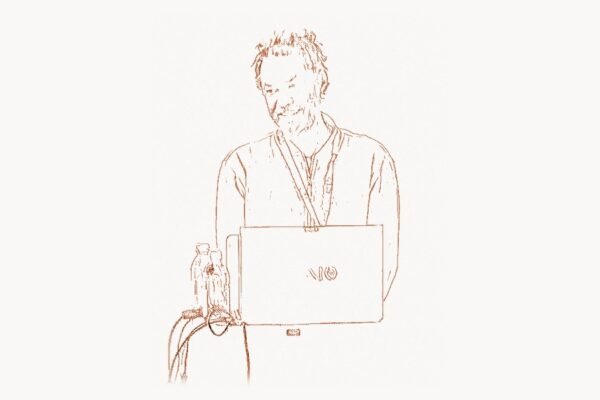
Peiter “Mudge” Zatko: From L0pht Hacker to Government Cybersecurity Pioneer
In 1998, seven hackers sat before the United States Senate and made a claim that stunned Washington: they could take down the entire internet in 30 minutes. The…
Stories of legendary people who shaped the tech industry
In 1998, seven hackers sat before the United States Senate and made a claim that stunned Washington: they could take down the entire internet in 30 minutes. The…
In the spring of 1973, a Danish computer scientist working at the California Institute of Technology published a paper that would quietly revolutionize how software manages simultaneous operations.…
In the race to build ever-larger language models, one Stanford professor dared to ask an unfashionable question: how do we actually know these systems work? While billion-dollar labs…
In the landscape of modern web development, few technical contributions have been as quietly revolutionary as the virtual DOM — a deceptively simple idea that fundamentally changed how…
In the early 1960s, while most computer scientists focused on making programs run faster on existing hardware, a quiet British mathematician named Peter Landin was asking a different…
Few engineers can claim they reshaped two entirely different corners of the software world. Peter Mattis is one of them. In 1995, as an undergraduate at UC Berkeley,…
Few game designers have shaped an entire genre from scratch, and fewer still have done it more than once. Peter Molyneux — the British designer behind Populous, Dungeon…
In 2011, Peter Norvig and Sebastian Thrun offered a free online course on artificial intelligence through Stanford University. They expected a few thousand sign-ups. They got 160,000 students…
In 1994, a mathematician at AT&T Bell Labs published a paper that sent shockwaves through the worlds of computer science, mathematics, and national security simultaneously. Peter Shor demonstrated…
Peter Thiel co-founded PayPal and Palantir Technologies, made the first outside investment in Facebook, and wrote Zero to One — one of the most influential startup philosophy texts of the 2010s. His career is a study in contrarian thinking applied to technology, markets, and society.
On January 9, 2007, Steve Jobs stood on a stage in San Francisco and introduced the iPhone to the world. Behind him, carefully choreographed, every transition was seamless,…
In June 1991, a software engineer from Boulder, Colorado uploaded a program to a public Usenet newsgroup that would make him the target of a three-year federal criminal…
There are computer scientists who build practical tools and those who illuminate the mathematical foundations beneath them. Philip Wadler has done both — and in doing so, he…
On Labor Day weekend in September 1995, a 28-year-old French-born Iranian-American software engineer sat down at his home computer in San Jose, California, and spent a single holiday…
In the world of artificial intelligence, there is a persistent gap between what algorithms can learn in simulation and what robots can actually do in the physical world.…
In 1998, a quiet 27-year-old software engineer in Shenzhen pooled together 500,000 yuan with four university classmates to start an internet company. They had no venture capital, no…
When most developers think about CSS Grid Layout, they think about the specification itself — its rows, columns, and areas. But behind the specification’s journey from experimental idea…
In the early 1980s, a young engineer at Digital Equipment Corporation was handed a problem that nobody else wanted to touch. Computer networks were crashing whenever someone accidentally…
In 1966, a young graduate student at Stanford sat in a cramped lab, speaking into a microphone connected to a machine the size of a refrigerator. Each word…
Long before the phrase “video game” entered everyday vocabulary, a German-American engineer in his mid-forties sat in a New Hampshire bus terminal and sketched an idea that would…
What if a computer could look at your face and know exactly how you feel — not through words, not through text, but through the subtle movement of…
In the summer of 1994, a 26-year-old Danish-Canadian programmer named Rasmus Lerdorf wrote a set of Common Gateway Interface (CGI) binaries in C to track visits to his…
In 1990, a 42-year-old inventor named Ray Kurzweil published a book called The Age of Intelligent Machines. In it, he made a series of predictions that most technologists…
Reed Hastings co-founded Netflix in 1997 and transformed it from a DVD-by-mail service into the world’s largest streaming platform with over 260 million subscribers. His innovations in recommendation algorithms, adaptive bitrate streaming, chaos engineering, and data-driven content production fundamentally restructured global entertainment distribution.
In 2003, while most of Silicon Valley was still recovering from the dot-com crash, a philosopher-turned-entrepreneur launched a website that asked a deceptively simple question: what if your…
In 2010, a 34-year-old lawyer with no engineering background did something that shook the foundations of American politics: Reshma Saujani became the first Indian-American woman to run for…
Rich Harris created Svelte, the compile-time JavaScript framework that eliminates runtime overhead, and Rollup, the bundler that introduced tree-shaking. From data journalism at The Guardian and NYT to pioneering the disappearing framework approach at Vercel.
In an industry obsessed with adding more features, more frameworks, and more complexity, Rich Hickey did something radical — he took two years off from paid work to…
When people talk about the creation of Android, the conversation usually starts and ends with Andy Rubin. But the full story of how the world’s most widely used…
Before millions of players roamed persistent virtual worlds together, before guilds and raids and player economies became gaming staples, one man sat in a cramped Austin apartment writing…
Somewhere in the quiet outskirts of Charlotte, North Carolina, a programmer named D. Richard Hipp sat down in the spring of 2000 to solve a problem that had…
In 1972, a single paper shattered the comfortable assumption that every well-posed problem could be efficiently solved by a computer. Richard Manning Karp, then a professor at the…
In the world of natural language processing, few breakthroughs have been as quietly revolutionary as teaching machines to understand the meaning of words through dense vector representations. Richard…
In September 1983, a researcher at the MIT Artificial Intelligence Laboratory published a manifesto that would reshape the software industry. Richard Stallman announced the GNU Project — an…
Every iPhone, MacBook, and iPad in existence runs a kernel that traces a direct lineage back to a research project begun at Carnegie Mellon University in 1985. The…
On September 21, 2007, Rob Pike sent an email to Robert Griesemer and Ken Thompson with the subject line “a]language.” Attached was a rough sketch of ideas for…
Robert Gentleman co-created the R programming language and founded the Bioconductor project, building the open-source infrastructure that transformed statistical computing and genomic research worldwide.
When Robert Griesemer joined Google in 2003, he was already one of the most accomplished virtual machine engineers alive. He had worked on Sun Microsystems’s Java HotSpot VM…
In the world of programming language design, few contributions have been as quietly transformative as Standard ML. While mainstream developers debate the merits of dynamic versus static typing,…
In the summer of 1959, Robert Noyce sat at his desk at Fairchild Semiconductor and sketched a solution to a problem that had been haunting the electronics industry…
In the early 1970s, a young mathematician at Cornell University looked at a fundamental problem in computer science — how to efficiently explore every corner of a graph…
Before Roberta Williams sat down at an Apple II in 1979, computer games existed only as text on a screen. Players typed commands like “go north” or “pick…
The story of Roberto Ierusalimschy, the Brazilian computer scientist who co-created Lua — a tiny, embeddable programming language that powers game engines, web infrastructure, and millions of applications worldwide.
Roberto Peon co-created the SPDY protocol at Google and designed HPACK header compression for HTTP/2, fundamentally transforming how the modern web communicates and reducing latency for billions of daily connections.
In January 2000, a young Chinese engineer returned home from Silicon Valley with a patent for a search algorithm that would rival Google’s PageRank — and a conviction…
Robin Milner (1934-2010) created the ML programming language, which introduced the revolutionary Hindley-Milner type inference system used in Haskell, Rust, F#, TypeScript, and many modern languages. He also developed CCS and the pi-calculus for concurrent systems and built the LCF theorem prover. Turing Award recipient in 1991.
In 1977, three researchers at the Massachusetts Institute of Technology answered what many mathematicians believed was an open question that might never find a practical solution: how to…
In 2014, a single research paper shattered the performance ceiling of object detection benchmarks and redefined how machines perceive visual scenes. Ross Girshick, then a postdoctoral researcher at…
Web performance isn’t a feature you add at the end of a project. It’s a fundamental property of your…
The gap between how agencies describe their process on their website and how they actually deliver projects is often…
Small development teams face a unique tooling challenge. Enterprise platforms like Jira, Confluence, and PagerDuty offer powerful capabilities but…
Developer teams have a complicated relationship with project management tools. Most options on the market…
Most portfolio websites fail at the one thing they’re supposed to do: bring in clients. They look beautiful,…
The web design toolkit has evolved dramatically over the past few years. Tools that once dominated the industry have been…