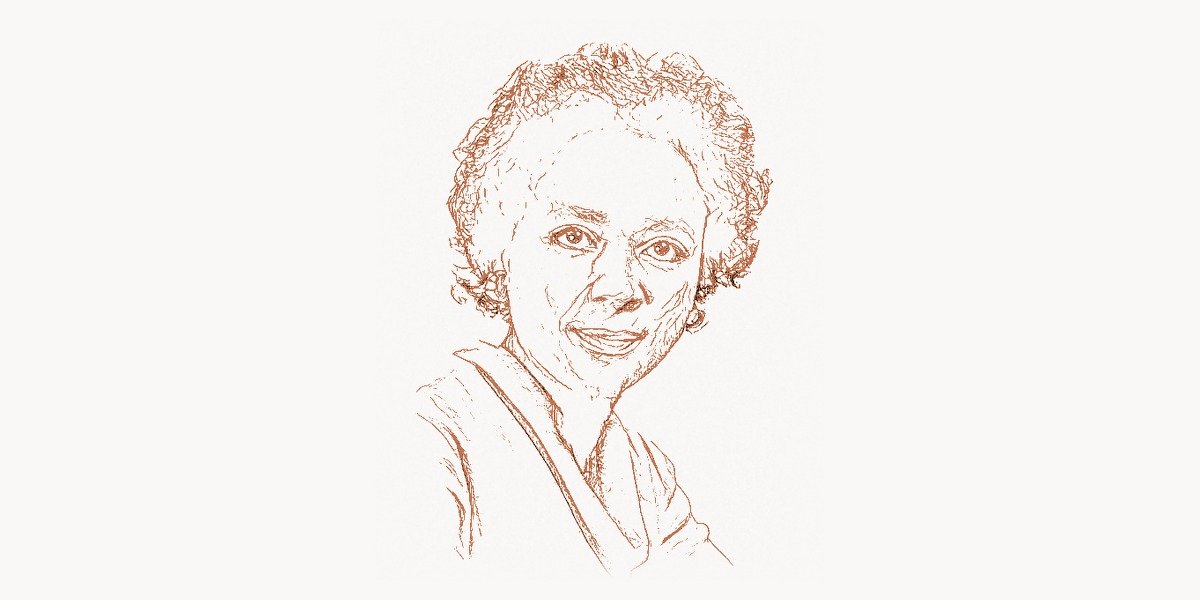
In 1955, a 22-year-old African American woman from Birmingham, Alabama, walked into the National Advisory Committee for Aeronautics (NACA) laboratory in Cleveland, Ohio, and applied for a job as a “human computer.” She had read a local newspaper story about a pair of twin sisters who worked at the facility, performing complex mathematical calculations by hand. If they can do it, she thought, so can I. Annie Easley was hired that same day. She had no idea that the laboratory would transform into NASA, that she would help develop the software powering the Centaur upper-stage rocket — the vehicle that launched countless spacecraft including the Voyager probes and Cassini to Saturn — or that her later work on energy-conversion systems and battery technology would lay groundwork for hybrid electric vehicles decades before they entered the mainstream. Over her 34-year career, Easley made the transition from human calculator to computer programmer to rocket scientist, all while navigating the daily realities of racial discrimination in mid-century America. She was one of only four African American employees at the laboratory when she started. She never let that stop her.
Early Life and Path to Technology
Annie Jean Easley was born on April 23, 1933, in Birmingham, Alabama — a deeply segregated city that would become a flashpoint of the Civil Rights Movement. Her mother, Mary Melvina Hoover, was a powerful influence, instilling in Annie the conviction that she could be anything she wanted to be, provided she was willing to work for it. “You can be anything you want,” her mother told her repeatedly, “but you have to work at it.” In a city where Black citizens faced systematic barriers to education, employment, voting, and virtually every other aspect of civic life, this was an extraordinary assertion — and Annie took it to heart.
Easley attended segregated schools in Birmingham but excelled academically. She was valedictorian of her high school class, a distinction that earned her a scholarship to Xavier University of Louisiana in New Orleans, where she initially studied pharmacy. After two years at Xavier, she married and moved to Cleveland, Ohio, with her husband in 1954. When she attempted to continue her pharmacy studies, she discovered that the pharmacy program at the nearest university had closed. It was a setback that might have derailed someone with less determination — but Easley pivoted. She read the newspaper article about the NACA computers, walked in, and started a new career in aerospace mathematics.
At NACA (which became NASA in 1958), Easley began as a human computer — one of a group of mathematicians, mostly women, who performed complex calculations by hand for the engineers and scientists. This was the same role performed by the women profiled in the story of NASA’s early computing efforts, where human computers were essential to the space program before electronic machines took over the work. Easley’s mathematical skill was immediately apparent. She was assigned to increasingly complex problems, and when the laboratory acquired its first electronic computers in the late 1950s, she was among the first to make the transition from hand computation to machine programming.
The Breakthrough: Centaur Rocket and Energy Systems
Programming the Centaur Upper Stage
Easley’s most significant contribution to spaceflight was her work on the Centaur upper-stage rocket project, which became one of the most important and longest-serving vehicles in the history of space exploration. The Centaur was the first rocket stage to use liquid hydrogen and liquid oxygen as propellants — a technically demanding approach that offered dramatically higher performance than previous propellant combinations but presented formidable engineering challenges. Liquid hydrogen must be stored at minus 253 degrees Celsius (just 20 degrees above absolute zero), it boils at the slightest thermal input, it is extraordinarily difficult to contain (hydrogen molecules are small enough to leak through microscopic gaps in metalwork), and its combustion characteristics are fundamentally different from traditional kerosene-based fuels.
Easley developed and refined the computer code used to analyze the Centaur’s propulsion performance. This was numerical simulation work of the highest order: modeling the thermodynamics of cryogenic propellant behavior, the fluid dynamics of propellant flow through turbopumps and injectors, the combustion physics inside the engine chamber, and the resulting thrust profile under varying conditions. The code had to account for the changing mass of the vehicle as propellant was consumed, the varying atmospheric conditions during ascent, gravitational variations, and dozens of other parameters that affected trajectory and performance.
# Simplified Centaur-style rocket propulsion analysis
# Inspired by the numerical methods Annie Easley developed
# at NASA Lewis Research Center in the 1960s-1970s

import math

# ---- Physical Constants ----
G0 = 9.80665         # standard gravity, m/s^2
R_UNIVERSAL = 8314.0  # universal gas constant, J/(kmol*K)

# ---- RL-10 Engine Parameters (LH2/LOX) ----
CHAMBER_PRESSURE = 2.415e6   # Pa (~350 psi)
EXPANSION_RATIO = 57.0       # nozzle area ratio
MIXTURE_RATIO = 5.0          # O/F by mass
MOLECULAR_WEIGHT = 10.0      # effective exhaust MW, kg/kmol
GAMMA = 1.25                 # ratio of specific heats
CHAMBER_TEMP = 3350.0        # combustion temperature, K

def compute_exhaust_velocity(Pc, Pe, gamma, Tc, M_w):
    """
    Compute ideal exhaust velocity using the de Laval nozzle equation.
    Easley's code performed these calculations iteratively across
    thousands of operating conditions to map engine performance.

    Ve = sqrt( (2*gamma/(gamma-1)) * (R*Tc/Mw) * (1 - (Pe/Pc)^((gamma-1)/gamma)) )
    """
    pressure_ratio = Pe / Pc
    exponent = (gamma - 1.0) / gamma
    R_specific = R_UNIVERSAL / M_w

    term1 = (2.0 * gamma) / (gamma - 1.0)
    term2 = R_specific * Tc
    term3 = 1.0 - pressure_ratio ** exponent

    Ve = math.sqrt(term1 * term2 * term3)
    return Ve

def specific_impulse(Ve):
    """Convert exhaust velocity to specific impulse (seconds)."""
    return Ve / G0

def centaur_stage_analysis(payload_kg, struct_mass_kg, prop_mass_kg):
    """
    Analyze Centaur upper-stage performance using the Tsiolkovsky
    rocket equation — the fundamental relationship between
    delta-v, specific impulse, and mass ratio.

    delta_v = Isp * g0 * ln(m_initial / m_final)
    """
    # Vacuum exhaust conditions (Centaur fires in space)
    P_exit = 0.0  # vacuum
    Ve = compute_exhaust_velocity(
        CHAMBER_PRESSURE, P_exit + 1.0,  # near-vacuum approx
        GAMMA, CHAMBER_TEMP, MOLECULAR_WEIGHT
    )
    Isp = specific_impulse(Ve)

    m_initial = payload_kg + struct_mass_kg + prop_mass_kg
    m_final = payload_kg + struct_mass_kg
    mass_ratio = m_initial / m_final

    delta_v = Isp * G0 * math.log(mass_ratio)

    print("=== Centaur Upper Stage Analysis ===")
    print(f"  Exhaust velocity : {Ve:,.1f} m/s")
    print(f"  Specific impulse : {Isp:.1f} s")
    print(f"  Mass ratio       : {mass_ratio:.3f}")
    print(f"  Delta-V          : {delta_v:,.1f} m/s")
    print(f"  Payload          : {payload_kg:,} kg")
    print(f"  Propellant       : {prop_mass_kg:,} kg")
    return delta_v

# Typical Centaur D (Atlas V configuration)
# Structural mass ~2,250 kg, propellant ~20,830 kg
dv = centaur_stage_analysis(
    payload_kg=4750,       # to GTO
    struct_mass_kg=2250,
    prop_mass_kg=20830
)
print(f"
  Sufficient for GTO insertion: {dv > 4000}")
The Centaur program had a troubled early history — its first test flight in 1962 ended in explosion — but the simulations and analyses that Easley contributed to helped engineers identify and solve the technical problems. By the mid-1960s, Centaur was operational, and it went on to become the workhorse upper stage of the American space program. Centaur launched the Surveyor lunar landers that paved the way for the Apollo missions. It launched the Viking missions to Mars, the Voyager 1 and Voyager 2 probes that explored the outer solar system and are now in interstellar space, the Pioneer probes, the Cassini mission to Saturn, and the New Horizons mission to Pluto. Variants of the Centaur remain in active service today, more than six decades after Easley began working on the project. Few pieces of technology in the history of spaceflight have been as reliable, as long-lived, or as consequential.
Energy Conversion and Battery Research
In the 1970s and 1980s, Easley’s work shifted toward energy research, reflecting a broader reorientation at NASA’s Lewis Research Center (now Glenn Research Center) in response to the energy crises of that era. She developed computer code for analyzing alternative energy technologies, including solar and wind power systems, and she made significant contributions to the study of energy-conversion systems and battery technology.
Her work on battery technology was particularly forward-looking. Easley contributed to research on nickel-hydrogen batteries and other advanced storage systems, developing software to model battery performance, charge-discharge cycles, degradation patterns, and energy density under varying conditions. This research, conducted decades before the electric vehicle revolution, contributed to the knowledge base that would eventually make hybrid and fully electric vehicles practical. The battery modeling techniques she helped develop informed the design of power systems for both terrestrial and space applications — NASA needed reliable batteries for spacecraft and satellites, and the same principles applied to ground-based energy storage.
# Energy storage simulation inspired by Annie Easley's
# battery research at NASA Lewis Research Center (1970s-1980s)
# She modeled charge/discharge behavior for Ni-H2 cells
# used in spacecraft and early hybrid vehicle prototypes

import math

class NickelHydrogenCell:
    """
    Simplified nickel-hydrogen battery cell model.
    Easley's simulations tracked these parameters across
    thousands of charge/discharge cycles to predict
    satellite power system lifetimes and degradation.
    """
    def __init__(self, capacity_ah=50.0, voltage_nom=1.30):
        self.capacity_ah = capacity_ah     # ampere-hours
        self.voltage_nom = voltage_nom     # nominal voltage
        self.soc = 1.0                     # state of charge (0-1)
        self.cycle_count = 0
        self.degradation = 0.0             # cumulative degradation
        self.temperature_k = 293.0         # operating temp, Kelvin

    def discharge(self, current_a, duration_h):
        """
        Model a discharge event.
        Voltage drops as SOC decreases — Easley's code tracked
        this nonlinear relationship across operating conditions.
        """
        ah_removed = current_a * duration_h
        effective_cap = self.capacity_ah * (1.0 - self.degradation)
        self.soc = max(0.0, self.soc - ah_removed / effective_cap)

        # Peukert effect: higher current = less usable capacity
        peukert_factor = (current_a / 10.0) ** 0.08
        self.soc = max(0.0, self.soc / peukert_factor)

        # Voltage model (simplified Shepherd equation)
        v = self.voltage_nom * (0.85 + 0.15 * self.soc)
        v -= 0.02 * current_a / self.capacity_ah  # IR drop
        return max(0.9, v)

    def charge(self, current_a, duration_h):
        """Model a charge event with efficiency losses."""
        charge_efficiency = 0.92 - 0.01 * self.degradation * 100
        ah_added = current_a * duration_h * charge_efficiency
        effective_cap = self.capacity_ah * (1.0 - self.degradation)
        self.soc = min(1.0, self.soc + ah_added / effective_cap)

    def age_one_cycle(self, depth_of_discharge):
        """
        Degradation model: capacity fades with each cycle.
        Deeper discharges cause faster degradation — a key
        finding from Easley's parametric studies.
        """
        # Base degradation per cycle (function of DOD)
        base_fade = 0.00005 * (1.0 + 2.0 * depth_of_discharge)
        # Temperature acceleration (Arrhenius-like)
        temp_factor = math.exp((self.temperature_k - 293.0) / 50.0)
        self.degradation += base_fade * temp_factor
        self.cycle_count += 1

# Simulate a low-Earth orbit satellite power profile
# (90-minute orbits, ~35 minutes in eclipse)
cell = NickelHydrogenCell(capacity_ah=50, voltage_nom=1.30)
print("=== Ni-H2 Battery Life Simulation ===")
print("  Simulating LEO satellite power cycling...
")

for year in range(1, 16):
    orbits_per_year = 365 * 16   # ~16 orbits/day
    for _ in range(orbits_per_year):
        v = cell.discharge(current_a=8.0, duration_h=0.58)
        cell.charge(current_a=5.5, duration_h=0.92)
        cell.age_one_cycle(depth_of_discharge=0.35)

    remaining = (1.0 - cell.degradation) * 100
    print(f"  Year {year:2d}: {cell.cycle_count:>7,} cycles"
          f"  |  capacity remaining: {remaining:5.1f}%")
    if remaining < 70:
        print(f"
  End of useful life at year {year}"
              f" ({cell.cycle_count:,} cycles)")
        break
Easley also developed codes for analyzing solar photovoltaic cells and wind turbine performance under varying atmospheric conditions. This body of work was part of NASA's broader contribution to alternative energy research during the 1970s and 1980s, and it fed directly into the technologies that would become commercially viable in the 21st century.
Breaking Barriers in a Segregated System
Annie Easley's technical achievements are inseparable from the social context in which she accomplished them. When she arrived at NACA in 1955, she was one of only four African American employees at the Cleveland facility. The laboratory was in Ohio, not the Deep South, but racial discrimination was pervasive throughout American institutions in the 1950s. Easley later recalled that she was excluded from certain social activities, passed over for assignments, and subjected to the kind of casual, daily discrimination that characterized the era.
Despite these obstacles, Easley advanced steadily. When NASA began requiring its employees to have college degrees, she went back to school while working full time, earning a Bachelor of Science in Mathematics from Cleveland State University in 1977. NASA had previously helped pay for employees' education, but by the time Easley applied, the policy had changed — she paid for her degree herself, taking classes in the evenings after full days of programming and analysis. This combination of persistence and pragmatism characterized her entire career.
Easley also became an important mentor and advocate for diversity in STEM. She served as an Equal Employment Opportunity (EEO) counselor at NASA Glenn, working to ensure that hiring and promotion practices were fair. She participated in outreach programs aimed at encouraging young women and minorities to pursue careers in science and engineering. She understood that her presence — a Black woman writing code for rocket engines at NASA — was itself a powerful statement, and she took seriously the responsibility of making the path easier for those who came after her. Her efforts paralleled the broader movement to democratize access to technical careers, a mission that modern organizations and project management platforms continue to advance by making collaborative tools accessible to diverse teams worldwide.
Philosophy and Engineering Approach
Key Principles
Easley approached her work with a philosophy rooted in precision, persistence, and an unwavering belief that hard work could overcome any obstacle. Her engineering methodology was characterized by several principles that remain relevant to software development and technical work today.
First, she believed in the power of numerical simulation. At a time when many engineers relied primarily on physical testing and analytical approximations, Easley was an early advocate of using computer models to explore design spaces, predict performance, and identify potential problems before hardware was built. This approach — now standard in virtually every engineering discipline — was pioneering in the 1960s and 1970s. Modern developers who use simulation, modeling, and automated testing are following a methodology that Easley helped establish.
Second, she believed in continuous learning. Her decision to earn a bachelor's degree while working full time in her forties demonstrated a commitment to professional growth that went beyond career requirements. She learned new programming languages as they emerged, adapting from machine code to Fortran to later languages as the field evolved. This adaptability — the willingness to learn new tools and paradigms rather than clinging to familiar ones — is a quality that distinguishes the best engineers in any era. It is the same quality that drives modern teams to adopt new development frameworks and refine their project management methodologies as technology evolves.
Third, she believed in thoroughness. Her simulation code was not written for quick answers — it was written for comprehensive analysis. She modeled entire parameter spaces, running thousands of cases to map the performance envelope of a system rather than checking a single design point. This parametric approach to engineering analysis, which she applied to both rocket propulsion and energy systems, is the foundation of modern computational engineering and optimization.
The Human Computer to Programmer Transition
Easley's career spanned one of the most profound transitions in the history of technology: the shift from human computation to machine computation. She began her career performing calculations with pencil, paper, and mechanical desk calculators — the same basic tools that Ada Lovelace had envisioned being replaced by Babbage's Analytical Engine a century earlier. She ended her career writing sophisticated computer programs that modeled complex physical systems with thousands of variables.
This transition was not automatic. Many human computers found themselves unable or unwilling to adapt to the new electronic machines. Easley, however, embraced the change. She taught herself programming, learned Fortran (the language created by John Backus specifically for scientific and engineering computation), and quickly became one of the most proficient programmers at the Lewis Research Center. Her mathematical training as a human computer gave her an advantage: she understood the underlying mathematics that the programs were implementing, which made her code more reliable and her debugging more effective.
This dual competence — deep mathematical understanding combined with programming skill — made Easley particularly valuable on projects like Centaur, where the correctness of the simulation code depended on a thorough understanding of the physics being modeled. It is a lesson that remains relevant: the best software developers are those who understand not just the code they write, but the domain the code serves. A developer building a web application for a digital agency benefits from understanding design and marketing, just as Easley's rocket simulations benefited from her deep understanding of thermodynamics and propulsion physics.
Legacy and Modern Relevance
Annie Easley retired from NASA Glenn Research Center in 1989 after 34 years of service. In retirement, she pursued real estate and continued to be an advocate for diversity in STEM education, speaking publicly about her experiences and encouraging young people — especially women and minorities — to pursue technical careers. She gave several oral history interviews to NASA that provide invaluable firsthand accounts of the early space program, the transition to electronic computing, and the experience of being a Black woman in a predominantly white technical institution.
Easley passed away on June 25, 2011, at the age of 78. Her contributions to aerospace and energy technology are substantial and enduring. The Centaur upper stage she helped develop remains in service — modern versions fly on the Atlas V and Vulcan Centaur rockets, continuing to launch scientific missions, military satellites, and commercial payloads. The battery and energy-conversion research she conducted contributed to knowledge that ultimately enabled the electric vehicle revolution and the growth of renewable energy systems. Her work on solar cell analysis anticipated the solar energy boom by decades.
Easley is often mentioned alongside Margaret Hamilton, Grace Hopper, Katherine Johnson, Dorothy Vaughan, and Mary Jackson as one of the women whose technical expertise was essential to the success of the American space program but who received inadequate recognition during their careers.
Easley's career offers several lessons that are particularly relevant in the current technology landscape. Her transition from human computer to programmer demonstrates the importance of adaptability — the willingness to learn new skills and embrace new paradigms rather than being defined by a single technology. Her emphasis on rigorous simulation remains foundational to modern computational engineering. Her advocacy for diversity anticipated the current focus on these issues in the tech industry by decades. And her persistence in the face of systematic discrimination provides an example of resilience that transcends any particular technology or era.
The technologies Annie Easley helped develop continue to shape the world. Centaur rockets still carry spacecraft to orbit and beyond. Battery technology derived from research she contributed to powers electric vehicles and grid-scale energy storage. The numerical simulation methodologies she applied are now standard practice in every engineering discipline. Modern AI-powered development tools and scientific computing environments are the direct descendants of the Fortran programs she wrote on mainframes in Cleveland. Her legacy is embedded in the infrastructure of space exploration, clean energy, and computational science — quietly foundational, like the code itself.
Key Facts
- Born: April 23, 1933, Birmingham, Alabama, USA
- Died: June 25, 2011, Cleveland, Ohio, USA (aged 78)
- Education: B.S. in Mathematics, Cleveland State University (1977); studied pharmacy at Xavier University of Louisiana (1950-1952)
- Career: NASA Lewis Research Center (now Glenn Research Center), 1955-1989 — human computer, mathematician, computer programmer, rocket scientist
- Key Projects: Centaur upper-stage rocket propulsion analysis, energy-conversion systems, battery technology research, solar and wind energy modeling
- Languages & Tools: Fortran, SOAP (Symbolic Optimal Assembly Program), machine code; IBM 650, IBM 7090/7094 mainframes
- Notable Firsts: One of the first African Americans at NACA/NASA Lewis; contributed to the first liquid hydrogen/liquid oxygen rocket stage (Centaur)
- Awards & Recognition: NASA Equal Employment Opportunity counselor; featured in NASA's history of pioneering women and African Americans; oral history preserved in NASA Glenn archives
- Philosophy: "You can be anything you want to be, but you have to work at it." — instilled by her mother and carried throughout her career
Frequently Asked Questions
What did Annie Easley do at NASA?
Annie Easley worked at NASA's Lewis Research Center (now Glenn Research Center) in Cleveland, Ohio, from 1955 to 1989. She started as a human computer, performing complex mathematical calculations by hand. As the agency transitioned to electronic computers, she became a computer programmer and developed simulation code for rocket propulsion analysis (most notably for the Centaur upper-stage rocket) and energy-conversion systems including batteries, solar cells, and wind energy. Her 34-year career spanned the transition from NACA to NASA and from hand computation to sophisticated computer modeling.
How did Annie Easley's work on the Centaur rocket impact space exploration?
Easley developed computer code to analyze the performance of the Centaur upper-stage rocket, which was the first rocket stage to use liquid hydrogen and liquid oxygen propellants. The Centaur became one of the most important and reliable vehicles in space history, launching the Surveyor missions to the Moon, the Viking missions to Mars, the Voyager probes to the outer solar system and beyond, the Cassini mission to Saturn, and the New Horizons mission to Pluto. Modern variants of the Centaur remain in active service today, meaning Easley's contributions continue to support space exploration more than six decades after she began working on the project.
What barriers did Annie Easley face as a Black woman at NASA?
When Easley joined NACA in 1955, she was one of only four African American employees at the Cleveland facility. She faced racial discrimination throughout her career, including being excluded from social activities and being literally cropped out of group photographs. When NASA changed its education reimbursement policy, she paid for her own bachelor's degree while working full time. Despite these obstacles, she advanced steadily, became a respected programmer and engineer, and served as an Equal Employment Opportunity counselor to help improve conditions for others.
How did Annie Easley's battery research relate to modern electric vehicles?
In the 1970s and 1980s, Easley contributed to NASA research on energy-conversion systems and advanced battery technology, including nickel-hydrogen batteries. She developed computer simulations to model battery performance, charge-discharge cycles, and degradation patterns. While this research was primarily aimed at spacecraft and satellite power systems, the knowledge and modeling techniques it produced contributed to the broader understanding of battery technology that eventually enabled hybrid and fully electric vehicles. Her energy research was decades ahead of the commercial electric vehicle revolution.
What programming languages did Annie Easley use?
Easley's programming career tracked the evolution of computing languages. She began with machine code and assembly-level languages like SOAP (Symbolic Optimal Assembly Program) on early IBM computers including the IBM 650. She later became proficient in Fortran, the scientific computing language created by John Backus at IBM, which became the standard language for engineering and scientific computation. Throughout her career, she adapted to new computing platforms and methodologies as they became available, demonstrating the continuous learning philosophy that characterized her approach to engineering.