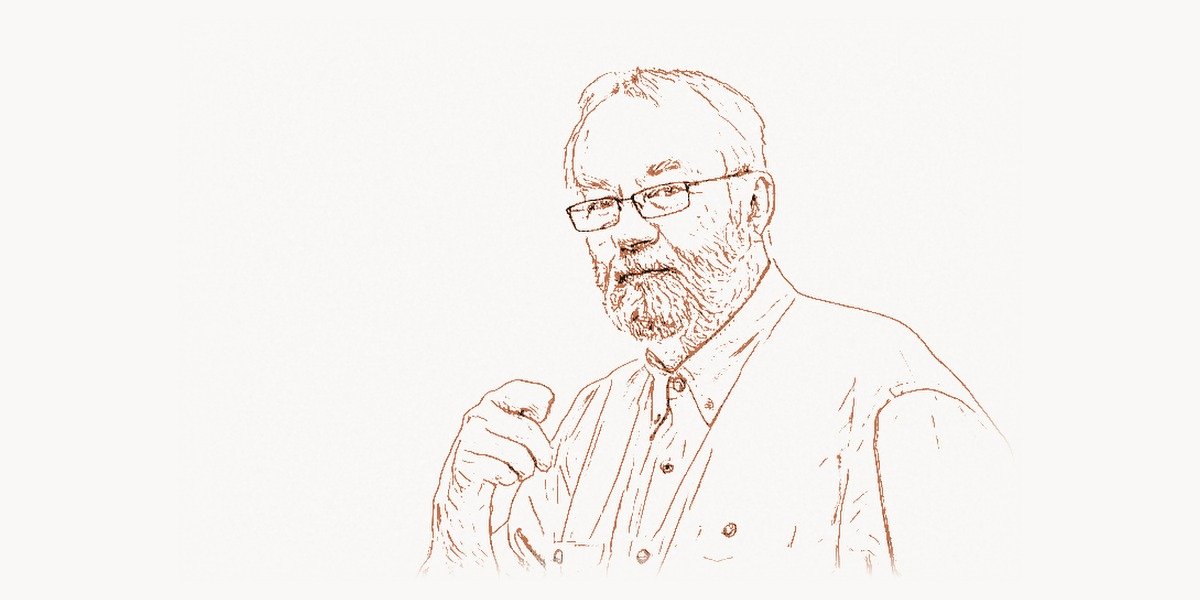
In 1982, while most computer engineers were obsessed with making machines faster and more powerful, a British-born industrial designer named Bill Moggridge was quietly solving a different problem entirely: how to make a computer that a human being could actually carry. The result — the GRiD Compass 1101 — weighed just 5 pounds, folded shut like a book, and became the first laptop computer ever produced. It flew aboard NASA Space Shuttle missions, traveled with special forces operatives, and, most importantly, redefined what a “personal” computer could be. But the GRiD Compass was only the beginning. Moggridge would go on to co-found IDEO, the world’s most influential design consultancy, coin the term “interaction design,” and fundamentally reshape how the technology industry thinks about the relationship between people and the devices they use. His legacy is not a single product but an entire discipline — one that insists technology must serve human needs, not the other way around.
From Industrial Design to the Birth of the Laptop
William Grant Moggridge was born on June 25, 1943, in London, England. He studied industrial design at the Central School of Art and Design (now part of Central Saint Martins), where he developed a deep appreciation for the Bauhaus tradition of uniting form and function. After graduating in the mid-1960s, Moggridge worked in London’s thriving design scene before making a pivotal decision in 1969: he moved to Silicon Valley, establishing a design consultancy called ID Two (later renamed to IDEO) in Palo Alto, California.
The timing was remarkable. Silicon Valley in the late 1970s was a cauldron of hardware innovation, but industrial design was an afterthought. Engineers built circuit boards and wrote firmware; the casing was typically a beige metal box shaped by manufacturing constraints rather than human considerations. Moggridge saw an opportunity that most engineers missed entirely — the physical form of a computer was not just packaging but a fundamental part of the user experience.
In 1979, John Ellenby, founder of GRiD Systems Corporation, approached Moggridge with an ambitious brief: design a portable computer that business executives would actually want to carry. The technical specifications were punishing — the device needed to house a full Intel 8086 processor, 256KB of magnetic bubble memory, a built-in modem, and a 6-inch electroluminescent display, all within a form factor that could fit in a briefcase. Moggridge’s answer was the clamshell design — a flat keyboard base connected to a hinged display panel that folded down to cover the keys when closed. This design language, which Moggridge spent nearly three years perfecting, became the universal template for every laptop computer that followed.
The GRiD Compass 1101: Engineering Elegance Under Constraint
The GRiD Compass 1101 shipped in April 1982 at a price of $8,150 (roughly $26,000 in today’s dollars). It was not a consumer product — its customers were government agencies, military contractors, and Fortune 500 executives. But its influence on computing form factors was seismic. The magnesium alloy casing, the flat-panel display, and the clamshell hinge mechanism were all Moggridge innovations that set the template for portable computing for the next four decades.
What separated Moggridge from pure industrial designers was his obsessive attention to how people actually interacted with objects. He did not simply design an attractive enclosure for electronic components; he studied hand positions, viewing angles, typing ergonomics, and the physical gestures involved in opening, closing, and carrying a device. Each design decision was rooted in observation of real human behavior — a methodology that would later become formalized as interaction design.
The GRiD Compass also demonstrated a principle that Moggridge would champion throughout his career: constraints breed creativity. The severe limitations of early 1980s hardware — battery technology, display weight, thermal management — forced Moggridge to innovate in ways that unconstrained design never would have demanded. The clamshell form factor was not just aesthetically pleasing; it solved real engineering problems by protecting the fragile display during transport and creating a natural stand for screen viewing.
Co-Founding IDEO: Where Design Thinking Was Born
In 1991, Moggridge merged his consultancy ID Two with David Kelley Design and Matrix Product Design to form IDEO, which would become the most celebrated design firm in the world. The merger brought together three complementary approaches: Moggridge’s interaction design philosophy, David Kelley’s mechanical engineering wizardry (Kelley had designed Apple’s first mouse), and Mike Nuttall’s product design expertise.
IDEO became the laboratory where “design thinking” was refined from an instinct into a repeatable methodology. Under Moggridge and Kelley’s leadership, IDEO developed a human-centered design process that has since been adopted by organizations ranging from Stanford University (through the d.school, which Kelley founded) to the governments of Singapore and Denmark. IDEO’s client list read like a who’s who of Silicon Valley: Apple, Microsoft, Samsung, Steelcase, and Procter & Gamble all turned to IDEO to make their products more humane.
The firm’s greatest hits included the first mouse for Apple, the Palm V PDA, the stand-up toothpaste tube for Oral-B, and the redesign of Bank of America’s Keep the Change savings program. But Moggridge always insisted that IDEO’s most important contribution was not any individual product — it was the process itself. Design thinking, as practiced at IDEO, was a structured approach to innovation that began with empathy for the user, moved through rapid prototyping and iteration, and only converged on a solution after extensive testing with real people.
The IDEO Design Process as a Framework
Moggridge’s design thinking process can be understood as a systematic framework that modern teams still implement. The following pseudocode captures the iterative nature of the approach that IDEO refined under his leadership:
// Design Thinking Process — IDEO's Human-Centered Framework
// Inspired by Bill Moggridge's interaction design philosophy

class DesignThinkingProcess {
  constructor(challenge) {
    this.challenge = challenge;
    this.insights = [];
    this.prototypes = [];
    this.iteration = 0;
  }

  // Phase 1: Empathize — observe real users in real contexts
  empathize(targetUsers) {
    const observations = [];
    for (const user of targetUsers) {
      observations.push({
        behaviors: this.observeInContext(user),
        painPoints: this.conductInterview(user),
        workarounds: this.identifyHacks(user),
        emotionalState: this.mapEmotionalJourney(user)
      });
    }
    // Moggridge's key insight: watch what people DO,
    // not what they SAY they do
    this.insights = this.synthesize(observations);
    return this.insights;
  }

  // Phase 2: Define — frame the real problem
  define(insights) {
    const needs = insights.filter(i => i.frequency > 0.3);
    // "How might we..." framing — IDEO's signature technique
    return needs.map(need => ({
      statement: `How might we ${need.desire}
                  for ${need.userGroup}
                  so that ${need.outcome}?`,
      priority: need.impact * need.feasibility
    }));
  }

  // Phase 3: Ideate — diverge before converging
  ideate(problemStatements) {
    const ideas = [];
    // Rule: no criticism during divergent phase
    // Quantity over quality — filter comes later
    for (const problem of problemStatements) {
      ideas.push(...this.brainstorm(problem, {
        timeBox: '20min',
        buildOnOthers: true,
        encourageWild: true
      }));
    }
    return this.clusterAndPrioritize(ideas);
  }

  // Phase 4: Prototype — make ideas tangible quickly
  prototype(topIdeas) {
    // Moggridge principle: "the best way to experience
    // an experience is to experience it"
    return topIdeas.map(idea => ({
      concept: idea,
      mockup: this.buildMinimalPrototype(idea),
      testScript: this.createTestScenario(idea),
      maxBuildTime: '1 day' // fast and rough beats slow and polished
    }));
  }

  // Phase 5: Test — learn, iterate, refine
  test(prototypes, users) {
    this.iteration++;
    const results = prototypes.map(proto => ({
      prototype: proto,
      feedback: this.getUserFeedback(proto, users),
      metrics: this.measureUsability(proto, users),
      surprises: this.captureUnexpected(proto, users)
    }));

    // Core loop: iterate until human needs are met
    if (this.needsRefinement(results) && this.iteration < 10) {
      const refined = this.incorporateFeedback(results);
      return this.test(this.prototype(refined), users);
    }
    return this.selectFinalDesign(results);
  }
}
This iterative loop — empathize, define, ideate, prototype, test — became the foundation of design education worldwide. Moggridge’s contribution was insisting that the process always begin with genuine empathy, not with technological capability or business requirements.
Coining “Interaction Design”: A New Discipline Emerges
Perhaps Moggridge’s most enduring intellectual contribution was giving a name — and a rigorous framework — to a practice that had previously existed only as an informal craft. In the mid-1980s, Moggridge began using the term “interaction design” to describe the design of the behavior of products, services, and systems. The term distinguished this practice from industrial design (which focused on physical form), graphic design (which focused on visual communication), and software engineering (which focused on functional implementation).
Interaction design, as Moggridge defined it, was concerned with the quality of the relationship between a person and a designed artifact over time. It encompassed not just visual interfaces but the full spectrum of human-computer interaction: how a device responds to touch, how software communicates its state, how errors are handled gracefully, and how the overall experience feels to the user. This was decades before “UX design” became a standard job title in the tech industry.
Moggridge’s thinking on interaction design was deeply influenced by his collaborations with other pioneers. He worked alongside Don Norman, whose book “The Design of Everyday Things” had articulated the cognitive principles underlying good design. He admired the pioneering interface work at Xerox PARC, where Alan Kay and his colleagues — including Chuck Thacker and Butler Lampson — had created the graphical user interface, the mouse-driven desktop metaphor, and the foundational concepts of modern computing. And he drew inspiration from Douglas Engelbart, whose legendary 1968 “Mother of All Demos” had shown that computers could augment human intellect rather than merely perform calculations.
The Books That Defined a Field
Moggridge was not content to practice interaction design — he wanted to ensure the discipline had a solid intellectual foundation for future generations. His 2007 book, “Designing Interactions,” became the definitive text on the history and practice of interaction design. The book was a monumental undertaking: over 766 pages of interviews, case studies, and analysis covering the major milestones in human-computer interaction from the 1960s through the early 2000s.
“Designing Interactions” featured extended interviews with more than 40 design and technology leaders, including Jony Ive of Apple, Larry Page and Sergey Brin of Google, and Brendan Boyle of IDEO. The book was accompanied by a DVD containing video interviews and demonstrations, making it one of the first design texts to embrace multimedia documentation of the design process.
His follow-up book, “Designing Media” (2010), examined how interaction design principles applied to the transformation of media by digital technology. It included interviews with media innovators ranging from newspaper editors to game designers, reflecting Moggridge’s conviction that interaction design had relevance far beyond traditional technology products.
Interaction Design Principles in Modern Web Development
Moggridge’s principles of interaction design translate directly into modern frontend development practices. The following example demonstrates how his emphasis on feedback, state communication, and graceful error handling manifests in contemporary user interface code:
/* Interaction Design Principles Applied to UI Components
   Based on Bill Moggridge's framework:
   1. Visibility of system state
   2. Graceful error recovery
   3. Progressive disclosure
   4. Responsive feedback loops */

class InteractionFeedbackSystem {
  constructor(element) {
    this.element = element;
    this.stateHistory = [];
    this.transitionDuration = 200; // ms — human perception threshold
  }

  // Principle: Every action must produce visible feedback
  // Moggridge insisted that users should never wonder
  // "did the system hear me?"
  async handleUserAction(action) {
    // Immediate acknowledgment (within 100ms)
    this.showMicroFeedback(action.type);
    this.stateHistory.push({ action, timestamp: Date.now() });

    try {
      // Optimistic UI — show expected result immediately
      const predictedState = this.predictOutcome(action);
      this.renderState(predictedState, { optimistic: true });

      // Execute actual operation
      const result = await this.executeAction(action);

      // Confirm or correct the optimistic prediction
      if (this.statesMatch(predictedState, result)) {
        this.confirmState(result);
      } else {
        this.transitionState(predictedState, result, {
          animation: 'smooth',
          explain: true  // tell user what changed and why
        });
      }
    } catch (error) {
      // Graceful error recovery — never leave user stranded
      await this.handleErrorGracefully(error, action);
    }
  }

  // Principle: Progressive disclosure — reveal complexity gradually
  renderProgressiveDetail(data, userExpertise) {
    const layers = [
      { level: 'essential', always: true },
      { level: 'helpful', showIf: userExpertise >= 'intermediate' },
      { level: 'advanced', showIf: userExpertise >= 'expert' },
      { level: 'diagnostic', showOn: 'explicit-request' }
    ];

    return layers
      .filter(layer => this.shouldShow(layer, userExpertise))
      .map(layer => this.renderLayer(data, layer));
  }

  // Principle: Error recovery should preserve user's work
  async handleErrorGracefully(error, originalAction) {
    // Save user's current state — never lose their work
    const savedState = this.captureUserState();

    // Communicate what happened in human terms
    const explanation = this.translateError(error);

    // Offer concrete recovery paths
    const recoveryOptions = this.generateRecoveryPaths(
      error, originalAction, savedState
    );

    this.renderRecoveryUI({
      message: explanation,
      options: recoveryOptions,
      savedWork: savedState,
      // Allow user to retry with one click
      retryAction: () => this.handleUserAction(originalAction)
    });
  }

  showMicroFeedback(actionType) {
    const feedbackMap = {
      'click':  { visual: 'ripple', haptic: 'light', duration: 150 },
      'submit': { visual: 'pulse',  haptic: 'medium', duration: 200 },
      'delete': { visual: 'shake',  haptic: 'heavy', duration: 300 },
      'drag':   { visual: 'lift',   haptic: 'light', duration: 100 }
    };

    const feedback = feedbackMap[actionType] || feedbackMap['click'];
    this.element.animate(feedback.visual, feedback.duration);
  }
}
These patterns — immediate feedback, optimistic rendering, graceful error recovery, and progressive disclosure — are direct descendants of Moggridge’s interaction design philosophy. Every modern design system, from Google’s Material Design to Apple’s Human Interface Guidelines, builds on the conceptual foundation that Moggridge helped establish.
Leading the Cooper Hewitt into the Digital Age
In 2010, Moggridge accepted one of the most prestigious positions in the design world: Director of the Smithsonian’s Cooper Hewitt National Design Museum in New York City. It was a bold choice for an institution that had traditionally focused on decorative arts and physical artifacts. Moggridge’s appointment signaled a recognition that digital and interaction design had become central to the design discipline.
During his tenure at Cooper Hewitt, Moggridge initiated plans for the museum’s major renovation, which would eventually incorporate interactive digital installations throughout the galleries. He championed the idea that a design museum should not merely display finished products but should immerse visitors in the design process itself — a direct extension of his IDEO philosophy. He pushed for the museum’s permanent collection to include software, interfaces, and digital experiences alongside the traditional furniture, textiles, and graphic art.
Moggridge also advocated for making the museum’s collection digitally accessible, laying groundwork for open-access initiatives that would make design history available to students and practitioners worldwide. His vision was that a museum of design in the 21st century needed to practice what it preached — embracing interactivity, openness, and user-centered experience in its own operations.
Design Philosophy: The Intersection of Empathy and Engineering
Moggridge’s design philosophy rested on a deceptively simple premise: understanding people is the foundation of good design. This sounds obvious today, but in the engineering-dominated culture of Silicon Valley in the 1980s and 1990s, it was practically radical. The dominant approach was technology-first: build something powerful, then figure out how to make people use it. Moggridge inverted this sequence entirely.
His approach began with ethnographic research — observing people in their natural environments, watching how they struggled with existing tools, and identifying the unspoken needs that no focus group would ever articulate. This methodology, which IDEO formalized as “deep hanging out,” produced insights that surveys and market research consistently missed. It was through this kind of observation that IDEO redesigned the shopping cart for ABC’s Nightline in a famous 1999 segment, and it was this approach that yielded the GRiD Compass’s clamshell form factor.
Moggridge also believed fiercely in the power of prototyping. He often said that the quickest way to understand a design problem was to build something — anything — and put it in front of a real user. This bias toward making was central to IDEO’s culture and became a cornerstone of design education at Stanford’s d.school. The prototype did not need to be polished or functional; it needed to be tangible enough to provoke a reaction and generate learning.
For teams building digital products today, Moggridge’s approach offers a powerful corrective to the data-driven optimization that dominates much of the tech industry. While analytics can tell you what users do, only empathetic observation can tell you why they do it — and what they wish they could do instead. Organizations looking to integrate genuine user-centered design into their product development can benefit from the structured project management workflows at Taskee, which support iterative design processes with built-in feedback loops and collaborative review stages.
Legacy and Lasting Impact
Bill Moggridge passed away on September 8, 2012, at the age of 69, following a battle with cancer. His death was mourned across the design and technology communities, with tributes from Steve Jobs‘s Apple colleagues, IDEO’s global team, and design educators worldwide.
His legacy is woven into the fabric of modern technology in ways both visible and invisible. Every time you open a laptop, you are using a form factor that Moggridge invented. Every time a design team conducts user research before writing code, they are following a methodology that Moggridge and IDEO systematized. Every job listing for an “interaction designer” or “UX designer” traces its lineage to the discipline that Moggridge named and defined.
Moggridge received numerous honors during his lifetime, including the Prince Philip Designers Prize (the UK’s highest design honor) in 2010 and the Lifetime Achievement Award from the Smithsonian’s Cooper Hewitt museum in 2010. He was a fellow of the Royal Society of Arts and served on advisory boards for institutions including the MIT Media Lab and the London Design Museum.
The design consultancy he co-founded continues to thrive. IDEO has expanded from product design into organizational design, healthcare innovation, food systems, and education. The firm’s design thinking methodology has been taught at hundreds of universities and adopted by companies in every industry. The digital design expertise at Toimi reflects many of the human-centered principles that Moggridge championed — the conviction that beautiful, functional design is not a luxury but a necessity for effective digital products.
Perhaps most importantly, Moggridge changed what it means to be a designer in the technology industry. Before him, designers were often brought in at the end of the product development process to make things look attractive. After him, designers had a seat at the table from the very beginning, shaping not just the appearance but the fundamental behavior and experience of technology products. He proved that the most important question in technology is not “what can this machine do?” but “what do people need this machine to do?”
Frequently Asked Questions
What was Bill Moggridge’s most significant invention?
Moggridge designed the GRiD Compass 1101, which shipped in 1982 and is widely recognized as the first laptop computer. Its clamshell design — a hinged display panel that folds down over a flat keyboard — established the form factor that every laptop manufacturer has followed for over four decades. Beyond the hardware itself, the GRiD Compass demonstrated that industrial design and engineering could work in concert to create entirely new product categories.
What is interaction design and why did Moggridge coin the term?
Interaction design is the discipline focused on designing the behavior of products, services, and systems — how they respond to human input, communicate their state, and evolve over time. Moggridge coined the term in the mid-1980s because existing design disciplines (industrial design, graphic design, software engineering) did not adequately address the experiential dimension of using digital technology. He recognized that as computing became interactive, design needed to encompass temporal and behavioral qualities, not just static physical or visual attributes.
How did IDEO’s design thinking methodology influence the tech industry?
IDEO’s design thinking process — empathize, define, ideate, prototype, test — became the most widely adopted innovation methodology in the technology industry and beyond. It shifted product development from a technology-first approach to a human-first approach, requiring teams to deeply understand user needs before proposing solutions. Companies including Apple, Google, Samsung, and hundreds of startups have adopted variations of IDEO’s process. Stanford’s d.school, co-founded by IDEO’s David Kelley, has trained thousands of students in the methodology, creating a global network of design thinking practitioners.
What was the relationship between the GRiD Compass and NASA?
The GRiD Compass 1101 was used extensively by NASA aboard Space Shuttle missions throughout the 1980s. Its rugged magnesium construction, lightweight form factor, and reliable performance made it suitable for the demanding environment of space travel. NASA astronauts used the GRiD Compass for mission planning, data analysis, and communication tasks. The laptop’s presence in space cemented its reputation as a serious professional tool and demonstrated that portable computing could function reliably in extreme conditions.
How does Moggridge’s work influence modern UX design practices?
Moggridge’s influence on modern UX design is foundational. His insistence on beginning the design process with empathetic user research, rather than technical specifications or business requirements, is now standard practice. His concept of progressive disclosure — revealing complexity gradually based on user expertise — is embedded in every modern design system. His emphasis on prototyping and iteration shaped the Agile and Lean Startup methodologies that dominate software development. And his fundamental principle that technology should adapt to human behavior, rather than forcing humans to adapt to technology, remains the central tenet of user experience design.