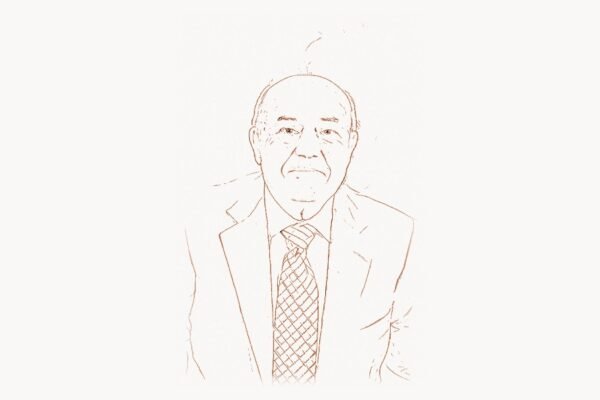
In 1973, a young researcher at Xerox PARC scribbled a memo that would reshape how every computer on the planet communicates. That researcher was Bob Metcalfe, and his invention — Ethernet — became the foundational fabric connecting billions of devices worldwide. But Metcalfe did not stop at building cables and protocols. He went on to formulate one of technology’s most powerful economic principles, co-found a billion-dollar networking company, and eventually earn computing’s highest honor, the Turing Award. His career spans the full arc from theoretical insight to engineering triumph to entrepreneurial success, making him one of the most consequential figures in the history of computing.
Early Life and Education
Robert Melancton Metcalfe was born on April 7, 1946, in Brooklyn, New York. Growing up on Long Island, he showed an early aptitude for mathematics and science. His father was a technician for Gyrodyne, a helicopter company, and young Bob absorbed a practical, engineering-oriented worldview from an early age. He attended Bay Shore High School, where his academic abilities earned him admission to the Massachusetts Institute of Technology.
At MIT, Metcalfe pursued a dual degree in electrical engineering and business management, graduating in 1969. This unusual combination of technical depth and business acumen would define his entire career. While many brilliant engineers struggled to translate inventions into viable products, Metcalfe understood from the start that technology had to serve real people solving real problems.
He continued at Harvard University, earning a master’s degree and then pursuing a PhD. His doctoral work focused on packet-switching networks, specifically the ARPANET — the precursor to the modern internet. Working under the guidance of leading network researchers, Metcalfe built one of the early interfaces connecting Harvard to the ARPANET. His dissertation, initially rejected and then revised, forced him to deepen his understanding of network theory in ways that would prove critical to his most famous invention. It was during this period that he encountered the ALOHAnet system at the University of Hawaii, a radio-based network whose randomized access protocol planted the seed for what would become Ethernet.
His path from Harvard led directly to Xerox PARC in Palo Alto, California — the legendary research lab where the personal computer revolution was being quietly assembled. Metcalfe arrived in 1972, and within a year, he would change networking forever. His academic grounding in packet switching, combined with his hands-on ARPANET experience, gave him a unique vantage point that few other researchers possessed. Figures like Vint Cerf and Bob Kahn were shaping the internet’s protocols at the same time, but Metcalfe was about to solve a different piece of the puzzle — local connectivity.
The Ethernet Breakthrough
Technical Innovation
The problem Metcalfe faced at Xerox PARC was deceptively simple: how do you connect dozens of computers in the same building so they can share a laser printer? The Alto workstations being built by Butler Lampson and his colleagues needed a fast, reliable local network, and nothing suitable existed. The ARPANET was designed for long-distance communication, not for linking machines down the hall.
Metcalfe drew inspiration from the ALOHAnet protocol he had studied in Hawaii. ALOHAnet used a shared radio channel where stations transmitted whenever they had data, listening for collisions and retransmitting if necessary. It was simple and elegant, but its throughput was limited — the randomized access scheme wasted capacity when traffic was heavy.
Metcalfe’s key insight was to adapt this approach for a wired medium and dramatically improve its efficiency. On May 22, 1973, he wrote a memo titled “Alto Ethernet” that described a system where multiple computers shared a single coaxial cable. Each machine would listen to the cable before transmitting. If the cable was busy, the machine would wait. If two machines transmitted simultaneously and a collision occurred, both would stop, wait a random interval, and try again. This protocol became known as CSMA/CD — Carrier Sense Multiple Access with Collision Detection.
Working with David Boggs, a talented engineer at PARC, Metcalfe built the first working Ethernet system. It operated at 2.94 megabits per second — a speed chosen to match the clock rate of the Alto’s processor. The coaxial cable ran through the building, and each computer connected via a transceiver that tapped into the cable. The beauty of the design was its simplicity: no central controller, no complex routing, just a shared medium with an elegant contention protocol.
The following simplified representation illustrates the core logic of CSMA/CD, the protocol at the heart of Ethernet:
// CSMA/CD — Carrier Sense Multiple Access with Collision Detection
// Simplified pseudocode for Ethernet transmission logic

function transmitFrame(frame) {
    maxAttempts = 16;
    attempt = 0;

    while (attempt < maxAttempts) {
        // Step 1: Carrier Sense — listen before transmitting
        while (channelIsBusy()) {
            wait();  // defer to ongoing transmission
        }

        // Step 2: Begin transmission
        startTransmitting(frame);

        // Step 3: Collision Detection — monitor while sending
        if (collisionDetected()) {
            // Send jam signal to notify all stations
            sendJamSignal();
            stopTransmitting();

            attempt++;

            // Step 4: Exponential backoff
            // Wait a random number of slot times
            // Range doubles with each attempt: [0, 2^attempt - 1]
            maxSlots = Math.pow(2, Math.min(attempt, 10));
            slotsToWait = randomInt(0, maxSlots - 1);
            wait(slotsToWait * SLOT_TIME);
        } else {
            // Transmission successful, no collision
            return SUCCESS;
        }
    }
    // Maximum attempts exceeded
    return FAILURE;
}
The exponential backoff algorithm was particularly clever. By doubling the random wait window after each collision, the protocol naturally adapted to congestion. Under light load, collisions were rare and resolved quickly. Under heavy load, the increasing backoff intervals reduced contention and allowed the network to stabilize. This self-regulating behavior was a key reason Ethernet scaled so well in practice.
Why It Mattered
Before Ethernet, local area networking was either nonexistent or prohibitively complex. Proprietary systems required expensive central switches, dedicated wiring for each connection, and specialized hardware. Metcalfe's approach demolished these barriers. A single cable could serve an entire floor of computers. Adding a new machine meant attaching one more transceiver — no rewiring, no reconfiguration of central equipment.
This simplicity had profound consequences. When Xerox, Intel, and Digital Equipment Corporation jointly published the Ethernet specification (known as DIX Ethernet) in 1980, they created an open standard that any manufacturer could implement. The IEEE formalized it as 802.3 in 1983. Because the standard was open and the hardware was relatively cheap to produce, Ethernet became the lingua franca of local networking.
The impact cascaded through every sector of the economy. Office workers could share files and printers. Researchers could collaborate across departments. Factories connected sensors and controllers. Every time you plug a cable into a laptop, connect to a switch in a data center, or access a cloud server, you are using a descendant of the protocol Metcalfe sketched in that 1973 memo. Modern Ethernet runs at 400 gigabits per second — more than 100,000 times faster than the original — but the fundamental architecture of shared, standardized, packet-based local networking remains Metcalfe's creation.
The importance of open networking standards cannot be overstated. Just as Tim Berners-Lee later made the web open and free for everyone, Metcalfe's push for an open Ethernet specification ensured that no single company could monopolize local networking. This openness fueled competition, drove prices down, and accelerated adoption worldwide.
Other Major Contributions
Metcalfe's ambitions extended far beyond a single protocol. In 1979, he left Xerox PARC to co-found 3Com (Computer Communication Compatibility), one of the first companies dedicated to networking products. His goal was ambitious: make Ethernet available to every personal computer. At the time, PCs were isolated machines. Metcalfe saw that connecting them would multiply their value exponentially.
Under his leadership as CEO, 3Com developed Ethernet adapter cards for the IBM PC and its clones. These affordable cards transformed PCs from standalone devices into networked workstations. The company grew rapidly, going public in 1984 and eventually reaching billions in revenue. Metcalfe demonstrated that great engineering research could become great business — a path that modern technology teams, supported by strategic digital agencies, continue to follow today.
Perhaps Metcalfe's most enduring intellectual contribution beyond Ethernet itself is Metcalfe's Law, which he formulated in the early 1980s. The principle states that the value of a telecommunications network is proportional to the square of the number of connected users. In mathematical terms:
// Metcalfe's Law: Network Value Estimation
// V = C * n^2
// where n = number of connected nodes, C = value constant per connection

function calculateNetworkValue(nodes, valuePerConnection) {
    // Each node can connect to (n - 1) others
    // Total unique connections = n * (n - 1) / 2
    let connections = nodes * (nodes - 1) / 2;
    let networkValue = connections * valuePerConnection;

    return {
        nodes: nodes,
        connections: connections,
        estimatedValue: networkValue
    };
}

// Example: How value scales with network size
// 10 nodes   →   45 connections →   V = 45C
// 100 nodes  → 4,950 connections →   V = 4,950C
// 1,000 nodes → 499,500 connections → V = 499,500C
// Each 10x increase in nodes yields ~100x increase in value

// This explains why platforms fight so hard for user growth:
// Adding one node to a 1,000-node network creates 1,000 new
// possible connections — the marginal value of each new user
// increases as the network grows.
This deceptively simple principle explains why networks exhibit winner-take-all dynamics, why platforms fight so hard for user growth, and why early Ethernet adoption created a self-reinforcing cycle of value. Metcalfe's Law became a cornerstone of network economics and influenced investment thinking throughout the dot-com era and beyond. Every social network, every messaging platform, every collaborative tool owes a conceptual debt to this insight. Modern project coordination tools like Taskee exemplify this principle — each additional team member multiplies the possible connections and collaborative value within the system.
After leaving 3Com in 1990, Metcalfe reinvented himself as a technology commentator, writing an influential column for InfoWorld. His writing was sharp, opinionated, and widely read. He made bold predictions — some prescient, some famously wrong. In 1995, he predicted the internet would suffer a catastrophic collapse in 1996. When it did not, he publicly ate his column at a technology conference, blending the words into a smoothie and drinking it on stage. The episode became legendary, illustrating both his willingness to make daring claims and his intellectual honesty in owning mistakes.
Later in his career, Metcalfe moved into academia and venture capital. He became a professor of innovation at the University of Texas at Austin and a general partner at Polaris Venture Partners. In these roles, he mentored a new generation of entrepreneurs and invested in emerging technologies, continuing to shape the industry from different vantage points.
Philosophy and Principles
Key Principles
Metcalfe's worldview is shaped by a set of convictions forged across decades of research, entrepreneurship, and public commentary. These principles offer a blueprint for anyone building technology that matters.
Open standards win. Metcalfe fought to make Ethernet an open specification rather than a proprietary Xerox technology. He understood that a protocol owned by everyone would be adopted by everyone. This conviction drove the DIX Ethernet standard and the subsequent IEEE 802.3 process. It is the same philosophy that animated the work of pioneers like Radia Perlman, whose Spanning Tree Protocol ensured that Ethernet networks could scale without catastrophic loops.
Networks create nonlinear value. The insight behind Metcalfe's Law is not merely mathematical — it is a philosophical stance. Metcalfe believes that connectivity is inherently multiplicative. Each new node does not simply add to a network; it multiplies the possibilities for every existing node. This conviction informed his decision to leave Xerox and build a company around making Ethernet universal.
Engineers must be entrepreneurs. Metcalfe has consistently argued that invention without commercialization is incomplete. A technology that stays in the lab helps no one. His dual MIT degree in engineering and management was not an accident — it reflected a belief that technical brilliance must be paired with business execution. He carried this philosophy into 3Com, into his venture capital career, and into his teaching at UT Austin.
Intellectual courage requires accountability. The infamous internet-collapse prediction and subsequent public retraction reveal a deeper principle: Metcalfe believes that making bold, testable claims — and accepting the consequences — is essential to intellectual progress. In a field often plagued by vague predictions and unfalsifiable hype, he insisted on specificity and accountability.
Simplicity enables scale. The genius of Ethernet was not raw speed or exotic hardware — it was simplicity. A shared cable, a listen-before-talk protocol, and exponential backoff. This minimal design could be implemented cheaply, understood quickly, and extended indefinitely. Metcalfe has often emphasized that the best engineering solutions are those simple enough to be manufactured at scale and robust enough to work in unpredictable environments.
Legacy and Lasting Impact
Bob Metcalfe's legacy operates on multiple levels. At the most tangible level, Ethernet is everywhere. As of the mid-2020s, there are billions of Ethernet ports in operation worldwide. The technology underpins data centers, corporate networks, industrial systems, and increasingly even automotive and aerospace applications. The IEEE 802.3 standard has been extended and revised dozens of times, reaching speeds that Metcalfe could not have imagined in 1973, yet the core principles — shared medium, packet switching, standardized framing — remain intact.
At the economic level, Metcalfe's Law has become one of the foundational models for understanding network effects. Investors, strategists, and economists invoke it to explain the rapid growth of social networks, marketplaces, and platform businesses. While scholars have debated the exact exponent — some argue that value scales as n*log(n) rather than n-squared — the qualitative insight is universally accepted: connected networks exhibit superlinear value growth.
At the cultural level, Metcalfe embodies the archetype of the researcher-turned-entrepreneur. His journey from Xerox PARC to 3Com to venture capital to academia traces a path that many technologists now aspire to follow. He demonstrated that the same person could write the memo, build the prototype, ship the product, grow the company, and then teach the next generation how to do it all over again.
In 2023, Metcalfe received the ACM A.M. Turing Award — often called the Nobel Prize of computing — for his invention, standardization, and commercialization of Ethernet. The award recognized not just the technical achievement but the entire lifecycle of innovation: from the initial idea at PARC, through the open standardization process, to the commercial success of 3Com and the global adoption that followed. He joined a lineage that includes Alan Turing himself, the award's namesake, as well as other pioneers whose work formed the digital world we inhabit.
Metcalfe's influence also extends through the people he mentored and the companies he funded. As a venture capitalist and professor, he guided dozens of startups and hundreds of students. His emphasis on combining technical rigor with entrepreneurial thinking has shaped how an entire generation approaches innovation. The interactive, connected style of modern software development — a vision first demonstrated by pioneers like Douglas Engelbart with his collaborative computing concepts — where tools coordinate distributed teams in real time — is a direct descendent of the networked world Metcalfe helped build.
Today, as Ethernet evolves to support terabit speeds, as network effects drive the growth of AI platforms, and as billions more devices come online through the Internet of Things, Metcalfe's foundational contributions only grow more relevant. The cable may now be fiber, the speeds may be measured in hundreds of gigabits, and the networks may span continents rather than buildings — but the principles remain those of a young engineer at Xerox PARC who believed that connecting computers would change everything.
Key Facts About Bob Metcalfe
- Full name: Robert Melancton Metcalfe
- Born: April 7, 1946, Brooklyn, New York
- Education: BS in Electrical Engineering and BS in Management from MIT (1969); MS and PhD from Harvard University
- Key invention: Ethernet (1973), developed at Xerox PARC with David Boggs
- Original Ethernet speed: 2.94 Mbps over coaxial cable
- Company founded: 3Com Corporation (1979), pioneering PC networking hardware
- Metcalfe's Law: Network value is proportional to the square of connected users (n squared)
- Turing Award: 2022 (announced 2023), for the invention, standardization, and commercialization of Ethernet
- IEEE 802.3: The formal standard derived from Metcalfe's Ethernet specification, first published in 1983
- Other honors: National Medal of Technology (2005), IEEE Medal of Honor (1996), elected to National Inventors Hall of Fame
- Famous prediction: Predicted internet collapse in 1996; publicly ate his words (literally) when proven wrong
- Later career: Professor at University of Texas at Austin; venture partner at Polaris Venture Partners
Frequently Asked Questions
What exactly is Ethernet and why is it important?
Ethernet is a family of networking technologies originally invented by Bob Metcalfe in 1973 for connecting computers over short distances — typically within a building or campus. It defines how data is packaged into frames, how devices share a communication channel, and how collisions are handled. Ethernet matters because it became the universal standard for local area networks (LANs). Nearly every wired network connection in the world — from office networks to data centers to industrial systems — uses Ethernet or a direct descendant of it. Its open, standardized nature allowed thousands of manufacturers to produce compatible equipment, driving costs down and adoption up over five decades.
How does Metcalfe's Law apply to modern technology?
Metcalfe's Law states that the value of a network grows proportionally to the square of its users. In modern terms, this explains why platforms like social networks, messaging apps, and collaborative tools grow explosively once they reach critical mass. Each new user adds value not just for themselves but for every existing user by creating new possible connections. This principle drives business strategies focused on rapid user acquisition, even at initial losses, because the network effects eventually generate enormous value. It also explains why dominant platforms are so hard to displace — their accumulated network value creates a powerful barrier to competition.
What was the relationship between Ethernet and the internet?
Ethernet and the internet are complementary but distinct technologies. Ethernet handles local connectivity — linking computers within a building or campus. The internet, built on TCP/IP protocols developed by researchers like Vint Cerf and Bob Kahn, handles global connectivity — routing data across vast distances between different networks. In practice, most internet traffic begins and ends its journey on an Ethernet segment. Your computer uses Ethernet (wired or via Wi-Fi, which shares Ethernet's frame format) to reach a local router, which then forwards your data across the internet. Metcalfe himself built one of the early ARPANET connections at Harvard before inventing Ethernet at Xerox PARC, so he understood both layers intimately.
Why did Bob Metcalfe receive the Turing Award?
The ACM awarded Metcalfe the 2022 Turing Award (announced in March 2023) specifically for the invention, standardization, and commercialization of Ethernet. What made the award notable was its recognition of the full innovation lifecycle. The committee honored not just the original 1973 invention at Xerox PARC, but also Metcalfe's role in pushing for the open DIX Ethernet standard, his work with the IEEE 802.3 committee, and his founding of 3Com to bring Ethernet to the mass market. The Turing Award committee emphasized that Ethernet's success stemmed from this complete arc — from laboratory idea to global infrastructure — and that Metcalfe personally drove each stage of that journey.