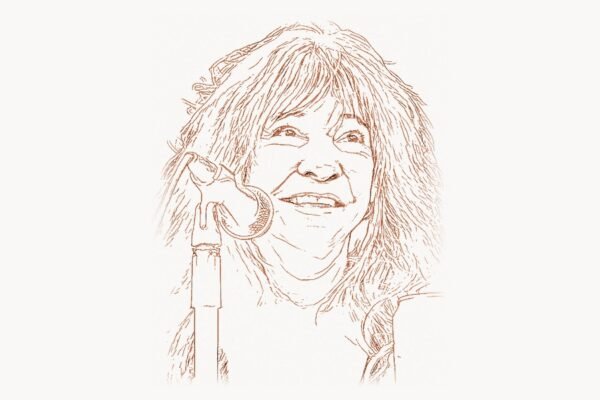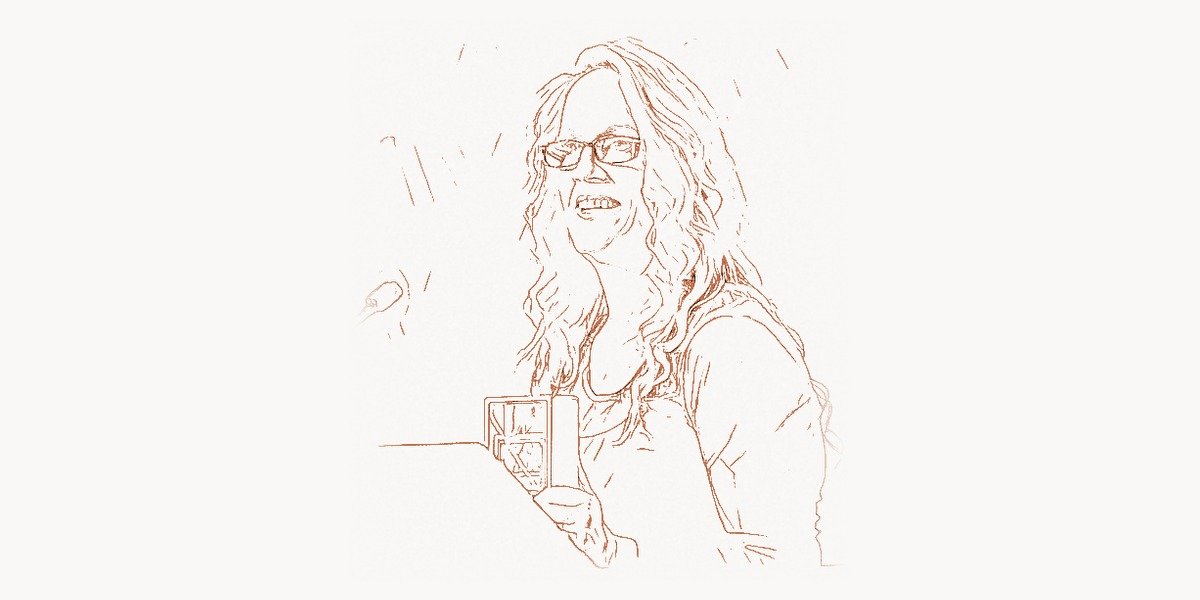
In 1981, a fourteen-year-old girl from Ogdensburg, New York walked into Sir-tech Software and asked for a job. She had no formal training, no college degree, and no industry connections — because there was barely an industry to have connections in. The game she was hired to work on was Wizardry: Proving Grounds of the Mad Overlord, one of the most influential role-playing games ever made and the title that essentially created the JRPG genre by inspiring Dragon Quest and Final Fantasy. That teenager was Brenda Romero (then Brenda Garno), and she has never left the game industry since. Over more than four decades, she has worked on over fifty shipped titles, co-founded Romero Games with John Romero, created an acclaimed series of analog board games that use game mechanics to explore historical atrocities, and become one of the most respected game design educators in the world. Her career spans the entire commercial history of video games — from the 8-bit era of Apple II RPGs through the rise of consoles, the mobile revolution, and the current age of independent studios. Where most game designers are remembered for a single franchise or a single technical breakthrough, Romero’s contribution is more fundamental: she has spent her career demonstrating that game mechanics are not just entertainment tools but a powerful language for expressing human experience, and that the game industry itself must be understood as a cultural institution with responsibilities that extend beyond commerce.
Early Life and Path Into Games
Brenda Romero was born Brenda Garno on January 18, 1966, in Ogdensburg, a small city on the St. Lawrence River in northern New York State. She grew up in a working-class family and became fascinated with computers and games at an early age. By her teenage years, she was already experimenting with game design concepts, creating her own paper-based games and exploring the limited software available on early personal computers. Ogdensburg was not a technology hub — it was a remote, economically depressed border town — and Romero’s path into the game industry was improbable by any standard.
Her break came when Sir-tech Software, a small game company based in the nearby city of Ogdensburg, hired her in 1981 to work on the Wizardry series. She was just fourteen years old. Sir-tech had been founded by the Sirotek family, and Wizardry was their flagship product — a first-person dungeon crawler for the Apple II that combined intricate RPG systems with punishing difficulty. Romero started in a junior role, contributing to game design and eventually working her way up through the company over the next fifteen years. She would eventually become a lead designer and creative director on multiple Wizardry titles, helping to shape a franchise that sold millions of copies and defined the template for computer role-playing games.
What made her early career remarkable was not just her age but the depth of systems knowledge she developed. Wizardry was not a simple game — it featured complex character creation, class-based party systems, spell mechanics, dungeon mapping, and permadeath. Designing for these systems required understanding probability, game balance, player psychology, and narrative pacing simultaneously. Romero learned these disciplines on the job, absorbing the craft of RPG design through direct practice rather than academic study. This practical education gave her a fluency with game systems that would distinguish her work for the rest of her career. Her trajectory parallels that of other early pioneers who entered technology as teenagers — much as Ada Lovelace grasped the potential of Babbage’s Analytical Engine before anyone else saw it, Romero recognized the expressive power of game mechanics before the concept of “game design” even existed as a formal discipline.
The Wizardry Legacy and RPG Systems Design
Technical Innovation
The Wizardry series, which Romero worked on from the very first title in 1981 through Wizardry 8 in 2001, was foundational to the RPG genre. The original Wizardry: Proving Grounds of the Mad Overlord established conventions that remain standard in role-playing games today: first-person dungeon exploration, party-based combat, character classes with distinct abilities, experience-point-based progression, and equipment systems with tiered rarity. These were not just design choices — they were a formalized language for modeling adventure and conflict in interactive systems.
Romero’s contributions to the series grew as her role expanded. By the mid-to-late entries in the franchise, she was making design decisions that directly shaped how millions of players experienced RPG systems. She worked on balancing the intricate probability tables that governed combat outcomes, loot distribution, and encounter difficulty — work that required a mathematical sensibility alongside creative instinct. The Wizardry games were among the first to treat game balance as an engineering problem: every class needed to feel viable, every spell needed to justify its slot, every dungeon floor needed to present an escalation in both challenge and reward that kept players engaged without overwhelming them.
One of the most significant aspects of Wizardry’s design was its influence on Japanese game developers. When Yuji Horii created Dragon Quest in 1986, he openly acknowledged Wizardry as a primary inspiration. Hironobu Sakaguchi’s Final Fantasy drew equally from Wizardry’s systems. The entire JRPG genre — which became one of the dominant forms of video game entertainment in the 1990s and 2000s — traces its mechanical DNA back to the Wizardry series. Romero’s work on these games was thus not just locally significant but globally foundational. The RPG systems she helped design and refine at Sir-tech became the template that Japanese developers adapted for console audiences, creating franchises that would go on to sell hundreds of millions of copies collectively.
# Wizardry-style party balance system
# Illustrating the kind of class-interaction design Romero refined
# across two decades of RPG development at Sir-tech

class WizardryPartyBalancer:
    """
    Romero's RPG design insight: party balance emerges from
    asymmetric dependencies between classes, not from making
    each class equally powerful in isolation. A Fighter is
    worthless without a Priest to heal; a Mage is fragile
    without a Fighter's front line. The PARTY is the unit
    of design, not the individual character.
    """

    CLASS_ROLES = {
        'fighter':  {'hp_mult': 1.4, 'damage': 'high',   'defense': 'high',   'magic': None},
        'mage':     {'hp_mult': 0.6, 'damage': 'low',    'defense': 'low',    'magic': 'offensive'},
        'priest':   {'hp_mult': 0.9, 'damage': 'medium', 'defense': 'medium', 'magic': 'healing'},
        'thief':    {'hp_mult': 0.8, 'damage': 'medium', 'defense': 'low',    'magic': None},
        'bishop':   {'hp_mult': 0.7, 'damage': 'low',    'defense': 'low',    'magic': 'both'},
        'samurai':  {'hp_mult': 1.1, 'damage': 'high',   'defense': 'medium', 'magic': 'offensive'},
    }

    def evaluate_party_viability(self, party_classes):
        """
        A viable party must cover four roles: damage absorption,
        damage dealing, healing, and utility (traps/locks).
        The design goal is that no single class covers all roles,
        forcing cooperation and strategic party composition.
        """
        has_tank = any(
            self.CLASS_ROLES[c]['defense'] == 'high' for c in party_classes
        )
        has_healer = any(
            self.CLASS_ROLES[c]['magic'] in ('healing', 'both') for c in party_classes
        )
        has_damage = any(
            self.CLASS_ROLES[c]['damage'] == 'high' for c in party_classes
        )
        has_utility = any(
            c in ('thief', 'bishop') for c in party_classes
        )

        viability = sum([has_tank, has_healer, has_damage, has_utility])

        return {
            'viable': viability >= 3,
            'optimal': viability == 4,
            'missing': [
                role for role, present in {
                    'tank': has_tank, 'healer': has_healer,
                    'damage': has_damage, 'utility': has_utility
                }.items() if not present
            ],
            # Romero's key balance principle: even a "bad" party
            # should be PLAYABLE, just significantly harder.
            # The game punishes poor composition with difficulty,
            # not with impossibility.
            'difficulty_modifier': 1.0 + (0.35 * (4 - viability))
        }
Why It Mattered
Romero’s two decades of work on Wizardry mattered because it established RPG systems design as a rigorous craft. Before Wizardry and its contemporaries, role-playing games on computers were often crude translations of tabletop mechanics. The Wizardry team — with Romero as an increasingly central contributor — transformed these mechanics into something native to the digital medium. They discovered which tabletop conventions worked on screen and which needed to be reinvented. They developed the concept of encounter balance as a tunable parameter, the idea that loot tables could drive long-term engagement, and the principle that character progression should provide a continuous sense of growth that motivated exploration.
These contributions were invisible to most players but foundational to the entire RPG genre. When modern designers build skill trees, design loot systems, or balance multiplayer character classes, they are working within a tradition that Wizardry helped establish — a tradition that Romero spent her formative years developing and refining. Her longevity in the franchise gave her a depth of craft knowledge that few designers of any era can match.
The Mechanic Is the Message: Games as Expressive Art
In 2008, Romero began work on what would become her most critically discussed project: a series of non-digital board games collectively titled “The Mechanic is the Message.” Each game in the series uses analog game mechanics — dice, tokens, boards, cards — to explore a specific historical atrocity. The games are not commercial products; they are artistic works designed to make players feel the systemic forces behind events like the Middle Passage, the Irish famine, and the mechanics of displacement and genocide.
The first and most discussed game in the series is Train (2009). In Train, players load small yellow tokens representing people into boxcars on a game board. The rules encourage efficient loading — players compete to fill their trains and move them along the track. Only when a train reaches its destination is a card revealed showing the name of a concentration camp. The game forces players to confront their own complicity in following rules without questioning their purpose. It is a devastating experience — players who have gone through it report visceral emotional reactions — and it demonstrated something that the game design community had long discussed theoretically but rarely seen in practice: that game mechanics themselves, independent of graphics or narrative text, can carry profound meaning.
The series title, “The Mechanic is the Message,” is a deliberate reference to Marshall McLuhan’s famous phrase. Romero’s argument, embodied in the games, is that the rules of a game are not neutral scaffolding for content — they are the content. The act of optimizing within a system, of following rules, of making strategic choices under constraint, is itself a form of communication. When the system models something real and terrible, the player’s participation becomes a form of experiential understanding that no passive medium — no book, no film, no lecture — can replicate.
This work positioned Romero at the forefront of the “games as art” discourse. While other designers had created emotionally powerful digital games, Romero’s analog approach stripped away all technological mediation and proved that the power lay in the mechanics themselves, not in rendering engines or musical scores. Train has been exhibited at museums and galleries worldwide, and Romero was invited to speak at venues far outside the game industry, including the Game Developers Conference, BAFTA, and academic institutions focused on media theory and cultural studies. The work brought intellectual legitimacy to game design as an expressive discipline, alongside pioneers like Sid Meier, whose Civilization series had already proven that complex historical systems could be modeled through gameplay.
Other Contributions
Romero Games and Empire of Sin. In 2015, Brenda co-founded Romero Games with her husband John Romero in Galway, Ireland. The studio’s first major title was Empire of Sin (2020), a strategy-RPG set during Prohibition-era Chicago. The game combined XCOM-style tactical combat with empire-management systems and narrative-driven character interactions. While the title received mixed reviews at launch, its ambition — blending multiple genres with historical setting and systemic storytelling — reflected Romero’s career-long interest in using game mechanics to model human behavior and social systems. The studio continues to develop original titles from its base in Ireland, operating as an independent studio in an industry increasingly dominated by large publishers.
Game Design Education. Romero has been one of the most influential game design educators of her generation. She held the position of game designer in residence at the University of California, Santa Cruz, and has taught and lectured at institutions worldwide. Her educational work emphasizes the same principles that define her design practice: that game mechanics are a language, that understanding systems is as important as understanding art or narrative, and that the history of games is inseparable from the history of culture. She has mentored hundreds of students who have gone on to work across the game industry, and her talks at GDC and other conferences are widely regarded as essential viewing for aspiring designers. Her commitment to education echoes the approach of Andrew Ng, who demonstrated that world-class practitioners can multiply their impact enormously by investing in the next generation of talent.
Advocacy for Women in Games. Throughout her career, Romero has been a vocal advocate for women and underrepresented groups in the game industry. Having entered the industry at fourteen and worked through decades in which women were a tiny minority of game developers, she speaks from direct experience about the barriers women face. She has been a prominent voice in the ongoing conversation about industry culture, hiring practices, and representation in game content. Her advocacy is not abstract — it is grounded in the practical reality of having been, for long stretches of her career, one of the only women in the room. The parallel to Adele Goldberg’s experience at Xerox PARC — another woman whose foundational technical contributions were made in an overwhelmingly male environment — is instructive. Both demonstrated that inclusion is not just a moral imperative but a practical one: the perspectives that diversity brings produce better design.
Industry Awards and Recognition. Romero has received numerous honors for her contributions. She was inducted into the AIAS Hall of Fame in 2015, making her one of only a handful of designers so recognized. She received the Lifetime Achievement Award at the Game Developers Choice Awards in 2017, and has been named to multiple “most influential” lists across the industry. In 2023, she was awarded a Fulbright scholarship for her work in games and culture. These honors recognize not just her individual games but her broader contribution to establishing game design as a respected creative and intellectual discipline.
Design Philosophy
Romero’s design philosophy is built on several interconnected principles that distinguish her from many of her contemporaries.
Mechanics are meaning. This is the central tenet of Romero’s work, most visibly expressed in “The Mechanic is the Message” series but present throughout her career. She believes that the rules of a game communicate values, model assumptions, and shape understanding. A game that rewards violence teaches that violence is effective. A game that rewards cooperation teaches that cooperation is effective. The designer’s choice of mechanics is therefore an ethical act, whether the designer recognizes it or not. This perspective elevates game design from a technical craft to a humanistic discipline.
Systems model reality. From Wizardry’s dungeon ecosystems to Empire of Sin’s criminal empires, Romero designs games as models of complex systems. Her interest is not in individual moments of spectacle but in how interlocking rules produce emergent behavior that mirrors real-world dynamics. This systems-thinking approach connects her work to the broader tradition of simulation and modeling in computer science, and it gives her games a depth that survives repeated play. Where a narrative-focused game may lose its power once the story is known, a systems-focused game reveals new dynamics with each session — an approach shared with Shigeru Miyamoto’s philosophy of emergent gameplay through simple interacting rules.
History is a design material. Romero treats history not as a backdrop for gameplay but as raw material to be modeled and explored through mechanics. Whether it is the dungeon-delving fantasy of Wizardry (which modeled historical adventure narratives), the Prohibition-era crime networks of Empire of Sin, or the systemic horrors explored in her board games, historical context is integral to her design process. She researches extensively, and her games reflect a seriousness about their subject matter that is uncommon in an industry that often treats history as an aesthetic rather than a substance.
Analog validates digital. Romero’s turn to board games was not a retreat from digital design — it was an act of rigorous investigation. By stripping away graphics, sound, and code, she isolated the fundamental question of what game mechanics can communicate on their own. This approach has influenced a generation of designers who now use paper prototyping and analog playtesting as core parts of their digital design process. The principle that if a game is not fun on paper it will not be fun on screen has become industry conventional wisdom, and Romero’s board games are the most powerful demonstration of why this is true. Modern game development teams managing complex projects through platforms like Taskee often begin their design phases with analog prototyping sessions inspired by this approach.
// Romero's "Mechanic is the Message" design framework
// How game rules encode meaning — illustrated through
// the structure of Train (2009)

const TrainDesignFramework = {
  // Phase 1: Players learn and optimize within the rules
  // The mechanic FEELS like an efficiency puzzle
  mechanicalLayer: {
    objective: "Load passengers into trains, move trains along track",
    tokens: "Small yellow wooden people (dehumanized by abstraction)",
    rules: [
      "Draw a card each turn — cards modify loading or movement",
      "Players compete to move their trains furthest along the track",
      "Broken windows on the boxcar cards slow loading (deliberate friction)",
      "Rules are printed on deliberately fragile parchment (can be torn)"
    ],
    playerBehavior: "Optimization — players naturally try to load efficiently"
  },

  // Phase 2: The reveal recontextualizes everything
  // Destination cards name real concentration camps
  meaningLayer: {
    revealMoment: "When a train reaches the end, flip the destination card",
    destinations: ["Auschwitz", "Dachau", "Bergen-Belsen"],
    playerReaction: "Horror, guilt, refusal to continue",
    designInsight: [
      "Players followed rules without questioning their purpose",
      "Efficiency optimization became complicity in atrocity",
      "The 'game' feeling made participation feel voluntary",
      "The mechanic IS the message: systems create complicity"
    ]
  },

  // Phase 3: The meta-design — rules that can be broken
  subversiveLayer: {
    hiddenRule: "Nothing in the rules says you MUST play",
    breakableRules: "The parchment rules can physically be torn up",
    windowMechanic: "Broken windows on boxcars — a Kristallnacht reference",
    designPhilosophy: `Romero designed the game so that the MOST
      meaningful act is refusing to play or breaking the rules.
      The game rewards disobedience — but only if the player
      realizes that disobedience is an option. Most do not,
      because games train us to follow rules.`
  },

  // The core thesis that drives all of Romero's work
  thesis: `Game mechanics are not neutral. Every rule teaches behavior.
    Every system models assumptions about the world. The designer
    who chooses the rules is making a statement about what matters,
    what is rewarded, and what is punished. This responsibility
    exists whether the game is about dungeons or about history.`
};
Legacy and Influence
Brenda Romero’s legacy is unusual in the game industry because it operates on multiple levels simultaneously. She is one of the longest-serving active game designers in the world, with a career that now exceeds forty years. That longevity alone gives her a perspective that few contemporaries share — she has lived through every era of commercial game development, from the Apple II to cloud gaming, and her work reflects that breadth of experience.
Her influence on RPG design is foundational. The Wizardry series that she helped shape for two decades established conventions that remain the backbone of the RPG genre. Every modern RPG — from Baldur’s Gate to Elden Ring to the latest entries in the Final Fantasy and Dragon Quest series — works within a design tradition that Wizardry helped create. The party-based combat systems, the class-role dependencies, the loot-driven exploration loops, the balance between player agency and systemic challenge: these are not features that were invented once and frozen. They were developed iteratively over years of design and refinement, and Romero was central to that process during the genre’s formative period.
Her board game work has had an impact that extends far beyond the game industry. “The Mechanic is the Message” demonstrated that games can engage with the most serious subjects in human history — not by grafting narrative onto gameplay, but by making the gameplay itself the vehicle for understanding. This work has influenced designers, educators, artists, and scholars who study how interactive systems shape human understanding. It has been discussed in academic papers on game studies, exhibited in museums, and cited as evidence that games deserve the same critical attention as literature, film, and visual art. Roberta Williams had pioneered narrative ambition in games through her graphic adventure work at Sierra; Romero pushed the boundary further by proving that mechanics alone, without any graphics at all, could carry emotional and intellectual weight equal to any narrative medium.
As an educator and advocate, Romero has shaped the careers of hundreds of game designers and contributed to a broader cultural shift in how the industry thinks about inclusion, responsibility, and the cultural significance of its products. Her voice carries authority because it is grounded in four decades of practice — she does not theorize about what games can be; she has spent her career proving it.
The game industry in 2025 generates more revenue than film and music combined, and yet it still struggles with questions of cultural legitimacy, creative ambition, and social responsibility. Brenda Romero’s career is a sustained argument that these questions matter — that games are not just products but a medium with the power to shape how people understand themselves and the world. From the dungeons of Wizardry to the boxcars of Train, her work demonstrates that the rules we design are never just rules. They are always, whether we intend it or not, a message.
Key Facts
| Detail | Information |
|---|---|
| Full Name | Brenda Romero (nee Garno; formerly Brathwaite) |
| Born | January 18, 1966, Ogdensburg, New York, USA |
| Known For | Wizardry series, “The Mechanic is the Message” board game series, Train (2009), co-founding Romero Games, game design education |
| Key Projects | Wizardry series (1981-2001), Train (2009), Empire of Sin (2020) |
| Career Span | 1981 – present (40+ years in the game industry) |
| Company | Co-founder, Romero Games (Galway, Ireland, est. 2015) |
| Awards | AIAS Hall of Fame (2015), GDC Lifetime Achievement Award (2017), Fulbright Scholar (2023), multiple Women in Games Hall of Fame recognitions |
| Education Role | Game Designer in Residence at UC Santa Cruz; lecturer and mentor at institutions worldwide |
| Design Philosophy | “The Mechanic is the Message” — game rules are inherently expressive and carry ethical weight |
Frequently Asked Questions
Who is Brenda Romero?
Brenda Romero (born 1966) is an American game designer, educator, and industry advocate with over forty years of experience in the video game industry. She began her career at age fourteen working on the original Wizardry at Sir-tech Software and has since worked on more than fifty shipped titles. She is best known for her foundational contributions to the RPG genre through the Wizardry series, her acclaimed board game series “The Mechanic is the Message” (which includes the widely discussed game Train), and her role as co-founder of Romero Games alongside her husband John Romero. She is also one of the game industry’s most respected educators and advocates for diversity.
What is “The Mechanic is the Message” and why is Train considered important?
“The Mechanic is the Message” is a series of non-digital board games created by Brenda Romero, each using analog game mechanics to explore a specific historical atrocity. The most famous game in the series, Train (2009), asks players to efficiently load tokens into boxcars and move them along tracks — only revealing at the end that the destination is a concentration camp. The game is considered important because it demonstrates that game mechanics themselves, without any digital technology or narrative text, can carry profound emotional and intellectual meaning. Train has been exhibited in museums worldwide and is widely cited as one of the most compelling arguments that games are a legitimate artistic and cultural medium.
How did the Wizardry series influence modern RPGs?
The Wizardry series, which Romero worked on from 1981 through 2001, established many of the conventions that define role-playing games today: first-person dungeon exploration, party-based combat with distinct character classes, experience-point progression, equipment systems with tiered rarity, and balanced encounter design. Critically, Wizardry directly inspired Japanese developers Yuji Horii (Dragon Quest) and Hironobu Sakaguchi (Final Fantasy), meaning the entire JRPG genre traces its mechanical DNA to the Wizardry series. The RPG systems design principles refined across twenty years of Wizardry development remain foundational to every modern RPG, from Baldur’s Gate to Elden Ring.
What is Romero Games, and what has it produced?
Romero Games is an independent game studio co-founded by Brenda Romero and John Romero in 2015, headquartered in Galway, Ireland. The studio’s first major release was Empire of Sin (2020), a strategy-RPG set during Prohibition-era Chicago that combined tactical combat with empire-management systems and narrative-driven character interactions. The studio operates independently and continues to develop original titles, reflecting both founders’ commitment to creative independence in an industry increasingly consolidated by large publishers.