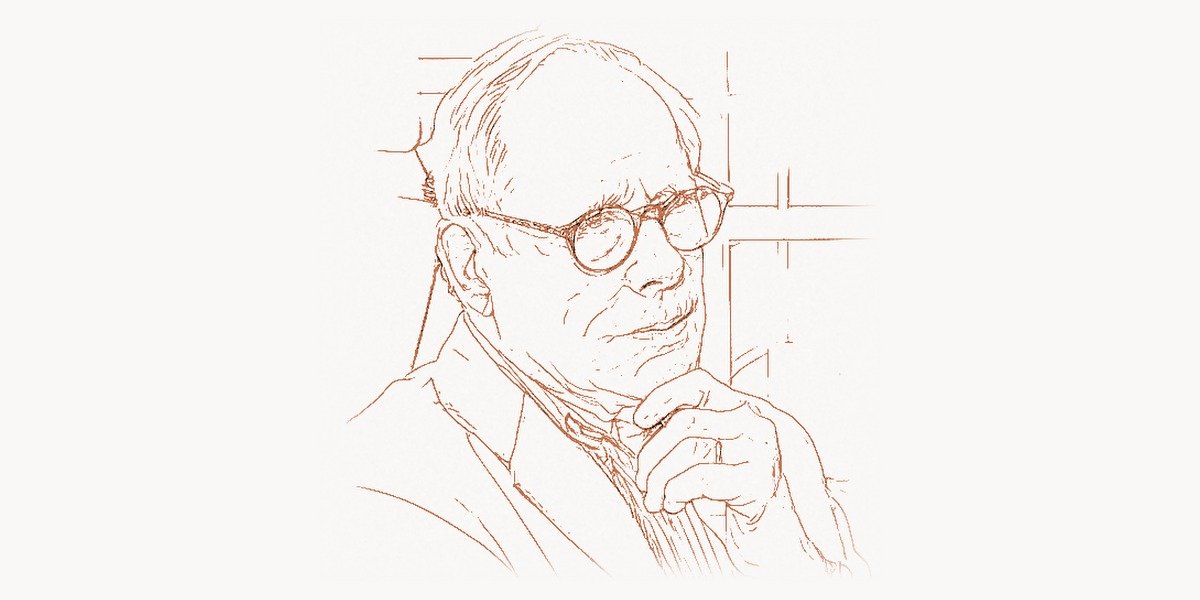
Long before Apple’s sleek aluminum unibodies and minimalist interfaces became cultural icons, a quiet German industrial designer was already perfecting the philosophy behind them. Dieter Rams spent over four decades at Braun, transforming household electronics from cluttered boxes into objects of enduring clarity. His work did not just define a brand — it established a design grammar that the entire technology industry eventually adopted. From the calculator that inspired the iPhone’s first calculator app to the principles that guide design systems at the world’s most valuable companies, Rams proved that restraint is the most powerful tool a designer can wield.
From Carpenter’s Workshop to Braun’s Design Revolution
Born in Wiesbaden, Germany in 1932, Dieter Rams grew up surrounded by craftsmanship. His grandfather was a carpenter, and young Rams absorbed a deep respect for materials, precision, and honest construction. After studying architecture and interior design at the Werkkunstschule Wiesbaden, he briefly worked as an architect for Otto Apel, contributing to projects influenced by the modernist tradition of the Frankfurt School.
In 1955, Rams joined Braun, the electronics manufacturer founded by Max Braun. The company was in transition — Max had passed away, and his sons Artur and Erwin were steering Braun toward a new visual identity. They brought in designers from the Ulm School of Design, and Rams found himself in a creative environment that valued function, honesty, and systematic thinking above all else. Within six years, he became Braun’s Chief Design Officer, a position he would hold until 1995.
At Braun, Rams oversaw the design of more than 500 products. The SK 4 record player — nicknamed “Snow White’s Coffin” for its transparent lid — shattered conventions about what consumer electronics could look like. The T3 pocket radio, the RT 20 table radio, the 606 Universal Shelving System (designed for Vitsoe): each product stripped away ornamentation and let the object communicate its purpose through form alone. These designs were not minimalist as an aesthetic choice — they were minimalist because Rams believed anything unnecessary was dishonest.
The 10 Principles of Good Design
By the late 1970s, Rams had grown increasingly troubled by what he saw as a world filling with thoughtless products. He formalized his design philosophy into ten principles — a framework that has since become the most quoted set of design guidelines in modern product development. These principles did not emerge from abstract theory; they crystallized decades of practical decisions made over hundreds of real products. Every principle addresses a specific failure mode that Rams had observed and fought against throughout his career.
The Complete Framework
Rams’s ten principles function as a checklist, a diagnostic tool, and a philosophical compass all at once. Each principle challenges designers to justify every decision — not through subjective preference, but through measurable impact on the user’s experience. Designers at companies from Toimi to global enterprises reference these principles when evaluating product quality. Here is the full framework as Rams articulated it:
/*
 * Dieter Rams — 10 Principles of Good Design
 * A systematic framework for evaluating product quality
 * Applied at Braun (1955-1995) across 500+ products
 */

const DESIGN_PRINCIPLES = {
  1: {
    principle: "Good design is innovative",
    diagnostic: "Does this advance possibilities beyond existing solutions?",
    antiPattern: "Copying trends without understanding the problem"
  },
  2: {
    principle: "Good design makes a product useful",
    diagnostic: "Does every element serve the user's actual needs?",
    antiPattern: "Features added for marketing rather than utility"
  },
  3: {
    principle: "Good design is aesthetic",
    diagnostic: "Does the form reward sustained engagement?",
    antiPattern: "Visual noise that fatigues rather than pleases"
  },
  4: {
    principle: "Good design makes a product understandable",
    diagnostic: "Can a new user operate this without instruction?",
    antiPattern: "Requiring manuals for basic interactions"
  },
  5: {
    principle: "Good design is unobtrusive",
    diagnostic: "Does the design recede to let the task dominate?",
    antiPattern: "Design that calls attention to itself over function"
  },
  6: {
    principle: "Good design is honest",
    diagnostic: "Does the product promise only what it delivers?",
    antiPattern: "Decorative elements that suggest false capabilities"
  },
  7: {
    principle: "Good design is long-lasting",
    diagnostic: "Will this feel appropriate in 10 years?",
    antiPattern: "Trend-driven styling that dates rapidly"
  },
  8: {
    principle: "Good design is thorough down to the last detail",
    diagnostic: "Has every element received equal care?",
    antiPattern: "Polished surfaces hiding sloppy internals"
  },
  9: {
    principle: "Good design is environmentally friendly",
    diagnostic: "Does this minimize waste across its lifecycle?",
    antiPattern: "Planned obsolescence and disposable construction"
  },
  10: {
    principle: "Good design is as little design as possible",
    diagnostic: "Can anything be removed without loss of function?",
    antiPattern: "Complexity added to justify the designer's involvement"
  }
};

// "Less, but better" — Weniger, aber besser
// The guiding reduction that underlies all ten principles
These principles resonated far beyond industrial design. Software engineers, UX researchers, architects, and product managers discovered that Rams’s framework applied with remarkable precision to their own disciplines. The reason is simple: Rams was not designing objects — he was designing relationships between people and tools.
From Braun to Apple: The Design Lineage That Changed Computing
The most visible inheritance of Rams’s philosophy runs through Apple. When Jef Raskin first conceived the Macintosh, he envisioned a computer that ordinary people could understand without training — a direct echo of Rams’s fourth principle. But the physical, visual connection became unmistakable under Jonathan Ive, Apple’s Chief Design Officer from 1997 to 2019.
Ive has spoken openly about Rams’s influence. The Braun T3 pocket radio and the original iPod share the same circular control element centered on a clean rectangular face. The Braun ET 66 calculator’s color scheme and button layout reappeared almost exactly in Apple’s iOS calculator app. The Braun LE 1 speaker’s perforated aluminum grille inspired the Mac Pro’s ventilation pattern. These were not copies — they were evidence of a shared design logic that values clarity above novelty.
This lineage matters because it demonstrates that great design principles transcend their original medium. Rams designed physical knobs and switches; Apple translated those same principles into touch interfaces and software experiences. The principle stayed constant: remove everything that does not serve the user. Pioneers like Craig Federighi, who leads Apple’s software engineering, continue to navigate the tension between feature richness and the Rams-inspired simplicity that defines Apple’s identity.
Component-Based Design: Rams’s Modular Thinking in Modern Code
One of Rams’s most forward-thinking contributions was his modular approach to product design. The 606 Universal Shelving System, which he designed for Vitsoe in 1960, is still manufactured and sold today — unchanged. Its genius lies in composability: standardized components that users combine to fit their own needs. No bolts penetrate walls. Shelves, cabinets, and tables clip onto a shared rail system. The user becomes a co-designer.
This philosophy maps directly onto modern component-based software architecture. When Alan Cooper pioneered interaction design patterns, or when Alex Russell pushed for progressive web applications, they were applying the same principle: build small, honest parts that compose into larger systems. Today’s design systems — collections of reusable UI components governed by consistent rules — are digital 606 shelving systems.
/**
 * Rams-Inspired Component Design System
 * Principles: composable, honest, minimal, thorough
 *
 * Each component follows the Rams diagnostic:
 * - Does it serve a real user need? (Principle 2)
 * - Can it be understood without documentation? (Principle 4)
 * - Is it unobtrusive in context? (Principle 5)
 * - Can anything be removed? (Principle 10)
 */

// Base design tokens — the "rail system" all components share
const designTokens = {
  spacing: {
    unit: 8,                    // All spacing derives from one base unit
    scale: [0, 4, 8, 16, 24, 32, 48, 64],  // Deliberate, not arbitrary
  },
  color: {
    intent: {                   // Colors communicate function, not decoration
      primary: 'hsl(210, 60%, 45%)',   // Actions the user initiates
      feedback: 'hsl(145, 50%, 40%)',  // System confirming success
      warning: 'hsl(35, 90%, 50%)',    // Requires attention
      critical: 'hsl(0, 65%, 50%)',    // Destructive or irreversible
    },
    neutral: {                  // Content hierarchy through value, not hue
      900: 'hsl(0, 0%, 10%)',  // Primary text
      600: 'hsl(0, 0%, 40%)',  // Secondary text
      200: 'hsl(0, 0%, 87%)', // Borders and dividers
      50:  'hsl(0, 0%, 97%)',  // Background surfaces
    }
  },
  typography: {
    scale: [12, 14, 16, 20, 24, 32], // Each size has a clear purpose
    weight: { regular: 400, medium: 500, bold: 700 },
    lineHeight: 1.5,           // Optimized for sustained reading
  }
};

// Component: Button — "as little design as possible"
function createButton({ label, intent = 'primary', size = 'md' }) {
  // Principle 4: The label IS the interface
  // Principle 6: Visual weight matches action severity
  // Principle 8: Includes focus ring, loading state, disabled state
  const sizeMap = { sm: 0, md: 1, lg: 2 };
  return {
    element: 'button',
    text: label,
    padding: designTokens.spacing.scale[sizeMap[size] + 2],
    background: designTokens.color.intent[intent],
    borderRadius: designTokens.spacing.unit / 2,
    // Nothing else. Every property justified.
  };
}

// Component: Card — modular container (like a Vitsoe shelf)
function createCard({ children, elevation = 1 }) {
  // Principle 5: The card recedes; content dominates
  // Principle 10: Shadow is the only decoration — it communicates depth
  return {
    element: 'div',
    role: 'article',
    padding: designTokens.spacing.scale[4],
    background: designTokens.color.neutral[50],
    boxShadow: `0 ${elevation}px ${elevation * 3}px rgba(0,0,0,0.1)`,
    children,
  };
}
The parallel between Rams’s physical design system and modern digital design systems is not coincidental. Both solve the same problem: how do you maintain quality and coherence across hundreds of products (or screens) created by dozens of people over many years? The answer Rams discovered — rigorous constraints, honest materials, and composable parts — is exactly what modern teams implement when they build shared component libraries. Project management platforms like Taskee help design and development teams coordinate the adoption of these shared systems across distributed workflows.
Less But Better: The Philosophy of Deliberate Reduction
“Weniger, aber besser” — less, but better — is the phrase most associated with Rams. It is frequently misunderstood. Rams was not advocating for fewer features or simpler products in absolute terms. He was demanding that every element justify its existence through contribution to the user’s experience. A Rams product might contain sophisticated engineering — but the user encounters only the clarity that results from that engineering.
This distinction matters enormously in technology. The minimalist aesthetic that Rams pioneered has sometimes been reduced to a visual style — clean lines, white space, sans-serif fonts — stripped of its functional foundation. True Rams-inspired design is not about looking minimal; it is about being minimal in the demands it places on the user’s attention. A complex dashboard can embody Rams’s principles if every data point earns its place. A sparse landing page can violate them if it hides essential information behind unnecessary clicks.
The Nicole Sullivan approach to object-oriented CSS, for instance, applies Rams’s reduction philosophy to code itself: identify patterns, eliminate redundancy, and let each rule do exactly one thing well. Similarly, Chris Richardson‘s work on microservices patterns echoes Rams’s modular thinking — each service, like each Braun product, should do one thing thoroughly and compose cleanly with others.
The Environmental Imperative
Rams’s ninth principle — good design is environmentally friendly — was decades ahead of its time. In the 1970s, when planned obsolescence was standard business strategy, Rams was designing products meant to last. The 606 shelving system’s 60+ year production run is not a marketing gimmick; it is the natural result of a design philosophy that considers the entire lifecycle of a product.
This principle has gained urgent new relevance in technology. The electronics industry generates over 50 million tonnes of e-waste annually. Rams’s approach — build it right, build it to last, build it to be repaired — offers a concrete alternative. When a Braun alarm clock from 1971 still functions and still looks appropriate on a modern nightstand, it demonstrates that longevity is not a sacrifice but a feature. The Dieter Rams Foundation continues to advocate for these values, promoting design education that places sustainability at its core.
In software, this translates to building systems that age gracefully: clean APIs that do not break when requirements evolve, accessible interfaces that work across devices and abilities, and architectures that can be maintained by teams who did not write the original code. Rams would recognize a well-documented, thoroughly tested codebase as a product that embodies his eighth principle: thoroughness down to the last detail.
Influence Beyond Products
Rams’s impact extends far beyond the objects he designed. His systematic approach to design — principles, diagnostics, measurable criteria — helped professionalize design as a discipline with the same rigor as engineering. Before Rams, industrial design was often treated as a late-stage cosmetic exercise. Rams demonstrated that design decisions made at the beginning of a project determine the quality of its entire lifecycle.
This elevation of design thinking influenced the entire structure of technology companies. When firms like Apple gave their design team authority over product decisions — rather than subordinating design to engineering or marketing — they were following a path Rams had blazed at Braun. The Chief Design Officer role that exists at major tech companies today traces its lineage directly to the position Rams held starting in 1961.
Pioneers in human-computer interaction, such as Ivan Sutherland, were exploring parallel questions: how should a computer present itself to a human? Sutherland’s Sketchpad, created in 1963, shared Rams’s conviction that the tool should be transparent — that the interface should disappear, leaving only the user’s intent and the result. This convergence between industrial design and computer science set the stage for the user experience discipline that now shapes every digital product.
The Documentary and the Legacy
Gary Hustwit’s 2018 documentary Rams brought renewed global attention to the designer’s philosophy. The film revealed something striking: at 86, Rams was not celebrating his legacy but questioning it. He expressed concern that design had become complicit in overconsumption, that even well-designed products contribute to environmental harm when they multiply without restraint. The film captures a designer who holds himself and his profession to the highest possible standard — and who finds that standard perpetually unmet.
This self-critical honesty is perhaps Rams’s most important lesson for technology. In an industry that celebrates disruption and growth, Rams asks a more difficult question: should this product exist at all? Every feature request, every new app, every product launch should pass through this filter before any design work begins. The most powerful application of principle ten — as little design as possible — might be deciding that the best design is no product at all.
Rams’s Enduring Relevance in the Age of AI
As artificial intelligence reshapes how products are designed and experienced, Rams’s principles face their most significant test yet. AI-powered interfaces can adapt in real time, personalizing layouts, content, and interactions for each user. This capability creates a new tension: personalization can serve the user (principle two), but it can also become obtrusive (violating principle five) or dishonest (violating principle six) if the user cannot understand why the interface is changing.
Rams’s framework provides clear guidance here. An AI-enhanced product should still be understandable — the user should grasp what is happening and why. It should still be honest — recommendations should serve the user’s needs, not hidden commercial objectives. And it should still be as little design as possible — AI should simplify the experience, not add layers of complexity disguised as intelligence.
The designers and engineers building the next generation of technology products would do well to keep Rams’s principles visible. Not as aesthetic guidelines, but as ethical ones. Each principle is ultimately a commitment to respecting the user — their time, their attention, their intelligence, and their environment. In a world of increasingly complex technology, that respect remains the foundation of good design.
Frequently Asked Questions
What are Dieter Rams’s 10 Principles of Good Design?
Dieter Rams’s ten principles state that good design is: innovative, useful, aesthetic, understandable, unobtrusive, honest, long-lasting, thorough down to the last detail, environmentally friendly, and involves as little design as possible. He developed these principles during his tenure as Chief Design Officer at Braun (1961-1995) as a systematic framework for evaluating product quality across any discipline.
How did Dieter Rams influence Apple’s design?
Jonathan Ive, Apple’s former Chief Design Officer, has publicly acknowledged Rams as a primary influence. Specific Braun products — the T3 radio, the ET 66 calculator, and the LE 1 speaker — share clear design DNA with Apple’s iPod, iOS calculator, and Mac Pro respectively. More fundamentally, Apple’s company-wide commitment to simplicity, material honesty, and user-centered design reflects Rams’s philosophical framework.
What products did Dieter Rams design at Braun?
Over his 40-year career at Braun, Rams oversaw the design of more than 500 products. His most iconic creations include the SK 4 record player (1956), the T3 pocket radio (1958), the RT 20 table radio (1961), and the ET 66 calculator (1987). He also designed the 606 Universal Shelving System for Vitsoe in 1960, which remains in production today — a testament to the longevity his principles produce.
How do Rams’s design principles apply to software development?
Rams’s principles translate directly to software through design systems, component libraries, and UX methodologies. His emphasis on composable, modular parts mirrors modern component-based architecture. His demand for understandability aligns with usability testing. His insistence on thoroughness maps to code quality practices like testing and documentation. The principle of environmental responsibility translates to performance optimization, accessibility, and sustainable digital practices that minimize resource consumption.
What does “less but better” mean in design?
“Weniger, aber besser” (less, but better) is Rams’s guiding philosophy. It does not mean fewer features in absolute terms — it means every element must justify its existence through genuine contribution to the user experience. A complex product can embody this principle if every detail serves a purpose. The concept challenges designers and engineers to focus not on what can be added, but on what can be removed without diminishing the product’s usefulness or quality.