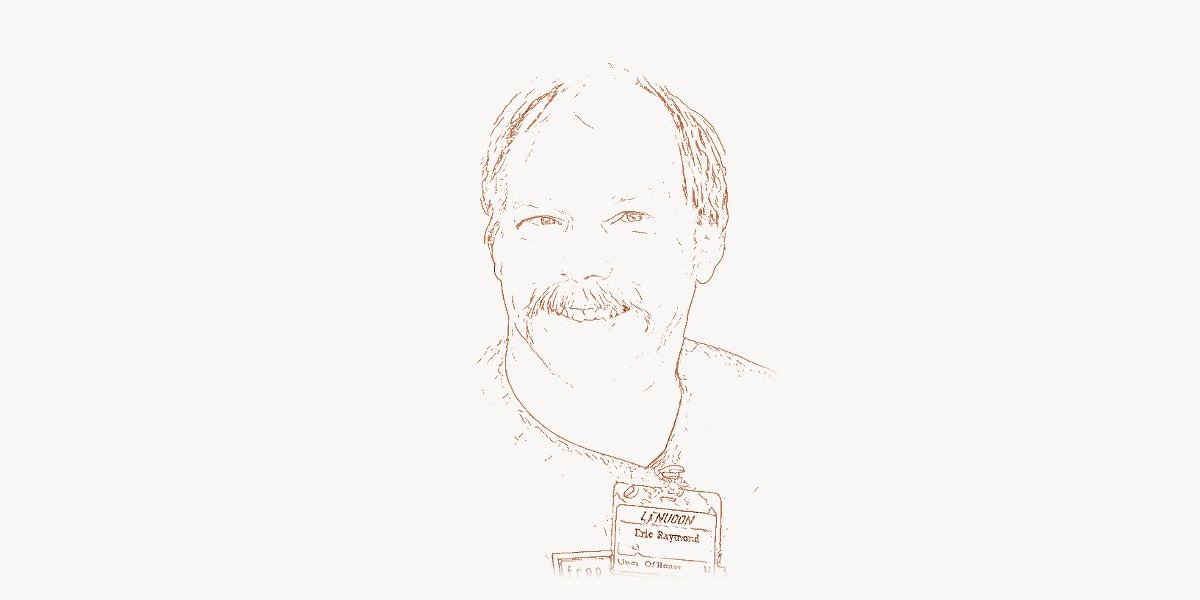
In 1997, a programmer and self-described hacker released an essay that would fundamentally reshape how the software industry thinks about development. Eric S. Raymond’s “The Cathedral and the Bazaar” didn’t just describe the open source movement — it provided its intellectual ammunition. When Netscape executives read it, they decided to release their browser’s source code, a decision that eventually led to Firefox and transformed the web. Raymond became the philosopher-warrior of open source, turning scattered ideas about collaborative development into a coherent ideology that Silicon Valley could embrace.
But Raymond is far more than a single essay. He is a prolific programmer, the longtime maintainer of fetchmail, a major contributor to the Jargon File and its successor the New Hacker’s Dictionary, a co-founder of the Open Source Initiative, and one of the most provocative voices in technology culture. His fingerprints are on the vocabulary hackers use, the tools they rely on, and the principles that guide how modern software gets built.
Early Life and the Path to Hacking
Eric Steven Raymond was born on December 4, 1957, in Boston, Massachusetts. His family moved frequently during his childhood, and he spent parts of his youth in Venezuela and Pennsylvania. This peripatetic upbringing cultivated an autodidactic streak — Raymond learned to teach himself, a skill that would serve him well in the uncharted territory of early computing.
Raymond encountered computers in the early 1970s, during the era when access meant university mainframes and time-sharing systems. He was drawn not just to programming but to the culture surrounding it — the community of tinkerers, problem-solvers, and intellectuals who were building something unprecedented. He attended the University of Pennsylvania, where he studied philosophy and mathematics, disciplines that sharpened his ability to construct and deconstruct arguments — a talent that would later make him one of open source’s most effective advocates.
By the early 1980s, Raymond had immersed himself in the Unix ecosystem and the nascent free software community. He was an early participant in the culture that Richard Stallman was formalizing through the GNU Project and the Free Software Foundation. Raymond became a skilled C programmer, contributing to various Unix utilities and absorbing the collaborative ethos that characterized the best of academic computing. He was also deeply involved in the science fiction fan community and early internet culture, connections that would later inform his understanding of decentralized communities.
During this period, Raymond began his involvement with the Jargon File, a glossary of hacker slang that had been circulating since the early days of MIT’s AI Lab and Stanford. When he took over as editor and maintainer in 1990, he transformed it from a historical curiosity into a living document of hacker culture, eventually publishing it as “The New Hacker’s Dictionary.” This project gave him a unique vantage point — he wasn’t just participating in hacker culture, he was documenting and defining it.
The Cathedral and the Bazaar Breakthrough
Technical Innovation: A New Model for Software Development
Raymond’s pivotal contribution wasn’t a piece of software — it was an idea, articulated with enough precision and rhetorical force to change an industry. “The Cathedral and the Bazaar,” first presented at the Linux Kongress in 1997, compared two fundamentally different models of software development.
The “cathedral” model represented traditional software engineering: a small group of developers working in careful, planned isolation, releasing polished versions at long intervals. This was how most commercial software was built, and how even many free software projects like GNU Emacs operated. The “bazaar” model, exemplified by Linus Torvalds and the Linux kernel, was something different entirely: a chaotic-seeming process where code was released early and often, every user was a potential co-developer, and bugs were found through sheer volume of eyeballs rather than careful top-down review.
Raymond didn’t just theorize about this distinction. He tested it by taking over development of a small mail client called popclient, renaming it fetchmail, and deliberately applying bazaar-style principles. He released early, released often, listened to his users as co-developers, and documented the entire process. The result was a concrete case study that demonstrated the bazaar model could work even for a single developer managing a moderately complex project.
The essay crystallized several principles that have become foundational to modern software development. Here is a simplified example showing the kind of open, modular design philosophy Raymond championed — code that invites contribution rather than obscuring its logic:
# fetchmail-style POP3 retrieval — clear, modular, inviting contribution
import poplib
import email

class MailFetcher:
    """Simple POP3 mail fetcher following Raymond's bazaar principles:
    - Clear interface over clever implementation
    - Release early, iterate based on user feedback
    - Every user is a potential co-developer
    """

    def __init__(self, host, user, password, port=995, use_ssl=True):
        self.host = host
        self.user = user
        self.password = password
        self.port = port
        self.use_ssl = use_ssl

    def connect(self):
        if self.use_ssl:
            self.server = poplib.POP3_SSL(self.host, self.port)
        else:
            self.server = poplib.POP3(self.host, self.port)
        self.server.user(self.user)
        self.server.pass_(self.password)
        return self.server.stat()  # (message_count, mailbox_size)

    def fetch_messages(self, limit=None):
        """Fetch messages — designed so users can easily extend
        with their own filtering and processing logic."""
        count, size = self.connect()
        messages = []
        fetch_count = min(count, limit) if limit else count

        for i in range(1, fetch_count + 1):
            raw = b'\n'.join(self.server.retr(i)[1])
            msg = email.message_from_bytes(raw)
            messages.append({
                'from': msg['From'],
                'subject': msg['Subject'],
                'date': msg['Date'],
                'body': self._get_body(msg)
            })

        self.server.quit()
        return messages

    def _get_body(self, msg):
        if msg.is_multipart():
            for part in msg.walk():
                if part.get_content_type() == 'text/plain':
                    return part.get_payload(decode=True).decode()
        return msg.get_payload(decode=True).decode()
Why It Mattered: From Essay to Industry Transformation
The impact of “The Cathedral and the Bazaar” was immediate and dramatic. Frank Hecker, a Netscape engineer, circulated the essay internally, and it became a key piece of evidence in the debate over whether Netscape should open-source its browser code. In January 1998, Netscape announced it would release the source code for Navigator — a decision that ultimately led to the Mozilla project and, eventually, to Firefox. It was one of the first times a major technology company had been directly influenced by an essay about software philosophy.
But the essay’s influence extended far beyond Netscape. It gave business leaders a vocabulary and framework for understanding why open source development could produce better software than closed, proprietary methods. Raymond’s most quoted insight — that given enough eyeballs, all bugs are shallow, which he named “Linus’s Law” — gave executives something they could repeat in boardrooms. It made open source legible to people who didn’t write code.
The essay also helped catalyze the founding of the Open Source Initiative (OSI) in February 1998, which Raymond co-founded with Bruce Perens. The OSI deliberately chose the term “open source” over “free software,” a strategic rebranding designed to make the concept palatable to the business world. While this created a lasting rift with Stallman and the Free Software Foundation, it was enormously effective at its stated goal. Companies like IBM, Oracle, and eventually Microsoft began embracing open source, a process that might have taken decades longer without the intellectual groundwork Raymond laid. Today, teams managing complex open source projects frequently rely on Taskee and similar platforms to coordinate contributions across distributed developer communities.
Other Major Contributions
While “The Cathedral and the Bazaar” is Raymond’s most famous work, his contributions span decades and multiple domains. His stewardship of fetchmail wasn’t just a case study for an essay — it was a genuinely useful piece of software that millions of Unix and Linux users relied on to retrieve their email from remote servers throughout the late 1990s and 2000s.
Raymond’s editing of the Jargon File and publication of “The New Hacker’s Dictionary” (first edition 1991, third edition 1996) preserved and propagated the language of hacker culture. Terms like “crufty,” “grok,” “foo” and “bar,” and dozens of others reached wider audiences through his work. The Jargon File served as both a dictionary and an anthropological document, capturing the values, humor, and worldview of the programming subculture that built the internet.
He authored numerous other influential essays and books. “Homesteading the Noosphere” (1998) examined how open source developers establish and maintain intellectual property norms within a gift economy. “The Magic Cauldron” (1999) analyzed the economics of open source software, arguing that it was not just ideologically desirable but economically rational. Together with “The Cathedral and the Bazaar,” these essays were published as a collection that became a foundational text of the open source movement.
Raymond also created and maintained several significant software tools. He contributed to GNU Emacs, wrote the widely used bogofilter spam filter, and maintained various other open source utilities. His work on gpsd, the GPS daemon that provides location data to applications on Linux systems, demonstrated his continued engagement with practical systems programming well into the 2000s and 2010s.
His “How To Become A Hacker” FAQ, originally published in 2001 and regularly updated, became one of the most widely read introductions to programming culture on the internet. It directed countless aspiring programmers toward Unix, open source contribution, and languages like Python and Perl, shaping a generation of developers’ early learning paths.
Philosophy and the Open Source Ideology
Key Principles That Reshaped Software Development
Raymond’s philosophical contribution to technology is inseparable from his practical work. He articulated a set of principles that, whether developers have read his essays or not, underpin much of how modern software gets built.
His most enduring principle is the idea that transparency and openness produce better outcomes than secrecy and control. This isn’t just about source code — it’s about bug tracking, development roadmaps, decision-making processes, and communication. The bazaar model suggests that the best way to solve problems is to expose them to the widest possible audience of motivated people. This idea now pervades not just software development but organizational theory, with modern web agencies and development firms regularly adopting transparent, collaborative workflows inspired by open source principles.
Raymond also championed the Unix philosophy of small, sharp tools that do one thing well and compose cleanly with other tools. This is visible in his own software — fetchmail does one thing (retrieve mail from remote servers) and does it thoroughly. It doesn’t try to be a mail reader, a spam filter, or a mail server. This modularity principle, inherited from the Unix tradition of interconnected systems, has become a cornerstone of modern software architecture, from microservices to Unix pipelines.
His approach to software can be illustrated through a configuration pattern he advocated — making tools flexible through clear, declarative configuration rather than hardcoded assumptions:
#!/bin/bash
# Raymond-style Unix philosophy: small tools, composable, configurable
# A fetchmail-inspired config parser demonstrating declarative setup

FETCHMAIL_RC="$HOME/.fetchmailrc"

parse_server_config() {
    local config_file="$1"

    # Read declarative config — user intent, not implementation details
    while IFS='=' read -r key value; do
        # Skip comments and empty lines
        [[ "$key" =~ ^[[:space:]]*# ]] && continue
        [[ -z "$key" ]] && continue

        key=$(echo "$key" | xargs)
        value=$(echo "$value" | xargs)

        case "$key" in
            server)   MAIL_SERVER="$value" ;;
            protocol) MAIL_PROTO="$value" ;;
            user)     MAIL_USER="$value" ;;
            folder)   MAIL_FOLDER="$value" ;;
            action)   POST_ACTION="$value" ;;
        esac
    done < "$config_file"

    # Unix philosophy: do one thing, report clearly, pipe to next tool
    echo "Polling ${MAIL_SERVER} via ${MAIL_PROTO} for ${MAIL_USER}"
    echo "Folder: ${MAIL_FOLDER:-INBOX}"
    echo "Post-fetch: ${POST_ACTION:-deliver}"
}

# Composability: output feeds into the next tool in the pipeline
parse_server_config "$FETCHMAIL_RC" | logger -t fetchmail-check
Another key aspect of Raymond's philosophy is pragmatism over purity. Unlike Stallman, who frames software freedom as a moral imperative, Raymond argued for open source on utilitarian grounds — it produces better software, faster, more reliably. This pragmatic framing made open source accessible to business leaders and corporate developers who might have been put off by the more ideological tone of the free software movement.
Raymond also articulated important ideas about reputation economies in open source. In "Homesteading the Noosphere," he argued that open source developers are motivated not by altruism but by the desire for peer recognition. This insight anticipated much of what we now understand about motivation in distributed online communities, from Wikipedia to Stack Overflow.
Legacy and Lasting Influence
Eric S. Raymond's legacy is woven into the fabric of modern software development, even if many contemporary developers don't realize it. The principles he articulated — release early, release often; treat users as co-developers; optimize for transparency — are now so widely accepted that they're simply how software gets made. Every GitHub pull request, every open issue tracker, every public development roadmap carries echoes of the bazaar model he described.
His role in the founding of the Open Source Initiative and the deliberate rebranding of "free software" as "open source" was a pivotal moment in technology history. Whatever one thinks of the political maneuvering involved, the practical result is undeniable: open source went from a fringe practice to the default mode of software development. Today, virtually every major technology company — from Google to Microsoft to Amazon — both uses and contributes to open source projects. The infrastructure of the internet, from the Linux kernel to web servers to programming languages like JavaScript, is overwhelmingly open source.
Raymond's influence on hacker culture through the Jargon File is harder to quantify but no less real. He helped codify and transmit a set of cultural norms — intellectual curiosity, playful cleverness, meritocratic evaluation of ideas, and deep respect for technical competence — that continue to shape how programmers see themselves and their work. The vocabulary he preserved and popularized remains in active use decades later.
His advocacy for Unix-style thinking — modularity, composability, text as a universal interface — helped ensure that these principles survived the transition from academic Unix to Linux and the open source world. Modern tools like Docker containers, microservices architectures, and CI/CD pipelines all embody the Unix philosophy that Raymond championed.
Raymond is also a controversial figure, and his legacy includes the tensions and debates he has provoked. His split with the free software movement over pragmatism versus ideology remains a live fault line in open source culture. His outspoken positions on politics, gun rights, and cultural issues have made him a polarizing personality. But even his critics generally acknowledge that his contributions to open source advocacy and hacker culture were substantial and consequential.
The world Raymond helped bring into being — where software development happens in the open, where collaboration across organizational boundaries is normal, where the source code for critical infrastructure is publicly available for inspection and improvement — would have been nearly unimaginable to most of the software industry in the mid-1990s. That it now seems obvious and inevitable is perhaps the best measure of how thoroughly his ideas won.
Key Facts About Eric S. Raymond
- Born: December 4, 1957, in Boston, Massachusetts
- Education: University of Pennsylvania (philosophy and mathematics)
- Most Famous Work: "The Cathedral and the Bazaar" (1997), the essay that catalyzed Netscape's open-sourcing and the founding of the Open Source Initiative
- Key Software: fetchmail (maintainer), gpsd (lead developer), bogofilter (creator), Jargon File (editor since 1990)
- Organizations: Co-founded the Open Source Initiative (1998) with Bruce Perens
- Major Books: "The New Hacker's Dictionary" (1991), "The Cathedral and the Bazaar" (collected essays, 1999), "The Art of Unix Programming" (2003)
- Key Concept: Linus's Law — "Given enough eyeballs, all bugs are shallow"
- Languages: Proficient in C, Python, Lisp, and numerous other languages; advocate for learning multiple programming paradigms
- Cultural Impact: Helped define and popularize the term "open source" as distinct from "free software," making collaborative development palatable to the business world
Frequently Asked Questions
What is "The Cathedral and the Bazaar" about?
"The Cathedral and the Bazaar" is an essay by Eric S. Raymond that compares two models of software development. The "cathedral" model involves a small group of developers working privately and releasing polished versions at long intervals — the traditional approach to software engineering. The "bazaar" model, exemplified by Linux kernel development, involves releasing code frequently to a large community of developers and users who collectively find and fix bugs. Raymond argued that the bazaar model produces better software more efficiently, using his experience with fetchmail as a practical demonstration. The essay was directly responsible for Netscape's decision to open-source its browser code in 1998 and helped launch the broader open source movement.
How did Raymond differ from Richard Stallman on free software?
While both Raymond and Stallman advocated for making source code available, they disagreed fundamentally on why. Stallman frames software freedom as a moral and ethical imperative — users have a right to study, modify, and share software, and denying those rights is inherently wrong. Raymond takes a pragmatic, utilitarian approach — open source development produces better software because it harnesses more talent, finds bugs faster, and encourages innovation. This philosophical split led Raymond and Bruce Perens to found the Open Source Initiative in 1998, deliberately rebranding "free software" as "open source" to make it more appealing to businesses. Stallman has consistently criticized this rebranding as missing the point about user freedom.
What was fetchmail and why was it significant?
Fetchmail is a mail retrieval utility for Unix and Linux systems that retrieves email from remote POP3 and IMAP servers and delivers it to the local mail system. While not revolutionary as software, fetchmail became historically significant because Raymond used its development as a deliberate test case for the bazaar development model described in his famous essay. He took over an existing project (popclient), renamed it, and managed it using open, community-driven practices — releasing frequently, treating users as co-developers, and iterating rapidly based on feedback. Fetchmail thus served as both a useful tool and a proof of concept for the development methodology that would reshape the software industry.
What is the Jargon File and what role did Raymond play in it?
The Jargon File is a comprehensive glossary of hacker slang and culture that originated at MIT's AI Lab and Stanford in the 1970s. It documents the specialized vocabulary, humor, folklore, and values of the programming community. Raymond became the Jargon File's editor and primary maintainer in 1990, significantly expanding and updating it. He published a print version as "The New Hacker's Dictionary" through MIT Press, with three editions between 1991 and 1996. Under his stewardship, the Jargon File evolved from an insider reference document into the most widely read account of hacker culture, helping define terms and norms that continue to shape the programming community today.