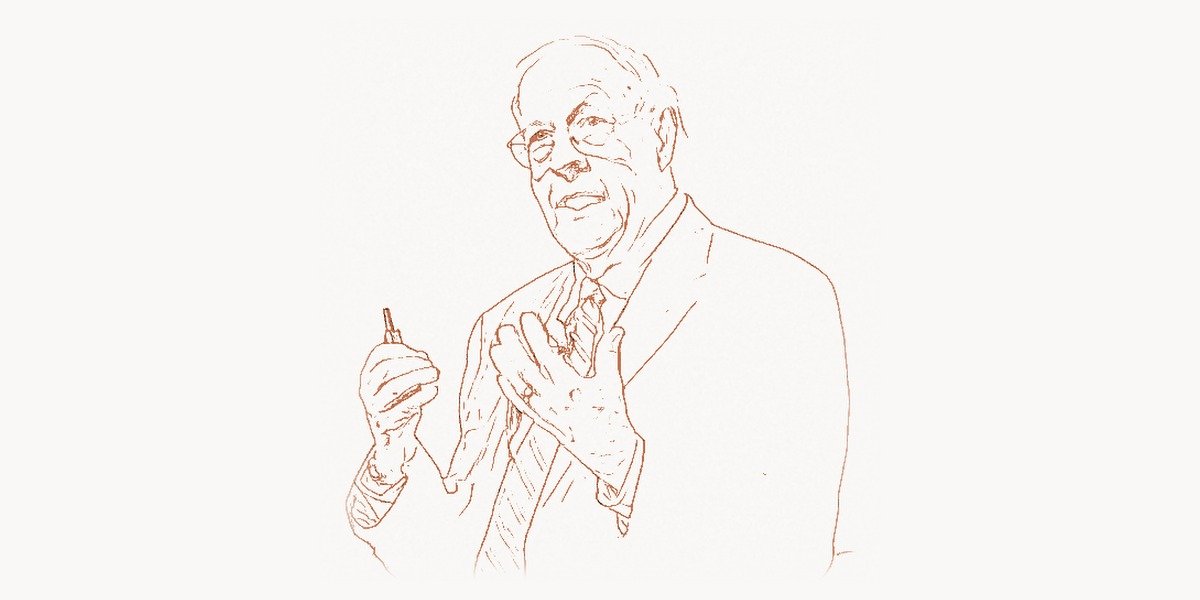
In 1975, a former IBM manager published a slim book of essays about software projects. Its central claim was deceptively simple: adding more programmers to a late project only makes it later. Half a century on, Fred Brooks and his masterwork The Mythical Man-Month remain the most-cited reference in software engineering management. Brooks did not just write about the problems of building large systems — he lived them, leading one of the most ambitious software efforts in computing history, IBM’s OS/360. His insights into complexity, communication, and the irreducible difficulty of software design earned him the Turing Award and shaped how every modern team thinks about shipping code.
Early Life and Academic Formation
Frederick Phillips Brooks Jr. was born on April 19, 1931, in Durham, North Carolina. He grew up in a family that valued education, and his intellectual curiosity emerged early. Brooks attended Duke University, where he earned a bachelor’s degree in physics in 1953. Even at Duke, he was drawn to the intersection of science and engineering — the idea that mathematical abstractions could drive tangible machines.
Brooks then moved to Harvard University for graduate work, studying under the legendary Howard Aiken, one of the pioneers of early electromechanical computing. Aiken’s Harvard Mark series of computers were among the first large-scale automatic calculators, and working in that environment gave Brooks a firsthand look at the challenges of building complex computational systems. He completed his Ph.D. in applied mathematics (computer science as a separate discipline did not yet exist) in 1956. His dissertation focused on the design of computer architectures — a theme that would define his career.
The Harvard years were formative. Brooks learned not only how computers worked at the hardware level but also how teams worked to build them. Aiken’s lab was a place where engineers, mathematicians, and technicians had to coordinate across disciplinary boundaries. That experience planted the seeds for Brooks’s later observations about the social dynamics of software development, themes he would explore alongside thinkers like Edsger Dijkstra and Donald Knuth.
The System/360 Breakthrough
Technical Innovation: A Family of Compatible Computers
In 1956, Brooks joined IBM, and by the early 1960s he was placed in charge of one of the most daring projects in the history of technology: the IBM System/360. Before System/360, IBM sold a bewildering array of incompatible computer models. A program written for one machine could not run on another, even if both bore the IBM logo. Customers were locked into specific hardware, and IBM’s own development resources were fragmented across dozens of product lines.
System/360 was IBM’s bet-the-company gamble to replace all of that with a single, compatible family of computers. The machines would range from small business systems to large scientific computers, but all would share the same instruction set architecture. Software written for the smallest model would run — correctly, if more slowly — on the largest. Brooks, as the project manager for the hardware architecture, was responsible for making this vision real.
The architectural decisions were groundbreaking. System/360 introduced a clean separation between the architecture (what the programmer sees) and the implementation (how the hardware achieves it). This distinction, which we now take for granted, was revolutionary. It meant that multiple engineering teams could work on different hardware implementations of the same architecture simultaneously. It also meant that the architecture had to be specified with extraordinary precision — every edge case, every instruction behavior had to be documented unambiguously.
Brooks and his team created a formal architectural specification that ran to hundreds of pages. The discipline required to produce this document — and the painful lessons learned when ambiguities slipped through — became a core part of Brooks’s philosophy of software engineering.
Why It Mattered: The Birth of Software Engineering as a Discipline
System/360 shipped in 1964 and was an enormous commercial success for IBM. But the software side — OS/360, the operating system that was supposed to make the compatibility dream real — was a catastrophe in process terms. It was late, over budget, and riddled with bugs. At its peak, the OS/360 project had over a thousand programmers working on it. Brooks managed this effort, and the experience burned into his memory every pathology that can afflict a large software team.
OS/360 eventually shipped and became the foundation of IBM’s dominance for decades, but the scars of the project drove Brooks to analyze why large software projects fail. His conclusion was both counterintuitive and profound: the primary difficulty is not technical — it is communication. As a team grows, the number of communication channels grows as the square of the number of people. Ten programmers require forty-five pairwise channels. A hundred require nearly five thousand. No amount of process can fully overcome this combinatorial explosion.
This insight, combined with dozens of other observations from the OS/360 trenches, became the foundation of The Mythical Man-Month, published in 1975. The book transformed software engineering from a purely technical pursuit into a discipline that acknowledged the human, organizational, and communication challenges at its core — challenges that project management platforms like Taskee now help teams navigate daily.
Other Major Contributions
While The Mythical Man-Month is Brooks’s most famous work, his contributions extend far beyond one book.
The University of North Carolina at Chapel Hill. In 1964, Brooks left IBM to found the Department of Computer Science at UNC Chapel Hill. He built it from nothing into one of the top programs in the country, serving as chair for twenty years. His vision was that computer science should be a practical discipline, closely tied to real engineering problems, not an ivory-tower abstraction. The department became especially renowned for its work in computer graphics and virtual reality.
Virtual reality and molecular graphics. Brooks led pioneering research in haptic interfaces and virtual environments at UNC. His GROPE project explored force-feedback systems that allowed chemists to “feel” molecular interactions. This work, begun in the 1970s, was decades ahead of its time and anticipated the VR technologies that are only now becoming mainstream.
“No Silver Bullet.” In 1986, Brooks published his second most influential essay, “No Silver Bullet — Essence and Accident in Software Engineering.” In it, he argued that there is no single technology or methodology that can produce an order-of-magnitude improvement in software productivity. The reason is that most of the difficulty in software is essential complexity — the inherent difficulty of specifying, designing, and testing the abstract constructs that make up software. The accidental complexity — the difficulties imposed by our tools and languages — is a smaller fraction, and improving tools (which is what most “silver bullet” claims address) cannot eliminate the essential part. This essay remains one of the most debated papers in the field, and it complements the theoretical work of figures like Leslie Lamport and Edgar F. Codd on managing complexity in formal systems.
The Design of Design. Published in 2010, this book extended Brooks’s thinking about the design process itself. Drawing on architecture, engineering, and software, Brooks examined how designers actually make decisions, arguing for iterative, empirical approaches over rigid top-down methodologies.
Philosophy of Software Engineering
Key Principles
Brooks’s thinking can be distilled into several interconnected principles that remain as relevant today as when he first articulated them.
Brooks’s Law: “Adding manpower to a late software project makes it later.” This is perhaps the most quoted sentence in software engineering. The reasoning is straightforward: new team members need to be trained by existing members (who are thus pulled away from productive work), and every new person increases the communication overhead. The net effect, at least in the short and medium term, is negative. Modern development teams still grapple with this trade-off, which is why organizations increasingly rely on tools like Toimi to coordinate distributed work without adding unnecessary headcount.
The Surgical Team. Brooks proposed that the ideal software team should be organized like a surgical team: a small group of specialists, centered on one brilliant programmer (the “surgeon”), supported by people who handle all the ancillary work. This way, the conceptual integrity of the code is preserved while the “surgeon” is freed from administrative overhead. This idea anticipated the modern concept of small, empowered teams.
Conceptual integrity. Brooks argued that the most important quality of a large system is conceptual integrity — the sense that the system reflects a single, coherent vision. Achieving this requires that the architecture be the work of one mind, or at most a very small group. This principle has influenced everything from the design of Unix (the philosophy of simplicity in systems) to modern API design.
The Second-System Effect. Brooks observed that designers, after completing a successful first system, tend to over-engineer the second one. Freed from the constraints that shaped the first project, they load the second with every feature and idea they had to suppress the first time around. The result is a bloated, incoherent system. This pattern recurs constantly in software history.
Plan to throw one away. Based on his experience with OS/360, Brooks advised that the first version of a new system will always be flawed. Teams should plan to build a prototype, learn from it, and then build the real system. This idea anticipates the iterative and agile methodologies that dominate modern development.
Many of these principles can be expressed in terms that modern developers understand. Consider a simplified model of Brooks’s Law, where communication overhead grows quadratically:
# Brooks's Law: Communication overhead model
# As team size grows, the number of communication channels
# grows much faster than the productive capacity

def communication_channels(n):
    """Calculate pairwise communication channels for n people."""
    return n * (n - 1) // 2

def effective_output(n, ramp_up_months=2, project_months_elapsed=6):
    """
    Estimate effective team output, accounting for:
    - Communication overhead (quadratic growth)
    - Ramp-up time for new members
    - Productive capacity per person (normalized to 1.0)
    """
    channels = communication_channels(n)
    # Each channel costs ~0.5% of a person-month in overhead
    overhead_fraction = channels * 0.005
    # New members added after month 3 are still ramping up
    productive_members = n - max(0, (n - 5) * (ramp_up_months / project_months_elapsed))
    raw_output = productive_members
    effective = raw_output * (1 - overhead_fraction)
    return max(effective, 0)

# Demonstration: diminishing returns of adding people
for team_size in [4, 8, 12, 16, 20, 30]:
    channels = communication_channels(team_size)
    output = effective_output(team_size)
    print(f"Team: {team_size:2d} | Channels: {channels:3d} | "
          f"Effective output: {output:.1f} person-months")
This model illustrates the core intuition: beyond a certain team size, adding people produces diminishing — and eventually negative — returns. The exact numbers vary, but the shape of the curve is universal.
Another key concept Brooks championed was the importance of precise architectural specification. The discipline he learned on System/360 — where ambiguities in specifications caused real bugs across multiple hardware implementations — translates directly to modern API and interface design:
// Conceptual Integrity in API Design
// Brooks argued that a system should look as if one mind designed it.
// Modern API design applies this principle through consistent contracts.

/**
 * Example: A specification-first approach to interface design,
 * reflecting Brooks's emphasis on conceptual integrity.
 *
 * Every endpoint follows the same patterns:
 * - Consistent naming conventions
 * - Uniform error handling
 * - Single responsibility per endpoint
 */
const projectAPISpec = {
  // One "architect" defines the contract; many can implement
  version: "2.0",
  conventions: {
    naming: "kebab-case for URLs, camelCase for JSON fields",
    pagination: "cursor-based, using 'after' parameter",
    errors: {
      format: { code: "string", message: "string", details: "object|null" },
      // Conceptual integrity: EVERY error follows this shape
    },
  },
  endpoints: {
    "GET /projects":          { returns: "ProjectList", paginated: true },
    "GET /projects/:id":      { returns: "Project" },
    "POST /projects":         { accepts: "CreateProject", returns: "Project" },
    "PUT /projects/:id":      { accepts: "UpdateProject", returns: "Project" },
    "DELETE /projects/:id":   { returns: "void", status: 204 },
    // The surgeon-team model: one architect owns this spec,
    // multiple teams implement individual endpoints
  },
};

// Brooks's "plan to throw one away" in practice:
// Version 1.0 of this API taught us that nested resources
// (e.g., /projects/:id/tasks/:taskId/comments) created
// coupling problems. Version 2.0 flattens the hierarchy.
Legacy and Lasting Influence
Fred Brooks received the ACM Turing Award in 1999, often called the Nobel Prize of computing. The citation recognized his contributions to computer architecture, operating systems, and software engineering. But his influence extends far beyond any single award.
The Mythical Man-Month has been continuously in print since 1975. A twentieth-anniversary edition, published in 1995, added the “No Silver Bullet” essay and Brooks’s retrospective chapter, “The Mythical Man-Month after 20 Years,” in which he assessed which of his original claims had held up (most of them had). The book has sold over a million copies and has been translated into more than twenty languages. It is required reading in computer science programs around the world, alongside foundational texts like those by John Backus and Margaret Hamilton.
Brooks’s concepts have become part of the vocabulary of software engineering. “Brooks’s Law” is invoked whenever a manager considers throwing more bodies at a deadline. The “second-system effect” is cited when a promising project becomes an overengineered disaster. “No silver bullet” is the standard response to hype about any new tool or methodology that claims to solve all problems.
At UNC Chapel Hill, Brooks built a department that trained generations of computer scientists. His emphasis on practical, systems-oriented research — particularly in computer graphics and virtual reality — helped establish those fields as serious academic disciplines. He continued teaching and advising until his retirement, and his influence on his students and colleagues propagated through the field for decades.
Fred Brooks passed away on November 17, 2022, at the age of 91. He left behind a body of work that fundamentally changed how we think about building software. In an era obsessed with technical tools and frameworks, Brooks’s enduring message is that the hardest problems in software are human problems: communication, design judgment, and the management of complexity in the minds of the people doing the work.
Key Facts About Fred Brooks
- Full name: Frederick Phillips Brooks Jr.
- Born: April 19, 1931, Durham, North Carolina, USA
- Died: November 17, 2022 (aged 91)
- Education: B.S. Physics, Duke University (1953); Ph.D. Applied Mathematics, Harvard University (1956)
- Key role at IBM: Project manager for System/360 hardware architecture and OS/360 software
- Major publication: The Mythical Man-Month: Essays on Software Engineering (1975, 20th anniversary edition 1995)
- Key essays: “No Silver Bullet — Essence and Accident in Software Engineering” (1986)
- Academic career: Founded UNC Chapel Hill Computer Science Department (1964), chaired it for 20 years
- Awards: ACM Turing Award (1999), National Medal of Technology (1985), IEEE John von Neumann Medal (1993)
- Research areas: Computer architecture, operating systems, software engineering, virtual reality, haptics
- Famous concept: Brooks’s Law — “Adding manpower to a late software project makes it later”
Frequently Asked Questions
What is Brooks’s Law and why does it still matter?
Brooks’s Law states that adding more programmers to a software project that is already behind schedule will make it even later. The reasoning is that new team members require training from existing members (reducing their productivity), and every additional person increases the communication overhead quadratically. This law remains relevant because the fundamental dynamics of human communication and team coordination have not changed, even as programming tools and languages have improved dramatically. Every software organization eventually confronts this trade-off when deciding whether to grow a team or keep it small and focused.
What was IBM System/360 and why was it important?
IBM System/360 was a family of computers announced in 1964 that shared a common instruction set architecture. Before System/360, each computer model was incompatible with others, even from the same manufacturer. System/360 introduced the revolutionary idea that software written for one model could run on all models in the family, from small business machines to large scientific computers. This concept of architectural compatibility became the foundation of the modern computer industry and directly influenced the design of every processor family that followed, from Intel x86 to ARM.
What does “No Silver Bullet” mean in software engineering?
In his 1986 essay, Brooks argued that no single technology, tool, or methodology can deliver an order-of-magnitude improvement in software development productivity. He distinguished between essential complexity (the inherent difficulty of the problem being solved) and accidental complexity (difficulties caused by imperfect tools and methods). Since most of software’s difficulty is essential, improving tools — which only addresses accidental complexity — cannot produce dramatic gains. This essay is frequently invoked to temper unrealistic expectations about new technologies, from object-oriented programming in the 1990s to AI-assisted coding today.
How did Fred Brooks influence modern software development practices?
Brooks’s influence on modern development is pervasive. His advocacy for small, focused teams anticipated the agile movement’s emphasis on compact, empowered squads. His concept of conceptual integrity — the idea that a system should reflect a unified design vision — drives modern practices like architecture decision records and API-first design. His “plan to throw one away” advice foreshadowed prototyping, MVP-based development, and iterative design. Even his surgical-team model finds echoes in modern tech-lead structures where a senior engineer guides a small team while others handle supporting tasks. Brooks demonstrated that understanding people and process is as critical to shipping software as understanding algorithms and data structures.