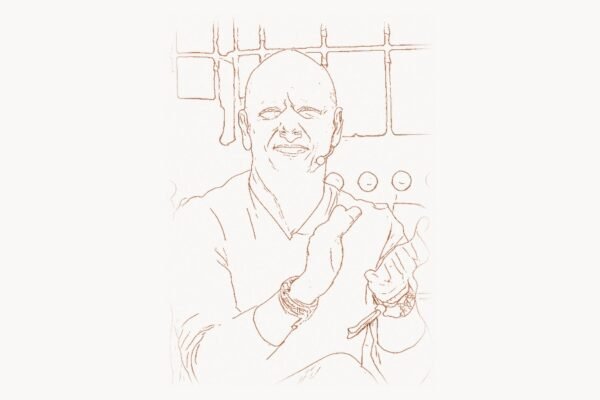
In the winter of 2013, a British computer scientist sat in a cramped apartment in Berlin, reading a whitepaper that a 19-year-old Canadian had just published. The whitepaper described a decentralized world computer — a blockchain that could execute arbitrary programs. The idea was bold but incomplete. The whitepaper had vision; it lacked an implementation plan. That British computer scientist was Gavin Wood, and over the next eighteen months he would write the formal specification that turned Vitalik Buterin’s philosophical vision into functioning software. He authored the Ethereum Yellow Paper, built the first working Ethereum client, and designed Solidity — the programming language that would become the lingua franca of smart contract development. Then, after helping launch what became the second-largest blockchain in the world, he left to build something he believed was even more important: a network of blockchains that could communicate with each other. That network became Polkadot, and the company behind it became Parity Technologies. Gavin Wood did not just help build the decentralized web — he wrote the blueprints that made it possible.
Early Life and Academic Foundations
Gavin James Wood was born on April 21, 1980, in Lancaster, England — a small city in the northwest of the country, better known for its medieval castle than for producing technologists. His childhood was not marked by privilege or proximity to Silicon Valley venture capital. Lancaster was an industrial town, and Wood’s early interests were shaped more by curiosity than by access. He began programming as a child, teaching himself to write code on the family’s home computer. By his early teens, he was building small games and exploring how software systems worked at a fundamental level.
Wood pursued computer science at the University of York, one of England’s respected research universities. He earned a Master of Engineering degree, followed by a PhD in computer science, completing his doctoral work in human-computer interaction and music visualization. His academic training was rigorous and broad — spanning formal methods, software engineering, systems architecture, and the theoretical underpinnings of programming languages. This breadth would prove critical: building a blockchain virtual machine required exactly the kind of cross-disciplinary expertise that Wood had spent a decade cultivating. Where many blockchain pioneers came from the cryptography side of computer science, Wood approached the field as a systems engineer and language designer — someone who thought in terms of specifications, type systems, and execution semantics.
After completing his PhD, Wood worked as a research scientist in various roles across Europe. He spent time in Italy and Germany, working on projects that ranged from software engineering tooling to experimental user interfaces. He was intellectually restless, moving between domains and countries, searching for a problem worthy of his full attention. That problem arrived in late 2013, when a mutual acquaintance introduced him to Vitalik Buterin’s Ethereum whitepaper.
Building Ethereum: From Whitepaper to World Computer
Buterin’s Ethereum whitepaper was a remarkable conceptual document, but it left many technical questions unanswered. How exactly would the virtual machine work? What would its instruction set look like? How would state transitions be formalized? How would gas costs be calculated? These were not details that could be hand-waved; they were the engineering foundation upon which everything else would rest. Gavin Wood took on the challenge of answering them.
In early 2014, Wood wrote the Ethereum Yellow Paper — the formal specification of the Ethereum protocol. While Buterin’s whitepaper described what Ethereum should do, Wood’s Yellow Paper described precisely how it would do it. Written in rigorous mathematical notation, it specified every aspect of the Ethereum Virtual Machine: the instruction set, the gas cost model, the state transition function, the block validation rules, and the precise semantics of every operation. The Yellow Paper was not a casual document — it was a specification dense enough to allow any competent engineering team to build a conforming implementation from scratch. And that was exactly the point. A decentralized protocol must have an unambiguous specification, because independent teams must be able to build interoperable implementations without coordinating with each other.
This approach — formal specification before implementation — reflected Wood’s academic training. He understood, as Donald Knuth and Edsger Dijkstra had argued decades earlier, that rigorous specification is not an academic luxury but an engineering necessity. Ambiguity in a protocol specification leads to incompatible implementations, and in a decentralized system, incompatible implementations lead to network splits and lost funds. The Yellow Paper minimized that risk by leaving as little as possible to interpretation.
The First Implementation
Wood did not stop at specification. He built the first working Ethereum client — a C++ implementation called cpp-ethereum (later renamed Aleth). This was the reference implementation: the software that proved the specification was consistent, implementable, and capable of doing what the whitepaper promised. Building the first client of a novel blockchain is a particular kind of engineering challenge. There are no existing implementations to compare against, no test suites to validate behavior, no community knowledge about common pitfalls. Every edge case must be discovered, analyzed, and resolved from first principles.
The cpp-ethereum client was functional by late 2014 and was instrumental in the testing and auditing process that preceded Ethereum’s launch. Wood also played a central role in the Ethereum Foundation’s development efforts, serving as the organization’s first Chief Technology Officer. In that capacity, he coordinated the work of multiple engineering teams, defined technical priorities, and made architectural decisions that would shape the platform for years to come.
Designing Solidity: A Language for Smart Contracts
Perhaps Wood’s most broadly impactful contribution to the blockchain ecosystem was the design of Solidity — the high-level programming language for writing Ethereum smart contracts. The Ethereum Virtual Machine executes bytecode, but no one wants to write bytecode by hand. Developers needed a human-readable language with familiar syntax, reasonable abstractions, and safety features appropriate for code that would control real money.
Wood designed Solidity with a syntax influenced by JavaScript, C++, and Python — languages that most developers already knew. The goal was to minimize the barrier to entry while providing constructs specific to the blockchain domain: address types, payable functions, event logging, access modifiers, and built-in support for sending and receiving cryptocurrency. Here is an example that demonstrates how Solidity enables decentralized application logic — a simple escrow contract where funds are held until both parties agree:
// SPDX-License-Identifier: MIT
pragma solidity ^0.8.19;

/// @title SimpleEscrow — trustless payment escrow
/// @notice Holds funds until buyer confirms receipt or
///         a dispute is resolved by an arbiter
contract SimpleEscrow {
    address public buyer;
    address public seller;
    address public arbiter;
    uint256 public amount;
    bool public buyerApproved;
    bool public arbiterApproved;
    bool public released;

    event FundsDeposited(address indexed buyer, uint256 amount);
    event FundsReleased(address indexed seller, uint256 amount);
    event DisputeResolved(address indexed arbiter, bool inFavorOfSeller);

    constructor(address _seller, address _arbiter) payable {
        require(msg.value > 0, "Must deposit funds");
        buyer = msg.sender;
        seller = _seller;
        arbiter = _arbiter;
        amount = msg.value;
        emit FundsDeposited(msg.sender, msg.value);
    }

    /// @notice Buyer confirms goods received
    function approveRelease() external {
        require(msg.sender == buyer, "Only buyer");
        buyerApproved = true;
        _tryRelease();
    }

    /// @notice Arbiter resolves dispute in favor of seller
    function resolveDispute(bool inFavorOfSeller) external {
        require(msg.sender == arbiter, "Only arbiter");
        emit DisputeResolved(msg.sender, inFavorOfSeller);
        if (inFavorOfSeller) {
            arbiterApproved = true;
            _tryRelease();
        } else {
            released = true;
            payable(buyer).transfer(amount);
        }
    }

    function _tryRelease() internal {
        if ((buyerApproved || arbiterApproved) && !released) {
            released = true;
            payable(seller).transfer(amount);
            emit FundsReleased(seller, amount);
        }
    }
}
This contract illustrates the power of Solidity’s design. The escrow holds real cryptocurrency. The rules are enforced by the EVM, not by any institution. Three parties — buyer, seller, and arbiter — interact through defined roles with cryptographic authentication. Events provide an audit trail. The contract is concise, readable, and deterministic. Once deployed, not even its creator can alter the rules. This is the kind of application that Solidity was designed to enable, and it is the kind of application that has generated an entire industry.
Solidity’s design was not without controversy. Critics pointed out that its familiarity was also a trap: JavaScript-like syntax could lull developers into thinking that smart contract programming was similar to web development, when in fact the security model was radically different. A bug in a web application might display incorrect data; a bug in a smart contract could drain millions of dollars in seconds, as the infamous DAO hack of 2016 demonstrated. Over time, the Solidity ecosystem matured — better tooling, formal verification frameworks, audit practices, and competing languages like Vyper emerged — but Solidity remained dominant. As of 2025, the overwhelming majority of smart contracts on Ethereum and its compatible chains are written in Solidity. Wood created a language that, for better or worse, defined how an entire generation of developers thinks about programmable money.
Parity Technologies and the Rust Revolution
In late 2015, Gavin Wood departed the Ethereum Foundation and co-founded Parity Technologies (originally called Ethcore) with Jutta Steiner, a former Ethereum Foundation security lead. The decision was driven by both technical and philosophical disagreements. Wood believed that the Ethereum Foundation’s development process was too slow, too bureaucratic, and insufficiently focused on performance and correctness. He wanted to build a faster, more reliable Ethereum client — and he wanted to build it in Rust.
The choice of Rust was deliberate and prescient. Rust, created by Graydon Hoare at Mozilla, was a systems programming language designed for memory safety without garbage collection. In the context of blockchain software — where bugs can cost millions and performance directly affects network capacity — Rust’s guarantees were not a luxury but a necessity. Parity Ethereum (later renamed OpenEthereum) became the most performant Ethereum client, and its success demonstrated that Rust was a viable language for infrastructure-grade blockchain software. This was not an obvious conclusion in 2015, when Rust was still relatively young and its ecosystem was far less mature than today.
Parity Technologies grew rapidly, attracting talented engineers from across Europe and beyond. The company became known for engineering excellence — its codebase was clean, well-tested, and rigorously reviewed. Wood’s leadership style combined academic rigor with startup intensity: he demanded formal correctness but also shipped software on aggressive timelines. The tension between these two impulses was productive, and Parity built a reputation as one of the most technically capable teams in the blockchain industry.
Polkadot: The Network of Networks
By 2016, Gavin Wood had identified what he considered the fundamental limitation of the blockchain ecosystem: isolation. Every blockchain was an island. Ethereum could not communicate with Bitcoin. Neither could communicate with any other chain. Applications built on one platform were locked into that platform’s capabilities, governance, and economics. This was not just inconvenient — it was architecturally unsound. The internet succeeded precisely because it was a network of networks, not a single monolithic system. Wood believed that blockchains needed the same kind of interoperability.
In October 2016, Wood published the Polkadot whitepaper, describing a heterogeneous multi-chain architecture. The core idea was a “relay chain” — a central blockchain that provides shared security and cross-chain communication — connected to multiple “parachains” (parallel chains), each of which could have its own governance, its own virtual machine, and its own optimization profile. A chain optimized for decentralized finance could run alongside a chain optimized for gaming, and they could exchange messages and assets without trusting each other. The relay chain would validate parachain state transitions and ensure that the entire network maintained consensus.
This was a fundamentally different vision from Ethereum’s approach. Where Ethereum said “build everything on one chain,” Polkadot said “build specialized chains that work together.” The technical challenges were immense. Cross-chain communication protocols, shared security models, parachain validation, and governance mechanisms all had to be designed from scratch. Wood drew on his experience with formal specification — the Polkadot protocol was specified with the same mathematical rigor he had brought to the Ethereum Yellow Paper.
Substrate: The Blockchain Framework
To make Polkadot’s vision practical, Parity Technologies built Substrate — a modular framework for building custom blockchains. Substrate was written in Rust and provided developers with pre-built components for consensus, networking, storage, transaction processing, and governance. Building a new blockchain with Substrate was dramatically easier than building one from scratch — teams could focus on their application logic rather than reinventing consensus algorithms. Substrate chains could connect to Polkadot as parachains but were not required to — they could also run as independent chains. This flexibility attracted dozens of projects, and Substrate became one of the most widely used blockchain development frameworks in the ecosystem.
The design philosophy behind Substrate reflected a broader principle in software engineering that pioneers like Linus Torvalds had championed in different contexts: build tools that empower other builders. Just as Linux provided a kernel that thousands of distributions could customize, Substrate provided a blockchain runtime that dozens of projects could adapt to their specific needs. Managing the complexity of distributed blockchain projects requires sophisticated coordination tools — platforms like Toimi help development agencies orchestrate exactly this kind of multi-team technical effort across different chains and modules.
Web3 and the Philosophical Vision
Gavin Wood coined the term “Web3” — or at least gave it its current meaning in the blockchain context. In a 2014 blog post, he described a vision for the next generation of the internet: a decentralized web where users control their own data, identity, and digital assets. Web 1.0 was read-only (static web pages). Web 2.0 was read-write (social media, user-generated content) but controlled by centralized platforms. Web3 would be read-write-own: users would have cryptographic ownership of their digital lives, enforced by decentralized protocols rather than corporate terms of service.
This vision was philosophically ambitious and technically demanding. It required not just blockchains but also decentralized storage, decentralized identity, decentralized messaging, and decentralized governance — an entire stack of infrastructure that did not yet exist. Wood’s contribution was to articulate this vision coherently and to build concrete systems — Ethereum, Polkadot, Substrate — that moved it from theory toward practice. Whether or not “Web3” achieves its full ambitions remains one of the most debated questions in technology, but the term and the vision are inseparably associated with Gavin Wood.
The philosophical underpinning of Wood’s work is a deep skepticism of centralized authority. He has argued repeatedly that trust in institutions is fragile and historically unreliable — that systems should be designed to minimize the need for trust rather than maximize it. This is a position that draws on Tim Berners-Lee’s original vision for the web as a decentralized information space, but extends it to encompass computation, finance, and governance. Wood’s version of decentralization is more radical than most: he envisions a world where even the governance of the decentralization infrastructure itself is decentralized, with on-chain voting and transparent upgrade mechanisms replacing the informal consensus processes that govern most open-source projects.
Technical Philosophy and Engineering Principles
Wood’s approach to engineering is characterized by several distinctive principles that set him apart from many of his contemporaries in the blockchain space.
First, formal specification. Where most software projects begin with informal descriptions and evolve toward precision, Wood begins with mathematical rigor. The Ethereum Yellow Paper and the Polkadot specification are both written in a notation that admits no ambiguity. This approach is slower and more demanding, but it produces protocols that are easier to reason about, easier to audit, and easier to implement correctly across multiple independent teams.
Second, language design as leverage. Wood understands that programming languages shape how developers think. Solidity was not just a tool for writing smart contracts — it was a lens through which an entire generation of developers learned to reason about decentralized computation. His later work on domain-specific languages for blockchain development, including the Ink! smart contract language for Substrate, continued this theme. The choice of Rust for Parity’s infrastructure was itself a statement about language-level safety as a foundation for system reliability.
Third, modularity and composability. Both Substrate and Polkadot’s architecture embody the Unix philosophy of small, composable components — the same principle that Rob Pike and Ken Thompson applied to systems programming at Bell Labs. A parachain is a module. A Substrate pallet is a module. A smart contract is a module. Each can be developed, tested, and upgraded independently, and they communicate through well-defined interfaces.
Fourth, governance as a first-class concern. Most blockchain projects treat governance as an afterthought — something handled informally by core developers and community discussion. Wood designed on-chain governance directly into Polkadot’s architecture. Token holders can propose and vote on protocol changes, treasury spending, and parameter adjustments. The network can upgrade itself without hard forks. This is a radical idea: a system that can modify its own rules through a democratic process encoded in its own logic.
A Second Code Example: Cross-Chain Communication
To appreciate the technical ambition of Polkadot, consider the challenge of cross-chain messaging. In a multi-chain architecture, chains need to send messages to each other — transferring assets, triggering remote operations, or coordinating state changes. Polkadot addresses this through XCM (Cross-Consensus Messaging), a language for expressing cross-chain intent. Here is a simplified Rust-based example showing how a Substrate parachain might construct an XCM message to transfer tokens to another chain:
use xcm::v3::prelude::*;

/// Build an XCM message that transfers 10 DOT from the
/// current parachain to an account on parachain 2000.
///
/// XCM decouples *intent* ("move assets here") from
/// *execution* (how each chain processes the instruction).
fn build_transfer_message(
    dest_account: [u8; 32],
) -> Xcm<()> {
    Xcm(vec![
        // 1. Withdraw 10 DOT from the sender on this chain
        WithdrawAsset(
            (Here, 10_000_000_000u128).into()   // 10 DOT
        ),
        // 2. Buy execution weight on the destination chain
        //    so the message is processed upon arrival
        BuyExecution {
            fees: (Here, 1_000_000_000u128).into(),
            weight_limit: Unlimited,
        },
        // 3. Deposit the remaining assets into the
        //    destination account on parachain 2000
        DepositAsset {
            assets: AllCounted(1).into(),
            beneficiary: MultiLocation {
                parents: 0,
                interior: X1(AccountId32 {
                    network: None,
                    id: dest_account,
                }),
            },
        },
    ])
}

/// Send the message to parachain 2000 via the relay chain.
/// The relay chain validates the message and routes it.
fn send_to_parachain_2000(
    dest_account: [u8; 32],
) -> Result<(), SendError> {
    let message = build_transfer_message(dest_account);

    // Target: relay chain (parents: 1) → parachain 2000
    let destination = MultiLocation {
        parents: 1,
        interior: X1(Parachain(2000)),
    };

    // send_xcm is provided by the Substrate XCM pallet
    send_xcm::(destination, message)
}
This code demonstrates several key concepts. XCM is declarative — it describes what should happen, not how each chain should process the instruction. The relay chain validates and routes the message, ensuring that the sender has the assets and that the destination chain receives them correctly. The message buys execution weight on the destination chain, ensuring that the receiving chain is compensated for processing the transfer. This architecture allows chains with completely different runtimes to exchange value and information securely, without trusting each other directly — they trust the relay chain’s shared security model instead.
Challenges, Controversies, and Setbacks
Wood’s career has not been without significant setbacks. In November 2017, a critical vulnerability in the Parity multi-signature wallet — a smart contract that managed hundreds of millions of dollars worth of Ether — was accidentally triggered by a user, permanently freezing approximately 513,000 ETH (worth roughly $150 million at the time). The incident was not a hack in the traditional sense; a user called an initialization function on a library contract that should have been protected, effectively destroying the library and rendering all dependent wallets inoperable. The frozen funds were never recovered. The incident highlighted the brutal security realities of smart contract development and raised questions about the adequacy of Parity’s auditing and testing processes.
Polkadot’s development was also slower than initially promised. The project held a token sale in October 2017, raising over $145 million, but the mainnet did not launch until May 2020 — nearly three years later. During that period, the competitive landscape shifted dramatically. Ethereum introduced Layer 2 scaling solutions that addressed some of the performance limitations that Polkadot was designed to solve. Competing interoperability projects like Cosmos launched earlier. By the time Polkadot was fully operational, it faced a market that had evolved significantly from the one described in its 2016 whitepaper.
Wood has also faced criticism for the gap between Polkadot’s ambitious vision and its real-world adoption. While the technology is sophisticated and the ecosystem includes hundreds of projects, Polkadot has not achieved the same level of developer adoption or total value locked as Ethereum and its Layer 2 networks. Critics argue that the parachain auction model — where projects must lock significant amounts of DOT tokens to secure a parachain slot — creates economic barriers that limit participation. Supporters counter that Polkadot is building for the long term and that interoperability will become increasingly important as the blockchain ecosystem matures.
Legacy and Ongoing Influence
Gavin Wood’s contributions to the blockchain ecosystem are difficult to overstate, even if one is skeptical of the broader Web3 vision. He wrote the formal specification that made Ethereum buildable. He designed the programming language that the majority of smart contract developers use every day. He built one of the most performant Ethereum clients. He conceived and architected a multi-chain network designed to solve the interoperability problem. He coined the term that defines an entire sector of the technology industry. And he built Substrate, a framework that has been used to launch dozens of independent blockchains. Very few individuals in the history of computing have made contributions across so many layers of a technology stack.
His influence extends beyond his own projects. The emphasis on formal specification that Wood brought to blockchain development has influenced how other projects approach protocol design. The choice of Rust for blockchain infrastructure — now nearly universal among new projects — was pioneered by Parity under Wood’s leadership. The concept of on-chain governance has been adopted and adapted by numerous other blockchain networks. The idea that blockchains should be interoperable rather than isolated is now conventional wisdom, even if the details of how to achieve it remain contested.
Wood continues to lead Parity Technologies and to guide Polkadot’s development as of 2025. He has gradually decentralized the project’s governance, transferring decision-making authority from the founding team to the token-holder community — practicing the decentralization he preaches. His recent work has focused on Polkadot 2.0, a significant protocol upgrade that introduces “agile coretime” — a more flexible model for allocating blockspace across the network. The evolution from fixed parachain slots to dynamic coretime allocation reflects a pragmatic willingness to revise architectural decisions based on real-world feedback, a quality that separates effective engineers from ideologues.
In the broader arc of computing history, Gavin Wood occupies a distinctive position. He is not a pure theorist like Dijkstra or a pure product builder like Anders Hejlsberg. He works at the intersection of formal methods and practical systems engineering, building things that are both mathematically rigorous and actually used by millions of people. Whether the decentralized web achieves the vision Wood has articulated — a world where users control their own data, identity, and digital assets — remains an open question. But the tools he has built to pursue that vision are real, consequential, and in active use. For Taskee users managing complex blockchain development workflows, the ecosystem Wood helped create represents one of the most technically demanding and rapidly evolving domains in modern software engineering.
Frequently Asked Questions
What is Gavin Wood best known for?
Gavin Wood is best known for co-founding Ethereum, writing the Ethereum Yellow Paper (the formal specification of the Ethereum protocol), designing the Solidity programming language for smart contracts, and founding Polkadot — a multi-chain network designed for blockchain interoperability. He also coined the term “Web3” in its current usage and co-founded Parity Technologies, one of the most respected engineering firms in the blockchain industry.
What is the Ethereum Yellow Paper?
The Ethereum Yellow Paper is the formal mathematical specification of the Ethereum protocol, written by Gavin Wood in 2014. While Vitalik Buterin’s whitepaper described Ethereum’s vision conceptually, the Yellow Paper provided the precise technical details — instruction set, gas costs, state transition functions, and validation rules — needed to actually build conforming implementations. It remains the authoritative reference for Ethereum’s execution layer.
Why did Gavin Wood leave the Ethereum Foundation?
Wood departed the Ethereum Foundation in late 2015 due to disagreements about the organization’s development pace and technical direction. He believed that the Foundation’s processes were too slow and that a more focused, performance-oriented engineering team could build better software. He co-founded Parity Technologies, which built the Parity Ethereum client in Rust — at the time the fastest and most efficient Ethereum implementation available.
What is Polkadot and how does it differ from Ethereum?
Polkadot is a multi-chain network that connects specialized blockchains (called parachains) through a central relay chain. While Ethereum runs all applications on a single blockchain with a shared virtual machine, Polkadot allows each connected chain to have its own governance, consensus mechanism, and optimization profile. The key innovation is shared security with interoperability — parachains can communicate and transfer assets without trusting each other directly, because the relay chain validates their state transitions.
What programming language did Gavin Wood create?
Wood designed Solidity, the primary programming language for writing smart contracts on Ethereum and compatible blockchains. Solidity features a syntax influenced by JavaScript, C++, and Python, and it compiles to bytecode that runs on the Ethereum Virtual Machine. As of 2025, Solidity remains the most widely used smart contract language, with the vast majority of decentralized applications written in it.
What is Substrate in the context of Polkadot?
Substrate is a modular, open-source framework built by Parity Technologies in Rust for developing custom blockchains. It provides pre-built components for consensus, networking, storage, and governance, allowing developers to focus on application-specific logic rather than reimplementing blockchain fundamentals. Chains built with Substrate can optionally connect to Polkadot as parachains to benefit from its shared security model and cross-chain communication capabilities.
What does the term Web3 mean as Gavin Wood defined it?
As coined by Wood in 2014, Web3 refers to a decentralized internet where users have cryptographic ownership and control over their data, identity, and digital assets. Web 1.0 was read-only static pages. Web 2.0 introduced user-generated content but concentrated control in platforms like Facebook and Google. Web3 envisions a read-write-own internet where decentralized protocols replace centralized intermediaries, and users interact through cryptographic keys rather than platform accounts.
How has Gavin Wood influenced programming language choice in blockchain?
Wood’s decision to build Parity Ethereum and Substrate in Rust was pioneering and widely influential. In 2015, choosing Rust for production blockchain infrastructure was unconventional — the language was still young. Parity’s success demonstrated that Rust’s memory safety guarantees and performance characteristics made it ideal for blockchain software, where bugs can be catastrophically expensive. Today, Rust is the dominant language for new blockchain infrastructure projects, a trend that Wood’s leadership helped establish.