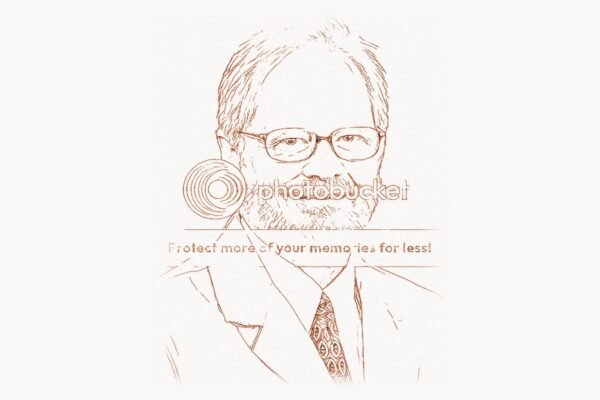
In the history of computing, few individuals have left a mark as deep and quantifiable as Gene Amdahl. A theoretical physicist turned computer architect, Amdahl shaped the very foundations of mainframe computing and, perhaps more importantly, gave the world a mathematical framework for understanding the limits of parallel processing. His famous law — Amdahl’s Law — remains one of the most cited principles in computer science, a constant reminder that raw hardware alone cannot solve every performance bottleneck. From designing the legendary IBM System/360 to challenging IBM itself with his own company, Amdahl’s career was a masterclass in technical brilliance and entrepreneurial courage.
Early Life and Academic Foundations
Gene Myron Amdahl was born on November 16, 1922, in Flandreau, South Dakota. Growing up in a small, rural community during the Great Depression, Amdahl developed an early fascination with electronics and mathematics. His family had Norwegian roots, and the values of perseverance and self-reliance deeply influenced his approach to both engineering and business throughout his life.
Amdahl attended South Dakota State University, where he initially studied engineering physics. His education was interrupted by World War II, during which he served in the U.S. Navy. After the war, he returned to academics with a sharpened focus on emerging computational technologies. He enrolled at the University of Wisconsin-Madison, where he pursued graduate work in theoretical physics.
It was at Wisconsin that Amdahl encountered his first real computing challenge. For his doctoral dissertation, he designed and built a computer called WISC (Wisconsin Integrally Synchronized Computer). This machine was not merely a classroom exercise — it was a functional, operational computer that demonstrated Amdahl’s instinct for translating theoretical knowledge into working hardware. His Ph.D., awarded in 1952, positioned him at the frontier of a discipline that barely existed yet. Where others saw vacuum tubes and relay circuits, Amdahl saw the skeleton of a future industry.
The IBM System/360 Breakthrough
Technical Innovation: A Unified Architecture
After completing his doctorate, Amdahl joined IBM in 1952. Over the next decade, he rose through the engineering ranks, contributing to several projects, including early work on the IBM 704 and 709 machines. But his defining contribution came in the early 1960s when he was appointed chief architect of the IBM System/360 — one of the most ambitious computing projects ever undertaken.
Before the System/360, IBM and its competitors produced families of computers that were fundamentally incompatible. A program written for one model could not run on another, even within the same company’s product line. Customers who outgrew their hardware faced the nightmare of rewriting all their software. Amdahl’s vision was revolutionary: create a single, unified instruction set architecture (ISA) that could span an entire range of machines — from small business systems to massive scientific computers — all running the same software.
The System/360 introduced several innovations that became industry standards. It used a byte-addressable memory model with 8-bit bytes (a departure from the 6-bit and 36-bit word sizes common at the time). It defined a standardized I/O channel architecture that decoupled peripheral devices from the CPU. And it employed microprogramming, allowing the same instruction set to be implemented on vastly different hardware — from low-cost models using slower, cheaper circuitry to high-performance models using the fastest available technology. This approach can be understood through the lens of architectural abstraction, a concept also explored in the work of John von Neumann decades earlier.
The “360” in the name referred to 360 degrees of a compass — IBM’s statement that this architecture could address the full circle of computing applications. The bet was enormous: IBM invested over $5 billion (roughly $45 billion in today’s dollars), making it the largest privately funded commercial project in history at the time.
Why It Mattered: The Birth of Software Compatibility
The System/360’s impact was transformational. For the first time, customers could upgrade their hardware without rewriting their software. This single idea — upward compatibility across a product line — fundamentally changed the economics of computing. It made software an asset rather than a disposable artifact tied to specific hardware.
The architecture also catalyzed the emergence of the independent software industry. With a stable platform guaranteed to persist across hardware generations, third-party developers could invest in creating sophisticated applications, knowing their work would not become obsolete with the next hardware refresh. Fred Brooks, who managed the System/360 operating system effort, later described the project’s challenges in his landmark book that became required reading for every software engineering student.
The System/360 dominated the mainframe market for decades. Its design principles — ISA compatibility, byte-addressable memory, standardized I/O — became the DNA of virtually every general-purpose computer architecture that followed, including the x86 family that powers most modern PCs and servers. The concept of building scalable, compatible architectures influenced later pioneers like John Hennessy, whose RISC approach reimagined processor design for a new era.
Amdahl’s Law: Quantifying Parallelism’s Limits
In 1967, Amdahl presented a short but profoundly influential paper at the AFIPS Spring Joint Computer Conference. In it, he articulated what would become known as Amdahl’s Law — a formula that describes the theoretical maximum speedup of a program when only a portion of it can be parallelized.
The law is expressed as:
# Amdahl's Law: Maximum theoretical speedup
# S(n) = 1 / ((1 - P) + P/n)
#
# Where:
#   P = fraction of the program that can be parallelized (0 to 1)
#   n = number of processors
#   S(n) = theoretical speedup

def amdahl_speedup(parallel_fraction, num_processors):
    """Calculate the maximum speedup according to Amdahl's Law."""
    serial_fraction = 1 - parallel_fraction
    return 1 / (serial_fraction + parallel_fraction / num_processors)

# Example: a program where 95% can be parallelized
p = 0.95

for n in [1, 2, 4, 8, 16, 64, 256, 1024]:
    speedup = amdahl_speedup(p, n)
    efficiency = (speedup / n) * 100
    print(f"Processors: {n:>5}  |  Speedup: {speedup:>7.2f}x  |  Efficiency: {efficiency:>6.1f}%")

# Output:
# Processors:     1  |  Speedup:    1.00x  |  Efficiency:  100.0%
# Processors:     2  |  Speedup:    1.90x  |  Efficiency:   95.2%
# Processors:     4  |  Speedup:    3.48x  |  Efficiency:   86.9%
# Processors:     8  |  Speedup:    5.93x  |  Efficiency:   74.1%
# Processors:    16  |  Speedup:    9.14x  |  Efficiency:   57.1%
# Processors:    64  |  Speedup:   15.42x  |  Efficiency:   24.1%
# Processors:   256  |  Speedup:   18.58x  |  Efficiency:    7.3%
# Processors:  1024  |  Speedup:   19.63x  |  Efficiency:    1.9%
# Maximum theoretical speedup (infinite processors): 20.0x
The implications were sobering. Even if 95% of a program can run in parallel, the theoretical maximum speedup with infinite processors is only 20x — because the remaining 5% serial portion becomes the absolute bottleneck. This insight was directly at odds with the optimism of those who believed that simply adding more processors would yield proportional performance gains.
Amdahl’s Law has become essential for modern software engineers designing concurrent and distributed systems. It explains why teams working on high-performance computing, from Seymour Cray’s supercomputers to today’s GPU clusters, must obsessively identify and minimize serial bottlenecks. The law also underpins benchmarking methodologies used by researchers like Jack Dongarra, whose LINPACK benchmarks measure real-world parallel efficiency.
Here is a practical visualization of how Amdahl’s Law applies to system design decisions:
#!/bin/bash
# Simulating Amdahl's Law impact on a data processing pipeline
# Demonstrates why optimizing the serial portion matters more
# than adding processors beyond a certain point

echo "=== Data Pipeline Optimization Analysis ==="
echo ""
echo "Scenario: Processing 1,000,000 records"
echo "Serial overhead (I/O, aggregation): 10 seconds"
echo "Parallelizable computation: 90 seconds"
echo ""
echo "Workers | Total Time | Speedup | Notes"
echo "--------|------------|---------|------"

# Serial portion = 10s, parallel portion = 90s
SERIAL=10
PARALLEL=90

for WORKERS in 1 2 4 8 16 32 64 128; do
    PARALLEL_TIME=$(echo "scale=2; $PARALLEL / $WORKERS" | bc)
    TOTAL=$(echo "scale=2; $SERIAL + $PARALLEL_TIME" | bc)
    SPEEDUP=$(echo "scale=2; ($SERIAL + $PARALLEL) / $TOTAL" | bc)
    echo "  $WORKERS     |  ${TOTAL}s    | ${SPEEDUP}x   |"
done

echo ""
echo "Key insight: After 32 workers, adding more yields"
echo "diminishing returns. The 10s serial portion dominates."
echo "Better strategy: reduce serial I/O from 10s to 2s."
Other Contributions: The Amdahl Corporation and Beyond
Despite his success at IBM, Amdahl grew frustrated with what he perceived as corporate bureaucracy stifling innovation. In 1970, he left IBM and founded Amdahl Corporation with the explicit goal of building mainframes that were compatible with the System/360 architecture but offered superior price-performance ratios. It was a bold, almost audacious move — competing directly against the company he had helped build into a computing giant.
Amdahl Corporation introduced the Amdahl 470V/6 in 1975, a machine that was plug-compatible with IBM mainframes but delivered better performance at a lower cost. The 470V/6 used large-scale integration (LSI) technology and air-cooling innovations that IBM had not yet adopted. The machine was a commercial success and proved that it was possible to compete with IBM on its home turf. This feat of building competitive hardware with leaner resources echoes the independent spirit seen in Gordon Moore’s work at Intel, where efficient transistor design drove an entire industry forward.
The success of Amdahl Corporation and other “plug-compatible” manufacturers forced IBM to accelerate its own innovation cycles and improve pricing. In this way, Amdahl’s entrepreneurial venture benefited the entire industry — including IBM’s customers — by introducing genuine competition into the mainframe market.
After leaving Amdahl Corporation in 1979, Gene Amdahl continued to pursue new ventures. He founded Trilogy Systems in 1980, which aimed to build an entire mainframe on a single silicon wafer — an extraordinarily ambitious goal that ultimately proved ahead of its time. Though Trilogy did not achieve its primary objective, it generated significant intellectual property and pushed the boundaries of semiconductor manufacturing. Later, Amdahl founded Andor International, which focused on enterprise computing.
Throughout these ventures, Amdahl demonstrated that his talent extended beyond pure engineering. He understood markets, competitive dynamics, and the strategic importance of compatibility and standards. Modern tech leaders navigating competitive landscapes — whether building digital agencies or managing complex software projects — can find enduring lessons in Amdahl’s approach to challenging incumbents through superior engineering rather than marketing alone.
Philosophy and Principles
Key Principles That Defined Amdahl’s Approach
Compatibility is king. Amdahl understood, perhaps earlier than anyone, that the value of a computer system lies not just in its hardware but in the ecosystem of software built around it. His insistence on instruction set compatibility in the System/360 — and later, his business model of plug-compatible mainframes — reflected a deep conviction that technology succeeds when it respects its users’ existing investments.
Quantify before you optimize. Amdahl’s Law is fundamentally a call for intellectual honesty in engineering. Rather than throwing resources at a problem and hoping for improvement, Amdahl insisted on understanding the mathematical limits of any proposed optimization. This principle resonates powerfully in modern software development, where profiling and measurement should precede optimization — a philosophy echoed by Alan Turing’s early work on computability and the theoretical limits of machines.
Competition drives progress. By founding a company to directly compete with IBM using IBM-compatible technology, Amdahl demonstrated his belief that healthy competition — not monopolistic control — produces the best outcomes for customers and the industry. He proved that a smaller, more focused team could outperform a corporate giant in specific domains.
Simplicity in architecture enables complexity in application. The System/360’s genius was not in any single hardware innovation but in its clean, consistent architectural abstraction. By providing a simple, stable interface between hardware and software, Amdahl enabled others to build arbitrarily complex applications without worrying about the underlying machine changing beneath them.
These principles remain vital for teams using modern project management platforms to coordinate complex engineering efforts. The ability to abstract complexity, measure bottlenecks, and build on stable foundations is as relevant to today’s cloud architectures as it was to 1960s mainframes.
Legacy and Lasting Influence
Gene Amdahl passed away on November 10, 2015, at the age of 92, but his legacy permeates virtually every corner of modern computing. The System/360 architecture is the direct ancestor of the IBM Z series mainframes that still process the majority of the world’s financial transactions. Amdahl’s Law is taught in every computer science curriculum and is invoked daily by engineers designing everything from multi-threaded applications to distributed cloud systems.
The concept of instruction set compatibility that Amdahl championed became the foundation of the modern computing industry. Intel’s x86 architecture, ARM’s instruction set, and the emerging RISC-V standard all owe a philosophical debt to the System/360’s demonstration that software compatibility across hardware generations is not just desirable but essential. Leslie Lamport’s later work on distributed systems and consensus algorithms built upon the understanding of parallel processing limits that Amdahl formalized.
Amdahl’s entrepreneurial legacy is equally significant. He proved that a single brilliant engineer with a clear vision could challenge the most powerful technology company in the world — and win. The “plug-compatible manufacturer” business model he pioneered created a competitive ecosystem around IBM mainframes that lowered prices, accelerated innovation, and ultimately benefited millions of users. This pattern of disruption — building compatible alternatives that offer better value — has been replicated countless times in the technology industry, from PC clones to Android smartphones to open-source software.
His influence on the theory of parallel processing continues to shape practical engineering decisions. Every time a developer profiles an application to find serial bottlenecks, every time an architect decides how many CPU cores to allocate to a workload, every time a researcher evaluates the scalability of an algorithm — Amdahl’s insight is there, quietly guiding the analysis.
Key Facts About Gene Amdahl
- Born November 16, 1922, in Flandreau, South Dakota; died November 10, 2015, in Palo Alto, California
- Earned his Ph.D. from the University of Wisconsin-Madison in 1952, building the WISC computer for his dissertation
- Served as chief architect of the IBM System/360, a $5 billion project that unified mainframe computing
- Formulated Amdahl’s Law in 1967, establishing the theoretical limits of parallel speedup
- Founded Amdahl Corporation in 1970, directly competing with IBM using plug-compatible mainframes
- The Amdahl 470V/6 (1975) was the first commercially successful IBM-compatible mainframe from a third-party vendor
- Founded Trilogy Systems (1980) to build a mainframe on a single wafer, and later Andor International
- Received the IEEE Emanuel R. Piore Award (1983), the National Medal of Technology (1987), and the IEEE Computer Pioneer Award
- Fellow of the Computer History Museum and member of the National Academy of Engineering
- The System/360 architecture directly influenced modern IBM Z series mainframes still in use globally
Frequently Asked Questions
What exactly does Amdahl’s Law tell us about parallel computing?
Amdahl’s Law provides a mathematical formula for calculating the maximum theoretical speedup achievable by parallelizing a program. The key insight is that the serial (non-parallelizable) portion of a program sets an absolute ceiling on speedup, regardless of how many processors are used. If 10% of a program must run sequentially, the maximum speedup with infinite processors is 10x — no matter how many cores or nodes you add. This principle is fundamental to understanding why scaling distributed systems is inherently challenging and why reducing serial bottlenecks often yields greater returns than adding more hardware.
How did the IBM System/360 change the computing industry?
Before the System/360, every computer model had its own unique instruction set, meaning software written for one machine could not run on another — even from the same manufacturer. The System/360 introduced the concept of a unified instruction set architecture spanning an entire product line, from entry-level to high-performance machines. This meant customers could upgrade hardware without rewriting software, which transformed software from a disposable expense into a long-term investment. The concept directly enabled the emergence of the independent software industry and established architectural compatibility as a core principle of computer design.
Why did Gene Amdahl leave IBM to start his own company?
Despite being one of IBM’s most accomplished engineers, Amdahl grew increasingly frustrated with corporate bureaucracy and what he saw as overly conservative design decisions. He believed he could build mainframes that offered better performance per dollar than IBM’s own machines — using IBM’s own architecture. In 1970, he founded Amdahl Corporation, secured funding from Fujitsu and other investors, and in 1975 delivered the Amdahl 470V/6, which outperformed comparable IBM systems at a lower price. This plug-compatible approach proved commercially successful and forced IBM to improve its own offerings, benefiting the entire market.
Is Amdahl’s Law still relevant in the age of cloud computing and GPUs?
Absolutely. Amdahl’s Law is arguably more relevant than ever. As modern systems deploy thousands of CPU cores, GPU shader units, and distributed cloud nodes, understanding the limits of parallelism is critical for efficient system design. GPU programmers routinely invoke Amdahl’s Law when analyzing kernel performance. Cloud architects use it to determine the optimal number of instances for a workload. Machine learning engineers apply it when deciding how to distribute training across multiple accelerators. The law also motivates ongoing research into reducing serial overhead through techniques like lock-free data structures, asynchronous I/O, and pipelined processing. While Gustafson’s Law (1988) provides a complementary perspective by focusing on scaled problem sizes, Amdahl’s original formulation remains the foundational framework for reasoning about parallel efficiency.