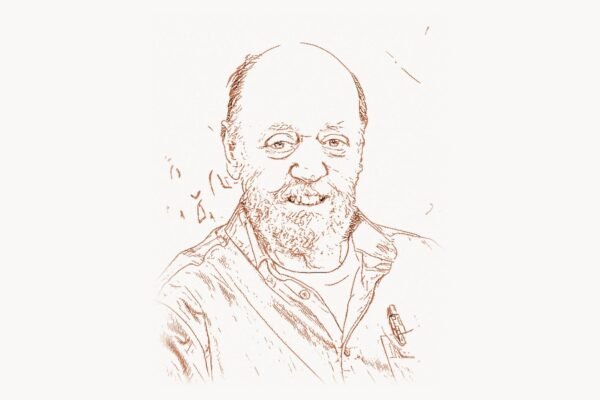
In the world of operating system kernels, where a single misplaced instruction can crash millions of machines, a handful of developers carry outsized influence. Linus Torvalds created the Linux kernel. Greg Kroah-Hartman maintains its stable releases. But when it comes to how Linux decides which process runs next, how it validates locking correctness, and how it traces problems deep inside kernel code — one name dominates the commit history: Ingo Molnar. Over more than two decades at Red Hat, this Hungarian developer has rewritten foundational subsystems of the Linux kernel, including the scheduler, the locking primitives, the tracing infrastructure, and the real-time preemption framework. His work touches every Linux machine on the planet, from Android phones to supercomputers to the servers behind every major website.
Early Life and Entry into Kernel Development
Ingo Molnar was born in Hungary and developed an early interest in low-level systems programming. Growing up during a period when access to Western hardware was limited in Eastern Europe, he learned to make the most of constrained environments — a skill that would later serve him well in kernel optimization, where every CPU cycle matters and memory is never free.
Molnar became involved with Linux development in the mid-1990s, during the kernel 2.0 era. Unlike many contributors who focused on drivers or user-facing features, Molnar was drawn to the core infrastructure: scheduling, synchronization, and interrupt handling. These are the subsystems that determine whether an operating system is fast or slow, stable or crash-prone, suitable for a desktop or capable of running a nuclear power plant. By the time the 2.4 kernel series was in development, Molnar had established himself as one of the most prolific contributors to the project, submitting patches that addressed performance bottlenecks and scalability limitations that affected every Linux user.
His early work caught the attention of Red Hat, the enterprise Linux company, which hired him to work on kernel development full-time. This was a significant arrangement: Red Hat gave Molnar the freedom to focus on deep kernel infrastructure rather than product-specific features. That freedom would prove extraordinarily productive. With corporate backing and no distractions from user-space concerns, Molnar could spend months redesigning a single subsystem — the kind of focused, patient engineering that produces truly foundational improvements.
The Completely Fair Scheduler (CFS)
The Problem with the O(1) Scheduler
To understand what Molnar achieved with the Completely Fair Scheduler, you need to understand what came before it. A process scheduler is the kernel component that decides which of the many running processes gets to use the CPU at any given moment. On a modern server handling thousands of simultaneous connections, or a desktop running a browser, an editor, and a music player simultaneously, the scheduler makes these decisions thousands of times per second. A bad scheduler means laggy applications, wasted CPU time, and unpredictable performance.
The Linux 2.6 kernel initially shipped with the O(1) scheduler, also designed by Molnar himself and merged in 2003. The O(1) scheduler was a major improvement over the earlier O(n) scheduler — as the name implies, it could select the next process to run in constant time regardless of how many processes were in the system. It used arrays of run queues indexed by priority, with a bitmap to quickly find the highest-priority non-empty queue. For servers, it worked well. But desktop users reported problems: interactive applications like text editors and music players would stutter when the system was under load. The heuristics the O(1) scheduler used to detect “interactive” processes were complex, fragile, and frequently wrong. The scheduler tried to guess which processes were interactive based on their sleeping patterns, but those heuristics created edge cases that were nearly impossible to fix without introducing new ones.
Meanwhile, Con Kolivas, an Australian anesthesiologist and part-time kernel hacker, proposed an alternative approach with his Rotating Staircase Deadline Scheduler (RSDL), later called BFS. Kolivas’ work demonstrated that fairness-based scheduling could solve the interactivity problem more elegantly than heuristic-based approaches. Inspired by these ideas but taking a fundamentally different implementation path, Molnar designed CFS from scratch.
The CFS Design
CFS, merged into Linux 2.6.23 in October 2007, replaced heuristics with a mathematically clean concept: virtual runtime. Every process in the system accumulates virtual runtime as it uses the CPU. The scheduler always picks the process with the lowest virtual runtime — the one that has received the least CPU time relative to what it deserves. Higher-priority processes accumulate virtual runtime more slowly, so they get picked more often. Lower-priority processes accumulate it faster, so they yield sooner. There are no magic heuristics, no interactive-detection guesswork. Just arithmetic.
The data structure underlying CFS is a red-black tree — a self-balancing binary search tree that Edsger Dijkstra would have appreciated for its algorithmic elegance. Processes are ordered in the tree by their virtual runtime value. Selecting the next process to run means picking the leftmost node in the tree — an O(log n) operation, which is slightly more expensive than the O(1) scheduler’s constant-time lookup, but the practical difference is negligible on real hardware, and the behavioral improvement is dramatic.
/*
 * Simplified representation of how CFS picks the next task.
 * The actual kernel code is in kernel/sched/fair.c
 *
 * CFS maintains a red-black tree (rb_tree) keyed by vruntime.
 * The leftmost node is always the task with the smallest
 * virtual runtime — the task that "deserves" CPU time most.
 */

struct sched_entity {
    struct rb_node    run_node;    /* node in the red-black tree */
    u64               vruntime;    /* accumulated virtual runtime */
    u64               sum_exec_runtime; /* actual wall-clock runtime */
    struct load_weight load;       /* weight derived from nice value */
};

struct cfs_rq {
    struct rb_root_cached tasks_timeline; /* rb-tree with leftmost cache */
    struct sched_entity *curr;            /* currently running entity */
    u64 min_vruntime;                     /* monotonically increasing floor */
    unsigned int nr_running;              /* number of runnable entities */
};

/*
 * __pick_next_entity — select the task with the smallest vruntime.
 * rb_first_cached() returns the leftmost node in O(1) thanks to
 * the cached pointer, so the actual "pick" is constant-time.
 * The O(log n) cost comes from reinserting the previous task
 * back into the tree after it has run.
 */
static struct sched_entity *
__pick_next_entity(struct cfs_rq *cfs_rq)
{
    struct rb_node *left = rb_first_cached(&cfs_rq->tasks_timeline);
    if (!left)
        return NULL;

    return rb_entry(left, struct sched_entity, run_node);
}

/*
 * update_curr — called on every timer tick and context switch.
 * Adds the time the current task has been running to its vruntime,
 * weighted inversely by its priority (nice value).
 * Higher-priority tasks accumulate vruntime more slowly.
 */
static void update_curr(struct cfs_rq *cfs_rq)
{
    struct sched_entity *curr = cfs_rq->curr;
    u64 now = rq_clock_task(rq_of(cfs_rq));
    u64 delta_exec = now - curr->exec_start;

    curr->sum_exec_runtime += delta_exec;
    /* calc_delta_fair applies weight: higher priority = slower vruntime growth */
    curr->vruntime += calc_delta_fair(delta_exec, curr);
    update_min_vruntime(cfs_rq);
    curr->exec_start = now;
}
The beauty of CFS is its simplicity of concept. Interactive processes naturally get responsive treatment — not because the scheduler detects them through fragile heuristics, but because interactive processes spend most of their time sleeping (waiting for user input). While they sleep, other processes accumulate virtual runtime. When the interactive process wakes up, it has the lowest virtual runtime and immediately gets the CPU. No special cases. No tuning parameters. The fairness model inherently produces the right behavior for both servers and desktops.
Impact on the Computing World
CFS transformed Linux scheduling from a source of constant complaints into a solved problem. Desktop Linux users stopped reporting the stuttering and latency issues that had plagued the O(1) scheduler. Server workloads saw more predictable performance. The scheduler became something most users and administrators never had to think about — which is exactly what a good scheduler should be. Every Android phone, every Linux server, every cloud instance that runs Linux today uses CFS or its direct successor, EEVDF (Earliest Eligible Virtual Deadline First), which was merged in kernel 6.6 in 2023 and builds directly on the CFS foundation Molnar established.
For teams managing complex projects — whether coordinating kernel patches or planning product development — the principle of fairness-based resource allocation applies broadly. Tools like Taskee apply similar thinking to task management: allocating attention and effort based on clear priorities rather than ad-hoc guesswork, much like CFS allocates CPU time based on virtual runtime rather than fragile heuristics.
PREEMPT_RT: Making Linux Real-Time
What Real-Time Means
A real-time operating system does not mean a fast operating system. It means a predictable operating system — one that can guarantee a response within a bounded time, every single time. When a robotic arm on a factory floor receives a command to stop, the control system must respond within microseconds. When an audio interface needs to deliver samples to a DAC at 48,000 times per second, a single missed deadline produces an audible click. When an anti-lock braking system detects wheel lockup, the response time is not optional.
Traditional Linux, designed as a general-purpose time-sharing system, could not provide these guarantees. The kernel contained long code paths that disabled preemption — meaning a high-priority real-time task could be blocked for milliseconds while the kernel finished handling an interrupt or holding a spinlock. Milliseconds sound fast, but for industrial control systems, audio production, and robotics, they represent unacceptable latency.
The PREEMPT_RT Patchset
Starting around 2004, Molnar began developing the PREEMPT_RT patchset — a comprehensive effort to make the Linux kernel fully preemptible. The idea was radical: convert nearly every non-preemptible code path in the kernel into a preemptible one. Spinlocks were replaced with mutexes that support priority inheritance. Interrupt handlers were moved from hard interrupt context into kernel threads that the scheduler could preempt and prioritize. Critical sections were minimized or restructured to reduce maximum latency.
This was not a simple patch. The Linux kernel contains millions of lines of code written by thousands of developers, many of whom assumed that certain code paths would never be preempted. Making the kernel fully preemptible required auditing and modifying locking throughout the entire codebase. It also required inventing new synchronization primitives. Molnar’s new mutex implementation, which replaced the older semaphore-based approach for sleeping locks, was a direct outcome of this work. The new mutexes were faster, had proper priority inheritance support (preventing priority inversion problems, where a low-priority task holding a lock blocks a high-priority task), and had cleaner semantics.
The connection to earlier work in computer science is direct. Per Brinch Hansen formalized the theoretical foundations of concurrent programming and monitors decades earlier. Molnar took those theoretical principles and applied them to a production operating system running on millions of machines — a practical engineering challenge of enormous complexity that required understanding both the theory and the messy reality of real hardware.
After nearly two decades of development and gradual mainline integration, PREEMPT_RT was fully merged into the mainline Linux kernel in version 6.12 (late 2024). This was a milestone moment: Linux, the general-purpose kernel that started as a student hobby project, officially became suitable for hard real-time applications without any external patches. Industrial automation systems, professional audio workstations, robotic surgery equipment, and autonomous vehicle controllers can now run on stock Linux kernels with guaranteed latency bounds.
Lockdep, Ftrace, and the Debugging Revolution
Lockdep: Finding Bugs Before They Crash
Concurrent programming is notoriously difficult. When multiple threads or processes share data protected by locks, the potential for deadlocks — situations where two or more threads wait forever for each other to release locks — grows combinatorially with the number of locks. Traditional debugging approaches wait for deadlocks to occur and then analyze crash dumps. But deadlocks in kernel code can freeze an entire machine, often with no diagnostic output at all.
Molnar’s lockdep (lock dependency validator), merged into the kernel in 2006, took a fundamentally different approach: it detects potential deadlocks at runtime, before they actually happen. Lockdep tracks the order in which locks are acquired across the entire kernel. If thread A acquires lock X before lock Y, and thread B acquires lock Y before lock X somewhere else in the code, lockdep flags this as a potential ABBA deadlock — even if the actual deadlock has never occurred in practice. The tool reasons about lock ordering across all possible execution paths, catching bugs that might only manifest under specific timing conditions that could take years of production use to trigger.
The impact on kernel quality was immediate and substantial. Lockdep found hundreds of latent deadlock bugs in existing kernel code that had been present for years. It fundamentally changed how kernel developers think about locking: instead of hoping their lock ordering is correct, they get immediate automated feedback. Writing lock-heavy kernel code with lockdep enabled is like having a concurrency expert reviewing every lock acquisition in real time. Bjarne Stroustrup once said that C++ aimed to make the machine help the programmer avoid errors. Lockdep achieves the same goal specifically for concurrency bugs in C kernel code, bringing the kind of rigorous checking to lock usage that Brian Kernighan advocated for all aspects of programming through careful, defensive coding practices.
Ftrace: X-Ray Vision for the Kernel
Debugging a running operating system kernel is fundamentally different from debugging a user-space application. You cannot simply attach a debugger and set breakpoints — stopping the kernel stops the entire machine. Print statements (printk in kernel parlance) are crude and slow. Performance profiling tools existed, but most were designed for user-space programs and could not see inside the kernel.
Ftrace (function tracer), another Molnar creation merged in 2008, gave developers unprecedented visibility into kernel behavior. At its core, ftrace can trace every function call in the kernel, recording entry and exit times with nanosecond precision. But it goes far beyond simple function tracing: it includes an event tracing framework that kernel subsystems can hook into, allowing developers to trace scheduling decisions, interrupt handling, lock contention, memory allocation, and virtually any other kernel activity — all with minimal overhead when tracing is not active.
Ftrace became the foundation upon which other powerful tools were built. Brendan Gregg’s widely used performance analysis tools, perf-tools, and later BPF-based tools, build on the tracing infrastructure Molnar created. The trace-cmd utility provides user-friendly access to ftrace. KernelShark offers graphical visualization. For web developers dealing with performance problems on Linux servers — slow response times, unexplained latency spikes, resource contention between containers — these tools trace the problem down to the exact kernel function responsible.
IRQ Threading and the Mutex Subsystem
Beyond the headline projects, Molnar redesigned several other critical kernel subsystems. IRQ threading, a key component of the PREEMPT_RT work, converted hardware interrupt handlers from non-preemptible hard-interrupt context into schedulable kernel threads. In the old model, when a network card generated an interrupt, the CPU immediately stopped whatever it was doing — even a real-time task — to handle the interrupt. With IRQ threading, interrupt handling becomes a schedulable activity that the kernel can prioritize against other work. This was essential for real-time behavior, but it also improved general system responsiveness by reducing the time that interrupts could monopolize a CPU.
The new mutex subsystem, merged in 2006, replaced the kernel’s older semaphore implementation for sleeping locks. The new mutexes had a critical property: they supported priority inheritance, meaning that if a high-priority task was blocked waiting for a mutex held by a low-priority task, the low-priority task temporarily inherited the high priority, preventing the unbounded priority inversion that had historically plagued real-time systems. This was the same class of bug that caused the Mars Pathfinder spacecraft to repeatedly reset in 1997 — a problem that the computer science community had understood theoretically for decades but that had not been properly addressed in Linux until Molnar’s work.
/*
 * Simplified illustration of priority inheritance in the mutex subsystem.
 * When a high-priority task blocks on a mutex held by a low-priority task,
 * the holder's priority is temporarily boosted to prevent priority inversion.
 *
 * Real implementation: kernel/locking/rtmutex.c
 */

struct rt_mutex {
    raw_spinlock_t      wait_lock;   /* protects the waiter list */
    struct rb_root_cached waiters;    /* tasks waiting for this mutex */
    struct task_struct  *owner;       /* current lock holder */
};

/*
 * rt_mutex_adjust_prio — boost the lock holder's priority
 * if a higher-priority task is now waiting for the lock.
 * This prevents the classic priority inversion scenario
 * (e.g., Mars Pathfinder, 1997).
 */
static void rt_mutex_adjust_prio(struct task_struct *task)
{
    struct task_struct *pi_task = NULL;

    /* Find the highest-priority waiter across all locks held by task */
    pi_task = task_top_pi_waiter(task);

    /* If the waiter's priority is higher, boost the holder */
    if (pi_task && prio_higher(pi_task, task)) {
        /*
         * Temporarily raise task->prio to match the waiting task.
         * When the mutex is released, priority reverts to normal.
         * This ensures the holder runs quickly and releases the lock,
         * unblocking the high-priority waiter without unbounded delay.
         */
        rt_mutex_setprio(task, pi_task->prio);
    }
}

/*
 * The priority inheritance chain can propagate through multiple locks:
 * Task A (high prio) waits on Lock 1, held by Task B (medium prio),
 * which waits on Lock 2, held by Task C (low prio).
 * Lockdep validates that these chains don't form cycles (deadlocks).
 */
The depth and breadth of Molnar’s contributions is exceptional. Where most kernel developers specialize in a single subsystem — networking, filesystems, drivers — Molnar rewrote core infrastructure that affects every subsystem. The scheduler determines when code runs. The locking primitives determine how code synchronizes. The tracing infrastructure determines how developers find problems. The preemption model determines what guarantees the system can provide. By redesigning all of these, Molnar effectively rebuilt the foundation that the rest of the kernel stands on.
Philosophy and Engineering Approach
Molnar’s engineering approach is characterized by several distinctive qualities that set his work apart.
Correctness through tooling. Rather than relying on manual code review alone to catch concurrency bugs, Molnar builds automated tools — lockdep, ftrace — that detect problems systematically. This philosophy mirrors the broader trend in software engineering toward automated verification, static analysis, and continuous testing. As Dennis Ritchie and Ken Thompson built Unix with tools that made programming more productive, Molnar builds kernel infrastructure that makes kernel development more reliable.
Replacing heuristics with models. The transition from the O(1) scheduler to CFS exemplifies this: instead of layering hack upon hack to handle edge cases, Molnar replaced the entire approach with a clean mathematical model. Virtual runtime is simple to explain, simple to reason about, and naturally handles the cases that required special-purpose heuristics before. This approach demands more upfront design effort but produces systems that are dramatically easier to maintain and extend.
Incremental mainlining of radical changes. PREEMPT_RT was too large and invasive to merge all at once. Molnar adopted a patient strategy of extracting individual improvements from the patchset and merging them into the mainline kernel one by one over nearly twenty years. The mutex subsystem, IRQ threading, and many other components were merged separately, each providing immediate value while bringing the mainline kernel closer to full real-time capability. This strategy is relevant to any large-scale software project — digital agencies and development teams working with platforms like Toimi often face similar challenges when modernizing complex systems, where incremental improvement outperforms risky big-bang rewrites.
Prolific output. Molnar is consistently one of the most prolific contributors to the Linux kernel by patch count. His contributions span decades without significant gaps — a sustained productivity that reflects both deep expertise and effective engineering practice. He works at the intersection of theory and practice, understanding both the computer science foundations (algorithm design, concurrency theory, real-time systems) and the practical engineering constraints (hardware behavior, backward compatibility, performance requirements) equally well.
Legacy and Modern Relevance
Ingo Molnar’s work is embedded in every Linux system on Earth. The CFS scheduler or its successor runs on every Android phone, every Linux server, every cloud virtual machine. The locking primitives he designed protect shared data in every kernel subsystem. Lockdep catches concurrency bugs in every kernel build compiled with debugging enabled. Ftrace powers the performance analysis tools that administrators use to diagnose problems on production servers handling millions of requests.
The full mainline integration of PREEMPT_RT in 2024 opened Linux to an entirely new class of applications. Industrial automation systems that previously required proprietary real-time operating systems can now run on Linux, with access to its vast driver support, networking stack, and developer ecosystem. Professional audio production on Linux — previously requiring patched kernels — now works out of the box. Robotic systems and autonomous vehicles gain a real-time-capable kernel backed by the largest open-source community in the world.
For web developers and infrastructure engineers, Molnar’s work is relevant in ways that are often invisible but always present. When a web server handles thousands of concurrent connections and each request gets fair CPU time, that is CFS. When a containerized microservice runs alongside dozens of others on a shared host without unpredictable latency spikes, that is the preemption and scheduling infrastructure Molnar built. When a performance engineer traces a latency problem to a specific kernel function on a production server, that is ftrace. When a kernel developer adds new locking code and immediately learns about a potential deadlock, that is lockdep.
Few individuals have reshaped as much core infrastructure of a globally deployed operating system. Linus Torvalds created Linux and continues to lead its development. But the kernel’s scheduler, its locking, its tracing, its real-time capabilities — the infrastructure that makes Linux not just functional but performant, debuggable, and reliable — bear Ingo Molnar’s unmistakable mark.
Key Facts
- Born: Hungary
- Known for: CFS scheduler, PREEMPT_RT, lockdep, ftrace, Linux kernel mutex subsystem, IRQ threading
- Employer: Red Hat
- Key contribution: Completely Fair Scheduler (CFS), merged in Linux 2.6.23 (2007) — replaced heuristic-based scheduling with a fairness model using red-black trees and virtual runtime
- PREEMPT_RT: Real-time preemption patchset, developed from ~2004, fully merged into mainline Linux 6.12 (2024)
- Lockdep: Lock dependency validator (2006) — detects potential deadlocks at runtime before they occur
- Ftrace: Function tracer (2008) — nanosecond-precision tracing of kernel function calls and events
- Other contributions: New mutex subsystem with priority inheritance, IRQ threading, O(1) scheduler (predecessor to CFS)
- Impact: His scheduler code runs on every Linux device — billions of Android phones, millions of servers, all top-500 supercomputers
Frequently Asked Questions
Who is Ingo Molnar?
Ingo Molnar is a Hungarian software engineer and one of the most prolific contributors to the Linux kernel. Working at Red Hat, he has designed and implemented several foundational kernel subsystems, including the Completely Fair Scheduler (CFS), the PREEMPT_RT real-time patchset, the lockdep deadlock detector, and the ftrace function tracer. His work directly affects every Linux-powered device in the world.
What is the Completely Fair Scheduler (CFS)?
CFS is the process scheduler that Molnar designed for the Linux kernel, merged in version 2.6.23 (2007). It replaced the older O(1) scheduler (also created by Molnar) with a fairness-based model. CFS tracks each process’s virtual runtime — how much CPU time it has received relative to what it deserves — and always runs the process with the lowest virtual runtime. It uses a red-black tree data structure for efficient process selection. CFS eliminated the interactivity problems that plagued the previous scheduler and ran on all Linux systems until EEVDF succeeded it in kernel 6.6 (2023).
What is PREEMPT_RT and why does it matter?
PREEMPT_RT is a patchset that makes the Linux kernel suitable for real-time applications — systems that must respond within guaranteed time bounds, such as industrial robots, professional audio equipment, and autonomous vehicles. Molnar led its development from approximately 2004, converting non-preemptible kernel code paths into preemptible ones, threading interrupt handlers, and implementing priority-inheriting mutexes. After nearly two decades of incremental mainlining, PREEMPT_RT was fully merged into Linux 6.12 in 2024.
What is lockdep?
Lockdep (lock dependency validator) is a runtime tool inside the Linux kernel that detects potential deadlocks before they happen. Created by Molnar in 2006, it tracks the order in which locks are acquired across the entire kernel and flags inconsistent orderings that could lead to deadlocks under different timing conditions. Lockdep has found hundreds of latent concurrency bugs in kernel code and fundamentally changed how kernel developers approach lock-based synchronization.
What is ftrace?
Ftrace (function tracer) is a tracing framework built into the Linux kernel, created by Molnar and merged in 2008. It can trace every function call in the kernel with nanosecond precision, as well as scheduling events, interrupt handling, lock contention, and other kernel activities. Ftrace serves as the foundation for many popular performance analysis tools and is essential for diagnosing latency and throughput problems on Linux servers.
How does Ingo Molnar’s work affect web developers?
Every web application deployed on Linux — which includes the vast majority of production web services — runs on infrastructure Molnar designed. CFS ensures fair CPU allocation between processes and containers. The preemption improvements reduce latency spikes under load. Ftrace and lockdep help operations teams diagnose server performance problems. When your web application serves consistent response times across thousands of concurrent users, Molnar’s scheduler and kernel infrastructure are a significant part of the reason.