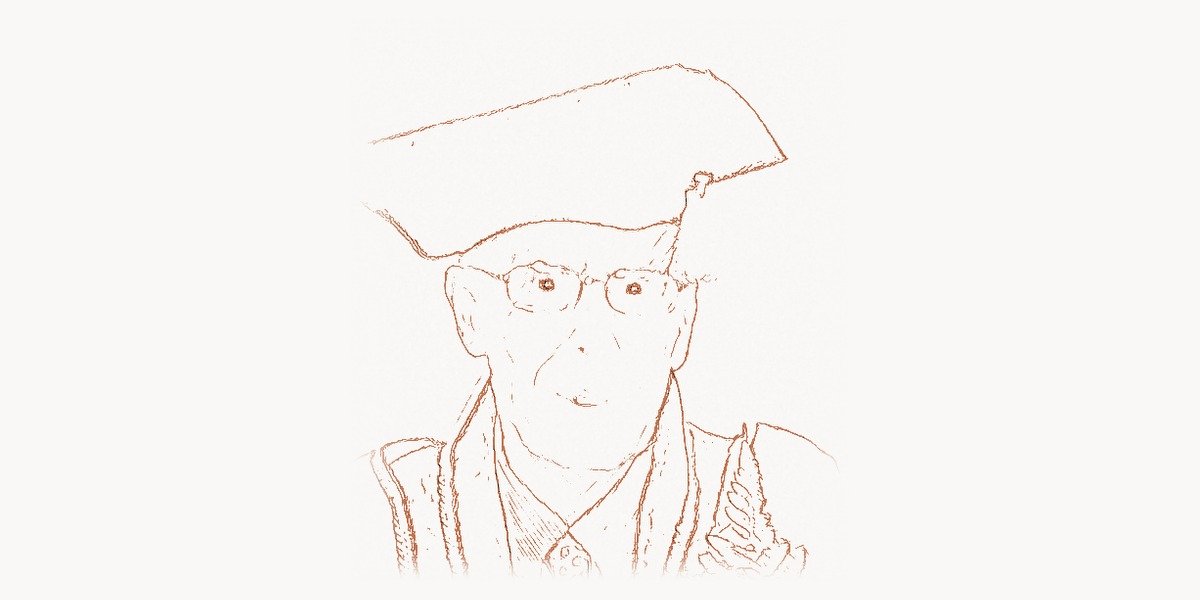
In 1971, a young professor at Cornell University sat down to write a textbook that would become the bible of computer science education for the next half century. John Edward Hopcroft, together with his colleague Alfred Aho, produced The Design and Analysis of Computer Algorithms — a book so rigorous and so clearly written that it redefined how an entire generation of researchers and students understood the mathematical foundations of computation. But the textbook was only the beginning. Hopcroft’s deep work on automata theory, formal languages, and algorithmic efficiency would earn him the highest honor in computing: the 1986 ACM Turing Award, shared with Robert Tarjan. His contributions did not merely advance the field — they provided the structural bedrock upon which compilers, search engines, network protocols, and artificial intelligence systems are built today.
Early Life and Academic Formation
John Hopcroft was born on October 7, 1939, in Seattle, Washington. Growing up in the Pacific Northwest during the postwar era, he was surrounded by the industrial and technological optimism that defined mid-century America. His intellectual curiosity emerged early, and he gravitated toward mathematics and engineering — disciplines that promised both rigor and practical impact.
Hopcroft earned his Bachelor of Science in electrical engineering from Seattle University in 1961, a foundation that gave him an engineer’s instinct for building things that work. He then moved to Stanford University, where he completed both his Master’s degree (1962) and his Ph.D. (1964) in electrical engineering. At Stanford, he encountered the nascent field of computer science at a time when the boundaries between electrical engineering, mathematics, and computation were still being drawn. His doctoral work, supervised by David Huffman (inventor of Huffman coding), focused on the synthesis of sequential switching circuits — a topic that sat squarely at the intersection of hardware design and formal logic.
This dual formation — one foot in engineering pragmatism, the other in mathematical abstraction — would define Hopcroft’s entire career. He never lost sight of the fact that the most elegant theory is the one that solves a real problem.
Automata Theory: The Grammar of Computation
After completing his doctorate, Hopcroft joined the faculty at Cornell University in 1964, where he would remain for decades and do his most celebrated work. He arrived at a pivotal moment: the theoretical foundations of computer science were being laid down at breakneck speed, and automata theory was at the center of it all.
Automata theory, at its core, is the study of abstract machines and the computational problems they can solve. A finite automaton is perhaps the simplest such machine: it reads input symbols one at a time, transitions between a finite set of states according to fixed rules, and ultimately accepts or rejects the input. Despite their simplicity, finite automata are astonishingly powerful models. They underpin regular expressions, lexical analyzers in compilers, protocol verification systems, and pattern-matching engines used by every modern search tool.
Hopcroft recognized that the real power of automata theory lay not just in describing what machines can do, but in providing efficient algorithms to reason about them. One of his most enduring contributions is the Hopcroft algorithm for minimizing deterministic finite automata (DFA), published in 1971. The DFA minimization problem asks: given a finite automaton, can we find the smallest equivalent automaton that recognizes exactly the same language? This is not merely an academic exercise — minimized automata consume less memory, execute faster, and are easier to verify for correctness.
The Hopcroft DFA Minimization Algorithm
Before Hopcroft’s algorithm, the standard approach to DFA minimization used a table-filling method with O(n²) time complexity, where n is the number of states. Hopcroft’s breakthrough was an algorithm that runs in O(n log n) time — an exponential improvement for large automata. The key insight was a partition-refinement strategy: start with a coarse partition of states (accepting vs. non-accepting), then iteratively refine it by splitting groups whose members behave differently on some input symbol. The clever trick is in choosing which splitters to process, using a worklist that ensures each state is processed at most O(log n) times.
Here is a simplified implementation of Hopcroft’s DFA minimization algorithm in Python, illustrating the core partition-refinement logic:
def hopcroft_minimize_dfa(states, alphabet, transition, start, accepting):
    """
    Hopcroft's algorithm for DFA minimization.

    Parameters:
        states: set of state identifiers
        alphabet: set of input symbols
        transition: dict mapping (state, symbol) -> state
        start: the start state
        accepting: set of accepting states

    Returns:
        Minimized DFA as (new_states, alphabet, new_transition, new_start, new_accepting)
    """
    # Initial partition: accepting states vs non-accepting states
    non_accepting = states - accepting
    partition = set()

    if accepting:
        partition.add(frozenset(accepting))
    if non_accepting:
        partition.add(frozenset(non_accepting))

    # Worklist initialized with the smaller of the two groups
    worklist = []
    for group in partition:
        worklist.append(group)

    while worklist:
        splitter = worklist.pop()

        for symbol in alphabet:
            # Find all states that transition INTO the splitter on this symbol
            predecessors = set()
            for s in states:
                if (s, symbol) in transition and transition[(s, symbol)] in splitter:
                    predecessors.add(s)

            if not predecessors:
                continue

            new_partition = set()
            for group in partition:
                intersection = group & predecessors
                difference = group - predecessors

                if intersection and difference:
                    # Split this group
                    new_partition.add(frozenset(intersection))
                    new_partition.add(frozenset(difference))

                    # Update worklist with the smaller fragment
                    if group in worklist:
                        worklist.remove(group)
                        worklist.append(frozenset(intersection))
                        worklist.append(frozenset(difference))
                    else:
                        if len(intersection) <= len(difference):
                            worklist.append(frozenset(intersection))
                        else:
                            worklist.append(frozenset(difference))
                else:
                    new_partition.add(group)

            partition = new_partition

    # Build minimized DFA from the final partition
    state_map = {}
    for group in partition:
        representative = min(group)
        for s in group:
            state_map[s] = representative

    new_states = set(state_map.values())
    new_transition = {}
    for (s, sym), target in transition.items():
        new_transition[(state_map[s], sym)] = state_map[target]

    new_start = state_map[start]
    new_accepting = {state_map[s] for s in accepting}

    return new_states, alphabet, new_transition, new_start, new_accepting


# Example: Minimize a DFA that recognizes strings ending in "ab"
states = {0, 1, 2, 3, 4}
alphabet = {'a', 'b'}
transition = {
    (0, 'a'): 1, (0, 'b'): 0,
    (1, 'a'): 1, (1, 'b'): 2,
    (2, 'a'): 1, (2, 'b'): 0,
    (3, 'a'): 1, (3, 'b'): 2,  # State 3 is equivalent to state 0
    (4, 'a'): 1, (4, 'b'): 0,  # State 4 is equivalent to state 0
}
start = 0
accepting = {2}

result = hopcroft_minimize_dfa(states, alphabet, transition, start, accepting)
print(f"Original states: {len(states)}")
print(f"Minimized states: {len(result[0])}")
# Output: Original states: 5, Minimized states: 3
This algorithm remains the fastest known method for DFA minimization and is implemented in virtually every compiler toolkit and regular expression engine in production today. When you type a search query and get results in milliseconds, Hopcroft's algorithm is likely working somewhere in the pipeline, ensuring that the pattern-matching automata are as lean as possible.
The Textbooks That Defined a Discipline
If Hopcroft's research contributions gave computer science its tools, his textbooks gave it its language. In the early 1970s, the field desperately needed canonical references that could organize the rapidly expanding body of knowledge into a coherent curriculum. Hopcroft, together with Alfred Aho and Jeffrey Ullman, rose to the challenge.
Their 1974 masterwork, The Design and Analysis of Computer Algorithms, was a landmark. It systematically presented algorithms for sorting, searching, graph problems, string matching, and computational geometry, all within a rigorous framework of asymptotic analysis. The book popularized Big-O notation as the standard language for discussing algorithmic efficiency — a convention that every programmer alive today takes for granted. The text drew heavily on the work of pioneers like Donald Knuth and Edsger Dijkstra, but synthesized their insights into a form that was accessible to students and practitioners alike.
Hopcroft and Ullman also co-authored Introduction to Automata Theory, Languages, and Computation (1979), often called the "Cinderella book" for its iconic cover. This text became the definitive reference for formal language theory, covering finite automata, pushdown automata, Turing machines, and the Chomsky hierarchy with a clarity that made the subject approachable without sacrificing rigor. The book went through multiple editions, with the 2006 third edition adding Hopcroft's former student Rajeev Motwani as co-author. Generations of computer scientists — from Google engineers to academic researchers — trace their understanding of computation theory back to this single book.
Why These Textbooks Mattered
The impact of Hopcroft's textbooks cannot be overstated. Before their publication, computer science education was fragmented: different universities taught different material using different frameworks, and there was no consensus on what a computer science student should know. The Aho-Hopcroft-Ullman texts established a standard curriculum that unified the field. They demonstrated that algorithms and data structures could be studied with the same rigor as mathematics, and that doing so led to practical improvements in software engineering. The books also served as a bridge between theory and practice — a recurring theme in Hopcroft's career — by including detailed analyses of real-world algorithms alongside their theoretical underpinnings.
Today, anyone working with project management tools or building software at scale is standing on foundations that Hopcroft's textbooks helped lay. The concepts of algorithmic complexity, data structure choice, and formal verification that he systematized are woven into every aspect of modern software development.
The Turing Award: Recognition of a Life's Work
In 1986, the Association for Computing Machinery (ACM) awarded John Hopcroft the A.M. Turing Award — the Nobel Prize of computer science — jointly with Robert Tarjan. The citation recognized their fundamental achievements in the design and analysis of algorithms and data structures. Tarjan, a former student of Hopcroft's, had built on his mentor's work to develop groundbreaking algorithms for graph problems, including Tarjan's algorithm for finding strongly connected components.
The Hopcroft-Tarjan collaboration was especially fruitful in the area of graph algorithms. Together, they developed the first linear-time algorithm for testing whether a graph is planar — a problem with applications ranging from circuit design to network visualization. Their planarity testing algorithm, published in 1974, was a tour de force of algorithmic engineering: it combined depth-first search, a technique Tarjan had refined, with careful bookkeeping of graph embeddings to achieve O(n) time complexity for a problem that had previously required O(n²) or worse.
The Turing Award placed Hopcroft in the company of titans like Alan Turing (the award's namesake), Donald Knuth, and Edsger Dijkstra. But unlike some laureates whose work remained purely theoretical, Hopcroft consistently advocated for the practical application of theoretical results — a philosophy that influenced the entire direction of computer science as a discipline.
Formal Languages and the Chomsky Hierarchy
A significant portion of Hopcroft's scholarly work centers on formal languages — the mathematical systems that describe the syntax of programming languages, natural languages, and biological sequences. The Chomsky hierarchy, proposed by linguist Noam Chomsky in 1956, classifies formal grammars into four types based on their generative power: regular languages (Type 3), context-free languages (Type 2), context-sensitive languages (Type 1), and recursively enumerable languages (Type 0). Each class corresponds to a type of automaton: finite automata, pushdown automata, linear-bounded automata, and Turing machines, respectively.
Hopcroft's textbooks and research papers did more than anyone to make this hierarchy accessible and practically useful. His work on context-free grammars, in particular, had direct implications for compiler design. Every programming language you use today — whether Python, Java, Rust, or JavaScript — is defined by a context-free grammar and parsed by algorithms that descend directly from the theory Hopcroft helped formalize.
Here is an example that demonstrates context-free grammar parsing using the CYK (Cocke-Younger-Kasami) algorithm, one of the key algorithms in formal language theory:
def cyk_parse(grammar, sentence):
    """
    CYK algorithm for parsing context-free grammars.
    Determines if a sentence belongs to the language
    generated by a grammar in Chomsky Normal Form (CNF).

    Parameters:
        grammar: dict mapping non-terminal -> list of productions
                 Each production is either (terminal,) or (NT1, NT2)
        sentence: list of terminal symbols

    Returns:
        True if the sentence is in the language, False otherwise
    """
    n = len(sentence)
    if n == 0:
        return False

    # table[i][j] = set of non-terminals that can derive sentence[i:j+1]
    table = [[set() for _ in range(n)] for _ in range(n)]

    # Base case: fill diagonal with terminals
    for i, symbol in enumerate(sentence):
        for non_terminal, productions in grammar.items():
            for production in productions:
                if len(production) == 1 and production[0] == symbol:
                    table[i][i].add(non_terminal)

    # Fill table for substrings of increasing length
    for length in range(2, n + 1):        # substring length
        for i in range(n - length + 1):   # start index
            j = i + length - 1            # end index

            for k in range(i, j):         # split point
                for non_terminal, productions in grammar.items():
                    for production in productions:
                        if len(production) == 2:
                            B, C = production
                            if B in table[i][k] and C in table[k + 1][j]:
                                table[i][j].add(non_terminal)

    # The sentence is in the language if the start symbol
    # can derive the entire sentence
    return 'S' in table[0][n - 1]


# Example: A grammar for balanced parentheses
# S -> AB | AC | a
# A -> a  (represents '(')
# B -> b  (represents ')')
# C -> SB (represents S followed by ')')
# Where a = '(' and b = ')'

grammar = {
    'S': [('A', 'B'), ('A', 'C')],
    'A': [('(',)],
    'B': [(')',)],
    'C': [('S', 'B')],
}

# Test: "(())" should be valid
test1 = list("(())")
print(f"'(())' in language: {cyk_parse(grammar, test1)}")  # True

# Test: "(()" should be invalid
test2 = list("(()")
print(f"'(()' in language: {cyk_parse(grammar, test2)}")   # False

# Test: "()" should be valid
test3 = list("()")
print(f"'()' in language: {cyk_parse(grammar, test3)}")    # True
The CYK algorithm, which runs in O(n³ · |G|) time, demonstrates the power of dynamic programming applied to formal language recognition. While modern parsers use more efficient techniques (such as LR or LL parsing) for specific grammar subclasses, the CYK algorithm remains the gold standard for general context-free parsing and is a staple of every automata theory course that uses Hopcroft's textbook.
Leadership in Computer Science Education
Hopcroft's influence extends far beyond research papers and textbooks. Throughout his career, he has been a tireless advocate for reforming computer science education to meet the demands of a rapidly changing world. As chair of Cornell's Department of Computer Science from 1987 to 1992, he oversaw a period of significant growth and curricular innovation, pushing the department to integrate theoretical and practical training more tightly.
In the 2000s, Hopcroft turned his attention to the global stage, particularly to China. He became deeply involved in efforts to improve computer science education at Chinese universities, serving as an advisor to multiple institutions and as a visiting professor at several leading Chinese research universities. He was instrumental in establishing exchange programs between Cornell and Chinese universities, and his textbooks were translated into Chinese and adopted widely across the country. In recognition of these efforts, he was awarded the Friendship Award by the Chinese government — the highest honor given to foreign nationals who have made outstanding contributions to China's modernization.
Hopcroft has been outspoken about what he sees as a crisis in computer science education: the growing gap between the theoretical foundations that students need and the practical skills that industry demands. He has argued that the solution is not to abandon theory in favor of vocational training, but to teach theory in a way that makes its practical relevance clear. This philosophy — that deep understanding of fundamentals leads to better engineering — is one that resonates with every digital agency building products that need to scale and perform under pressure.
Beyond Automata: Contributions to Data Science and Machine Learning
In the 2010s, Hopcroft pivoted his research focus toward the emerging fields of data science and machine learning — a move that surprised some of his colleagues but was entirely consistent with his career-long habit of identifying the most important problems of the moment. He recognized early that the explosion of data being generated by the internet, social media, and sensor networks would require new theoretical frameworks for understanding high-dimensional data.
Together with Ravindran Kannan, Hopcroft co-authored Foundations of Data Science, a textbook that applied the mathematical rigor of theoretical computer science to problems in machine learning, dimensionality reduction, random graphs, and clustering. The book was notable for its emphasis on the mathematical foundations underlying modern algorithms — the same emphasis that had characterized Hopcroft's earlier work on automata and algorithms.
This transition also reflected Hopcroft's belief that the fundamental questions of computer science do not change, even as the applications do. Whether you are minimizing a finite automaton, analyzing the complexity of a graph algorithm, or reducing the dimensionality of a dataset, the underlying challenge is the same: finding structure in complexity, and exploiting that structure to build efficient solutions.
The Hopcroft-Karp Algorithm for Bipartite Matching
Another significant contribution bears mention: the Hopcroft-Karp algorithm for finding maximum matchings in bipartite graphs, published in 1973. A bipartite graph consists of two disjoint sets of vertices, with edges only between vertices in different sets. The maximum matching problem asks for the largest set of edges with no shared vertices — a problem with applications in job assignment, resource allocation, network routing, and recommendation systems.
The Hopcroft-Karp algorithm runs in O(E√V) time, where E is the number of edges and V the number of vertices. This was a significant improvement over previous methods and remains the fastest known algorithm for bipartite matching in dense graphs. The algorithm uses breadth-first search to find shortest augmenting paths and then augments along all of them simultaneously — an elegant combination of graph traversal techniques that exemplifies Hopcroft's ability to extract maximum performance from simple building blocks.
This work connects to the broader tradition of algorithmic graph theory that Hopcroft helped establish, alongside colleagues like Robert Tarjan and Richard Karp. The algorithms they developed in the 1970s form the backbone of modern network analysis, from social network algorithms to logistics optimization.
Legacy and Continuing Influence
John Hopcroft's legacy is not a single breakthrough but a pattern of sustained excellence across multiple dimensions of computer science. His research contributions — DFA minimization, bipartite matching, planarity testing — are taught in every algorithms course in the world. His textbooks defined the curriculum for an entire discipline. His mentorship produced a generation of leading researchers, including Turing Award winner Robert Tarjan. And his advocacy for computer science education has had a global impact, particularly in Asia.
What distinguishes Hopcroft from many other theoretical computer scientists is his insistence that theory must serve practice. He has never been content to prove theorems in isolation; instead, he has consistently sought problems where a theoretical advance leads directly to faster, more efficient software. This pragmatic idealism — the belief that the best way to improve technology is to understand it deeply — is a philosophy that guides the best engineering teams and distributed systems researchers today.
At a time when computer science faces new challenges — the ethical implications of artificial intelligence, the security vulnerabilities inherent in complex systems, the environmental cost of computation — Hopcroft's example reminds us that the path forward begins with rigorous thinking. The automata theory he helped build is not just a historical curiosity; it is the living foundation of every compiler, every search engine, every natural language processing system, and every formal verification tool in use today. As long as we need machines to process language, recognize patterns, and make decisions, the work of John Hopcroft will remain essential.
His story is also a reminder that the most impactful contributions in computer science often come not from flashy product launches but from the patient, unglamorous work of building solid theoretical foundations. In an era that celebrates disruption, Hopcroft's career is a testament to the power of construction — building the frameworks, writing the textbooks, and training the students who will shape the future of technology for decades to come.
Frequently Asked Questions
What is John Hopcroft best known for?
John Hopcroft is best known for his foundational contributions to automata theory, formal languages, and algorithm design. His most cited achievements include the Hopcroft algorithm for DFA minimization (O(n log n) time), the Hopcroft-Karp algorithm for maximum bipartite matching (O(E√V) time), and his co-authorship of several canonical computer science textbooks with Alfred Aho and Jeffrey Ullman. He received the 1986 Turing Award jointly with Robert Tarjan for their achievements in the design and analysis of algorithms and data structures.
Why did John Hopcroft receive the Turing Award?
Hopcroft received the 1986 ACM Turing Award, shared with Robert Tarjan, for fundamental achievements in the design and analysis of algorithms and data structures. The award recognized their combined contributions to graph algorithms, including the first linear-time planarity testing algorithm, as well as Hopcroft's work on automata theory and Tarjan's work on efficient data structures like splay trees and Fibonacci heaps.
What is the Hopcroft algorithm for DFA minimization?
The Hopcroft algorithm is a partition-refinement algorithm that finds the smallest deterministic finite automaton (DFA) equivalent to a given DFA. It works by initially partitioning states into accepting and non-accepting groups, then iteratively refining the partition by splitting groups whose members respond differently to some input symbol. Its O(n log n) time complexity makes it significantly faster than the naive O(n²) table-filling method, and it remains the most efficient known algorithm for DFA minimization.
How did Hopcroft's textbooks influence computer science education?
Hopcroft's textbooks — particularly The Design and Analysis of Computer Algorithms (1974, with Aho and Ullman) and Introduction to Automata Theory, Languages, and Computation (1979, with Ullman) — established the standard curriculum for theoretical computer science courses worldwide. They popularized Big-O notation for analyzing algorithmic complexity, systematized the Chomsky hierarchy for formal languages, and demonstrated how to bridge the gap between mathematical theory and software engineering practice. These books are still used in universities globally and have been translated into numerous languages.
What are the practical applications of automata theory today?
Automata theory has pervasive practical applications in modern computing. Finite automata and regular expressions power text search, pattern matching, and lexical analysis in compilers. Context-free grammars define the syntax of every programming language and are used in natural language processing. Pushdown automata underlie parsing algorithms in compilers and interpreters. Turing machine theory provides the framework for understanding computational limits — what problems computers can and cannot solve. Additionally, automata-based techniques are used in network protocol verification, hardware design validation, DNA sequence analysis, and cybersecurity intrusion detection systems. The work of pioneers like Hopcroft and Stephen Cook in connecting automata to complexity theory continues to guide research in algorithm optimization and computational feasibility.