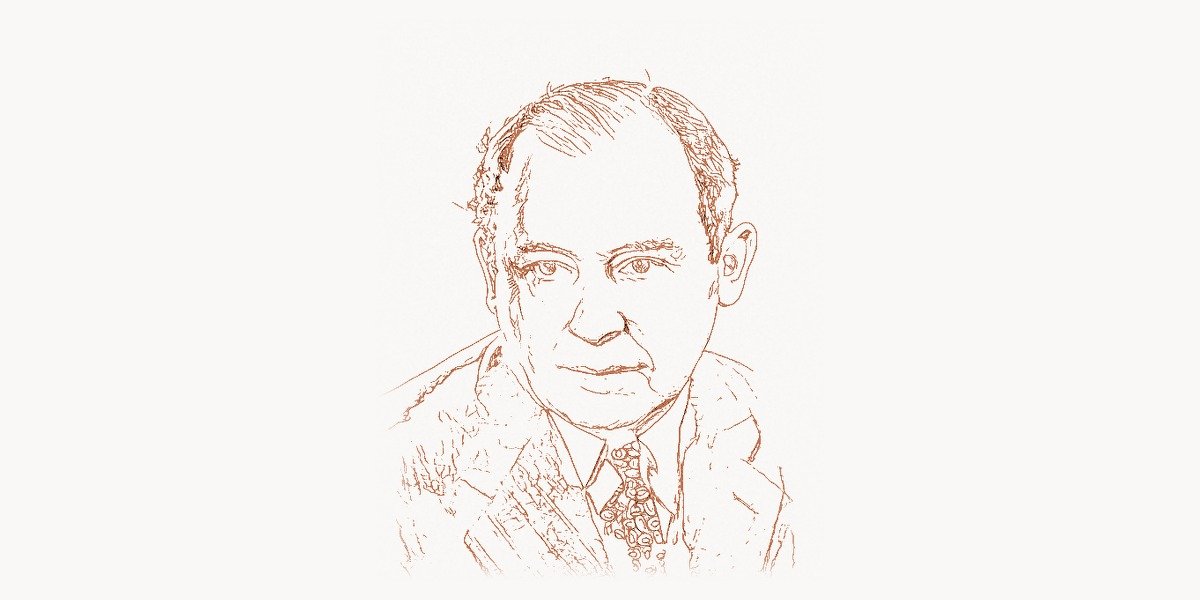
In 1945, a single 101-page document changed the trajectory of computing forever. Titled “First Draft of a Report on the EDVAC,” it described a radical idea: a computer that stores its own program in the same memory as its data. The author was John von Neumann, a Hungarian-American mathematician who had already made foundational contributions to quantum mechanics, game theory, and the atomic bomb. The architecture he outlined in that document — fetch an instruction from memory, decode it, execute it, store the result, repeat — became the blueprint for virtually every general-purpose computer built in the following eight decades. Your laptop, your phone, the servers running web frameworks and cloud infrastructure — all of them are von Neumann machines. The man who formalized how computers should be organized was not a computer engineer by training. He was a polymath whose mind ranged across pure mathematics, physics, economics, and biology, and who saw the stored-program computer as just one of many problems worth solving.
Early Life and Education
John von Neumann was born Neumann Janos Lajos on December 28, 1903, in Budapest, Hungary, into a wealthy Jewish banking family. His father, Miksa Neumann, was a banker who had been granted a minor hereditary title by Emperor Franz Joseph, allowing the family to use the German prefix “von” — hence John von Neumann. From an early age, von Neumann displayed extraordinary intellectual gifts. By age six, he could divide eight-digit numbers in his head. By age eight, he had mastered calculus. His memory was essentially photographic: he could recite entire pages of books he had read years earlier, word for word.
Von Neumann attended the Lutheran Gymnasium in Budapest, one of the most prestigious secondary schools in Hungary. His mathematics teacher, Laszlo Ratz, quickly recognized his exceptional talent and arranged for him to receive private tutoring from mathematicians at the University of Budapest, including Michael Fekete. By the time von Neumann was 17, he had co-authored his first mathematical paper with Fekete on the zeros of certain polynomials.
His formal higher education reflected both his mathematical genius and his father’s pragmatism. He simultaneously enrolled in mathematics at the University of Budapest (which he rarely attended, showing up mainly for exams) and in chemical engineering at ETH Zurich (his father’s concession to practicality). He received his diploma in chemical engineering from ETH in 1925 and his doctorate in mathematics from Budapest in 1926, at age 22. His doctoral thesis, on the axiomatization of set theory, was already a significant contribution to mathematical logic.
After completing his studies, von Neumann held positions at the University of Berlin and the University of Hamburg before being invited to Princeton University in 1930. In 1933, he became one of the original six professors at the newly founded Institute for Advanced Study in Princeton — alongside Albert Einstein. He was 29 years old, the youngest member of the Institute’s faculty. He would remain at the Institute for the rest of his life.
The Stored-Program Computer Breakthrough
Technical Innovation
The early electronic computers of the 1940s — machines like ENIAC (Electronic Numerical Integrator and Computer) — were programmed by physically rewiring their circuits. To change what the computer did, operators had to reconnect cables and set switches by hand, a process that could take days. The machine’s hardware was its program. This was roughly analogous to having to rebuild an engine every time you wanted to drive to a different destination.
Von Neumann’s insight, articulated in the 1945 EDVAC report and refined in subsequent work with Alan Turing‘s theoretical framework, was that the program itself should be stored in the computer’s memory, alongside the data it operates on. This meant programs could be loaded, modified, and replaced without any physical reconfiguration. The computer became a general-purpose machine that could execute any program simply by reading new instructions from memory.
The architecture he described has five core components: a central processing unit (CPU) containing an arithmetic logic unit (ALU) and control unit; a memory unit that stores both instructions and data; input devices; output devices; and a bus system connecting them. Instructions are fetched from memory sequentially (unless a branch instruction redirects the flow), decoded by the control unit, and executed by the ALU. Results are written back to memory.
# Von Neumann Architecture Simulator
# Demonstrates the fetch-decode-execute cycle

class VonNeumannMachine:
    """
    A simplified von Neumann architecture computer.
    Memory holds both instructions and data — the key insight.
    """
    def __init__(self, memory_size=256):
        self.memory = [0] * memory_size   # Unified memory for code + data
        self.pc = 0                        # Program counter
        self.accumulator = 0               # Single register (ALU)
        self.running = True

    # Instruction set:
    # 1 addr -> LOAD  (load memory[addr] into accumulator)
    # 2 addr -> STORE (store accumulator into memory[addr])
    # 3 addr -> ADD   (add memory[addr] to accumulator)
    # 4 addr -> SUB   (subtract memory[addr] from accumulator)
    # 5 addr -> JUMP  (set PC to addr)
    # 6 addr -> JZ    (jump to addr if accumulator == 0)
    # 7 addr -> MUL   (multiply accumulator by memory[addr])
    # 0 0    -> HALT

    def fetch(self):
        """Fetch: read instruction and operand from memory."""
        opcode = self.memory[self.pc]
        operand = self.memory[self.pc + 1]
        self.pc += 2
        return opcode, operand

    def decode_and_execute(self, opcode, operand):
        """Decode the opcode and execute the operation."""
        if opcode == 0:
            self.running = False
        elif opcode == 1:  # LOAD
            self.accumulator = self.memory[operand]
        elif opcode == 2:  # STORE
            self.memory[operand] = self.accumulator
        elif opcode == 3:  # ADD
            self.accumulator += self.memory[operand]
        elif opcode == 4:  # SUB
            self.accumulator -= self.memory[operand]
        elif opcode == 5:  # JUMP
            self.pc = operand
        elif opcode == 6:  # JZ (jump if zero)
            if self.accumulator == 0:
                self.pc = operand
        elif opcode == 7:  # MUL
            self.accumulator *= self.memory[operand]

    def run(self):
        """The fetch-decode-execute cycle — heart of von Neumann."""
        while self.running:
            opcode, operand = self.fetch()
            self.decode_and_execute(opcode, operand)

# Example: compute 7 * 8 + 3 = 59
vm = VonNeumannMachine()
# Program (instructions stored in memory starting at address 0)
vm.memory[0:14] = [
    1, 100,   # LOAD  memory[100]  -> acc = 7
    7, 101,   # MUL   memory[101]  -> acc = 7 * 8 = 56
    3, 102,   # ADD   memory[102]  -> acc = 56 + 3 = 59
    2, 103,   # STORE memory[103]  -> memory[103] = 59
    0, 0      # HALT
]
# Data (stored in the SAME memory — von Neumann's key insight)
vm.memory[100] = 7
vm.memory[101] = 8
vm.memory[102] = 3

vm.run()
print(f"Result: {vm.memory[103]}")  # Output: Result: 59
This code illustrates the essential von Neumann idea: instructions (the program at addresses 0-9) and data (the values at addresses 100-103) share the same memory space. The machine fetches instructions sequentially, decodes them, and executes operations using the ALU. This is precisely what every modern CPU does billions of times per second.
Why It Mattered
The stored-program concept transformed the computer from a specialized calculator into a universal tool. Before von Neumann, each computation required a machine specifically configured for that task. After von Neumann, a single machine could run any program — a word processor, a scientific simulation, a web server, a code editor — simply by loading different instructions into memory. This is the reason software exists as a distinct concept from hardware.
The economic implications were staggering. Instead of building a new machine for every new task, you could build one machine and write different programs for it. This made general-purpose computing economically viable and created the entire software industry. Every programming language from Fortran to Python, every operating system from Unix to Linux, every application ever written depends on the von Neumann architecture’s separation of the machine from its instructions.
It is worth noting that the attribution of this architecture solely to von Neumann has been controversial. J. Presper Eckert and John Mauchly, the designers of ENIAC and EDVAC, argued that the stored-program concept was a collaborative effort and that von Neumann received disproportionate credit because the EDVAC report was distributed under his name alone. Turing independently developed similar ideas in his 1936 Universal Turing Machine paper and his 1945 ACE design. The historical consensus is that the stored-program concept emerged from the interaction of multiple brilliant minds, but von Neumann’s formulation was the most influential in shaping how computers were actually built.
Other Contributions
The von Neumann architecture would have been enough to secure a permanent place in the history of technology. But for von Neumann, it was a side project — one thread in a career of extraordinary breadth and depth.
Game Theory. In 1928, von Neumann proved the minimax theorem, establishing the mathematical foundation of game theory. His 1944 book “Theory of Games and Economic Behavior,” co-authored with economist Oskar Morgenstern, created game theory as a formal discipline. The book demonstrated that economic behavior, military strategy, and political decisions could be analyzed using rigorous mathematical models. Game theory has since become essential in economics (multiple Nobel Prizes have been awarded for game-theoretic work), evolutionary biology, political science, and computer science. Modern algorithms for adversarial search, auction design, and multi-agent systems all trace their lineage to von Neumann’s foundational work.
EDVAC and the First Computers. Beyond writing the theoretical report, von Neumann was deeply involved in the practical development of stored-program computers. He led the design of the IAS machine at the Institute for Advanced Study, completed in 1951, which became the template for an entire generation of computers worldwide. The IBM 701, the ILLIAC series, the MANIAC, the JOHNNIAC (named after von Neumann himself), and many other early computers were directly based on the IAS architecture. Von Neumann personally wrote programs for these machines and understood their hardware at the transistor level.
The Manhattan Project. Von Neumann was recruited to the Manhattan Project in 1943, where he made critical contributions to the design of the implosion-type nuclear weapon. He performed the complex hydrodynamic calculations needed to determine the precise geometry of the explosive lenses that would compress the plutonium core to critical density. He also devised the concept of the explosive lens itself — the idea of shaping conventional explosives to focus their blast wave inward, much as an optical lens focuses light. The “Fat Man” bomb dropped on Nagasaki used the implosion design that von Neumann helped develop. His work on the bomb also motivated his interest in computers: the fluid dynamics calculations required for nuclear weapons design were so complex that only electronic computers could perform them in a reasonable time.
Cellular Automata. In the late 1940s, von Neumann began studying self-reproducing machines — the question of whether a machine could build a copy of itself. Working with Stanislaw Ulam, he developed the theory of cellular automata: grids of cells that evolve according to simple local rules but can produce complex global behavior. Von Neumann proved that a cellular automaton with 29 states could be constructed that was capable of universal computation and self-reproduction. This work laid the groundwork for the field of artificial life and directly inspired John Conway’s Game of Life (1970), Claude Shannon‘s work on information and automata, Stephen Wolfram’s research on computational complexity, and modern research in self-assembling nanotechnology.
Merge Sort. In 1945, von Neumann invented merge sort, one of the most important sorting algorithms in computer science. Merge sort divides a list into halves, recursively sorts each half, and then merges the sorted halves. It runs in O(n log n) time in all cases — the theoretical optimum for comparison-based sorting — and is stable (preserving the relative order of equal elements). Merge sort remains widely used today, particularly for sorting linked lists and in external sorting (when data is too large to fit in memory). Python’s Timsort algorithm, used as the default sort in Python, Java, and Android, is a hybrid algorithm based on merge sort.
/* Von Neumann's Merge Sort (1945)
 * One of the first algorithms designed specifically
 * for the stored-program computer architecture.
 * Guarantees O(n log n) — the theoretical optimum.
 */

#include <stdio.h>
#include <string.h>

void merge(int arr[], int left, int mid, int right) {
    int n1 = mid - left + 1;
    int n2 = right - mid;
    int L[n1], R[n2];

    memcpy(L, &arr[left], n1 * sizeof(int));
    memcpy(R, &arr[mid + 1], n2 * sizeof(int));

    int i = 0, j = 0, k = left;
    while (i < n1 && j < n2) {
        if (L[i] <= R[j])
            arr[k++] = L[i++];
        else
            arr[k++] = R[j++];
    }
    while (i < n1) arr[k++] = L[i++];
    while (j < n2) arr[k++] = R[j++];
}

void merge_sort(int arr[], int left, int right) {
    if (left < right) {
        int mid = left + (right - left) / 2;
        merge_sort(arr, left, mid);
        merge_sort(arr, mid + 1, right);
        merge(arr, left, mid, right);
    }
}

int main() {
    int data[] = {38, 27, 43, 3, 9, 82, 10};
    int n = sizeof(data) / sizeof(data[0]);

    merge_sort(data, 0, n - 1);

    for (int i = 0; i < n; i++)
        printf("%d ", data[i]);
    /* Output: 3 9 10 27 38 43 82 */
    return 0;
}
Quantum Mechanics. Von Neumann's 1932 book "Mathematische Grundlagen der Quantenmechanik" (Mathematical Foundations of Quantum Mechanics) provided the first rigorous mathematical framework for quantum theory. He formulated quantum mechanics in terms of operators on Hilbert spaces, a framework that remains standard today. He also introduced the concept of quantum entropy and the density matrix, tools that are essential in modern quantum computing and quantum information theory. When researchers at Google, IBM, and academic labs build quantum computers today, they work within the mathematical formalism that von Neumann established nearly a century ago.
Philosophy and Engineering Approach
Key Principles
Von Neumann's intellectual approach was characterized by a ruthless clarity and speed that awed even his most brilliant contemporaries. Hans Bethe, a Nobel laureate in physics, once said that he sometimes wondered whether von Neumann's brain indicated a species superior to humans. Edward Teller, another physicist of extraordinary ability, said that von Neumann would effortlessly handle problems that had taken Teller weeks to solve.
Several principles defined his work. First, he believed in the power of mathematical formalization. Whether the domain was quantum mechanics, economics, computing, or biology, von Neumann's approach was to strip the problem to its mathematical essence, formalize it rigorously, and then derive consequences. This is exactly what he did with game theory (formalizing strategic interaction), the stored-program computer (formalizing machine architecture), and cellular automata (formalizing self-reproduction).
Second, he was fearlessly interdisciplinary. At a time when academic specialization was becoming the norm, von Neumann moved freely between pure mathematics, applied mathematics, physics, economics, engineering, and biology. He did not merely dabble — he made foundational contributions in each field. This breadth was not random; he had an unusual ability to see structural similarities across different domains and to transfer techniques from one to another.
Third, he valued practical results alongside theoretical elegance. Unlike some pure mathematicians who disdained applications, von Neumann was deeply engaged with engineering and worked closely with the teams building the first computers. He wrote machine code by hand, debugged hardware problems, and insisted that his theoretical designs be tested against physical reality. For modern development teams working on complex system architectures, platforms like Taskee can help coordinate the kind of cross-disciplinary collaboration that von Neumann championed — bridging the gap between theoretical design and practical implementation.
Fourth, he worked at extraordinary speed. Colleagues reported that von Neumann could solve complex problems in his head faster than most mathematicians could solve them on paper. He was known for arriving at conferences and solving open problems during coffee breaks. This speed was not mere facility — it reflected a depth of understanding that allowed him to see shortcuts invisible to others. For organizations seeking to build engineering cultures that prioritize both rigor and velocity, consulting firms like Toimi specialize in helping teams adopt architectures and workflows that maximize both speed and reliability.
Legacy and Modern Relevance
The von Neumann architecture is so pervasive that it is essentially invisible. Every conventional computer — from embedded microcontrollers to supercomputers — follows the basic pattern of fetching instructions from memory, decoding them, and executing them sequentially. When developers write code in any imperative programming language, they are implicitly assuming a von Neumann machine: variables are memory locations, assignments are store operations, and the program executes statements in order. The entire edifice of modern software — operating systems, compilers, databases, Unix, the internet — rests on the architectural foundation von Neumann described in 1945.
The concept of the "von Neumann bottleneck," identified by John Backus in his 1977 Turing Award lecture, remains one of the central challenges in computer architecture. Because the CPU and memory communicate through a single shared bus, the speed of computation is limited by the rate at which data can be transferred between them — regardless of how fast the processor itself is. Modern hardware addresses this through caching hierarchies, pipelining, branch prediction, and parallel processing, but the fundamental bottleneck persists. Alternative architectures — dataflow machines, neural network processors, quantum computers — represent various attempts to escape the von Neumann model, but none has replaced it for general-purpose computing.
Von Neumann's game theory is now integral to computer science. Nash equilibria are computed in auction algorithms that power Google's ad marketplace. Adversarial game trees are the basis of chess engines and Go programs. Multi-agent reinforcement learning — the technique behind OpenAI's Dota 2 bots and DeepMind's StarCraft II agents — is a direct descendant of von Neumann's strategic analysis. The mechanism design work that won economists Leonid Hurwicz, Roger Myerson, and Eric Maskin the 2007 Nobel Prize is built on game-theoretic foundations that von Neumann established.
His cellular automata work foreshadowed complexity theory and artificial life. Conway's Game of Life, directly inspired by von Neumann's self-reproducing automata, became one of the most studied objects in recreational mathematics and theoretical computer science. Von Neumann's proof that a cellular automaton could be self-reproducing anticipated the discovery of DNA's structure by Watson and Crick in 1953 — he showed mathematically that self-reproduction was possible before biologists understood the physical mechanism.
Von Neumann died of cancer on February 8, 1957, at the age of 53. Even on his deathbed at Walter Reed Army Medical Center, he was surrounded by military officials receiving briefings — his contributions to nuclear strategy and ballistic missile defense were considered so important that the Pentagon could not afford to lose access to his mind. He was given last rites by a Catholic priest, having converted to Catholicism near the end of his life. His colleague Eugene Wigner commented that the loss of von Neumann was felt more deeply by the scientific community than any death since that of Grace Hopper's contemporary, Albert Einstein.
The IEEE John von Neumann Medal, established in 1990, is awarded annually for outstanding achievements in computer-related science and technology. The von Neumann architecture, game theory, cellular automata, merge sort, the mathematical foundations of quantum mechanics — any one of these achievements would constitute a remarkable career. That a single mind produced all of them in 53 years remains one of the most extraordinary facts in the history of science. Every time a processor fetches its next instruction from memory, it is executing the design that John von Neumann set down on paper in 1945.
Key Facts
- Born: December 28, 1903, Budapest, Hungary
- Died: February 8, 1957, Washington, D.C., United States
- Known for: Von Neumann architecture (stored-program computer), game theory, cellular automata, mathematical foundations of quantum mechanics, merge sort algorithm
- Key projects: EDVAC report (1945), IAS machine (1951), "Theory of Games and Economic Behavior" (1944), "Mathematische Grundlagen der Quantenmechanik" (1932), Manhattan Project (1943-1945)
- Awards: Enrico Fermi Award (1956), Medal of Freedom (1956), Member of the National Academy of Sciences, Fellow of the American Mathematical Society
- Education: Ph.D. in Mathematics from University of Budapest (1926), Diploma in Chemical Engineering from ETH Zurich (1925)
- Programming legacy: Invented merge sort (1945); von Neumann architecture remains the basis of virtually all modern CPUs
Frequently Asked Questions
What is the von Neumann architecture?
The von Neumann architecture is a computer design model in which a single memory stores both program instructions and data. The computer operates by fetching instructions from memory sequentially, decoding them, executing them using an arithmetic logic unit, and writing results back to memory. This fetch-decode-execute cycle is the fundamental operating principle of virtually every general-purpose computer built since the 1950s. The architecture was first described by John von Neumann in the 1945 EDVAC report and implemented in the IAS machine at Princeton in 1951. Its key innovation was separating the concept of a program from the physical hardware, enabling a single machine to run any software simply by loading different instructions into memory.
What did John von Neumann contribute to computer science?
Von Neumann's contributions to computer science include the stored-program computer architecture (the EDVAC report, 1945), which became the standard blueprint for all conventional computers; the design and construction of the IAS machine (1951), which served as the template for a generation of computers worldwide; the invention of merge sort (1945), a fundamental sorting algorithm still in wide use; the theory of cellular automata, which he developed with Stanislaw Ulam to study self-reproducing machines; and foundational work on numerical methods for scientific computing. He also made contributions to the theory of computation through his interactions with Alan Turing and his work on self-reproducing automata, which anticipated concepts in artificial life and computational complexity. Beyond computer science, his mathematical formalization of quantum mechanics and his creation of game theory have had profound influences on physics, economics, and many other fields.
Why is the von Neumann bottleneck important?
The von Neumann bottleneck refers to the limitation on throughput caused by the shared communication channel (bus) between the CPU and memory in the von Neumann architecture. Because the processor must fetch both instructions and data from the same memory through the same bus, the speed of computation is constrained by memory bandwidth rather than processor speed. Gordon Moore's observation about exponential growth in transistor density has made processors dramatically faster over time, but memory speed has not kept pace — creating an ever-widening performance gap. Modern hardware mitigates this with multi-level cache hierarchies (L1, L2, L3), prefetching, branch prediction, and out-of-order execution. Alternative architectures such as Harvard architecture (separate instruction and data memories), dataflow processors, and neuromorphic chips attempt to bypass the bottleneck entirely. Despite these efforts, the von Neumann model remains dominant because its simplicity and generality make it the most practical foundation for general-purpose computing.