In February 1962, John Glenn was about to become the first American to orbit the Earth. The mission was Friendship 7, the spacecraft was the Mercury-Atlas 6, and the stakes could not have been higher. NASA had spent months programming the trajectory on its new IBM 7090 mainframe computers — electronic machines that filled entire rooms and represented the cutting edge of Cold War computing. The orbital mechanics calculations were done. The numbers had been checked. But Glenn did not trust the computers. Before he would climb into the capsule, he made one request to mission controllers: “Get the girl to check the numbers.”
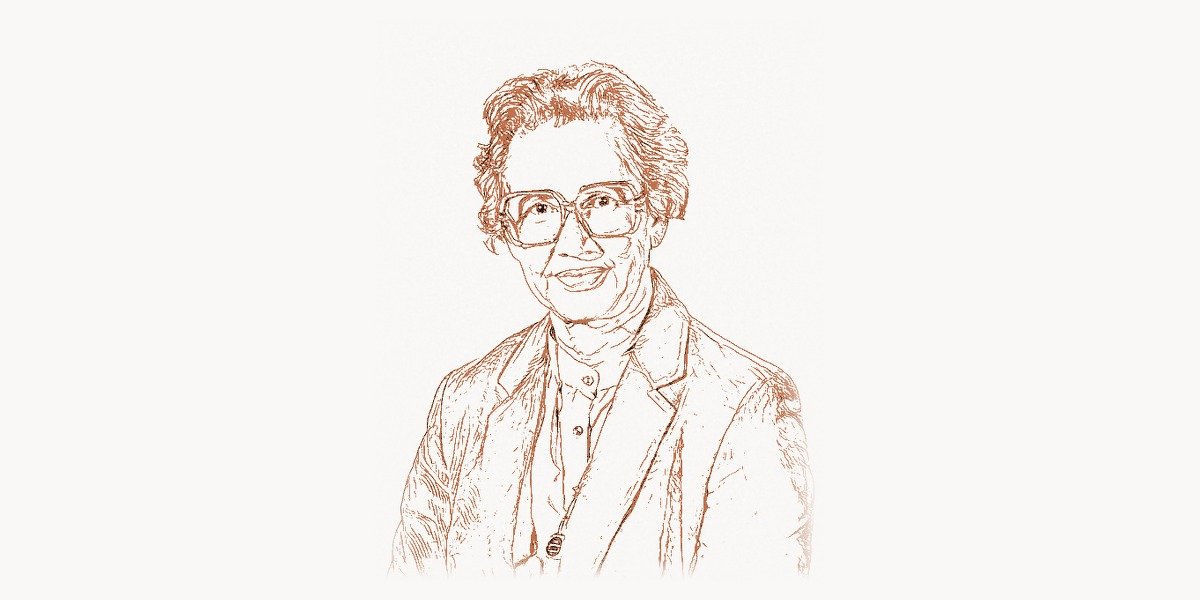
The girl was Katherine Johnson, a 43-year-old mathematician working in the Spacecraft Controls Branch at NASA’s Langley Research Center in Hampton, Virginia. She was African American. She was a woman. She worked in an era when both of those facts meant she was expected to sit quietly at a desk, run calculations someone else had framed, and stay invisible. Instead, she spent three days manually verifying the IBM’s orbital trajectory computations — equations involving gravitational acceleration, initial velocity vectors, orbital insertion angles, and atmospheric reentry windows. Her numbers matched the machine’s. Glenn flew. He orbited three times and came home alive. Johnson’s hand calculations had confirmed the path that kept him there.
That moment captured something essential about Johnson’s career: she was the human check on the machine. Over 33 years at NASA, she calculated trajectories for every major crewed spaceflight program from Mercury through the early Space Shuttle, including the orbital mechanics for Apollo 11. Her work was not theoretical — it was life-or-death applied mathematics, and the astronauts knew it.
Early Life and Path to Mathematics
Katherine Coleman was born on August 26, 1918, in White Sulphur Springs, West Virginia. Her father, Joshua Coleman, was a farmer and lumberman. Her mother, Joylette, was a former schoolteacher. From the earliest age, Katherine showed an extraordinary facility with numbers. She counted everything — the steps to the church, the dishes she washed, the stars she could see from the porch. By six, she was so far ahead of her peers that her parents faced a difficult decision.
White Sulphur Springs had no public school that admitted Black students beyond the eighth grade. Joshua Coleman’s solution was to move the family 120 miles to Institute, West Virginia, every school year so that Katherine and her siblings could attend the high school on the campus of West Virginia State College (now West Virginia State University), a historically Black institution. The family lived in two worlds, commuting annually, because Joshua Coleman was determined that his children would be educated.
Katherine entered high school at age 10 and graduated at 14. She enrolled at West Virginia State College in 1933, at age 15, and studied mathematics under W.W. Schieffelin Claytor, the third African American to earn a Ph.D. in mathematics in the United States. Claytor recognized Johnson’s exceptional ability and created an analytic geometry course specifically for her — a course that had never been offered at the college before. He told her she would make a fine research mathematician. She graduated summa cum laude in 1937, at age 18, with degrees in mathematics and French.
After college, Johnson taught at a Black public school in Marion, Virginia. In 1939, she became one of the first three African American students — and the only woman — selected to integrate the graduate program at West Virginia University. She left after one year to start a family. For the next decade, she taught school and raised her children. It was not until 1953, at age 34, that she entered the profession that would define her legacy.
The Breakthrough: Orbital Mechanics at NASA
The Technical Innovation
In 1953, Johnson was hired by the National Advisory Committee for Aeronautics (NACA) — the precursor to NASA — at the Langley Memorial Aeronautical Laboratory. She joined the West Area Computing section, a group of African American women mathematicians who performed complex calculations by hand. They were called “computers” — human beings whose job was to compute. The West Area Computers worked in a segregated building, used a separate bathroom, and ate at a separate cafeteria table labeled “Colored Computers.”
Johnson’s mathematical skills quickly attracted attention. After two weeks in the computing pool, she was temporarily assigned to the Maneuver Loads Branch of the Flight Research Division. The “temporary” assignment became permanent — the branch’s engineers recognized her ability and refused to send her back. She was the first woman and first African American in the branch. She asked questions in meetings, which women in the computing pool were not expected to do. When told that women did not attend editorial meetings for research reports, she asked, “Is there a law against it?” There was not. She attended.
When NASA was established in 1958, absorbing NACA, segregation at Langley was officially abolished — though it had already been eroding for years, partly because of people like Johnson who simply refused to observe the boundaries. Johnson moved to the Spacecraft Controls Branch, where she began the work that would define her career: computing the trajectories for America’s first crewed spaceflights.
The core challenge was orbital mechanics — predicting a spacecraft’s path under the influence of gravity from Earth, Moon, and Sun, while accounting for rocket thrust, atmospheric drag, and the rotation of the Earth beneath the orbiting vehicle. The governing equations derive from Newton’s law of universal gravitation and the vis-viva equation:
# Orbital Mechanics — Core Equations Used by Katherine Johnson
# These are the mathematical foundations she computed by hand

# === Vis-Viva Equation ===
# Relates orbital velocity to position in an elliptical orbit
# v^2 = GM * (2/r - 1/a)
#
# Where:
#   v  = orbital velocity (m/s)
#   G  = gravitational constant (6.674 × 10^-11 N⋅m²/kg²)
#   M  = mass of Earth (5.972 × 10^24 kg)
#   r  = current distance from Earth's center (m)
#   a  = semi-major axis of the orbit (m)
#
# GM (Earth) = 3.986 × 10^14 m³/s² (standard gravitational parameter)

# === Orbital Period ===
# T = 2π * sqrt(a³ / GM)
# For Mercury-Atlas 6 (John Glenn's flight):
#   Orbital altitude ≈ 260 km → r = 6,371 + 260 = 6,631 km
#   a ≈ 6,631 km = 6,631,000 m
#   T = 2π * sqrt((6,631,000)³ / (3.986 × 10^14))
#   T ≈ 5,376 seconds ≈ 88.6 minutes per orbit

# === Reentry Window Calculation ===
# The critical computation: when and where to fire retro-rockets
# so the capsule hits the atmosphere at the correct angle
#
# Reentry angle (γ) must satisfy:
#   -1° > γ > -7° (relative to local horizontal)
#
# Too shallow (γ > -1°): capsule skips off atmosphere into space
# Too steep (γ < -7°): capsule experiences fatal deceleration (>12g)
#
# Johnson computed the exact retrofire time, burn duration,
# and capsule orientation to achieve γ ≈ -1.5° over the Atlantic

# === Euler Method for Trajectory Integration ===
# Before digital computers, Johnson used numerical methods
# to integrate the equations of motion step by step:
#
# For each small time step Δt:
#   acceleration = -GM * r_vector / |r|³   (gravitational)
#   v_new = v_old + acceleration * Δt
#   r_new = r_old + v_new * Δt
#
# She performed these calculations across hundreds of steps
# using a desktop mechanical calculator and pencil
For Glenn’s orbital flight, Johnson computed the precise moment and angle for retrofire — firing braking rockets to drop the capsule into the atmosphere at exactly the right angle. Too shallow, and the capsule would skip off the atmosphere into space. Too steep, and the deceleration forces would be lethal. The margin between success and death was measured in fractions of a degree.
Johnson computed these trajectories using the Euler method of numerical integration — stepping through the equations of motion in small time increments, calculating gravitational forces, velocity changes, and position updates at each step. She did this on a desktop mechanical calculator, plotting results by hand. When the IBM 7090 was brought in to perform the same calculations electronically, Glenn’s request that Johnson verify the machine’s output was practical risk management, not sentimentality. The IBM’s software was new and unproven. Johnson’s track record was established.
Why It Mattered
Johnson’s work on the Mercury and Gemini programs established the mathematical procedures NASA would use throughout the crewed spaceflight era. Her 1960 research report, “Determination of Azimuth Angle at Burnout for Placing a Satellite Over a Selected Earth Position” — co-authored with Ted Skopinski — was one of the first technical papers from the Flight Research Division to have a woman as an author. The report laid out the geometry for computing the precise launch window and trajectory to place a spacecraft into orbit over a specific ground target.
For Apollo, Johnson computed the trajectory for the Apollo 11 mission in 1969, including the translunar injection maneuver that sent the spacecraft from Earth orbit to the Moon. She also worked on contingency return-to-Earth calculations for abort scenarios. These proved their worth during Apollo 13 in 1970, when an oxygen tank explosion forced the crew to use the lunar module as a lifeboat. The emergency return trajectory relied on mathematical frameworks Johnson had helped develop. When Margaret Hamilton’s software engineering kept the onboard computers running, it was Johnson’s trajectory mathematics that told those computers where to go.
Johnson later worked on the Space Shuttle program and early Mars mission planning. She retired from NASA in 1986, after 33 years and 26 co-authored research reports — a remarkable output for someone whose official role classification was “computer,” not “researcher” or “engineer.”
Beyond Mercury: Contributions Across NASA Programs
Johnson’s work extended far beyond Mercury-Atlas 6. During the Gemini program (1961-1966), she worked on orbital rendezvous calculations — the mathematics required for two spacecraft to find each other in orbit and dock. Rendezvous was essential for Apollo’s lunar orbit strategy, where the lunar module would separate from the command module, land on the Moon, and then rejoin for the return trip. The rendezvous calculations required solving the Lambert problem: given two objects in different orbits, compute the exact thrust to move one to the other at a specified time.
# Orbital Rendezvous — The Lambert Problem
# Johnson solved this for Gemini/Apollo rendezvous planning
#
# Problem: Two spacecraft in different orbits around Earth
#   Chaser position: r1 (known vector)
#   Target position:  r2 (known vector)
#   Transfer time:    Δt (specified by mission plan)
#   Find: velocity v1 at r1 to reach r2 in time Δt
#
# This is a two-point boundary value problem in orbital mechanics

import math

def lambert_transfer(r1, r2, delta_t, mu):
    """Simplified Lambert solver for coplanar orbits."""
    r1_mag = math.sqrt(r1[0]**2 + r1[1]**2)
    r2_mag = math.sqrt(r2[0]**2 + r2[1]**2)

    cos_theta = (r1[0]*r2[0] + r1[1]*r2[1]) / (r1_mag * r2_mag)
    c = math.sqrt(r1_mag**2 + r2_mag**2 - 2*r1_mag*r2_mag*cos_theta)
    s = (r1_mag + r2_mag + c) / 2

    # Iterate to find semi-major axis matching transfer time
    # Johnson used successive approximation on a desk calculator
    a = s / 2  # minimum energy estimate
    for _ in range(50):
        alpha = 2 * math.asin(math.sqrt(s / (2*a)))
        beta  = 2 * math.asin(math.sqrt((s - c) / (2*a)))
        t_calc = math.sqrt(a**3/mu) * (
            (alpha - math.sin(alpha)) - (beta - math.sin(beta)))
        if abs(t_calc - delta_t) < 0.1:
            break
        a *= (delta_t / t_calc) ** (2/3)

    # Lagrange coefficients → departure velocity
    f = 1 - (a / r1_mag) * (1 - math.cos(alpha - beta))
    g = delta_t - math.sqrt(a**3/mu) * (
        (alpha - beta) - (math.sin(alpha) - math.sin(beta)))
    return [(r2[0] - f*r1[0]) / g, (r2[1] - f*r1[1]) / g]

# Example: rendezvous from 200 km orbit to 300 km orbit
MU_EARTH = 3.986e14  # m³/s²
v = lambert_transfer([6_571_000, 0], [0, 6_671_000], 3600, MU_EARTH)
print(f"Departure velocity: [{v[0]:.1f}, {v[1]:.1f}] m/s")
Johnson's ability to perform these computations by hand was not simply a matter of arithmetic skill. It required deep physical intuition about orbital mechanics, an understanding of which approximations were safe and which would introduce dangerous errors, and the discipline to carry multi-step calculations across hundreds of iterations without a single mistake. The methods she used — numerical integration, successive approximation, coordinate transformations — are the same methods implemented in modern computational tools, but she executed them with pencil, paper, and a desktop calculator.
The Human Computer in the Age of Machines
Johnson's career spanned a pivotal transition in computing history. When she arrived at NACA in 1953, all complex calculations were performed by human mathematicians using desktop mechanical calculators, slide rules, and graph paper. By the time she retired in 1986, NASA was using supercomputers. She embraced the new technology, learning to program in FORTRAN — the language created by John Backus at IBM specifically for scientific and engineering computation. She used electronic computers as tools that amplified her mathematical ability, not as replacements for it.
But she also understood their limitations. She knew that a computer's output was only as good as its input and its programming. Bugs in the software, errors in data entry, incorrect assumptions baked into the algorithms — all could produce results that looked authoritative but were dangerously wrong. This is why Glenn's request for Johnson to verify the IBM's calculations was rational, not nostalgic. In 1962, electronic computers were new and their software was immature. Johnson was a known quantity.
This dynamic — the tension between trusting automated systems and maintaining human oversight — remains central in modern technology. When project managers debate how much to automate and how much to keep under human review, they are grappling with the same question Glenn answered in 1962. The modern practice of code review, where developers examine automated test results and machine-generated code rather than simply trusting the output, carries the same philosophy. Tools like Taskee help teams organize these review workflows so that human oversight is systematic rather than ad hoc.
Philosophy and Approach
Key Principles
Johnson's approach was shaped by her education, her personality, and the constraints of working in an environment designed to exclude her. Several principles defined her work:
- Ask questions, demand inclusion. Johnson's refusal to accept exclusion from meetings and authorship improved the quality of the work. By insisting on understanding the full context of the problems she solved, she caught errors invisible from a subordinate position. In modern project management, this manifests as cross-functional collaboration — the recognition that people who do the work must understand why.
- Verify everything. No calculation should be trusted until independently verified. Johnson applied this to her own work and to electronic computers. This is the ancestor of test-driven development, peer code review, and the principle that every calculation in a CI/CD pipeline should be reproducible.
- Understand the physics, not just the math. Johnson was not merely a calculator — she understood the physical systems her equations described. She knew what an orbit looked like, how gravity bent trajectories, and what would happen if a number was wrong. This physical intuition allowed her to spot errors that pure arithmetic checking would miss. In software engineering, the equivalent is domain knowledge: the best engineers understand the context of their code, not just the syntax.
- Precision is not optional. In orbital mechanics, a rounding error in the fifth decimal place can mean a reentry miss of dozens of miles. Johnson developed personal systems for checking and cross-checking that eliminated errors over a 33-year career. This commitment underpins modern performance engineering and numerical computing, where small errors compound into large failures.
- Persistence over protest. Johnson did not campaign publicly against segregation or sexism. She simply did the work, asked the questions, attended the meetings, and produced results that were impossible to ignore. Her strategy was to make herself indispensable — to be so good that excluding her was a cost the organization could not afford. Demonstrated competence is the most powerful argument against arbitrary barriers.
Legacy and Modern Relevance
Johnson's legacy operates on two levels: the mathematical contributions she made to spaceflight, and the broader significance of her career as an African American woman in a field that actively excluded both.
On the technical level, Johnson's trajectory calculations were essential to Mercury, Gemini, Apollo, and the early Space Shuttle. The mathematical methods she used — numerical integration, Lambert problem solutions, coordinate transformations for reentry targeting — remain the foundation of modern astrodynamics. Every spacecraft trajectory computed today uses descendants of the methods Johnson applied by hand.
On the cultural level, Johnson's career demonstrated that barriers excluding Black people and women from STEM were arbitrary and costly. NACA/NASA was losing mathematical talent by segregating its workforce. Johnson's success proved the organization was impoverishing itself by failing to use all available talent. This argument remains relevant to modern technology, where diversity in engineering teams correlates with better problem-solving and fewer blind spots. Agencies like Toimi emphasize diverse team composition precisely because varied perspectives produce stronger technical outcomes.
Johnson received the Presidential Medal of Freedom in 2015. In 2016, her story reached a global audience through the book and film "Hidden Figures." In 2017, NASA named its Langley computational research facility after her. In 2019, she received the Congressional Gold Medal at age 101.
Katherine Johnson died on February 24, 2020, at the age of 101. She had lived long enough to see her work publicly recognized and her story told to millions. Electronic computers had long surpassed human mathematical ability by orders of magnitude — and yet the principle she embodied, that human understanding must accompany automated computation, remains vital. Every time a developer reviews an AI-generated code suggestion, every time a code editor flags a potential error for human review, the spirit of Katherine Johnson's insistence on mathematical certainty persists.
Key Facts
- Born: August 26, 1918, White Sulphur Springs, West Virginia, USA
- Died: February 24, 2020, Newport News, Virginia, USA (age 101)
- Known for: Orbital trajectory calculations for Mercury, Gemini, Apollo, and Space Shuttle programs; verifying IBM computer output for John Glenn's orbital flight
- Key contributions: Mercury-Atlas 6 trajectory verification (1962), Apollo 11 translunar trajectory (1969), Apollo 13 contingency return calculations, Gemini rendezvous orbital mechanics, 26 co-authored NASA research reports
- Awards: Presidential Medal of Freedom (2015), Congressional Gold Medal (2019), NASA Langley facility named in her honor (2017)
- Education: B.S. summa cum laude in Mathematics and French from West Virginia State College (1937)
Frequently Asked Questions
Who was Katherine Johnson?
Katherine Johnson (1918-2020) was an African American mathematician at NASA's Langley Research Center for 33 years (1953-1986). She calculated orbital trajectories for America's first crewed spaceflights, including John Glenn's Mercury-Atlas 6 mission (1962) and the Apollo 11 Moon landing (1969). Glenn personally requested that Johnson verify the IBM mainframe's trajectory calculations before his flight. She co-authored 26 NASA research reports and received the Presidential Medal of Freedom in 2015.
What did Katherine Johnson calculate for NASA?
Johnson computed spacecraft trajectories — the precise paths through space under the influence of gravity, thrust, and atmospheric drag. For Mercury, she calculated launch windows, orbital parameters, and reentry trajectories. For Gemini, she worked on orbital rendezvous calculations. For Apollo, she computed translunar injection trajectories and contingency return paths critical during the Apollo 13 emergency. She also contributed to Space Shuttle trajectory planning. Her tools included the vis-viva equation, Lambert problem solutions, and numerical integration — initially performed by hand on a desktop mechanical calculator.
Why did John Glenn ask Katherine Johnson to check the computer?
In 1962, electronic computers were new and their software was unproven. Glenn understood that a software bug or data entry error in the IBM 7090's calculations could put his life at risk. Johnson had a proven track record of precise, error-free work on critical flight problems. Asking her to verify the machine's output was a rational engineering decision: use the most reliable verification available. Her numbers matched the IBM's, and Glenn flew with confidence.
How did Katherine Johnson's work relate to the Apollo 11 Moon landing?
Johnson calculated the trajectory for Apollo 11's translunar injection — the engine burn that sent the spacecraft from Earth orbit to the Moon. She also computed contingency return trajectories: emergency paths the crew could follow to return safely if something went wrong. These abort trajectories accounted for the gravitational fields of both Earth and Moon, fuel constraints, and the Earth-Moon geometry at the time of the mission. The contingency calculations proved their worth during the Apollo 13 emergency in 1970.
What is Katherine Johnson's legacy in modern technology?
Johnson's legacy extends beyond spaceflight into core engineering principles. Her insistence on independent verification of computer output anticipated the modern emphasis on testing, code review, and human oversight of automated systems. Her trajectory methods remain the foundation of modern astrodynamics. Culturally, her career demonstrated the cost of excluding talented people from technical work based on race or gender. Her story, popularized by the 2016 film "Hidden Figures," inspired a generation to pursue careers in STEM.