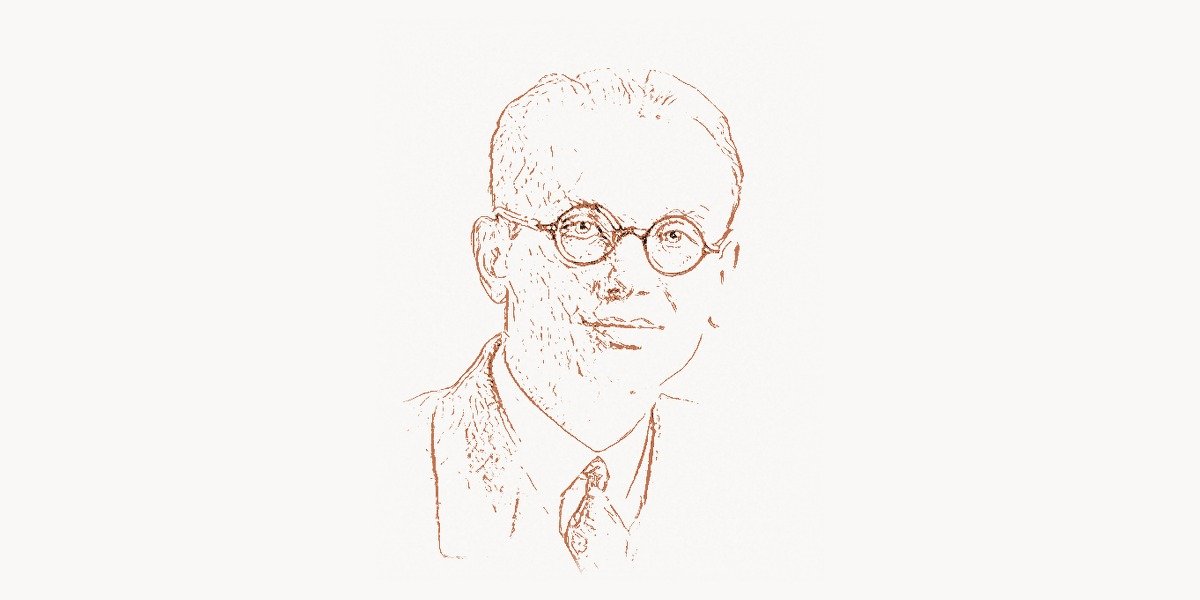
In 1931, a quiet 25-year-old Austrian mathematician walked into a Vienna seminar and calmly dismantled one of the grandest intellectual projects in human history. David Hilbert’s program — the ambitious effort to place all of mathematics on a complete, consistent, and decidable foundation — had been the dream of the world’s greatest logicians for decades. Kurt Gödel showed, with devastating precision, that this dream was impossible. His incompleteness theorems didn’t merely refute a conjecture; they redrew the boundaries of what formal systems can ever achieve. In doing so, Gödel laid the conceptual bedrock upon which Alan Turing, John von Neumann, and an entire generation of computer scientists would build the theoretical framework of modern computing.
Early Life and the Vienna Circle
Kurt Friedrich Gödel was born on April 28, 1906, in Brünn, Austria-Hungary (now Brno, Czech Republic). From childhood, he displayed an insatiable curiosity — his family nicknamed him “der Herr Warum” (Mr. Why) for his relentless questioning. He enrolled at the University of Vienna in 1924, initially studying physics before gravitating toward mathematics and logic.
Vienna in the 1920s was an extraordinary intellectual cauldron. The Vienna Circle — a group of philosophers, mathematicians, and scientists including Moritz Schlick, Rudolf Carnap, and Hans Hahn — met regularly to discuss the foundations of science and logic. Though Gödel attended their meetings, he never fully embraced logical positivism. Instead, he was drawn toward mathematical Platonism: the belief that mathematical truths exist independently of human minds. This philosophical stance would profoundly shape his approach to the foundations of mathematics.
Under the supervision of Hans Hahn, Gödel completed his doctoral thesis in 1929, proving the completeness of first-order predicate logic. This completeness theorem — distinct from his later incompleteness results — demonstrated that every logically valid formula in first-order logic can be formally proved. It was an elegant result, and it seemed to support Hilbert’s optimism. But Gödel was already thinking far beyond it.
Hilbert’s Program and the Crisis in Foundations
To understand why Gödel’s incompleteness theorems were so revolutionary, one must grasp the intellectual crisis they addressed. In the late 19th and early 20th centuries, mathematics faced a series of paradoxes — most famously Russell’s paradox — that shook confidence in its foundations. Bertrand Russell and Alfred North Whitehead attempted to rebuild mathematics from pure logic in their monumental Principia Mathematica (1910–1913), a work so painstaking that the proof of 1+1=2 doesn’t appear until page 379 of the second volume.
David Hilbert proposed a more ambitious solution: formalize all of mathematics into a complete, consistent system of axioms, and then prove — using only the simplest and most reliable (“finitary”) methods — that this system was free of contradictions. Hilbert’s program rested on three pillars: consistency (the system should never derive a contradiction), completeness (every true mathematical statement should be provable within the system), and decidability (there should be a mechanical procedure to determine whether any statement is provable).
It was an intoxicating vision. At the 1930 conference in Königsberg, Hilbert famously declared: “We must know. We will know.” The next day, at the very same conference, the young Gödel quietly announced that he had proved this program impossible.
The First Incompleteness Theorem
Gödel’s first incompleteness theorem, published in 1931 in his landmark paper “Über formal unentscheidbare Sätze der Principia Mathematica und verwandter Systeme” (On Formally Undecidable Propositions of Principia Mathematica and Related Systems), states:
Any consistent formal system F within which a certain amount of elementary arithmetic can be carried out is incomplete; that is, there are statements of the language of F which can neither be proved nor disproved in F.
The genius of Gödel’s proof lay in his technique of encoding. He devised a method — now called Gödel numbering — to assign a unique natural number to every symbol, formula, and proof sequence in a formal system. This mapping allowed the formal system to “talk about itself,” encoding metamathematical statements as arithmetical propositions.
Gödel Numbering in Practice
The fundamental idea is to create a one-to-one mapping between syntactic objects and natural numbers using prime factorization. Here is a simplified illustration of how Gödel numbering works:
"""
Simplified Gödel Numbering Demonstration

In Gödel's original scheme, each symbol in a formal system
is assigned a unique number. Sequences of symbols are then
encoded using prime factorization.

Symbol assignments (simplified):
  0 → 1,  S (successor) → 2,  + → 3,  = → 4,
  ( → 5,  ) → 6,  x → 7,  ∀ → 8,  ¬ → 9

To encode a formula like "0 = 0":
  Symbols: [0, =, 0]
  Codes:   [1, 4, 1]

  Gödel number = 2^1 × 3^4 × 5^1
               = 2 × 81 × 5
               = 810

To decode 810:
  810 = 2^1 × 3^4 × 5^1
  Exponents: [1, 4, 1]
  Symbols:   [0, =, 0]
  Formula:   "0 = 0"
"""

def encode_formula(symbol_codes):
    """Encode a sequence of symbol codes as a Gödel number."""
    primes = [2, 3, 5, 7, 11, 13, 17, 19, 23, 29, 31]
    godel_number = 1
    for i, code in enumerate(symbol_codes):
        godel_number *= primes[i] ** code
    return godel_number

def decode_formula(godel_number, symbol_map):
    """Decode a Gödel number back to a formula."""
    primes = [2, 3, 5, 7, 11, 13, 17, 19, 23, 29, 31]
    symbols = []
    for p in primes:
        if godel_number == 1:
            break
        exp = 0
        while godel_number % p == 0:
            godel_number //= p
            exp += 1
        if exp > 0:
            symbols.append(symbol_map.get(exp, '?'))
    return ''.join(symbols)

# Example: encoding "0 = 0"
symbol_to_code = {'0': 1, 'S': 2, '+': 3, '=': 4}
code_to_symbol = {1: '0', 2: 'S', 3: '+', 4: '='}

formula = [1, 4, 1]  # "0 = 0"
gn = encode_formula(formula)
print(f"Gödel number of '0 = 0': {gn}")  # Output: 810

decoded = decode_formula(gn, code_to_symbol)
print(f"Decoded formula: {decoded}")       # Output: 0=0
With this encoding in hand, Gödel constructed a sentence G — the famous “Gödel sentence” — that effectively says: “This statement is not provable in the system F.” If F is consistent, then G is true but unprovable within F. If G were provable, F would be proving a falsehood, contradicting its own consistency. The result is a true arithmetical statement that F cannot reach — an inherent blind spot in any sufficiently powerful formal system.
The Second Incompleteness Theorem
The second incompleteness theorem strikes even deeper. It states that no consistent formal system capable of expressing basic arithmetic can prove its own consistency. In formal terms: if F is consistent, then the statement “F is consistent” (expressible within F via Gödel numbering) is not provable in F.
This was the true death blow to Hilbert’s program. Hilbert had hoped to prove the consistency of powerful mathematical systems using only simple, “safe” methods. Gödel showed that even the system itself — let alone a weaker subsystem — cannot demonstrate its own reliability. Mathematics must forever operate on a foundation it cannot fully verify from within.
The philosophical implications were staggering. John von Neumann, who was present at Gödel’s announcement and was working on Hilbert’s program himself, immediately recognized the magnitude of the result and abandoned his own consistency proof. He later called Gödel’s achievement “a landmark which will remain visible far in space and time.”
Gödel’s Impact on Computability Theory
The incompleteness theorems didn’t just reshape the philosophy of mathematics — they catalyzed the birth of computer science. Gödel’s technique of encoding proofs as numbers, and his demonstration that self-reference could be rigorously formalized, directly inspired the foundational work of Alan Turing.
In 1936, Turing developed his model of computation — the Turing machine — partly to address the Entscheidungsproblem (decision problem), the third pillar of Hilbert’s program that Gödel had left unresolved. Turing showed that no general algorithm could decide the truth of all mathematical statements, echoing Gödel’s incompleteness in the language of mechanical computation. Turing’s proof used a diagonalization technique directly inspired by Gödel’s self-referential construction.
Independently, Alonzo Church reached the same conclusion using his lambda calculus. The resulting Church-Turing thesis — that all effectively computable functions are computable by a Turing machine — became the cornerstone of theoretical computer science. But it was Gödel’s incompleteness theorems that first revealed the fundamental limitations that made this entire research program necessary.
Formal Systems and Computation: A Concrete Example
The relationship between Gödel’s work and computation can be illustrated through a simple formal proof system. Consider a toy theorem prover that mechanically searches for proofs — exactly the kind of system Gödel’s theorems constrain:
"""
A minimal formal system demonstrating the limits
Gödel's theorems impose on automated reasoning.

This toy system works with simple arithmetic propositions
and attempts to prove or disprove them mechanically.
"""

class FormalSystem:
    """
    A minimal formal system for arithmetic.
    Axioms capture basic truths about natural numbers.
    Inference rules allow deriving new theorems.
    """

    def __init__(self):
        self.axioms = set()
        self.theorems = set()
        self.add_base_axioms()

    def add_base_axioms(self):
        """Establish Peano-like axioms for basic arithmetic."""
        # Axiom 1: Zero is a natural number
        self.axioms.add("is_nat(0)")
        # Axiom 2: Successor of a natural is a natural
        for n in range(100):
            self.axioms.add(f"is_nat({n})")
            self.axioms.add(f"succ({n}) = {n + 1}")
            # Basic addition facts
            for m in range(50):
                self.axioms.add(f"{n} + {m} = {n + m}")
        self.theorems = set(self.axioms)

    def can_prove(self, statement):
        """
        Attempt to prove a statement from axioms.
        Returns True if provable, False if not found.
        Note: returning False does NOT mean the statement
        is false — it may be TRUE but UNPROVABLE
        (Gödel's First Incompleteness Theorem).
        """
        if statement in self.theorems:
            return True
        # Try to derive via known rules
        return self._search_proof(statement, depth=0, max_depth=5)

    def _search_proof(self, goal, depth, max_depth):
        """Bounded proof search — necessarily incomplete."""
        if depth > max_depth:
            # We hit a limit. Gödel guarantees that for any
            # sufficiently powerful system, there will always
            # be truths we cannot reach no matter how deep
            # we search.
            return False
        if goal in self.theorems:
            return True
        # Attempt pattern matching for equality
        if '=' in goal:
            left, right = goal.split(' = ')
            try:
                if eval(left) == eval(right):
                    self.theorems.add(goal)
                    return True
            except:
                pass
        return False

    def consistency_check(self):
        """
        Gödel's Second Incompleteness Theorem tells us:
        this system CANNOT prove its own consistency
        (if it actually is consistent).

        Any 'proof' of consistency from within would
        mean the system is INCONSISTENT.
        """
        for t in self.theorems:
            negation = f"NOT({t})"
            if negation in self.theorems:
                return "INCONSISTENT: contradiction found"
        # This check is necessarily incomplete — absence of
        # a detected contradiction is NOT a proof of consistency
        return "No contradiction found (but cannot prove consistency)"

# Demonstration
fs = FormalSystem()

# Provable statements
print(fs.can_prove("2 + 3 = 5"))       # True — derivable
print(fs.can_prove("succ(6) = 7"))      # True — axiom

# A statement that might be true but unprovable in this system
print(fs.can_prove("exists_infinite_primes"))  # False — true
                                                # but beyond our axioms

print(fs.consistency_check())
This example, while vastly simplified, captures the essential insight: any formal system powerful enough to do arithmetic will have true statements it cannot prove, and it cannot verify its own soundness. These are not mere technical curiosities — they are fundamental constraints on every computer program, every proof assistant, and every formal verification system ever built. Modern tools like project management platforms that incorporate automated logic and rule-based systems all operate within the boundaries Gödel delineated nearly a century ago.
The Constructible Universe and Set Theory
Gödel’s contributions extended far beyond the incompleteness theorems. In 1938, he introduced the constructible universe (denoted L), an inner model of set theory in which every set is “built up” in a definable, orderly fashion from simpler sets. Using this model, Gödel proved that the Axiom of Choice and the Continuum Hypothesis are consistent with the standard axioms of set theory (ZFC). Paul Cohen later showed their independence in the 1960s, completing the picture: these fundamental principles of mathematics can neither be proved nor disproved from the standard axioms.
This result resonated deeply with the incompleteness theorems. It demonstrated that even the most basic questions about infinite sets — questions mathematicians had debated since Cantor — were inherently undecidable within our standard axiomatic frameworks. The independence of the Continuum Hypothesis remains one of the most profound results in the history of mathematics.
Gödel and Einstein: Rotating Universes
After emigrating to the United States in 1940, Gödel joined the Institute for Advanced Study in Princeton, where he formed a legendary friendship with Albert Einstein. The two walked together to and from the Institute daily, engaged in deep conversations about physics, philosophy, and mathematics.
In 1949, Gödel made a startling contribution to general relativity: he discovered exact solutions to Einstein’s field equations — now known as Gödel metrics — that describe rotating universes containing closed timelike curves. In plain language, Gödel showed that Einstein’s own equations permitted the theoretical possibility of time travel. While our universe doesn’t appear to rotate in the way Gödel described, his solutions raised profound questions about the nature of time that physicists continue to grapple with today.
Einstein himself said that his own work seemed “insignificant” compared to Gödel’s. Whether or not this was modesty, it reflects the extraordinary respect Gödel commanded among his peers.
Legacy in Computer Science and Artificial Intelligence
Gödel’s influence permeates modern computer science in ways both direct and subtle. His incompleteness theorems establish fundamental limits on what algorithms can decide — limits that manifest concretely in the halting problem, Rice’s theorem, and countless undecidability results throughout theoretical computer science.
Programming Language Theory
The Curry-Howard correspondence — which establishes a deep connection between mathematical proofs and computer programs — owes its conceptual foundations to Gödel’s work on the relationship between provability and truth. Every type system in every programming language, from Haskell to Rust, navigates the terrain Gödel mapped. Donald Knuth’s rigorous approach to algorithm analysis similarly reflects the formal precision Gödel championed.
Artificial Intelligence
The incompleteness theorems have fueled decades of debate about artificial intelligence. Some philosophers, notably John Lucas and Roger Penrose, have argued that Gödel’s theorems prove that human mathematical understanding cannot be replicated by any formal system — and therefore that AI can never match human cognition. Others, including John McCarthy and Douglas Hofstadter, have countered that human minds are also subject to Gödelian limitations but that this doesn’t prevent meaningful artificial intelligence.
This debate remains unresolved and continues to inform discussions about the capabilities and limitations of AI systems. Modern teams working on complex AI projects often rely on structured task management approaches to coordinate the enormous scope of problems that Gödel’s work reminds us may never be fully automated.
Formal Verification and Proof Assistants
Today’s proof assistants — Coq, Lean, Isabelle, and others — are direct intellectual descendants of Gödel’s formalization of proof. These systems mechanize mathematical reasoning, but they operate under the very constraints Gödel identified: they cannot prove their own consistency, and there will always be true mathematical statements beyond their reach. Understanding these limits is essential for anyone working in formal verification, a field critical to building reliable software systems.
Personal Life and Later Years
Gödel’s personal life was marked by brilliance paired with profound vulnerability. He suffered from severe anxiety and paranoia throughout his life, particularly regarding his health and food safety. He became convinced that people were trying to poison him and would often eat only food prepared by his wife, Adele.
His friendship with Einstein at Princeton was a source of great comfort. The two men, both emigrés from the German-speaking world, shared a deep intellectual bond and a certain wry detachment from the academic politics around them. When Einstein died in 1955, Gödel lost his closest companion and became increasingly isolated.
Despite his personal struggles, Gödel continued to produce remarkable work. He made significant contributions to the philosophy of mathematics, defending a Platonist view that mathematical objects exist independently of human thought. He also worked on foundational questions in physics and explored the ontological proof of God’s existence using modal logic — a formal argument that has fascinated logicians and theologians alike.
Kurt Gödel died on January 14, 1978, in Princeton, New Jersey. His death certificate listed the cause as “malnutrition and inanition caused by personality disturbance.” He had essentially starved himself, unable to trust that his food was safe. He was 71 years old.
Gödel’s Enduring Significance
Nearly a century after their publication, the incompleteness theorems remain among the most important results in the history of human thought. They stand alongside the discoveries of Claude Shannon in information theory and Turing‘s work on computability as foundational pillars of the information age.
Gödel showed us that mathematics — and by extension, computation — has inherent boundaries that no amount of cleverness can overcome. This is not a counsel of despair but a map of the territory. By knowing what cannot be done, we gain a deeper understanding of what can. Every programmer who encounters an undecidable problem, every logician who works within an axiomatic framework, and every AI researcher who confronts the limits of formal reasoning is working in the landscape Gödel revealed.
His work reminds us that the most profound advances often come not from solving problems, but from proving — with rigorous, irrefutable precision — that certain problems have no solution at all. In showing us the limits of formal systems, Kurt Gödel paradoxically expanded the horizons of human knowledge more than almost anyone in the twentieth century.
Frequently Asked Questions
What do Gödel’s incompleteness theorems actually prove?
The first incompleteness theorem proves that any consistent formal system powerful enough to express basic arithmetic contains true statements that cannot be proved within that system. The second theorem proves that such a system cannot prove its own consistency. Together, they establish fundamental limits on formal mathematical reasoning — limits that also apply to computer programs and algorithms, since these are formal systems themselves.
How did Gödel’s work influence the development of computers?
Gödel’s technique of encoding logical statements as numbers (Gödel numbering) was a direct precursor to the concept of stored-program computing. His demonstration that formal systems have inherent limitations inspired Alan Turing to develop the Turing machine model of computation. The incompleteness theorems also established that certain computational problems — like the halting problem — are fundamentally unsolvable, shaping our understanding of what computers can and cannot do.
What is the difference between Gödel’s completeness theorem and his incompleteness theorems?
These are distinct results that address different logical systems. The completeness theorem (1929) shows that first-order predicate logic is complete: every logically valid statement has a formal proof. The incompleteness theorems (1931) show that more powerful systems — those capable of expressing arithmetic — are necessarily incomplete. The key difference is the expressive power of the system: first-order logic alone cannot express arithmetic, so it escapes the incompleteness limitation.
Do the incompleteness theorems mean mathematics is flawed or unreliable?
No. The incompleteness theorems do not undermine the reliability of mathematical results. They show that no single formal system can capture all mathematical truths, but individual proofs within a system remain valid. Mathematicians continue to prove theorems with full confidence — they simply understand that any particular axiomatic framework will have blind spots. This is analogous to knowing that a map cannot represent every detail of the terrain without being as large as the terrain itself.
Can Gödel’s theorems tell us anything about the limits of artificial intelligence?
This is one of the most debated questions in the philosophy of mind and AI. Some scholars argue that since any AI system is ultimately a formal system, it is subject to Gödelian limitations and therefore cannot replicate the full scope of human mathematical intuition. Others counter that human minds are also physical systems with their own limitations and that Gödel’s theorems do not create an asymmetry between human and machine reasoning. The debate continues to inform research in AI, cognitive science, and the philosophy of computation.