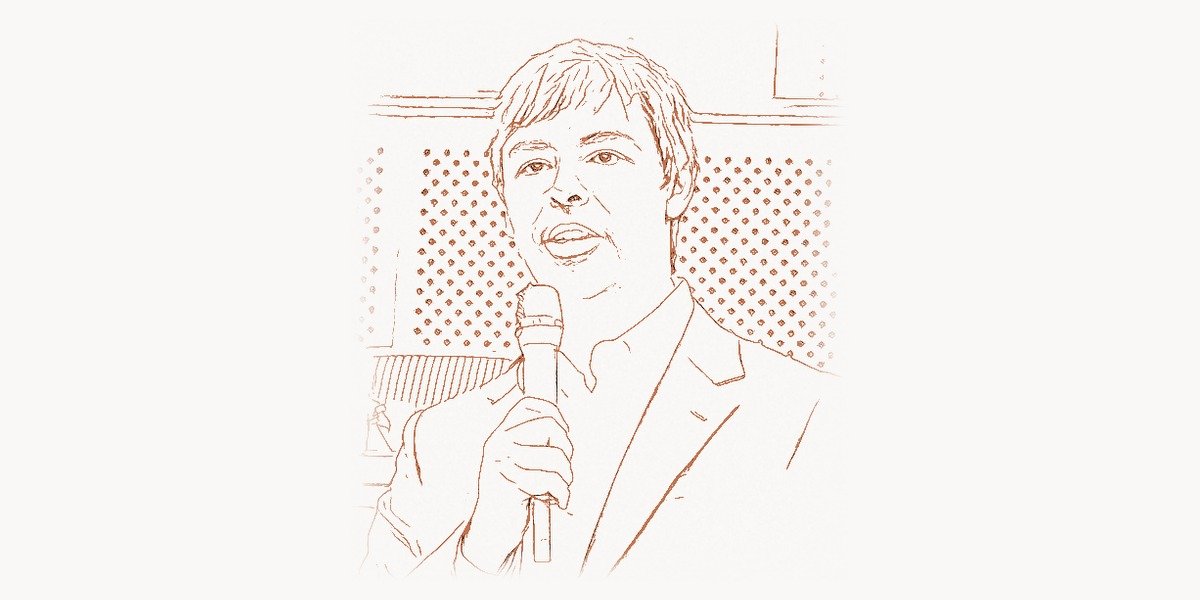
In 1998, two Stanford PhD students launched a search engine from a cluttered garage in Menlo Park, California. Within a decade, it would become the most visited website on the planet, process billions of queries per day, and fundamentally alter how humanity accesses information. The engine behind this transformation was not just raw computing power or venture capital — it was an elegant mathematical insight known as PageRank, conceived by Larry Page while he was still a 22-year-old graduate student. That single algorithmic idea — ranking web pages by the structure of links pointing to them, rather than merely by keyword frequency — became the foundation of modern search and one of the most consequential technical innovations of the internet era.
Early Life and the Seeds of Innovation
Lawrence Edward Page was born on March 26, 1973, in East Lansing, Michigan, into a household steeped in computer science. His father, Carl Victor Page, was a professor of computer science and artificial intelligence at Michigan State University. His mother, Gloria Page, was an instructor in computer programming at the same institution. Growing up surrounded by technical journals, early personal computers, and dinner-table conversations about algorithms and data structures gave young Larry a foundation that few of his peers could match.
Page was fascinated by invention from an early age. He read biographies of Alan Turing and Nikola Tesla, becoming particularly drawn to Tesla’s story — a brilliant inventor who struggled to commercialize his ideas. This duality of invention and business would later define Page’s approach at Google: the conviction that a great idea must be paired with a great organization to achieve its full impact.
At the University of Michigan, Page earned his bachelor’s degree in computer engineering with honors. He was already displaying the restless curiosity that would define his career. He served as president of the university’s chapter of Eta Kappa Nu, the electrical and computer engineering honor society, and participated in a solar car team. During his undergraduate years, he built an inkjet printer out of Lego bricks — an early indicator of his instinct for combining unlikely components to solve problems.
In 1995, Page enrolled in the PhD program in computer science at Stanford University. It was during a campus tour for prospective students that he met Sergey Brin, a second-year graduate student who had been assigned to show him around. By many accounts, the two argued about almost everything during that first meeting. But their intellectual friction quickly evolved into one of the most productive partnerships in the history of technology.
The PageRank Breakthrough
Technical Innovation: Turning Links Into Votes
Page’s dissertation advisor at Stanford was Terry Winograd, a respected figure in human-computer interaction. Page initially explored dozens of potential research topics before settling on one that would change the world: analyzing the link structure of the World Wide Web. At the time, the web was growing explosively — from roughly 10,000 sites in 1994 to over a million by 1997 — and existing search engines like AltaVista, Excite, and Lycos were struggling to return relevant results. They relied primarily on keyword matching and basic frequency analysis, techniques that were easily manipulated by spammers stuffing pages with hidden text.
Page’s insight was deceptively simple yet profoundly powerful. He recognized that the web’s hyperlink structure encoded a vast amount of human judgment. When a web developer linked to another page, they were implicitly endorsing it — casting a vote of confidence. Moreover, not all votes should count equally: a link from a highly regarded page (one that itself received many links) should carry more weight than a link from an obscure, rarely referenced page.
This recursive insight became the core of the PageRank algorithm. Named partly as a pun on Page’s own surname, it modeled the web as a directed graph and computed a probability distribution representing the likelihood that a person randomly clicking on links would arrive at any particular page. Mathematically, PageRank can be expressed as a problem of finding the principal eigenvector of the web’s link matrix. The simplified concept can be illustrated in code:
import numpy as np

def pagerank(adjacency_matrix, damping=0.85, iterations=100):
    """
    Simplified PageRank computation.
    adjacency_matrix: NxN numpy array where entry [i][j] = 1
                      means page i links to page j.
    damping: probability of following a link (vs. random jump).
    """
    n = adjacency_matrix.shape[0]
    # Normalize columns: each page distributes its rank
    # equally among all pages it links to
    out_degree = adjacency_matrix.sum(axis=1, keepdims=True)
    out_degree[out_degree == 0] = 1  # avoid division by zero
    transition = (adjacency_matrix / out_degree).T

    # Initialize all pages with equal rank
    rank = np.ones(n) / n

    for _ in range(iterations):
        rank = (1 - damping) / n + damping * transition @ rank

    return rank

# Example: 4-page web
# Page 0 links to 1,2; Page 1 links to 2;
# Page 2 links to 0; Page 3 links to 0,1,2
links = np.array([
    [0, 1, 1, 0],
    [0, 0, 1, 0],
    [1, 0, 0, 0],
    [1, 1, 1, 0]
])

scores = pagerank(links)
for i, score in enumerate(scores):
    print(f"Page {i}: {score:.4f}")
The damping factor (typically set to 0.85) models the behavior of a hypothetical web surfer: with 85% probability, they follow a link on the current page, and with 15% probability, they jump to a completely random page. This mechanism ensures that the algorithm converges and prevents rank sinks — pages or groups of pages that accumulate disproportionate rank by linking only to each other. The mathematical elegance of this approach drew directly from the linear algebra and Markov chain theory that John von Neumann had helped establish decades earlier.
Why PageRank Mattered
PageRank did not merely improve search — it redefined what search could be. Before Google, finding information on the web was an exercise in frustration. Users would sift through pages of irrelevant results, often encountering spam-filled directories or keyword-stuffed pages that bore no relation to their actual query. PageRank changed this by introducing a quality signal that was independent of the page’s own content: the collective judgment of the web itself.
The impact was immediate and dramatic. When Page and Brin launched their search engine (initially called “BackRub” before being renamed Google, a play on the mathematical term “googol”), word spread quickly through the Stanford community. The results were simply better — often strikingly so — than anything else available. By 1998, Google was processing over 10,000 queries per day. By 2000, it had become the world’s most popular search engine, processing over 100 million queries daily.
What made PageRank particularly revolutionary was that it was resistant to manipulation. While spammers could easily stuff a page with keywords, it was far harder to generate authentic inbound links from reputable sites. This created a natural defense against the spam that plagued competing search engines. The algorithm effectively turned the collective intelligence of the web’s millions of authors into a quality filter — an idea that resonated with the broader vision of the World Wide Web that Tim Berners-Lee had conceived as a collaborative knowledge system.
For modern digital agencies and web development firms, the legacy of PageRank continues to shape every aspect of search engine optimization, content strategy, and link-building methodology. Understanding the principles behind this algorithm remains essential for anyone building products for the web.
Building Google: From Garage to Global Infrastructure
The technical brilliance of PageRank would have meant nothing without the infrastructure to apply it at scale. And it was here that Larry Page’s ambitions proved truly extraordinary. From the earliest days of Google, Page insisted on building systems that could handle the entire web — not just a subset of it. This required solving problems in distributed computing, data storage, and network architecture that pushed the boundaries of what was possible.
In 1998, Page and Brin famously set up their first server in Susan Wojcicki’s garage in Menlo Park. They had maxed out their credit cards buying hard drives and were storing the entire index of the web (at the time, about 26 million pages) on a cobbled-together cluster of commodity hardware. This approach — using cheap, off-the-shelf components rather than expensive proprietary servers — became a defining characteristic of Google’s infrastructure philosophy and eventually influenced the entire technology industry.
As Google grew, the engineering challenges became immense. The company developed the Google File System (GFS) to manage petabytes of data across thousands of machines, MapReduce to process that data in parallel (a system whose development was spearheaded by Jeff Dean, one of the most brilliant engineers Page recruited), and BigTable to provide structured data storage on top of GFS. These systems were so influential that they inspired open-source equivalents — Hadoop, Spark, and HBase — that became the backbone of the big data revolution.
Page’s role in building Google extended far beyond the algorithm. He served as CEO from 1998 to 2001, then stepped aside in favor of Eric Schmidt (brought in by the board as an experienced executive), and returned as CEO in 2011. Throughout these transitions, Page remained the company’s chief visionary, pushing for ambitious projects and maintaining a relentless focus on speed, simplicity, and scale. His famous dictum that Google’s homepage should load as fast as possible — with minimal design elements and no advertising on the results page — reflected a philosophy that the search experience should be as frictionless as possible.
Other Contributions and Ventures
While PageRank and Google Search are Page’s most famous contributions, his influence extends across a remarkable range of technologies and industries. Under his leadership, Google expanded into email (Gmail), mapping (Google Maps and Google Earth), mobile operating systems (Android), web browsers (Chrome), cloud computing (Google Cloud), video sharing (YouTube), and hardware (Pixel phones, Nest devices).
Several of these ventures deserve special attention. Android, which Google acquired in 2005 under Page’s direction, became the world’s most widely used mobile operating system, running on over three billion devices globally. This achievement democratized smartphone access in ways that echoed the personal computing revolution of the 1980s — the same revolution that visionaries like Marc Andreessen had driven through the browser.
Chrome, launched in 2008, introduced process isolation for browser tabs and the V8 JavaScript engine, which dramatically improved web application performance. Today, Chrome commands roughly 65% of the global browser market, and V8 powers not just Chrome but also Node.js and countless server-side JavaScript applications.
In 2015, Page orchestrated one of the most significant corporate restructurings in tech history, creating Alphabet Inc. as a parent company for Google and its various subsidiaries. The move was designed to give ambitious, long-term projects — what Page called “moonshots” — the independence and focus they needed. These projects included Waymo (self-driving cars), Verily (life sciences), Calico (longevity research), DeepMind (artificial intelligence, now led by Demis Hassabis), and Wing (drone delivery).
Page’s investment in artificial intelligence has been particularly prescient. Google’s acquisition of DeepMind in 2014 and its development of the Transformer architecture (the foundation of modern large language models) positioned the company at the center of the AI revolution. The infrastructure and research culture that Page built at Google created the conditions for breakthroughs that continue to reshape every industry.
Managing the sheer scope of these projects requires sophisticated organizational tools. Teams working across Alphabet’s diverse portfolio rely on platforms like modern project management solutions to coordinate complex, cross-functional work at scale — the kind of operational discipline that Page himself championed as essential to turning ambitious ideas into reality.
Philosophy and Principles
Key Principles That Defined Larry Page’s Approach
Larry Page’s leadership philosophy can be distilled into several core principles that he articulated repeatedly throughout his career and that shaped Google’s distinctive culture.
Think 10x, not 10%. Page believed that incremental improvement was often harder and less rewarding than attempting radical breakthroughs. He encouraged engineers to aim for solutions that were ten times better than existing alternatives, not merely ten percent better. This philosophy drove Google’s most ambitious projects and created a culture where audacious goals were expected rather than discouraged.
Technology should organize the world’s information. Google’s mission statement — “to organize the world’s information and make it universally accessible and useful” — was not mere corporate rhetoric for Page. He saw it as a genuine engineering challenge that could occupy generations of researchers. This mission extended beyond search to encompass Google Books (digitizing the world’s libraries), Google Scholar (organizing academic literature), and Google Knowledge Graph (structuring facts into a queryable database).
Speed is a feature. Page was obsessive about latency and performance. He reportedly timed Google’s homepage load speed with a stopwatch and would object to any changes that added even a few milliseconds of delay. This principle applied not just to products but to decision-making within the company: Page favored fast iteration, rapid prototyping, and the willingness to launch imperfect products and improve them based on user feedback.
Invest in infrastructure before you need it. Page consistently advocated for building systems that could handle orders of magnitude more traffic than was currently necessary. This approach, while expensive in the short term, meant that Google was rarely caught off guard by growth. It also created a competitive moat: by the time rivals understood the scale of Google’s infrastructure advantage, it was nearly impossible to replicate.
Healthy disregard for the impossible. Perhaps Page’s most distinctive characteristic as a leader was his refusal to accept conventional limitations. When engineers told him something could not be done, he would ask them to explain precisely why not — and then challenge each assumption. This relentless questioning pushed his teams to achieve things that seemed impossible, from scanning every book ever printed to building a self-driving car. It echoed the same spirit of intellectual fearlessness that characterized earlier computing pioneers like Alan Turing, who dared to formalize the very notion of computation itself.
Legacy and Lasting Impact
Larry Page’s legacy extends far beyond any single product or algorithm. He fundamentally changed how the world accesses and processes information, and he built one of the most valuable companies in human history — one that touches the lives of billions of people every day.
The impact of PageRank on the web cannot be overstated. Before Google, the internet was a vast, disorganized repository of information with no reliable way to distinguish valuable content from noise. PageRank provided that mechanism, and in doing so, it created the economic model for the modern web: by delivering users to the most relevant content, Google became the default starting point for virtually all online activity, and the advertising revenue this generated transformed the internet into a viable commercial platform.
Page’s infrastructure innovations had an equally profound effect. The distributed computing systems developed at Google under his leadership — GFS, MapReduce, BigTable, Spanner, and others — became the templates for the entire cloud computing industry. Amazon Web Services, Microsoft Azure, and every other major cloud platform owes a debt to the architectural patterns that Google pioneered. The open-source versions of these systems power the data infrastructure of companies worldwide, from startups to Fortune 500 enterprises.
The Alphabet restructuring, while sometimes criticized for complexity, represented a bold bet on the future. By separating Google’s profitable core business from its speculative moonshot projects, Page created a structure that allows long-term, high-risk research to coexist with the discipline of a publicly traded company. Waymo’s self-driving technology, DeepMind’s breakthroughs in protein folding and game-playing AI, and Calico’s longevity research are all products of this vision.
Page stepped down as CEO of Alphabet in December 2019, passing the reins to Sundar Pichai. Since then, he has largely withdrawn from public life, pursuing private investments in areas like flying cars (Kitty Hawk), clean energy, and other frontier technologies. His personal fortune, estimated at over $100 billion, places him among the wealthiest individuals on the planet, but those who know him say his focus remains on solving hard technical problems rather than accumulating wealth.
The internet — the vast, interconnected network built on the protocols of Vint Cerf and Bob Kahn — found its most powerful organizer in Larry Page. His work transformed a chaotic collection of web pages into a navigable, searchable repository of human knowledge. For anyone who has ever typed a question into a search bar and received a useful answer in under a second, the invisible hand guiding that experience traces back to a graduate student’s insight about the hidden meaning of hyperlinks.
Key Facts About Larry Page
- Born: March 26, 1973, in East Lansing, Michigan, USA
- Education: B.S. in Computer Engineering from University of Michigan; M.S. in Computer Science from Stanford University (PhD not completed)
- Co-founded Google: September 4, 1998, with Sergey Brin, initially operating from a garage in Menlo Park, California
- PageRank patent: Filed in 1998, assigned to Stanford University, exclusively licensed to Google
- CEO roles: Google CEO (1998–2001, 2011–2015), Alphabet CEO (2015–2019)
- Created Alphabet Inc.: Restructured Google into Alphabet in 2015, enabling independent development of moonshot projects
- Net worth: Estimated at over $100 billion (as of mid-2020s), consistently ranked among the top 10 wealthiest people globally
- Key innovations: PageRank algorithm, Google Search, Alphabet corporate structure, investments in self-driving cars, AI, and clean energy
- Awards: Marconi Prize (2004), National Academy of Engineering member, inducted into the National Inventors Hall of Fame
- Personal: Known for his quiet, soft-spoken demeanor; passionate about sustainable transportation, urban planning, and flying vehicles
Frequently Asked Questions
How does the PageRank algorithm work in simple terms?
PageRank treats every hyperlink on the web as a vote of confidence. When page A links to page B, it is telling the algorithm that page B contains something valuable. However, not all votes are equal — a link from a highly authoritative page (one that itself receives many links) counts more than a link from an obscure page. The algorithm computes these scores iteratively across the entire web graph, producing a numerical ranking for every page. A damping factor (typically 0.85) models the probability that a user continues clicking links rather than jumping to a random page. The result is a global ranking of web pages by their structural importance, independent of any specific search query. Here is a minimal illustration of how the iterative score update works:
def simple_pagerank(graph, damping=0.85, steps=50):
    """
    graph: dict mapping page -> list of pages it links to
    Returns: dict of page -> PageRank score
    """
    pages = list(graph.keys())
    n = len(pages)
    rank = {p: 1.0 / n for p in pages}

    for _ in range(steps):
        new_rank = {}
        for page in pages:
            # Sum contributions from all pages linking to this one
            incoming = sum(
                rank[src] / len(graph[src])
                for src in pages
                if page in graph[src]
            )
            new_rank[page] = (1 - damping) / n + damping * incoming
        rank = new_rank
    return rank

# Example usage
web = {
    "A": ["B", "C"],
    "B": ["C"],
    "C": ["A"],
    "D": ["A", "B", "C"],
}
for page, score in sorted(simple_pagerank(web).items()):
    print(f"{page}: {score:.4f}")
What is the relationship between Larry Page and Sergey Brin?
Larry Page and Sergey Brin met at Stanford University in 1995 when Brin, a second-year PhD student, was assigned to give Page a campus tour. Despite initial disagreements — both are described as strong-willed and opinionated — they quickly discovered a shared intellectual curiosity and complementary skill sets. Page tended toward visionary, big-picture thinking focused on hardware, systems, and long-term strategy, while Brin brought strengths in mathematics, data mining, and pattern recognition. Together, they developed the PageRank algorithm, founded Google in 1998, and co-led the company through its most formative years. They co-created Alphabet in 2015 and both stepped down from day-to-day leadership roles in 2019, though they remain controlling shareholders and board members.
Why did Larry Page create Alphabet instead of keeping everything under Google?
Page created Alphabet in 2015 to solve a structural problem: Google had grown far beyond search and advertising into areas like self-driving cars, life sciences, venture capital, and urban planning. These diverse businesses had different timelines, risk profiles, and operational needs. By creating Alphabet as a holding company, Page gave each subsidiary — Waymo, Verily, Calico, DeepMind, Wing, and others — its own CEO, budget, and strategic independence. This allowed Google’s core business to maintain its focus on search, advertising, Android, and cloud services, while moonshot projects could pursue long-term goals without the quarterly earnings pressure of a publicly traded tech giant. The structure also improved transparency for investors, who could better evaluate each business unit on its own merits.
What is Larry Page doing now after leaving Alphabet?
Since stepping down as Alphabet CEO in December 2019, Larry Page has maintained an exceptionally low public profile. He has not given public speeches or media interviews, and he rarely appears at industry events. However, reports indicate that he remains active in private investments and technology development. He funded Kitty Hawk, a company working on electric vertical takeoff and landing (eVTOL) aircraft, reflecting his longstanding interest in personal air transportation. He is also reported to be involved in clean energy initiatives and other frontier technology projects. Despite his withdrawal from corporate leadership, Page retains significant influence through his controlling stake in Alphabet, which, combined with Brin’s shares, gives the co-founders majority voting power over the company’s direction.