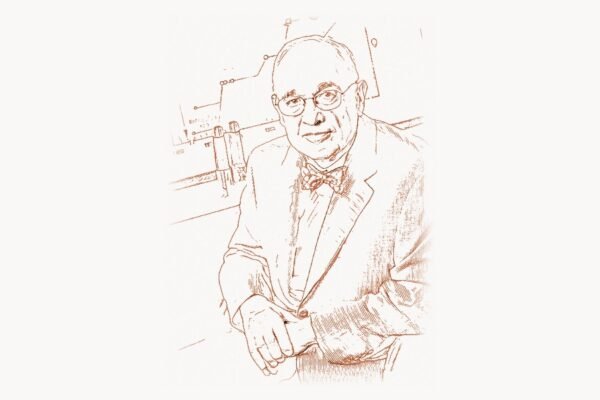
In 1977, three researchers at MIT turned a mathematical curiosity into the backbone of digital security. Their names — Rivest, Shamir, and Adleman — became an acronym known to every computer scientist on earth: RSA. But while Ron Rivest and Adi Shamir often receive the most attention for proposing candidate solutions, it was Leonard Adleman, the mathematician of the trio, whose rigorous analysis separated what could work from what could not. His role was deceptively simple — he broke every scheme his colleagues proposed until one survived. That surviving scheme became the most widely deployed public-key cryptosystem in history.
What makes Adleman’s story extraordinary is that RSA was only the beginning. Nearly two decades later, he would open an entirely new field of computation, one that used strands of DNA instead of silicon transistors. Leonard Adleman is a rare figure in computer science: a theoretician whose work shaped the practical infrastructure of the internet and then reimagined what a computer could be made of.
Early Life and the Road to Mathematics
Leonard Max Adleman was born on December 31, 1945, in San Francisco, California. He grew up in a middle-class family — his father was an appliance salesman, his mother a bank teller. Neither parent had attended college, and the young Adleman showed no early signs of becoming a mathematician. By his own account, he was an indifferent student through much of his youth, more interested in sports and socializing than academics.
Adleman enrolled at the University of California, Berkeley, in 1964, initially as a pre-medical student. He drifted through several majors before settling on mathematics, a subject that captivated him once he encountered its deeper abstractions. He completed his bachelor’s degree in mathematics in 1968 and remained at Berkeley for graduate work, eventually earning his Ph.D. in 1976 under the supervision of Manuel Blum, one of the founders of computational complexity theory.
Blum’s influence was profound. Under his mentorship, Adleman absorbed the discipline of rigorous proof and developed an intuition for the boundary between what is computationally feasible and what is not. This training — understanding the hardness of problems — would prove essential to everything Adleman accomplished afterward, from breaking flawed cryptosystems to encoding computation in molecular biology.
After completing his doctorate, Adleman joined the faculty at MIT, where he would meet two colleagues whose collaboration would change the course of information security forever.
The RSA Breakthrough
Technical Innovation: A Cryptosystem Built on Number Theory
The context for RSA was set by Whitfield Diffie and Martin Hellman, who in 1976 published their landmark paper introducing the concept of public-key cryptography. Diffie and Hellman proved that it was theoretically possible to create a system where two parties could communicate securely without ever sharing a secret key. But they did not provide a concrete, practical algorithm for doing so.
At MIT, Ron Rivest and Adi Shamir began working feverishly on candidate implementations. Their approach was iterative — Rivest and Shamir would propose a scheme, and Adleman would attempt to break it. This cycle repeated dozens of times. Adleman’s mathematical training made him extraordinarily effective at identifying weaknesses, and one after another, the proposals fell to his analysis.
Then, in April 1977, Rivest proposed a scheme based on the difficulty of factoring the product of two large prime numbers. Adleman subjected it to the same rigorous scrutiny — and it held. The core idea was elegant. Each user generates two large primes, p and q, and publishes their product n = p × q as part of a public key. The security of the system rests on a simple asymmetry: multiplying two primes is trivial, but factoring their product back into its constituent primes is computationally intractable for sufficiently large numbers.
RSA Key Generation (simplified):

1. Choose two large primes:        p, q
2. Compute modulus:                 n = p × q
3. Compute Euler's totient:         φ(n) = (p - 1)(q - 1)
4. Choose public exponent:          e such that 1 < e < φ(n), gcd(e, φ(n)) = 1
5. Compute private exponent:        d ≡ e⁻¹ (mod φ(n))

Public key:  (n, e)
Private key: (n, d)

Encryption:  ciphertext = message^e mod n
Decryption:  message = ciphertext^d mod n

Security depends on the computational difficulty of factoring n back into p and q.
For modern RSA, n is typically 2048 or 4096 bits long.
The mathematical beauty of RSA lies in its reliance on modular exponentiation and the properties of Euler's totient function. Anyone can encrypt a message using the public key, but only the holder of the private key — who knows the factorization of n — can decrypt it. The paper describing the algorithm, published in 1978 under the title "A Method for Obtaining Digital Signatures and Public-Key Cryptosystems," listed the authors alphabetically: Rivest, Shamir, Adleman.
Adleman has been characteristically modest about his contribution, sometimes describing himself as the person whose main job was saying "no" to the ideas that did not work. But Ron Rivest and Adi Shamir have both emphasized that without Adleman's analytical rigor, they would not have known which scheme was worth publishing. In any collaborative research effort, the ability to correctly distinguish a sound idea from a flawed one is just as vital as generating ideas in the first place.
Why It Mattered: The Foundation of Internet Security
RSA did not merely solve an academic puzzle — it became the infrastructure of digital trust. When you connect to a website over HTTPS, when you send an encrypted email, when you verify a software update's authenticity, RSA (or a descendant algorithm built on the same principles) is likely at work. Before RSA, secure communication required that both parties physically share a secret key. After RSA, strangers separated by continents could establish trust through mathematics alone.
The impact extended far beyond cryptography itself. RSA enabled digital signatures, which in turn made electronic commerce feasible. Without a way to verify that a message truly came from its purported sender, online transactions would be impossible. The entire architecture of internet security — SSL/TLS certificates, code signing, secure key exchange — traces its lineage to the algorithm that survived Adleman's scrutiny in 1977.
The commercial potential was not lost on the trio. In 1982, they co-founded RSA Security (later RSA Data Security), one of the first companies built around public-key cryptography. The company's products became standard components in enterprise security, and the RSA algorithm itself was embedded in browsers, operating systems, and network protocols worldwide. For teams building modern digital products, the descendants of RSA remain essential — whether you are securing a web development project or protecting user data in a project management workflow.
Other Contributions: From Computer Viruses to DNA Computing
While RSA would be enough to secure a permanent place in the history of computing, Adleman's intellectual curiosity carried him into territory that no one had explored before.
In 1983, working with Fred Cohen at the University of Southern California (where Adleman had moved in 1980), he provided the first rigorous mathematical definition of a computer virus. Cohen had created experimental self-replicating programs, but it was Adleman who gave the phenomenon its name — borrowing the term "virus" from biology — and formalized the concept within the framework of computability theory. His theoretical work demonstrated that detecting all possible computer viruses is undecidable, a result that has profound implications for cybersecurity to this day. This insight explains why antivirus software can never achieve perfect detection and why security researchers like Bruce Schneier have long argued for defense-in-depth strategies.
But Adleman's most radical departure came in 1994, when he published a paper in the journal Science demonstrating that DNA molecules could be used to solve computational problems. The experiment was deceptively simple in concept: Adleman encoded the vertices and edges of a small directed graph as sequences of DNA nucleotides, then used standard molecular biology techniques — polymerase chain reaction (PCR), gel electrophoresis, and affinity purification — to search for a Hamiltonian path through the graph.
DNA Computing — Adleman's 1994 Hamiltonian Path Experiment:

Problem: Find a path that visits every vertex exactly once in a directed graph.

Encoding:
  - Each vertex → a unique 20-nucleotide DNA sequence
  - Each edge (Vi → Vj) → a 20-nucleotide strand composed of:
      last 10 bases of Vi + first 10 bases of Vj

Process:
  1. Mix all vertex and edge DNA strands in solution
  2. Complementary sequences self-assemble (Watson-Crick base pairing)
  3. DNA ligase joins adjacent fragments into longer strands
  4. Result: a combinatorial library of all possible paths

Filtering:
  1. PCR amplification — select paths starting at V_start and ending at V_end
  2. Gel electrophoresis — select paths of correct length (n vertices)
  3. Affinity purification — for each vertex, select only paths containing it

The surviving DNA strands encode the Hamiltonian path (if one exists).
The experiment worked. A test tube of DNA molecules, guided by the laws of molecular biology, produced the correct answer to a problem that would challenge conventional computers for larger instances. The result electrified both the computer science and biology communities because it suggested something philosophically profound: computation is not an exclusively electronic phenomenon. Nature had been computing with molecules for billions of years.
Adleman continued to develop DNA computing throughout the late 1990s and 2000s, including work on autonomous molecular computers that could potentially detect and respond to disease markers within living cells. While DNA computing has not replaced silicon processors for general-purpose tasks, it opened an entirely new field of research at the intersection of computer science, mathematics, and molecular biology. The ideas Adleman pioneered continue to influence synthetic biology, molecular programming, and the emerging field of biological computation.
Philosophy and Approach to Science
Key Principles That Guided His Work
Adleman's career reveals a set of principles that are unusual in a field often driven by engineering pragmatism. He has always been a mathematician first, drawn to problems because they are beautiful rather than because they are commercially valuable. His approach to RSA was not to build things, but to break them — to apply the discipline of proof and disproof until only truth remained. This contrarian method, where progress comes through rigorous negation, is more common in pure mathematics than in applied computer science.
A second principle is interdisciplinary fearlessness. When Adleman became interested in molecular biology in the early 1990s, he did not delegate the wet-lab work to a biologist — he taught himself molecular biology from scratch, spending years learning techniques that were entirely outside his training. He has spoken about walking into biology laboratories as a complete outsider and learning to pipette, run gels, and culture cells. This willingness to become a beginner in a new field, at a stage in his career when he was already a celebrated cryptographer, is a trait he shares with other boundary-crossing pioneers like Alan Turing, who moved from mathematical logic to morphogenesis.
A third principle is intellectual honesty about credit. Adleman has repeatedly downplayed his role in RSA, sometimes to a degree that his collaborators find excessive. When asked about the algorithm, he tends to redirect attention to Rivest's creative ingenuity and Shamir's algebraic skill. This modesty is not false humility — it reflects a genuine belief that the contribution of the critic (the person who breaks flawed ideas) is less glamorous but no less essential than the contribution of the creator.
Finally, Adleman has maintained a deep commitment to theoretical foundations even when working on applied problems. His formalization of computer viruses was not an engineering exercise but a theorem about computability. His DNA computing work was not motivated by building a practical computer but by exploring the theoretical limits of molecular information processing. In this respect, his thinking aligns with the tradition of Claude Shannon, who sought fundamental truths about information before worrying about how to build a telephone switch.
Legacy: From Mathematical Cryptography to Molecular Computation
Leonard Adleman's legacy operates on multiple levels. At the most practical level, RSA and its descendants protect trillions of dollars in online transactions every year. The algorithm is embedded so deeply in the infrastructure of the internet that most people use it daily without ever knowing it exists. Every HTTPS connection, every digitally signed certificate, every encrypted email owes something to the scheme that Adleman validated in 1977.
At a deeper level, Adleman's work on DNA computing expanded the definition of what a computer can be. Before 1994, computation was synonymous with electronics. After Adleman's experiment, the field had to reckon with the possibility that computation is a more general phenomenon — that it can be instantiated in any physical substrate capable of representing and transforming information. This insight has influenced not just computer science but philosophy, biology, and physics.
In recognition of these contributions, Adleman shared the 2002 Turing Award with Rivest and Shamir for their work on public-key cryptography. The Turing Award, often called the Nobel Prize of computing, recognized not just the RSA algorithm itself but the broader impact of public-key cryptography on the digital world. Adleman also received the Kanellakis Award from the ACM, among numerous other honors.
As a professor at the University of Southern California, Adleman has mentored generations of students in both theoretical computer science and computational biology. His teaching reflects the same intellectual range as his research — a willingness to follow important questions wherever they lead, regardless of departmental boundaries. His students have gone on to make contributions in cryptography, complexity theory, bioinformatics, and molecular computing.
Perhaps the most enduring aspect of Adleman's legacy is the example he set for what a career in computer science can look like. He demonstrated that the same mathematical sensibility that can build a cryptosystem can also unlock the computational potential of a molecule. In a field that often rewards narrow specialization, Adleman proved that the deepest insights come from crossing boundaries — between mathematics and engineering, between silicon and biology, between creating ideas and breaking them.
Key Facts About Leonard Adleman
- Full name: Leonard Max Adleman
- Born: December 31, 1945, San Francisco, California, USA
- Education: B.A. in Mathematics, UC Berkeley (1968); Ph.D. in Computer Science, UC Berkeley (1976), advisor: Manuel Blum
- Known for: Co-invention of the RSA cryptosystem (the "A" in RSA), pioneering DNA computing, formalizing the concept of computer viruses
- Major awards: Turing Award (2002, shared with Rivest and Shamir), ACM Kanellakis Award, IEEE Koji Kobayashi Award, National Inventors Hall of Fame inductee
- Key publications: "A Method for Obtaining Digital Signatures and Public-Key Cryptosystems" (1978); "Molecular Computation of Solutions to Combinatorial Problems" (1994, Science)
- Academic position: Henry Salvatori Professor of Computer Science, University of Southern California
- Named the computer virus: Provided the first formal mathematical definition of a computer virus in 1983, coining the term by analogy with biological viruses
- RSA co-founders: Co-founded RSA Data Security, Inc. (1982) with Ron Rivest and Adi Shamir
- Cross-disciplinary: Taught himself molecular biology in his 40s, performing wet-lab experiments personally to pioneer DNA computing
Frequently Asked Questions
What exactly was Adleman's role in creating the RSA algorithm?
Adleman served as the critical analyst in the RSA collaboration. While Ron Rivest proposed candidate algorithms and Adi Shamir contributed algebraic expertise, Adleman's job was to find flaws and break each proposed scheme. This cycle repeated dozens of times before Rivest proposed the factoring-based scheme that Adleman could not break. Though he has modestly described his role as primarily destructive, his collaborators have emphasized that the algorithm would not have been published without his rigorous vetting. The ability to distinguish sound cryptography from flawed cryptography requires deep mathematical insight — precisely the skill Adleman brought to the team.
How does DNA computing work, and can it replace traditional computers?
DNA computing uses biological molecules to represent and process information. In Adleman's original 1994 experiment, he encoded a graph problem into DNA sequences, then used molecular biology techniques like PCR and gel electrophoresis to filter for the correct solution. The key advantage of DNA is massive parallelism — a single test tube can contain trillions of DNA molecules, all processing simultaneously. However, DNA computing is not a replacement for silicon-based computers. It is slow at sequential operations, error-prone, and difficult to scale for general-purpose tasks. Its greatest potential lies in specialized applications like molecular diagnostics, drug discovery, and programmable molecular systems that can operate inside living cells.
Why is the RSA algorithm still important if quantum computers could break it?
RSA remains critically important because large-scale quantum computers capable of running Shor's algorithm (which can factor large numbers efficiently) do not yet exist. Current quantum computers lack the qubit count and error correction needed to threaten RSA key sizes used in practice (2048+ bits). Meanwhile, RSA and its derivatives continue to protect the vast majority of internet communications. The cryptographic community is actively developing post-quantum algorithms as replacements, but the transition will take years. The principles Adleman helped establish — basing security on the hardness of mathematical problems — remain the foundation of post-quantum cryptography, even as the specific hard problems change.
What is the connection between Adleman's work on viruses and modern cybersecurity?
Adleman's 1983 formalization of computer viruses established the theoretical framework for understanding self-replicating malicious code. His most significant theoretical result was proving that perfect virus detection is undecidable — meaning no algorithm can correctly identify all possible viruses in all cases. This result has profound practical implications: it explains why antivirus software will always be an imperfect defense and why modern cybersecurity strategies emphasize multiple layers of protection (firewalls, sandboxing, behavioral analysis, network monitoring) rather than relying on any single detection method. Adleman's work gave the field a rigorous foundation that still shapes how security researchers think about the fundamental limits of malware detection.