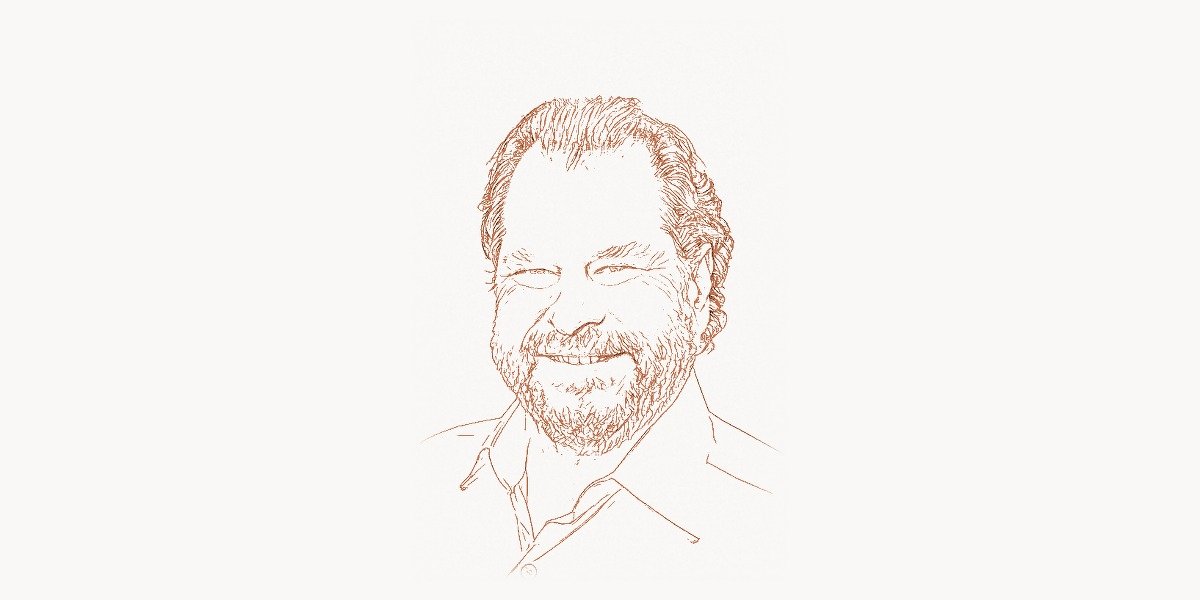
In March 1999, Marc Benioff launched Salesforce from a rented apartment on Telegraph Hill in San Francisco with a radical premise that the entire enterprise software industry considered absurd: business applications should be delivered over the internet, not installed on corporate servers. There would be no shrink-wrapped boxes, no six-month deployment cycles, no armies of consultants configuring middleware. Just a web browser, a login, and a customer relationship management system that worked immediately. The enterprise software establishment — led by his former employer Oracle, along with SAP and Siebel Systems — dismissed the idea as a toy. Within a decade, Salesforce had become the most consequential enterprise software company of the 21st century, and the model Benioff pioneered — Software as a Service — had become the default architecture for virtually all business software built since.
Early Life and the Making of a Software Prodigy
Marc Russell Benioff was born on September 25, 1964, in San Francisco, California. He grew up in a middle-class household in the Hillsborough area, where his father ran an apparel store. Benioff showed an early aptitude for programming — by age fifteen, he had taught himself to code on an Atari 800 and was selling his first commercial software, a game called “How to Juggle,” through a mail-order catalog. He earned $75 a month in royalties, which was meaningful income for a teenager in 1979. More importantly, it taught him a lesson that would shape his career: software could be created once and distributed to many people with almost zero marginal cost.
At the University of Southern California, Benioff studied business administration while continuing to develop software. During college summers, he interned at Apple Computer, where he worked in the Macintosh division under Steve Jobs. The experience left a permanent imprint. Jobs’s obsession with user experience, his contempt for complexity, and his belief that technology should be intuitive rather than imposing — all of these principles would resurface in Benioff’s vision for Salesforce years later. Jobs taught Benioff that great technology companies do not just build products; they create movements.
After graduating in 1986, Benioff joined Oracle Corporation, where he quickly rose through the ranks under Larry Ellison. By age 23, he had been named Oracle’s Rookie of the Year. By 26, he was a vice president — the youngest in the company’s history. Over thirteen years at Oracle, Benioff gained deep expertise in enterprise sales, database technology, and the mechanics of large-scale software deployments. He also witnessed firsthand the pain that enterprise customers endured: multi-million-dollar license fees, eighteen-month implementation timelines, constant upgrade cycles, and IT departments that spent more time maintaining software than using it. The dysfunction was systemic, and Benioff became convinced that the entire model was broken.
The Birth of Salesforce and the Cloud Revolution
The End of Software: A Platform Born in a San Francisco Apartment
The catalyst came during a sabbatical in 1998. Benioff traveled to India and Hawaii, reflecting on his career and the direction of the technology industry. The consumer internet was booming — Amazon, eBay, and Yahoo were demonstrating that complex applications could be delivered through web browsers to millions of users simultaneously. Yet enterprise software remained trapped in the client-server era, requiring dedicated hardware, specialized installations, and constant maintenance. Benioff asked a question that now seems obvious but was genuinely radical at the time: why couldn’t business software work like Amazon?
In March 1999, Benioff founded Salesforce with three co-founders: Parker Harris, Dave Moellenhoff, and Frank Dominguez. Harris, a quiet and technically brilliant engineer who had studied computer science at Middlebury College, became the architect of the platform. The division of labor was clear from the start: Benioff would handle vision, sales, and marketing; Harris would build the technology. They complemented each other perfectly, and their partnership became one of the most productive co-founder relationships in enterprise software history.
The team built the first version of Salesforce in a rented apartment at 1449 Montgomery Street. Their technology choices were pragmatic and forward-thinking: Java for the application layer, Oracle Database for persistence (an ironic choice given Benioff’s intent to disrupt his former employer’s business model), and a multi-tenant architecture where all customers shared the same codebase and infrastructure. Multi-tenancy was the critical technical decision. Unlike application service providers (ASPs) of the late 1990s, which ran separate instances for each customer, Salesforce’s architecture meant that every customer was always on the latest version, bugs fixed for one were fixed for all, and the platform could scale efficiently without linear hardware growth.
Multi-Tenant Architecture: The Technical Foundation
The multi-tenant model that Parker Harris designed was not simply a hosting arrangement — it was a fundamentally different software architecture. In traditional enterprise deployments, each customer had their own database schema, their own application server instance, and their own upgrade cycle. Salesforce collapsed all of this into a shared infrastructure layer with logical isolation. Customer data was separated by organization identifiers, not by physical database boundaries:
-- Salesforce multi-tenant architecture concept
-- All customers share tables, separated by OrgId
-- This is the core pattern that made SaaS economically viable

-- Shared metadata-driven table structure
SELECT Id, Name, Email, Phone, OrgId
FROM Contact
WHERE OrgId = '00D5e000000XXXXX'
  AND IsDeleted = false
  AND CreatedDate > 2024-01-01T00:00:00Z
ORDER BY LastModifiedDate DESC
LIMIT 200;

-- Custom fields stored as metadata, not schema changes
-- This eliminated the need for per-customer database migrations
SELECT
  cf.FieldName,
  cf.DataType,
  cf.DefaultValue,
  cf.IsRequired
FROM CustomFieldDefinition cf
WHERE cf.OrgId = '00D5e000000XXXXX'
  AND cf.ObjectId = 'Contact'
  AND cf.IsActive = true;

-- Governor limits enforce fair resource sharing
-- No single tenant can monopolize shared infrastructure
-- Max 50,000 SOQL query rows per transaction
-- Max 150 DML statements per transaction
-- Max 100 SOQL queries per transaction
This approach had profound implications. Upgrades happened three times a year for every customer simultaneously — no more version fragmentation. Performance optimizations benefited the entire platform at once. And the economics were transformative: instead of deploying dedicated infrastructure for each customer, Salesforce could serve thousands of organizations from the same hardware, dramatically reducing per-customer costs and enabling a subscription pricing model that was accessible to small businesses and large enterprises alike.
The technical challenges were immense. Multi-tenancy required solving problems that single-tenant architectures could ignore: fair resource allocation between tenants (solved through governor limits), metadata-driven customization without schema changes (solved through a universal data model), and maintaining performance at scale when any tenant’s query could potentially impact others. Harris and his team invented solutions to these problems that became foundational patterns for the entire SaaS industry, influencing how platforms from developer tools to project management systems are built today.
Apex and Force.com: Inventing the Platform as a Service
Beyond CRM: Building the First Cloud Platform
Salesforce’s most underappreciated innovation was not the CRM application itself but the platform that emerged beneath it. In 2007, Salesforce launched Force.com, the first Platform as a Service (PaaS) offering that allowed third-party developers to build and deploy custom applications on Salesforce’s infrastructure. Alongside Force.com came Apex, a strongly-typed, object-oriented programming language designed specifically for cloud multi-tenant execution.
Apex was a deliberate and opinionated language design. It looked familiar to Java developers — intentionally so, to lower the learning curve — but it operated under constraints that reflected the realities of shared infrastructure. Governor limits were enforced at the language level, preventing any single piece of code from consuming disproportionate resources. Bulk operations were encouraged by design, because in a multi-tenant environment, row-by-row processing was not just inefficient but potentially harmful to other tenants:
// Apex: Salesforce's cloud-native programming language
// Designed for multi-tenant execution with built-in governor limits

public class OpportunityHandler {

    // Trigger handler — processes records in bulk by design
    // This pattern prevents N+1 query problems in shared infra
    public static void updateAccountRevenue(List<Opportunity> newOpps) {

        // Collect all parent Account IDs in one pass
        Set<Id> accountIds = new Set<Id>();
        for (Opportunity opp : newOpps) {
            if (opp.StageName == 'Closed Won') {
                accountIds.add(opp.AccountId);
            }
        }

        // Single SOQL query instead of one per record
        // Governor limit: max 100 SOQL queries per transaction
        Map<Id, Account> accounts = new Map<Id, Account>(
            [SELECT Id, Total_Revenue__c
             FROM Account
             WHERE Id IN :accountIds]
        );

        // Aggregate calculations in memory
        Map<Id, Decimal> revenueByAccount = new Map<Id, Decimal>();
        for (Opportunity opp : newOpps) {
            if (opp.StageName == 'Closed Won' && accounts.containsKey(opp.AccountId)) {
                Decimal current = revenueByAccount.containsKey(opp.AccountId)
                    ? revenueByAccount.get(opp.AccountId) : 0;
                revenueByAccount.put(opp.AccountId, current + opp.Amount);
            }
        }

        // Bulk DML update — single operation for all records
        // Governor limit: max 150 DML statements per transaction
        List<Account> toUpdate = new List<Account>();
        for (Id accId : revenueByAccount.keySet()) {
            Account acc = accounts.get(accId);
            acc.Total_Revenue__c = (acc.Total_Revenue__c != null
                ? acc.Total_Revenue__c : 0) + revenueByAccount.get(accId);
            toUpdate.add(acc);
        }

        update toUpdate;
    }
}
Apex and Force.com created an entirely new category of software development. For the first time, developers could build enterprise applications without provisioning servers, managing databases, or handling infrastructure. The platform managed scaling, security, data isolation, and availability automatically. This was years before Amazon Web Services launched its comparable PaaS offerings, and nearly a decade before the term “serverless” entered the mainstream vocabulary.
The ecosystem that grew around Force.com — later rebranded as the Salesforce Platform — became one of the most economically significant developer ecosystems in history. By 2025, the Salesforce economy supported an estimated 9.3 million jobs worldwide. Independent software vendors built entire companies on the platform, distributed through the AppExchange marketplace that Salesforce launched in 2005 — three years before Apple’s App Store. The pattern of a platform company creating an ecosystem of complementary businesses has become a standard playbook in modern web development, but Benioff was among the first to execute it at enterprise scale.
Acquisitions and Strategic Vision
Benioff proved to be as aggressive an acquirer as his mentor Ellison, though with a different strategic logic. Where Ellison acquired to consolidate existing markets, Benioff acquired to expand Salesforce’s platform into adjacent categories and to stay ahead of architectural shifts.
ExactTarget (2013, $2.5 billion). This acquisition created the Salesforce Marketing Cloud, extending the platform from sales automation into digital marketing. It gave Salesforce a foothold in email marketing, advertising, and customer journey management — categories that generated billions in recurring revenue.
MuleSoft (2018, $6.5 billion). MuleSoft’s integration platform addressed one of the most persistent problems in enterprise IT: connecting disparate systems. By acquiring MuleSoft, Benioff positioned Salesforce as the hub through which data flowed between all enterprise applications, not just CRM. Teams leveraging modern frameworks for application development could now integrate with Salesforce ecosystems through standardized APIs and connectivity layers.
Tableau (2019, $15.7 billion). The acquisition of Tableau gave Salesforce world-class data visualization and analytics capabilities. It was a bet that the future of CRM was not just managing customer records but understanding customer behavior through data. Tableau’s technology, combined with Salesforce’s data assets, created a powerful analytics layer that transformed how businesses made decisions.
Slack (2021, $27.7 billion). The largest acquisition in Salesforce’s history was also its most strategic. Slack gave Salesforce a communication and collaboration platform that could serve as the user interface for its entire ecosystem. Benioff’s vision was to make Slack the “digital headquarters” where teams coordinated work, with Salesforce data and workflows embedded directly into conversations. For organizations that coordinate development work through tools like Toimi, the integration of collaboration and CRM data represents the broader trend toward unified work platforms that Benioff has championed.
The 1-1-1 Model: Redefining Corporate Philanthropy
One of Benioff’s most distinctive and lasting contributions extends beyond technology into corporate governance. In 2000 — when Salesforce was still a startup with fewer than 100 employees — Benioff established the 1-1-1 philanthropic model: Salesforce would donate 1% of its equity, 1% of its product, and 1% of its employees’ time to charitable causes. At the time, dedicating resources to philanthropy before a company was profitable was considered eccentric at best. Benioff argued that embedding social responsibility into a company’s DNA from day one was not charity but strategy — it attracted talent who wanted their work to matter, built trust with customers, and created a corporate culture that could sustain long-term growth.
The 1-1-1 model has since been adopted by more than 17,000 companies through the Pledge 1% movement that Benioff co-founded. Companies as diverse as Twilio, Atlassian, and DocuSign have pledged portions of their equity, product, and time. The model demonstrated that corporate social responsibility could be integrated into a company’s operating model rather than treated as an afterthought — a perspective that has influenced how a generation of technology founders thinks about the relationship between profit and purpose. Modern project management platforms like Taskee reflect a similar philosophy of building tools that prioritize team wellbeing alongside productivity.
Einstein AI and the Intelligence Layer
Benioff recognized early that artificial intelligence would transform CRM from a system of record into a system of intelligence. In 2016, Salesforce launched Einstein AI, an integrated artificial intelligence layer built directly into the platform. Rather than requiring customers to build their own machine learning pipelines, Einstein embedded predictive analytics, natural language processing, and recommendation engines into existing Salesforce workflows.
Einstein could predict which sales leads were most likely to convert, recommend next-best actions for service agents, automatically classify customer cases, and detect anomalies in business metrics. The approach was characteristically Benioff: take a complex technology — in this case, machine learning — and deliver it as a service that required no data science expertise from the customer. By 2024, Salesforce had evolved Einstein into Einstein Copilot, a generative AI assistant that could perform complex multi-step tasks across the platform using natural language instructions. This was followed by Agentforce, Salesforce’s autonomous AI agent framework that allowed businesses to deploy AI agents capable of handling customer interactions, resolving cases, and executing business processes without human intervention.
The evolution from Einstein AI to Agentforce mirrors the broader trajectory of the technology industry toward AI-augmented business operations — a shift that is reshaping everything from enterprise software reviews and evaluations to how development teams architect customer-facing systems.
Legacy and Influence on Modern Software
Marc Benioff’s impact on the technology industry extends far beyond Salesforce’s market capitalization or revenue figures. He fundamentally changed how software is built, sold, and consumed. The principles he championed — multi-tenant architecture, subscription pricing, continuous delivery, platform ecosystems, and integrated philanthropy — have become so deeply embedded in the technology industry’s DNA that they are now considered obvious rather than revolutionary. This is the mark of a truly transformative innovator: the ideas seem inevitable only in retrospect.
Before Salesforce, enterprise software companies measured success by the size of their upfront license deals. After Salesforce, the entire industry shifted to recurring revenue models that aligned vendor incentives with customer success. Before Salesforce, upgrading enterprise software was a multi-year project. After Salesforce, continuous delivery became the expectation. Before Salesforce, building an enterprise application required purchasing servers, hiring database administrators, and managing infrastructure. After Salesforce, a developer with a browser could build and deploy a business application in hours.
The generation of tech pioneers who built the SaaS industry — from Slack to Zoom to Shopify — owe a significant architectural and business model debt to the patterns that Salesforce established. Benioff did not just build a company; he created the template for how modern enterprise software companies operate.
Frequently Asked Questions
What is Marc Benioff best known for?
Marc Benioff is best known as the founder, chairman, and former CEO of Salesforce, the company that pioneered the Software as a Service (SaaS) model for enterprise applications. He transformed how business software is delivered by proving that complex applications could run entirely in the cloud, accessed through a web browser, and sold on a subscription basis rather than through traditional perpetual licenses. His “No Software” campaign became a defining moment in the shift from on-premise to cloud computing.
What is Salesforce’s multi-tenant architecture and why was it important?
Salesforce’s multi-tenant architecture is a design pattern where all customers share the same codebase, database infrastructure, and application instance, with data logically separated by organization identifiers. This was important because it made SaaS economically viable — instead of running separate servers for each customer (which the earlier ASP model required), Salesforce could serve thousands of organizations from shared infrastructure. This dramatically reduced costs, enabled universal upgrades, and made enterprise-grade software accessible to businesses of all sizes.
What is the Salesforce 1-1-1 philanthropic model?
The 1-1-1 model is a corporate philanthropy framework that Benioff established when Salesforce was founded in 1999. Under this model, Salesforce commits 1% of its equity, 1% of its product (through free or discounted licenses for nonprofits), and 1% of its employees’ time (through paid volunteer hours) to charitable causes. The model has since been adopted by over 17,000 companies through the Pledge 1% movement and has become one of the most influential frameworks for integrating social responsibility into corporate operations from day one.
What programming language did Salesforce create?
Salesforce created Apex, a strongly-typed, object-oriented programming language designed specifically for building business applications on the Salesforce Platform. Apex has Java-like syntax but operates under governor limits that enforce fair resource sharing in a multi-tenant environment. It supports triggers, batch processing, web service callouts, and complex business logic. Alongside Apex, Salesforce also developed Visualforce (a component-based UI framework), Lightning Web Components (a modern standards-based UI framework), and SOQL (Salesforce Object Query Language) for data queries.
How did Marc Benioff’s experience at Oracle influence Salesforce?
Benioff spent thirteen years at Oracle, rising to vice president by age 26, which gave him deep expertise in enterprise sales, database architecture, and large-scale software deployments. Critically, he observed the pain points that enterprise customers endured — enormous license fees, years-long implementations, and constant upgrade cycles. This firsthand experience with the dysfunction of the traditional enterprise software model directly motivated his vision for Salesforce as a simpler, subscription-based alternative. His mentor relationship with Oracle founder Larry Ellison also taught him the value of bold vision and aggressive market positioning, though Benioff ultimately channeled those lessons into a fundamentally different business model.