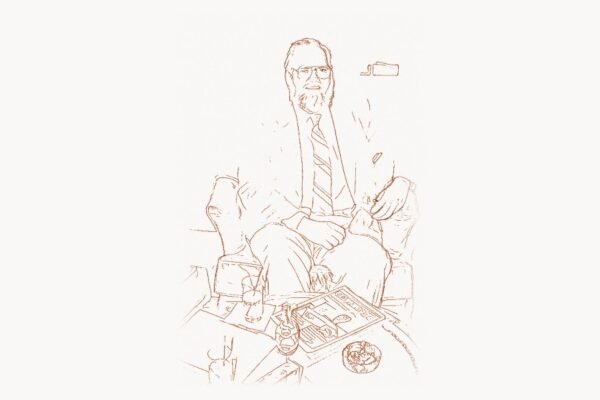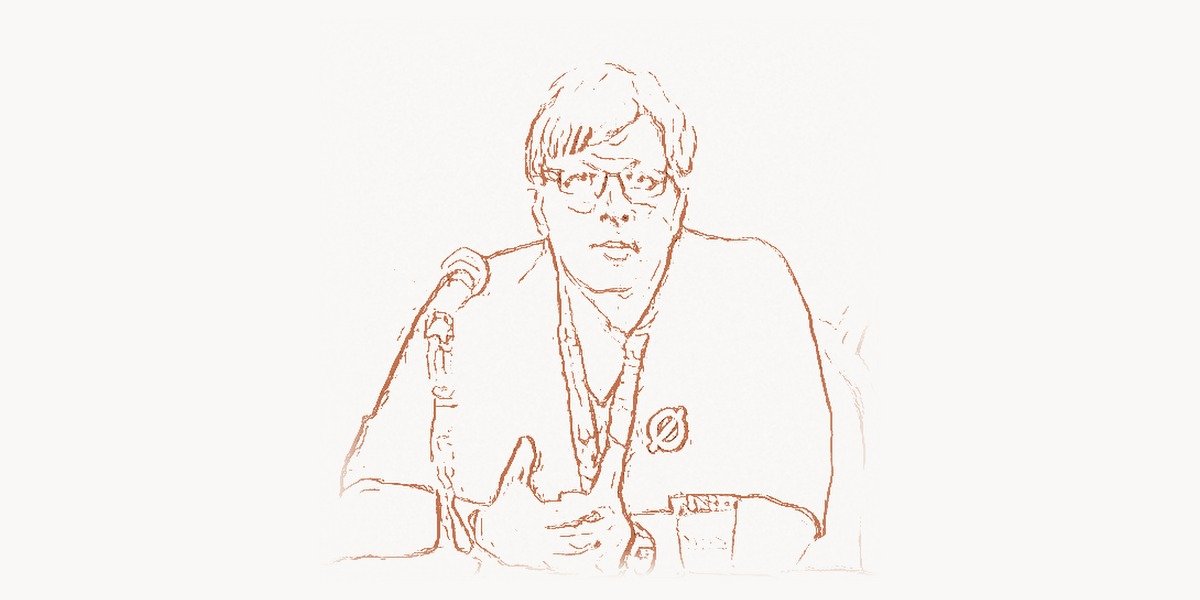
In 1993, the United States government believed it had the perfect solution to the encryption debate: a chip that would let citizens encrypt their communications while giving law enforcement a built-in backdoor. They called it the Clipper Chip, and it was supposed to end the Crypto Wars before they truly began. Then a young AT&T Bell Labs researcher named Matt Blaze took a careful look at the system’s key escrow protocol — and found a devastating flaw that allowed anyone to bypass the government’s backdoor entirely. His discovery didn’t just kill a government surveillance program; it fundamentally reshaped how the world thinks about cryptographic backdoors, government oversight of encryption, and the technical impossibility of building “secure” systems with intentional weaknesses.
Early Life and Education
Matthew Blaze grew up with an early curiosity for both mathematics and the mechanics of how systems work — and, perhaps more importantly, how they fail. He pursued his undergraduate studies at Hunter College of the City University of New York, where he developed a strong foundation in computer science and mathematics. His intellectual interests drew him toward the intersection of theoretical computer science and practical security, a combination that would define his entire career.
Blaze went on to earn his Ph.D. in Computer Science from Princeton University, where he studied under the guidance of some of the field’s most respected minds. His doctoral work focused on cryptographic systems and their real-world applications, particularly the ways in which theoretical security guarantees interact with the messy realities of implementation. At Princeton, he absorbed the rigorous approach to formal methods and proof-based reasoning that would later allow him to dissect complex government cryptographic schemes with surgical precision.
Even during his graduate studies, Blaze was already gravitating toward what would become his lifelong mission: examining the gap between what security systems promise and what they actually deliver. This perspective — that real security must be tested against real adversaries, not just theoretical models — became the intellectual foundation for everything that followed.
Career and Technical Contributions
After completing his doctorate, Blaze joined AT&T Bell Labs (later AT&T Labs–Research), one of the most storied research institutions in the history of computing. Bell Labs had already given the world Unix, the C programming language, and the transistor. In this environment of deep technical inquiry, Blaze found the freedom to pursue ambitious research at the intersection of cryptography, systems security, and public policy.
His early work at Bell Labs focused on practical cryptographic systems — not the abstract mathematics of encryption algorithms, but the way those algorithms behave when embedded in real software, real hardware, and real organizations. This practical orientation set him apart from many of his contemporaries in the cryptographic research community and positioned him perfectly for the moment that would define his career.
Technical Innovation: Breaking the Clipper Chip
In April 1993, the Clinton administration announced the Clipper Chip initiative. The plan was straightforward in concept: the government would promote a hardware encryption chip based on the classified Skipjack algorithm. Every chip would contain a unique key, and a copy of that key would be held in escrow by two separate government agencies. When law enforcement obtained a proper court order, they could retrieve the escrowed keys and decrypt the target’s communications.
The key escrow system relied on a 128-bit Law Enforcement Access Field (LEAF), which was transmitted alongside each encrypted communication. The LEAF contained the chip’s unique identifier and session key, encrypted in a way that only the escrow agencies could decrypt. A 16-bit checksum within the LEAF was supposed to ensure integrity — verifying that the LEAF hadn’t been tampered with and genuinely corresponded to the encryption session.
Blaze approached the Clipper Chip not as a policy debate but as an engineering problem. He obtained Clipper-equipped AT&T telephone units and began systematic testing of the escrow protocol. What he found was remarkable: the 16-bit LEAF checksum was catastrophically weak. With only 16 bits, there were just 65,536 possible checksum values. Through a brute-force approach, a user could generate fake LEAF values that passed the checksum validation but contained no usable escrow information. The attack was devastatingly simple:
"""
Conceptual demonstration of the LEAF checksum weakness
in the Clipper Chip's key escrow protocol.

The 16-bit checksum meant only 65,536 possible values —
an attacker could find a collision in seconds, rendering
the escrow mechanism completely bypassable.
"""

import hashlib
import struct
import os

CHECKSUM_BITS = 16
CHECKSUM_SPACE = 2 ** CHECKSUM_BITS  # 65,536

def compute_leaf_checksum(leaf_payload: bytes) -> int:
    """Simplified model of the LEAF checksum function."""
    digest = hashlib.sha256(leaf_payload).digest()
    return struct.unpack(">H", digest[:2])[0]

def generate_rogue_leaf(target_checksum: int) -> bytes:
    """
    Brute-force a fake LEAF that matches the target checksum
    but contains no valid escrow information.
    On average requires ~32,768 attempts — trivial.
    """
    attempts = 0
    while True:
        fake_payload = os.urandom(80)  # random non-escrow data
        attempts += 1
        if compute_leaf_checksum(fake_payload) == target_checksum:
            print(f"Collision found after {attempts} attempts")
            return fake_payload

# With 16 bits, collision is found almost instantly
target = compute_leaf_checksum(b"legitimate_leaf_data_here")
rogue = generate_rogue_leaf(target)
print(f"Checksum space: {CHECKSUM_SPACE:,} values")
print(f"Expected attempts for collision: ~{CHECKSUM_SPACE // 2:,}")
Blaze published his findings in a landmark 1994 paper titled “Protocol Failure in the Escrowed Encryption Standard.” The paper demonstrated that anyone using a Clipper Chip could bypass the escrow mechanism while still using the strong Skipjack encryption underneath. In other words, criminals — the very people the government wanted to surveil — could use Clipper Chips for unbreakable encryption while rendering the law enforcement backdoor useless. The system failed at its single most important design goal.
Why It Mattered
The significance of Blaze’s Clipper Chip analysis extended far beyond a single vulnerability. His work established a principle that remains central to cryptographic policy debates today: you cannot build a system that is simultaneously secure for authorized users and accessible to authorized interceptors without creating vulnerabilities that unauthorized parties can exploit. This isn’t a political argument — it’s an engineering reality.
The Clipper Chip’s failure demonstrated that key escrow systems face an inherent design tension. The escrow mechanism must be simple enough to be practical for law enforcement but complex enough to resist adversarial attacks. Blaze showed that the Clipper Chip designers had not found — and likely could not find — the right balance. The 16-bit checksum was too small to prevent brute-force attacks, but a larger checksum would have introduced bandwidth and latency problems that made the system impractical.
His analysis directly contributed to the eventual abandonment of the Clipper Chip program and became a foundational reference in every subsequent debate about encryption backdoors, from the FBI’s “Going Dark” campaign to the Apple-FBI encryption dispute of 2016. Every time a government proposes mandatory backdoor access to encrypted communications, security researchers cite Blaze’s work as evidence of why such schemes are technically dangerous. His findings also influenced the work of fellow cryptographers like Bruce Schneier, who frequently referenced the Clipper Chip failure in his arguments against backdoored encryption systems.
Other Notable Contributions
CFS — The Cryptographic File System
Before the Clipper Chip made him famous, Blaze had already made a significant contribution to practical cryptography with the creation of CFS, the Cryptographic File System. Released in 1993, CFS was one of the first systems that provided transparent, user-level file encryption on Unix systems. Unlike kernel-level encryption approaches, CFS operated as an NFS server that transparently encrypted and decrypted files as they were read and written, requiring no modifications to the operating system kernel.
CFS was elegant in its design: it used DES (and later other ciphers) to encrypt file contents and file names, stored the encrypted data in a regular directory, and served decrypted views through an NFS mount. Users could attach and detach encrypted directories with simple commands, making encrypted storage practical for everyday use. The system’s architecture influenced virtually every encrypted filesystem that followed, from EncFS to modern solutions like LUKS and FileVault.
#!/bin/bash
# CFS (Cryptographic File System) usage pattern — circa 1993
# Demonstrates the elegance of transparent user-level encryption

# Step 1: Create an encrypted directory
# CFS would prompt for a passphrase and cipher selection
cmkdir /cfs/secured_research

# Step 2: Attach (mount) the encrypted directory
# After passphrase authentication, decrypted view appears via NFS
cattach /cfs/secured_research ~/private/research
# Now ~/private/research shows decrypted contents transparently

# Step 3: Work with files normally — encryption is transparent
cp draft_paper.tex ~/private/research/
echo "All reads/writes are encrypted/decrypted on the fly"

# On disk, the actual stored data is fully encrypted:
# /cfs/secured_research/
#   ├── 3f8a91bc2d...  (encrypted filename)
#   ├── a72e04ff91...  (encrypted filename)
#   └── .cfs_metadata  (cipher parameters, NOT keys)

# Step 4: Detach when done — encrypted data remains on disk
cdetach ~/private/research
# Directory is now inaccessible without the passphrase
Trust Management and PolicyMaker
Together with Joan Feigenbaum and Jack Lacy, Blaze co-developed PolicyMaker, one of the earliest trust management systems for distributed computing. Published in 1996, PolicyMaker introduced the concept of a generalized framework for determining whether a set of credentials satisfies a security policy. Rather than relying on traditional identity-based access control (where you trust specific named entities), PolicyMaker enabled policy-based trust decisions: you define what actions are permitted under what conditions, and the system automatically evaluates whether a given request meets those conditions.
This work was far ahead of its time. PolicyMaker’s approach to decentralized trust became the conceptual foundation for later systems like SPKI/SDSI certificates and influenced the design of modern certificate transparency and authorization frameworks. In an era when most security systems depended on centralized certificate authorities, Blaze and his collaborators were already imagining a world of distributed, policy-driven trust — a vision that resonates strongly with today’s zero-trust architecture movement.
Physical Security and Lock Research
In a characteristic blending of digital and physical security, Blaze also conducted rigorous academic research on physical lock mechanisms. His 2003 paper on master key systems demonstrated how the structure of pin tumbler locks with master keying creates mathematical vulnerabilities that allow an attacker with a single working key to derive the master key for an entire building through systematic experimentation. This research applied the same analytical rigor he brought to cryptographic systems — treating physical locks as security protocols with their own attack surfaces and failure modes.
Election Security
In the 2000s and 2010s, Blaze became one of the leading academic voices on election security. He participated in multiple studies examining the security of electronic voting machines, most notably contributing to the landmark 2007 California Secretary of State’s “Top-to-Bottom” review of voting systems. His team found critical vulnerabilities in voting machines from multiple vendors — flaws that could allow vote manipulation, unauthorized access, and audit trail tampering. This work, conducted alongside security researchers like Aaron Swartz‘s generation of digital rights advocates, helped shape the national conversation about the integrity of democratic infrastructure.
Blaze’s election security work reinforced a recurring theme in his career: the systems society depends on most — communications, voting, infrastructure — are often the least rigorously examined from a security perspective. His advocacy for paper ballot backups, rigorous post-election audits, and open security testing of election equipment has directly influenced election security policy in multiple U.S. states.
Philosophy and Key Principles
Matt Blaze’s career embodies several principles that have become central to the modern security research community, principles also shared by contemporaries like Whitfield Diffie and Daniel J. Bernstein:
Security is empirical, not theoretical. Blaze has consistently argued that the only way to know whether a system is secure is to subject it to adversarial testing. Mathematical proofs of security are necessary but not sufficient — implementation details, protocol interactions, and human factors create vulnerabilities that formal models often miss. His Clipper Chip analysis is the perfect illustration: the Skipjack cipher itself was never broken, but the protocol surrounding it was fatally flawed.
Backdoors are vulnerabilities. Perhaps Blaze’s most enduring contribution to security philosophy is the demonstration that intentional access mechanisms (“lawful intercept,” “key escrow,” “exceptional access”) are functionally equivalent to security vulnerabilities. They expand the attack surface, create single points of failure, and introduce complexity that adversaries can exploit. This principle has been echoed by virtually every major cryptographer since, from Phil Zimmermann to the authors of the landmark 2015 paper “Keys Under Doormats.”
Public scrutiny strengthens security. Blaze is a firm believer in open security research and responsible disclosure. His decision to publish the Clipper Chip findings — rather than quietly report them to the NSA — reflected his conviction that public scrutiny is essential for security. Systems that can only survive in secrecy are not truly secure. This philosophy aligns closely with the open-source security principles championed by Theo de Raadt through the OpenBSD project.
Security and civil liberties are inseparable. Throughout his career, Blaze has maintained that strong encryption is a civil liberties issue. The ability to communicate privately is fundamental to free expression, political dissent, and personal autonomy. Any system that compromises encryption in the name of security ultimately threatens the broader rights it claims to protect.
Academic Career and Institutional Impact
After more than a decade at AT&T Labs–Research, Blaze joined the faculty of the University of Pennsylvania’s Department of Computer and Information Science, where he served as a professor and director of the Distributed Systems Lab. At Penn, he mentored a generation of security researchers and continued his work on cryptographic protocols, network security, and surveillance technology.
In 2018, Blaze moved to Georgetown University’s McDonough School of Business and Department of Computer Science, where he currently holds the position of McDevitt Professor of Computer Science and Law. This appointment reflects the interdisciplinary nature of his work — Blaze operates at the intersection of technology, policy, and law, bringing technical rigor to legal and policy debates that are often dominated by non-technical voices. His dual appointment allows him to train both computer scientists and law students in the security implications of technology policy, a combination that is critically needed as governments worldwide grapple with encryption regulation.
Blaze has also been a prolific expert witness and advisor, testifying before the United States Congress on encryption policy, surveillance technology, and election security. His ability to translate complex cryptographic concepts into language accessible to policymakers has made him one of the most influential voices in the ongoing debate between security agencies and the technology community. For teams managing complex projects at this intersection of technology and policy, tools like Taskee help coordinate the kind of cross-disciplinary collaboration that Blaze’s work exemplifies.
Legacy and Impact
Matt Blaze’s influence on the field of cryptography and security extends across multiple dimensions. His Clipper Chip analysis is one of the most consequential pieces of security research ever published — not because it involved novel mathematical techniques, but because it demonstrated a fundamental truth about the relationship between security and surveillance that policymakers continue to grapple with three decades later.
His work on CFS helped establish encrypted filesystems as a practical tool for everyday computing, paving the way for the ubiquitous disk encryption we take for granted today. His trust management research anticipated the decentralized authorization systems that power modern cloud computing. His election security work has directly contributed to more secure democratic processes. And his physical security research has blurred the boundaries between digital and physical security in ways that have enriched both fields.
Perhaps most importantly, Blaze has served as a model for what a security researcher can be: not just a technician who finds bugs, but a public intellectual who understands that security decisions are fundamentally political decisions that affect the rights and freedoms of every citizen. In this sense, his legacy parallels that of cryptographic pioneers like Ron Rivest and Moxie Marlinspike, who also combined deep technical expertise with a commitment to privacy as a fundamental right.
For modern technology organizations building secure systems, the lessons from Blaze’s career remain essential. His work reminds us that security cannot be an afterthought — it must be designed in from the beginning, tested adversarially, and subjected to public scrutiny. Organizations looking to build and manage digital products with security as a core principle can explore frameworks offered by firms like Toimi, where security-conscious development practices are integrated into the product lifecycle from day one.
Key Facts
| Detail | Information |
|---|---|
| Full Name | Matthew Blaze |
| Education | B.A. from Hunter College (CUNY); Ph.D. in Computer Science from Princeton University |
| Known For | Breaking the Clipper Chip key escrow protocol, CFS (Cryptographic File System), PolicyMaker trust management, election security research |
| Key Positions | Researcher at AT&T Bell Labs / AT&T Labs–Research; Professor at University of Pennsylvania; McDevitt Professor at Georgetown University |
| Landmark Paper | “Protocol Failure in the Escrowed Encryption Standard” (1994) |
| Policy Impact | Testified before U.S. Congress on encryption, contributed to California’s Top-to-Bottom voting security review |
| Research Areas | Cryptographic protocols, network security, trust management, election security, surveillance technology, physical security |
| Key Principle | Intentional backdoors in cryptographic systems are functionally equivalent to security vulnerabilities |
Frequently Asked Questions
What was the Clipper Chip and why did Matt Blaze’s analysis matter?
The Clipper Chip was a U.S. government-sponsored encryption chipset proposed in 1993 that included a built-in key escrow mechanism, allowing law enforcement to decrypt communications with a court order. Matt Blaze discovered a critical flaw in the chip’s 16-bit Law Enforcement Access Field (LEAF) checksum: the checksum was so short that an attacker could brute-force fake LEAF values in seconds, bypassing the escrow mechanism entirely while still using the chip’s strong encryption. His analysis proved that the system failed at its core design goal — providing law enforcement access — and provided lasting technical evidence that encryption backdoors create more security problems than they solve.
What is the Cryptographic File System (CFS) and how did it influence modern encryption?
CFS was a transparent, user-level encrypted filesystem created by Matt Blaze in 1993. It operated as an NFS server that encrypted and decrypted files on the fly, allowing users to work with encrypted storage without kernel modifications. CFS was pioneering because it made file encryption practical for everyday use — users simply attached an encrypted directory with a passphrase and worked normally. Its design principles — transparent encryption, user-space operation, and separation of key management from storage — influenced virtually every encrypted filesystem that followed, including modern solutions like LUKS, EncFS, and Apple’s FileVault.
How has Matt Blaze contributed to election security?
Blaze has been one of the most prominent academic researchers examining the security of electronic voting systems. He contributed to the landmark 2007 California “Top-to-Bottom” review, which uncovered critical vulnerabilities in voting machines from multiple vendors, including flaws that could allow vote manipulation and audit trail tampering. His work has advocated for paper ballot backups, rigorous post-election audits, and open security testing of election equipment. His research has directly influenced election security policy in multiple U.S. states and has been instrumental in shifting the national conversation toward treating election infrastructure as a critical security concern.
Why does Matt Blaze argue that encryption backdoors are inherently dangerous?
Blaze’s position — supported by his Clipper Chip research and decades of subsequent work — is that any intentional access mechanism built into a cryptographic system is functionally equivalent to a security vulnerability. Backdoors expand the attack surface by creating additional entry points that adversaries can discover and exploit. They introduce complexity that makes formal security analysis more difficult. They create key management challenges (who holds the backdoor keys? how are they protected?). And they establish a single point of catastrophic failure — if the backdoor mechanism is compromised, every user of the system is exposed simultaneously. This is not a political argument but an engineering assessment based on fundamental properties of cryptographic system design.