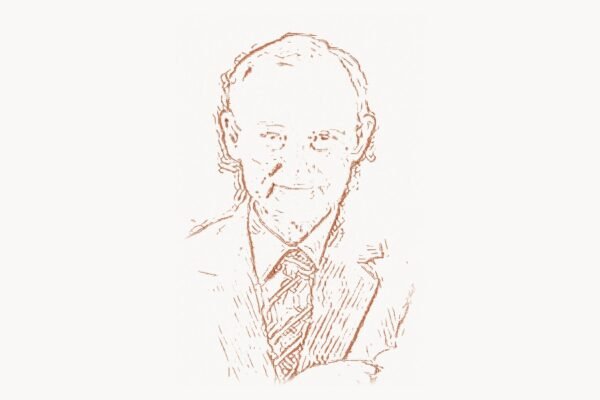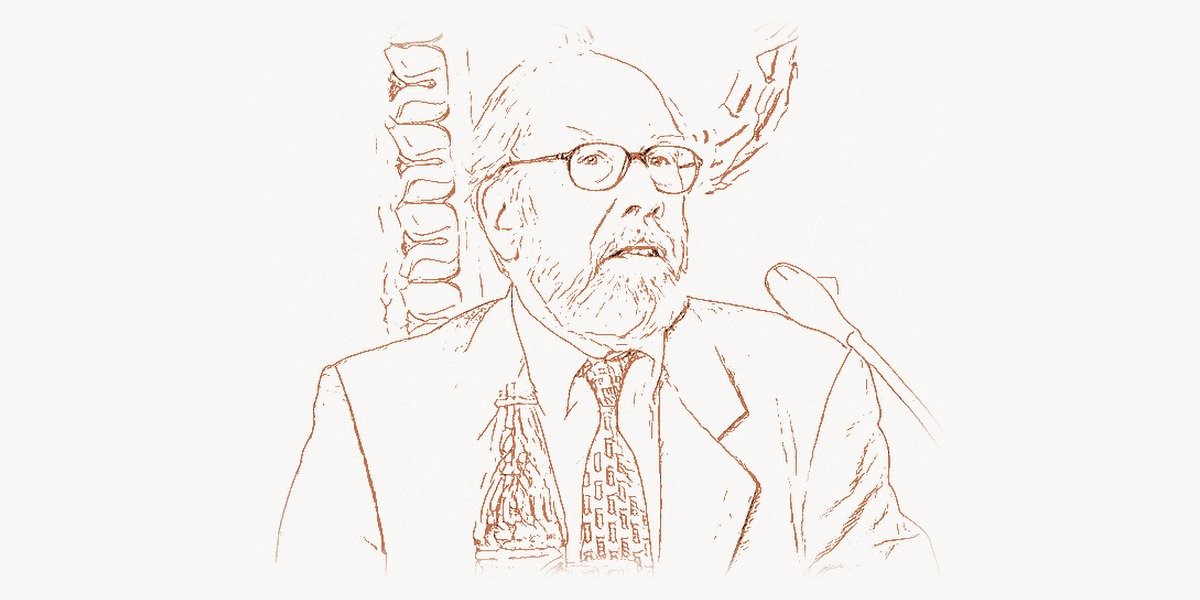
In February 1970, Niklaus Wirth published the first report on a new programming language called Pascal. Named after the 17th-century French mathematician Blaise Pascal, the language was designed with a clear purpose: to teach disciplined, structured programming to students. Within a decade, Pascal had become the most widely used language in computer science education worldwide. The UCSD Pascal system (1978) made it portable across different hardware platforms. Borland’s Turbo Pascal (1983), sold for just $49.95, turned it into a practical development tool used by hundreds of thousands of professional programmers. Apple chose Pascal as the primary language for Macintosh application development in 1984. But Pascal was only the most visible part of Wirth’s contribution. Before Pascal, he created Euler (1965) and PL/0 (1969). After Pascal, he created Modula (1975), Modula-2 (1978), and Oberon (1987) — each one refining his ideas about how programming languages should be designed. Wirth also designed the hardware to run his software: the Lilith workstation (1978) and the Ceres workstation (1986), both built at ETH Zurich. He was not just a language designer — he was a systems architect who believed that hardware and software should be designed together, each informing the other. His guiding principle, expressed in his famous epigram “Wirth’s Law,” was that software gets slower faster than hardware gets faster — a warning that remains disturbingly relevant in the age of bloated web applications and electron-based desktop software.
Early Life and Path to Technology
Niklaus Emil Wirth was born on February 15, 1934, in Winterthur, Switzerland. His father was Walter Wirth, a geography professor. Growing up in Winterthur, a city with a strong tradition of engineering and manufacturing, Wirth developed an early interest in building things — particularly model aircraft and electronics. He constructed radio receivers and model airplanes as a teenager, and this hands-on engineering mindset would characterize his entire career.
Wirth studied electrical engineering at the Swiss Federal Institute of Technology (ETH Zurich), earning his diploma in 1958. He then moved to Laval University in Quebec, Canada, where he obtained a Master’s degree in 1960. For his doctoral work, he went to the University of California, Berkeley, where he completed his Ph.D. in 1963 under the supervision of Harry Huskey (who had worked with Alan Turing on the ACE computer in the 1940s). His dissertation was on the programming language Euler, an extension of ALGOL 60 that addressed some of its limitations.
After brief positions at Stanford University (1963–1967) and the University of Zurich (1968), Wirth returned to ETH Zurich in 1968 as a full professor, where he would remain until his retirement in 1999. At ETH, he built one of the most productive systems research groups in Europe, creating a succession of languages, compilers, operating systems, and even custom hardware.
The Breakthrough: Pascal
The Technical Innovation
Wirth designed Pascal between 1968 and 1969, and the first compiler was operational in 1970 on a CDC 6000 series mainframe at ETH Zurich. His motivation was straightforward: existing languages were not suitable for teaching. Fortran was designed for numerical computation and lacked proper data structures. COBOL was verbose and business-oriented. PL/I (IBM’s attempt at a universal language) was enormous and complex. ALGOL 60, while elegant, lacked standard I/O facilities and had implementation difficulties that limited its practical adoption.
Pascal drew on the ALGOL tradition but was designed with several specific goals: it should be small enough to be learned in a single semester course, it should enforce structured programming discipline (no undisciplined use of GOTO), it should support a rich set of data types (arrays, records, sets, pointers, enumerated types), and the compiler should be implementable by a small team on modest hardware. Every design decision was driven by these goals.
program StandardDeviation(input, output);
{ Pascal example — clean, readable, structured code }
{ This is the same computation as the Fortran example, }
{ but with proper type checking and structured control flow }

const
  MaxN = 100;

type
  DataArray = array[1..MaxN] of real;

var
  x: DataArray;
  n, i: integer;
  sum, mean, sumsq, variance, stddev: real;

begin
  write('Enter number of values: ');
  readln(n);

  { Read data values }
  for i := 1 to n do
  begin
    write('Enter value ', i, ': ');
    readln(x[i])
  end;

  { Compute mean }
  sum := 0.0;
  for i := 1 to n do
    sum := sum + x[i];
  mean := sum / n;

  { Compute variance and standard deviation }
  sumsq := 0.0;
  for i := 1 to n do
    sumsq := sumsq + sqr(x[i] - mean);
  variance := sumsq / (n - 1);
  stddev := sqrt(variance);

  writeln('Mean = ', mean:10:4);
  writeln('Std Dev = ', stddev:10:4)
end.
Pascal’s type system was a central innovation. Every variable had to be declared with its type before use. The compiler verified that types were used consistently — you could not accidentally add an integer to a character or assign a real number to a boolean variable. This caught a large class of bugs at compile time rather than at runtime. The type system included enumerated types (allowing programmers to define their own named constants), subrange types (restricting integer variables to specific ranges), record types (similar to C structs, but with variant records), set types (for mathematical set operations), and pointer types (for dynamic data structures like linked lists and trees).
The language also enforced structured programming through its control flow constructs. While Pascal had a GOTO statement (for pragmatic reasons), it strongly encouraged the use of if-then-else, while-do, repeat-until, for, and case statements. Procedures and functions supported proper nesting and recursion. The language was block-structured, with clearly defined scope rules.
Why It Mattered
Pascal’s adoption in education was rapid and widespread. By the mid-1970s, it had become the standard language for introductory computer science courses at universities across North America, Europe, and Australia. The College Board chose Pascal as the language for the Advanced Placement (AP) Computer Science exam in 1984, a position it held until 1999 (when Java replaced it). Textbooks like Oh! Pascal! by Doug Cooper and Pascal: An Introduction to Methodical Programming by Wirth himself became staples of CS education.
The UCSD Pascal system, developed at the University of California, San Diego, in the late 1970s, compiled Pascal to a platform-independent bytecode (p-code) that ran on a virtual machine. This was remarkably similar to the approach Java would use 15 years later — compile once, run anywhere. UCSD Pascal ran on Apple II, PDP-11, Z80, and other platforms, making Pascal the first truly cross-platform programming language in practice.
Borland’s Turbo Pascal, released in November 1983 by Anders Hejlsberg (who would later create Delphi and TypeScript), was a commercial sensation. At $49.95, it undercut competitors by a factor of ten. It compiled Pascal code almost instantly — the entire compile-link-run cycle took seconds rather than minutes. Turbo Pascal sold over 250,000 copies in its first two years and made Pascal the language of choice for DOS application development throughout the 1980s.
Beyond Pascal: Other Contributions
Wirth viewed Pascal as just one step in an ongoing exploration of language design. Modula-2 (1978) added module-based separate compilation, coroutines for concurrent programming, and low-level system programming facilities that Pascal lacked. Modula-2 was designed as the systems programming language for the Lilith workstation, and it addressed the criticism that Pascal was too limited for real-world systems development.
Oberon (1987) was Wirth’s most radical simplification. Taking the “less is more” approach to its extreme, Oberon had a complete language definition of just 16 pages. The Oberon System — a complete operating system, window manager, and development environment — was written entirely in Oberon by Wirth and Jurg Gutknecht in about 3 person-years. The entire system, including the compiler, editor, file system, and GUI, fit in roughly 200 KB of code. For comparison, a modern web page’s CSS framework alone can exceed that size.
Wirth’s hardware projects were equally significant. The Lilith workstation (1978–1980) was a personal computer with a high-resolution bitmapped display, a mouse, and a graphical user interface — roughly contemporary with the Xerox Alto and several years ahead of the Macintosh. The hardware was designed specifically to run Modula-2 code compiled by Wirth’s compiler. This co-design of hardware and software allowed Wirth to build a complete, efficient system from the ground up.
His work on compiler design was foundational. His book Algorithms + Data Structures = Programs (1976) is considered a classic of computer science literature. The technique of recursive descent parsing — a simple, elegant method for writing compilers — was popularized by Wirth and is used in many modern development tools and language implementations. The PL/0 language he designed specifically as a teaching example for compiler construction has been used in compiler courses for over 50 years.
Philosophy and Engineering Approach
Key Principles
Wirth’s engineering philosophy is captured in his famous observation, now called “Wirth’s Law”: software is getting slower more rapidly than hardware becomes faster. He made this observation in a 1995 paper titled “A Plea for Lean Software,” and it was a direct criticism of the trend toward bloated, over-featured software that consumed ever-increasing hardware resources without providing proportionate benefits to users.
His design philosophy was ruthless simplicity. When designing a new language, Wirth was more concerned with what to leave out than what to put in. Pascal’s original definition was deliberately small. Oberon was smaller still. He believed that complexity was the enemy of reliability, and that a programmer who truly understood their tools could accomplish more with a simple language than with a complex one. This put him at odds with the trend toward feature-rich languages like C++, Java, and modern JavaScript frameworks.
Wirth also believed in the importance of formal education in programming. He was critical of the “hacker culture” that celebrated clever tricks and late-night coding marathons. In his view, programming was an engineering discipline that required systematic training, rigorous methodology, and attention to correctness. His languages were designed to support this disciplined approach — Pascal’s type checking caught errors that other languages allowed through, and its structured control flow discouraged the spaghetti code that was common in the 1970s.
Another key principle was vertical integration. Wirth did not just design languages — he designed compilers, operating systems, and hardware. He believed that each layer of a computing system should be designed with full knowledge of the layers above and below it. This holistic approach produced systems that were remarkably efficient and cohesive, but it also meant that Wirth’s systems were self-contained and did not always integrate easily with the broader computing ecosystem.
Wirth’s pedagogical impact cannot be overstated. Through Pascal, he taught millions of students to think about programming as a disciplined, systematic activity. The AP Computer Science exam used Pascal from 1984 to 1999, meaning an entire generation of American computer science students learned to program using Wirth’s language. His textbook Algorithms + Data Structures = Programs (1976) presented the idea that algorithms and data structures are inseparable — that choosing the right data structure is as important as choosing the right algorithm. This insight, which seems obvious today, was not widely appreciated before Wirth articulated it.
His influence on the Object Pascal / Delphi lineage is particularly significant for application development. Borland’s Delphi (1995), built on Object Pascal, was one of the first rapid application development (RAD) environments, allowing developers to build Windows applications with drag-and-drop visual designers backed by strongly-typed compiled code. Delphi’s component architecture influenced the design of .NET Windows Forms and, indirectly, the component-based architecture that dominates modern frontend development in React, Vue, and Svelte. The Free Pascal / Lazarus open-source project continues to provide a cross-platform Pascal development environment used by thousands of developers worldwide.
Legacy and Modern Relevance
Niklaus Wirth died on January 1, 2024, at the age of 89, in Zurich, Switzerland. His influence on computing is pervasive, even if his name is less widely known than some of his contemporaries. Pascal’s direct descendants include Object Pascal, Delphi (still actively maintained by Embarcadero), and Free Pascal. Anders Hejlsberg, who wrote Turbo Pascal and later created Delphi, went on to design C# and TypeScript — two of the most widely used languages today — carrying Wirth’s emphasis on type safety and clean syntax into the modern era.
The structured programming principles Pascal embodied are now universal. No modern language encourages GOTO-based spaghetti code. Strong typing, which Pascal helped popularize, is experiencing a renaissance through TypeScript, Rust, Kotlin, and Swift. The idea that a programming language should catch errors at compile time rather than runtime — a core Wirth principle — is the driving force behind the TypeScript movement that has taken over frontend development.
Wirth’s Law remains uncomfortable relevant. Modern web applications routinely require gigabytes of RAM, multi-core processors, and high-bandwidth network connections to perform tasks that 1990s software handled on a fraction of the hardware. The Oberon System — a complete GUI operating system with editor, compiler, web browser, and email client — ran in less than 2 MB of RAM. This serves as a stark reminder of what is possible when software is designed with discipline and restraint.
Wirth received the Turing Award in 1984 for “developing a sequence of innovative computer languages — Euler, ALGOL W, Pascal, Modula, and Modula-2.” He was a Fellow of the ACM (1994) and IEEE, and received numerous honorary doctorates from universities around the world. He was awarded the Marcel Benoist Prize (1989), the IEEE Computer Pioneer Award (1988), and the SIGPLAN Programming Languages Achievement Award (2012).
His career demonstrated that one person, working carefully and systematically, could design complete computing systems — hardware, operating system, compiler, and programming language — that were elegant, efficient, and correct. In an era of million-line codebases and sprawling container orchestration systems, Wirth’s example stands as both an inspiration and a rebuke.
Key Facts
- Born: February 15, 1934, Winterthur, Switzerland
- Died: January 1, 2024, Zurich, Switzerland
- Known for: Creating Pascal, Modula-2, and Oberon; pioneering structured programming education; formulating Wirth’s Law
- Key projects: Pascal (1970), Modula-2 (1978), Oberon (1987), Lilith workstation (1980), Ceres workstation (1986)
- Awards: Turing Award (1984), IEEE Computer Pioneer Award (1988), Marcel Benoist Prize (1989), ACM Fellow (1994)
- Education: Diploma from ETH Zurich (1958), M.S. from Laval University (1960), Ph.D. from UC Berkeley (1963)
Frequently Asked Questions
Who is Niklaus Wirth?
Niklaus Wirth (1934–2024) was a Swiss computer scientist and professor at ETH Zurich who designed several influential programming languages, most notably Pascal (1970). He also created Modula-2 and Oberon, designed custom computer hardware (the Lilith and Ceres workstations), and wrote foundational textbooks on algorithms and compiler construction. He received the Turing Award in 1984.
What did Niklaus Wirth create?
Wirth created a series of programming languages: Euler (1965), ALGOL W (1966), Pascal (1970), Modula (1975), Modula-2 (1978), and Oberon (1987). He also designed the Lilith workstation (1980), one of the first personal computers with a graphical user interface, and the Oberon operating system. His textbook Algorithms + Data Structures = Programs (1976) is a classic of computer science literature.
Why is Niklaus Wirth important?
Wirth is important because Pascal became the most widely used language for teaching computer science and influenced the design of countless subsequent languages. His emphasis on type safety, structured programming, and compiler error detection anticipated the modern movement toward statically typed languages like TypeScript and Rust. His observation that software grows slower faster than hardware grows faster (Wirth’s Law) remains a critical insight about software engineering. Turbo Pascal, based on his language, launched the career of Anders Hejlsberg, who went on to create C# and TypeScript.