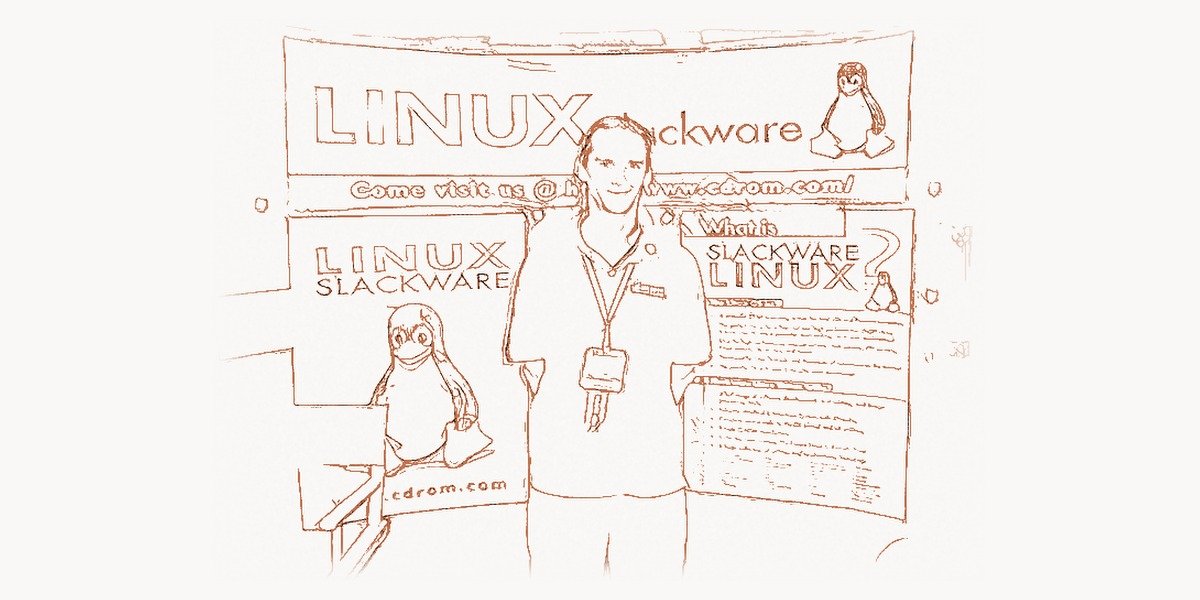
In the sprawling history of open-source operating systems, certain names recur with an almost gravitational force: Linus Torvalds, Richard Stallman, Ian Murdock. But among the very earliest Linux distribution creators — the people who actually made the kernel usable for ordinary humans — one figure stands apart through sheer longevity and singular dedication. Patrick Volkerding created Slackware Linux in 1993, making it the oldest actively maintained Linux distribution in the world. For more than three decades, he has guided its development almost single-handedly, refusing to compromise on the Unix philosophy that defined his creation from day one.
While other distributions pivoted toward graphical installers, automatic dependency resolution, and corporate backing, Slackware remained deliberately austere. It never chased market share. It never courted venture capital. And yet, it endured — a quiet monument to the idea that simplicity, transparency, and manual control are not relics of a bygone era but enduring principles of good software engineering.
Early Life and Education
Patrick J. Volkerding was born on September 20, 1966, in the United States. He grew up during a period when personal computing was transitioning from hobbyist curiosity to mainstream phenomenon. As a young man, Volkerding developed an interest in computing that eventually led him to pursue studies at Minnesota State University Moorhead, where he studied computer science.
It was during his time at university in the early 1990s that Volkerding first encountered Linux. The kernel, released by Linus Torvalds in 1991, was generating considerable excitement in academic computing circles. However, actually installing and using Linux at the time was an exercise in frustration. There was no coherent distribution — users had to download the kernel, compile it, and manually assemble a working system from scattered software packages. The Softlanding Linux System (SLS) was one of the first attempts to package Linux into something installable, but it was riddled with bugs and poorly maintained.
Volkerding began fixing SLS for his own use and for the computer science department at his university. What started as a personal patch collection gradually evolved into something far more ambitious — a complete rethinking of how a Linux system should be assembled and distributed.
The Birth of Slackware: A Technical Revolution in Packaging
On July 17, 1993, Patrick Volkerding released Slackware Linux 1.0 to the world. The name was originally a tongue-in-cheek reference to the Church of the SubGenius and its concept of “slack,” though Volkerding later noted that the name stuck because it was intended as a placeholder that he never got around to changing.
Slackware was built on a radically simple premise: a Linux distribution should be as close to the upstream source code as possible, with minimal patching, and should use a packaging system that is transparent and easy to understand. This was the foundation of the pkgtool system — a set of shell scripts for creating, installing, and removing software packages stored as compressed tarballs.
The pkgtool Package Management System
Unlike the complex dependency-resolution systems that would later appear in distributions like Debian (with dpkg/APT) and Red Hat (with RPM/YUM), Slackware’s package management was deliberately minimal. A Slackware package is fundamentally a compressed tar archive with a simple installation script:
# Creating a Slackware package from source
# 1. Configure and compile the software
./configure --prefix=/usr --sysconfdir=/etc
make
make install DESTDIR=/tmp/package-myapp

# 2. Create the package directory structure
cd /tmp/package-myapp
mkdir install
cat > install/slack-desc << "EOF"
# HOW TO EDIT THIS FILE:
# The "handy ruler" below aligns descriptions at column 15.
#        |-----handy-ruler----------------------------------------------|
myapp: myapp (A sample application)
myapp:
myapp: This is a brief description of what myapp does.
myapp: It follows the standard Slackware slack-desc format,
myapp: with the package name preceding each description line.
myapp:
EOF

# 3. Build the package
makepkg -l y -c n /tmp/myapp-1.0-x86_64-1.txz

# 4. Install the package
installpkg /tmp/myapp-1.0-x86_64-1.txz
This approach was criticized by some as primitive, but it embodied a philosophy that remains influential: the administrator should understand exactly what is being installed on their system. There is no hidden dependency tree, no automatic pulling of packages from remote repositories, no background daemon managing updates. Every action is explicit, visible, and reversible.
Why It Mattered
Slackware’s release in 1993 was historically significant for multiple reasons. First, it was one of the very first complete Linux distributions — arriving in the same year as Debian and preceding Red Hat Linux by a year. Second, it established a template for how Linux could be packaged and distributed that prioritized stability and transparency over convenience. Third, it proved that a single developer with a clear vision could create and maintain a full operating system distribution — a notion that many considered impossible at the time.
The distribution quickly became the most popular way to run Linux in the mid-1990s. Before Red Hat and SUSE gained corporate traction, before Ubuntu made Linux accessible to non-technical users, Slackware was the distribution that system administrators and developers reached for when they needed a reliable Unix-like system on commodity hardware. It trained an entire generation of Linux professionals who went on to build the infrastructure of the modern internet.
Many influential figures in the Linux ecosystem cut their teeth on Slackware. Alan Cox, who became one of the most important early Linux kernel contributors, and Greg Kroah-Hartman, now the maintainer of the Linux stable kernel, both worked in environments where Slackware was a standard choice for servers and development workstations. The distribution’s insistence on shipping software close to upstream meant that its users developed a deep understanding of how Linux systems actually worked — knowledge that proved invaluable as the open-source movement grew.
Three Decades of Solo Maintenance
Perhaps the most remarkable aspect of Slackware is not its technical design but the fact that Patrick Volkerding has maintained it almost single-handedly for over thirty years. While other distributions grew into organizations with hundreds of paid developers — Canonical employs over 800 people for Ubuntu, Red Hat has thousands of engineers — Slackware remained essentially a one-person project with occasional contributions from a small circle of trusted helpers.
Volkerding compiles packages, writes build scripts, tests releases, manages the FTP mirrors, and handles virtually every aspect of the distribution’s lifecycle. His approach to release management reflects this: Slackware releases come when they are ready, not according to a corporate schedule. The distribution went through a notably long development cycle between Slackware 14.2 (released in 2016) and Slackware 15.0 (released in February 2022), during which Volkerding dealt with serious health issues while continuing to maintain the -current development branch.
This solo maintenance model has drawn both admiration and concern from the community. Admirers point to the consistency and quality that a single maintainer’s vision ensures — every package in Slackware reflects Volkerding’s judgment about how software should be compiled and configured. Critics worry about the bus factor: what happens to Slackware if Volkerding can no longer maintain it? This tension highlights a broader question in open source about sustainability and the hidden human costs of maintaining critical infrastructure, a theme explored well in the context of modern development workflows by task management platforms that help distribute workload across teams.
The Slackware Init System and Unix Orthodoxy
One of the most technically distinctive and controversial aspects of Slackware is its init system. While the majority of Linux distributions adopted systemd — the init system created by Lennart Poettering and Kay Sievers — Slackware retained the traditional BSD-style init scripts. This was not an oversight or a failure to keep up with the times; it was a deliberate architectural decision rooted in the Unix philosophy articulated by figures like Richard Stallman and codified by Eric S. Raymond.
Slackware’s init system uses simple shell scripts in /etc/rc.d/ to manage system services. The structure is elegant in its transparency:
# Slackware BSD-style init script example: /etc/rc.d/rc.httpd
#!/bin/sh
#
# Start/stop/restart the Apache HTTP Server

PIDFILE=/var/run/httpd/httpd.pid

httpd_start() {
  if [ -x /usr/sbin/httpd ]; then
    echo "Starting Apache web server: /usr/sbin/httpd"
    /usr/sbin/httpd -k start
  fi
}

httpd_stop() {
  if [ -r "$PIDFILE" ]; then
    echo "Stopping Apache web server..."
    /usr/sbin/httpd -k stop
    sleep 1
  fi
}

httpd_restart() {
  httpd_stop
  sleep 2
  httpd_start
}

case "$1" in
  'start')
    httpd_start
    ;;
  'stop')
    httpd_stop
    ;;
  'restart')
    httpd_restart
    ;;
  *)
    echo "Usage: $0 {start|stop|restart}"
    ;;
esac
Each service is controlled by a simple script that any administrator can read, understand, and modify. To enable or disable a service, you simply toggle the executable permission on the script — chmod +x /etc/rc.d/rc.httpd to enable, chmod -x /etc/rc.d/rc.httpd to disable. There is no binary logging format, no complex dependency graph, no PID-1 daemon managing every process on the system. The entire init process is auditable with cat and less.
This decision became increasingly controversial as systemd gained dominance across the Linux ecosystem. By the mid-2010s, essentially every major distribution — Fedora, Ubuntu, Debian, Arch, openSUSE — had adopted systemd. Slackware’s refusal to follow suit made it an outlier, but also a refuge for administrators and developers who preferred the traditional Unix approach to system management.
Other Contributions to the Linux Ecosystem
Beyond Slackware itself, Volkerding’s work has had a ripple effect across the broader Linux ecosystem. Several important distributions trace their lineage directly to Slackware:
SUSE Linux — one of the most important enterprise Linux distributions in history — was originally based on Slackware before developing its own package management and identity. The fact that SUSE, now owned by a private equity firm and serving Fortune 500 companies, grew from Slackware’s roots speaks to the quality of the foundation Volkerding built.
Slax, a popular live CD distribution, was built on Slackware and demonstrated that the distribution’s simplicity made it an excellent base for specialized systems. Porteus, Salix OS, and Zenwalk all descend from Slackware, each adding user-friendly features while preserving the core philosophy.
Volkerding also contributed to the broader culture of Linux distribution development. His approach — meticulous attention to build quality, minimal patching of upstream sources, and transparent packaging — influenced how other distribution maintainers thought about their craft. The Linux kernel maintenance practices that emerged in the early 2000s share a philosophical kinship with Volkerding’s approach: stability through careful, deliberate engineering rather than rapid feature addition.
The Slackware community also pioneered SlackBuilds.org, a community-driven repository of build scripts for third-party software. This project extended Slackware’s capabilities without compromising its core principle of transparency — every SlackBuild script is a readable shell script that shows exactly how a piece of software is compiled and packaged.
Philosophy: Simplicity as a Design Principle
Patrick Volkerding’s design philosophy can be summarized in a single principle: the system should do what the administrator tells it to do and nothing more. This stands in stark contrast to the trend in modern Linux distributions toward automation, abstraction, and “intelligence” — auto-configuring network managers, desktop environment integrations, snap packages, and flatpaks that abstract away the underlying system.
Volkerding has repeatedly expressed skepticism toward complexity for its own sake. Slackware does not include a graphical installer (though the ncurses-based installer is remarkably efficient). It does not automatically resolve dependencies. It does not include a system management daemon that takes control of the boot process. These are not limitations — they are design choices that reflect a coherent philosophy about how operating systems should work, and how teams can leverage streamlined tools like modern project management solutions to maintain clarity in complex workflows.
This philosophy resonates with the broader Unix tradition articulated in Peter Salus’s summary of the Unix philosophy: write programs that do one thing and do it well, write programs to work together, and write programs that handle text streams. Slackware, more than any other surviving Linux distribution, embodies these principles at the distribution level. Configuration is done through text files. Services are managed through shell scripts. The package manager operates on compressed archives that can be inspected with standard Unix tools.
The appeal of this approach extends beyond nostalgia. In an era of supply-chain attacks and increasingly opaque software stacks, Slackware’s transparency has practical security implications. When every package is a tarball built from a readable script, and every system service is managed by a shell script that an administrator can audit in minutes, the attack surface for hidden malicious code is dramatically reduced.
Legacy and Continuing Influence
Patrick Volkerding’s legacy is paradoxical: he created one of the most influential Linux distributions in history, yet he remains one of the least celebrated figures in the open-source movement. He has never sought publicity, rarely gives public talks, and maintains a minimal online presence. His work speaks through the distribution itself and through the thousands of system administrators and developers who learned Linux by wrestling with Slackware’s uncompromising simplicity.
Slackware’s influence on the Linux ecosystem is difficult to overstate. It was the distribution that proved Linux could be a serious operating system for servers and workstations. It was the foundation from which SUSE emerged to become an enterprise powerhouse. It was the training ground for a generation of Linux professionals who valued understanding over convenience. And it remains, to this day, a working demonstration that the Unix philosophy is not just a historical curiosity but a viable approach to modern system design.
The release of Slackware 15.0 in 2022, after years of development and Volkerding’s personal health struggles, was greeted with genuine emotion by the Linux community. It demonstrated that the project — and its creator — remained vital and committed. The -current branch continues to receive regular updates, tracking the latest kernel releases and software versions.
In the broader narrative of computing history, Volkerding occupies a unique position. He is not a corporate founder like Bill Gates or a charismatic evangelist like Mark Shuttleworth. He is a craftsman — someone who has dedicated more than half his life to building and maintaining a single piece of software that embodies his vision of how a computer should work. In an industry obsessed with disruption, scale, and novelty, that kind of quiet dedication is both rare and profoundly admirable.
His work reminds us that not every important contribution to technology comes wrapped in a press release or a TED talk. Sometimes the most enduring innovations are the ones maintained in quiet persistence by a single person who refuses to compromise on their principles.
Key Facts
| Detail | Information |
|---|---|
| Full Name | Patrick J. Volkerding |
| Born | September 20, 1966 |
| Nationality | American |
| Education | Minnesota State University Moorhead (Computer Science) |
| Known For | Creator and maintainer of Slackware Linux |
| First Release | July 17, 1993 (Slackware 1.0) |
| Latest Major Release | Slackware 15.0 (February 2, 2022) |
| Package System | pkgtool (compressed tarballs with shell-script management) |
| Init System | BSD-style init scripts (no systemd) |
| Derived Distributions | SUSE, Slax, Porteus, Salix OS, Zenwalk, Vector Linux |
| Maintenance Model | Primarily solo with small community assistance |
| Notable Achievement | Oldest actively maintained Linux distribution (30+ years) |
Frequently Asked Questions
Why is Slackware considered important in Linux history?
Slackware, released in 1993, is the oldest actively maintained Linux distribution. It was one of the first distributions to make Linux accessible as a complete, installable operating system. During the mid-1990s, it was the most widely used Linux distribution, and it served as the foundation for SUSE Linux, which became a major enterprise platform. Slackware trained a generation of Linux professionals and demonstrated that a distribution could prioritize simplicity and transparency without sacrificing functionality.
Why doesn’t Slackware use systemd like other distributions?
Patrick Volkerding made a deliberate decision to retain BSD-style init scripts rather than adopting systemd. This aligns with Slackware’s core philosophy of simplicity and transparency. BSD-style init scripts are plain shell scripts that any administrator can read, modify, and debug using standard Unix tools. Volkerding has expressed that the complexity introduced by systemd — with its binary logging, process management daemon, and extensive scope — conflicts with the Unix principle of doing one thing well.
Is Slackware suitable for beginners?
Slackware is generally not recommended as a first Linux distribution for complete beginners. It expects users to have a basic understanding of Unix concepts, command-line usage, and manual configuration. However, many experienced Linux users argue that learning with Slackware provides a deeper understanding of how Linux systems work than starting with more automated distributions. The skills gained from using Slackware — manual package management, text-based configuration, init script management — transfer directly to any other Linux or Unix system.
How has Volkerding maintained Slackware for so long as essentially a solo project?
Volkerding’s ability to maintain Slackware for over thirty years stems from several factors: the distribution’s deliberately simple architecture means there is less code to maintain; the decision to ship software close to upstream with minimal patching reduces the maintenance burden; and a small but dedicated community of contributors helps with testing and the SlackBuilds.org third-party package repository. Volkerding has also benefited from donations from the Slackware community, though the project has never had corporate sponsorship on the scale enjoyed by distributions like Ubuntu or Fedora.