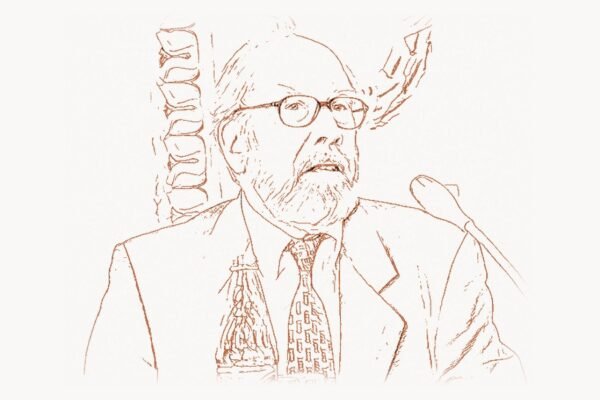
Few game designers have shaped an entire genre from scratch, and fewer still have done it more than once. Peter Molyneux — the British designer behind Populous, Dungeon Keeper, Black & White, and the Fable series — didn’t just make games; he invented new ways for players to interact with virtual worlds. His career, stretching from the bedroom coders of 1980s Britain to the cutting edge of AI-driven game design, is a masterclass in creative ambition, technical risk-taking, and the tension between vision and execution. Through studios Bullfrog Productions and Lionhead Studios, Molyneux pioneered the god game, popularized emergent AI behavior in commercial titles, and pushed the boundaries of what players expected from interactive entertainment.
Early Life & Education
Peter Douglas Molyneux was born on May 5, 1959, in Guildford, Surrey, England — a town that would later become a major hub for the British games industry. Growing up in the 1960s and 1970s, Molyneux was fascinated by technology from an early age. He attended the local grammar school and later studied at the University of Southampton, though he has described his academic experience as unremarkable. Unlike many computing pioneers who emerged from elite institutions, Molyneux’s path into technology was driven by personal curiosity and entrepreneurial instinct rather than formal training.
In the early 1980s, as the home computer revolution swept Britain, Molyneux started several small business ventures — including a baked bean export company and a floppy disk distribution business. These early entrepreneurial efforts, while modest, gave him a practical education in business operations and taught him lessons about risk that would later inform his approach to game development. His entry into software came almost by accident: Commodore mistakenly thought his small company, Taurus, was a software house and sent him free hardware. This fortunate error gave Molyneux his first real access to computing equipment and sparked his transition from general entrepreneur to software creator.
Career & Technical Contributions
Molyneux’s career in gaming can be divided into three major chapters: the Bullfrog era (1987–1997), the Lionhead era (1997–2012), and his post-Lionhead independent work at 22cans. Each period was marked by bold experiments, new genres, and technologies that pushed the industry forward.
Technical Innovation
In 1987, Molyneux co-founded Bullfrog Productions with Les Edgar. The studio’s early titles were modest, but everything changed in 1989 with the release of Populous — widely regarded as the first god game ever made. The concept was revolutionary: instead of controlling a single character or unit, the player assumed the role of a deity, shaping terrain, guiding followers, and waging wars against rival gods. The game’s isometric perspective and real-time terrain manipulation were technically groundbreaking for the era.
Populous introduced a landscape engine that allowed players to raise and lower terrain in real time — a mechanic that had no real precedent in commercial gaming. The technical implementation involved a tile-based heightmap system where each terrain cell stored an elevation value that could be dynamically modified. This approach, while commonplace today, was novel in 1989 and required careful optimization for the hardware of the era.
# Simplified conceptual model of Populous-style terrain heightmap
# Demonstrates the core idea behind real-time terrain manipulation

class TerrainGrid:
    """
    A 2D grid where each cell holds an elevation value.
    Players (as gods) can raise or lower terrain to
    influence settlement patterns and strategic advantage.
    """
    def __init__(self, width, height, default_elevation=1):
        self.width = width
        self.height = height
        self.grid = [[default_elevation for _ in range(width)]
                     for _ in range(height)]

    def raise_terrain(self, x, y, radius=1, amount=1):
        """Raise terrain around (x, y) within a given radius."""
        for dy in range(-radius, radius + 1):
            for dx in range(-radius, radius + 1):
                nx, ny = x + dx, y + dy
                if 0 <= nx < self.width and 0 <= ny < self.height:
                    distance = (dx**2 + dy**2) ** 0.5
                    if distance <= radius:
                        # Elevation falls off with distance
                        factor = max(0, 1 - distance / (radius + 1))
                        self.grid[ny][nx] += int(amount * factor)
                        self.grid[ny][nx] = min(self.grid[ny][nx], 10)

    def flatten_for_settlement(self, x, y, size=3):
        """
        Flatten a region to allow followers to build.
        In Populous, flat land was essential for constructing
        larger, more powerful settlements.
        """
        target = self.grid[y][x]
        for dy in range(size):
            for dx in range(size):
                nx, ny = x + dx, y + dy
                if 0 <= nx < self.width and 0 <= ny < self.height:
                    self.grid[ny][nx] = target

    def get_elevation(self, x, y):
        return self.grid[y][x]

# Usage: God raises land near coordinates (5, 5)
world = TerrainGrid(32, 32)
world.raise_terrain(5, 5, radius=3, amount=4)
world.flatten_for_settlement(4, 4, size=3)
Populous sold over four million copies and spawned an entire genre. Its success established Bullfrog as one of the most innovative studios in Europe. Molyneux followed it with Powermonger (1990), which expanded on the god game formula with more sophisticated AI and resource management, and then Theme Park (1994), a management simulation that let players design and operate their own amusement parks. Theme Park was another massive commercial hit and demonstrated Molyneux's ability to create accessible simulations with surprising depth — an approach that paralleled the work of Will Wright, who was simultaneously revolutionizing simulation gaming with SimCity and later The Sims.
In 1997, Bullfrog released Dungeon Keeper, which inverted the traditional fantasy RPG formula: instead of playing the hero, players built and managed a dungeon, attracting monsters and defending against heroic invaders. Dungeon Keeper featured a sophisticated creature AI system where each monster type had distinct personality traits, needs, and behaviors. Creatures would get angry if not paid, fight each other over territory, and even defect to the enemy if mistreated. This kind of emergent behavior was ambitious for its era and foreshadowed the more complex AI systems Molyneux would develop later.
After Electronic Arts acquired Bullfrog in 1995, Molyneux stayed on for a transitional period before departing in 1997 to found Lionhead Studios. It was at Lionhead that Molyneux's most technically ambitious work took shape. The studio's debut title, Black & White (2001), was a god game that featured a revolutionary AI creature — a giant animal companion that learned from the player's actions through a machine learning system. The creature's behavior was governed by a neural network-inspired system that adjusted based on reinforcement: if the player rewarded the creature for eating villagers, it would become aggressive; if punished, it would learn to be gentle.
// Simplified model of Black & White creature learning system
// Demonstrates reinforcement-based behavior adaptation

class CreatureBehavior {
  constructor() {
    // Behavior weights: positive values encourage, negative discourage
    this.weights = {
      eatVillagers: 0.0,
      helpVillagers: 0.0,
      throwRocks: 0.0,
      dance: 0.0,
      waterCrops: 0.0
    };
    this.learningRate = 0.15;
    this.decayRate = 0.01; // Behaviors slowly fade without reinforcement
  }

  /**
   * Player reinforcement: stroke (reward) or slap (punish)
   * after the creature performs an action.
   * Over time, the creature develops a "personality"
   * based on accumulated reinforcement.
   */
  reinforce(action, isReward) {
    if (this.weights.hasOwnProperty(action)) {
      const delta = isReward ? this.learningRate : -this.learningRate;
      this.weights[action] = Math.max(-1,
        Math.min(1, this.weights[action] + delta)
      );
    }
  }

  /**
   * Choose next action based on learned preferences.
   * Higher weights = more likely to be chosen.
   */
  chooseAction() {
    const actions = Object.entries(this.weights);
    // Softmax-style probability distribution
    const expWeights = actions.map(([a, w]) => [a, Math.exp(w * 3)]);
    const total = expWeights.reduce((sum, [, w]) => sum + w, 0);
    let roll = Math.random() * total;

    for (const [action, weight] of expWeights) {
      roll -= weight;
      if (roll <= 0) return action;
    }
    return actions[0][0];
  }

  applyDecay() {
    for (const key in this.weights) {
      this.weights[key] *= (1 - this.decayRate);
    }
  }
}

// Example: creature learns that helping villagers is rewarded
const creature = new CreatureBehavior();
creature.reinforce('helpVillagers', true);   // Player strokes creature
creature.reinforce('eatVillagers', false);   // Player slaps creature
creature.reinforce('waterCrops', true);      // Player strokes creature
console.log(creature.chooseAction());        // Likely: helpVillagers
Black & White's creature AI was one of the most sophisticated learning systems ever deployed in a commercial game at the time. The concept of an AI agent that adapts to player behavior through reinforcement had deep roots in academic research — the kind of work explored by pioneers like Alan Turing in the foundations of machine intelligence and later refined by researchers such as Peter Norvig in practical AI applications. Molyneux brought these concepts into a mainstream entertainment product, making AI learning tangible and emotionally engaging for millions of players.
Why It Mattered
Molyneux's technical contributions mattered because they fundamentally changed what players and developers believed games could be. Before Populous, the idea that a player could assume a godlike role and reshape an entire world in real time was essentially unexplored in commercial gaming. Before Black & White, the concept of an AI companion that genuinely learned and adapted to individual play styles was confined to academic labs and research papers.
His work at Bullfrog and Lionhead influenced an entire generation of game designers. The god game genre he created with Populous directly inspired titles ranging from From Dust to Reus to WorldBox. The emergent AI behaviors in Dungeon Keeper and Black & White laid groundwork for the sophisticated NPC systems found in modern games like Dwarf Fortress, RimWorld, and The Sims. The management simulation approach pioneered in Theme Park evolved into a massive subgenre that includes Planet Coaster, Two Point Hospital, and countless others.
Molyneux's influence extended beyond specific mechanics to a broader philosophy of game design: that games should give players agency, surprise them with emergent outcomes, and make them feel emotionally connected to virtual worlds. This approach resonated with the design philosophies of contemporaries like Sid Meier, who championed player-driven strategy, and Shigeru Miyamoto, who emphasized joy and discovery in game design.
Other Notable Contributions
Beyond his genre-defining work, Molyneux made several other significant contributions to the gaming industry:
The Fable Series (2004–2010): Developed at Lionhead Studios, the Fable franchise was an ambitious attempt to create a morality-driven action RPG where every player choice had visible consequences. Players' characters physically changed based on their moral alignment — becoming angelic or demonic in appearance. The game's dynamic reputation system, where NPCs reacted differently to the player based on their accumulated deeds, was ahead of its time and influenced subsequent RPGs. While Molyneux's pre-release promises for Fable often exceeded the delivered product — a pattern that became a defining aspect of his public persona — the series sold millions and remains beloved.
Curiosity: What's Inside the Cube? (2012): After leaving Lionhead, Molyneux founded 22cans and released this experimental mobile game where millions of players collectively tapped away layers of a virtual cube to reveal a secret. The experiment explored collective behavior at scale and demonstrated Molyneux's continued interest in social mechanics and large-scale player interaction. The project showed how game designers could create meaningful shared experiences on mobile platforms, a space where sophisticated design thinking was still rare.
Industry Advocacy: Throughout his career, Molyneux has been one of gaming's most visible and vocal advocates. He received an OBE (Officer of the Order of the British Empire) in 2005 for services to the computer games industry and was inducted into the AIAS Hall of Fame. His willingness to speak publicly about game design, both its triumphs and its difficulties, helped elevate the cultural status of game development as a creative discipline. In an industry that benefits from platforms for managing complex creative projects, tools like Taskee demonstrate how far project management has evolved since the early days of game studio coordination.
Philosophy & Key Principles
Molyneux's design philosophy can be distilled into several core principles that have remained consistent throughout his career:
Player agency above all: Molyneux believed that the most compelling games are those where players feel they have genuine power over the world. From the terrain manipulation in Populous to the moral choices in Fable, his games consistently prioritized giving players meaningful control and letting them see the consequences of their decisions.
Emotional connection through AI: Molyneux was among the first commercial game designers to recognize that believable AI could create deep emotional bonds between players and virtual characters. The creature in Black & White, the monsters in Dungeon Keeper, and the NPCs in Fable all reflected this conviction that artificial intelligence should serve emotional storytelling, not just tactical challenge.
Simplicity as a gateway to depth: Despite the technical complexity under the hood, Molyneux's best games featured intuitive interfaces. Populous used a simple raise/lower terrain mechanic. Black & White's gesture-based interface let players cast spells by drawing symbols. Theme Park let players drag and drop rides. This commitment to accessibility — making complex systems approachable — mirrors the design thinking that drives modern creative tools and web design studios focused on user experience.
Ambition as a design tool: Perhaps more controversially, Molyneux embraced grand ambition as a fundamental part of his creative process. He frequently described features and possibilities that pushed beyond what was technically achievable at the time. While this led to criticism when delivered products didn't match pre-release descriptions, it also drove his teams to achieve things that more cautious designers would never have attempted. This approach shares a philosophical kinship with the bold technical bets made by innovators in other domains — figures like John Carmack, who consistently pushed 3D graphics beyond what seemed possible.
Legacy & Impact
Peter Molyneux's legacy is complex and multifaceted. On one hand, he is unquestionably one of the most influential game designers in history. He created the god game genre outright, advanced AI-driven gameplay to a level unprecedented in commercial entertainment, and built two of the most celebrated studios in European gaming history. His games have collectively sold tens of millions of copies and influenced virtually every simulation, strategy, and god game that followed.
On the other hand, Molyneux became equally known for the gap between his public promises and his delivered products. His tendency to describe idealized versions of his games during development — and his genuine, almost childlike enthusiasm for features that were still aspirational — made him a lightning rod for criticism, particularly in the internet age where every interview was archived and every promise was tracked. The "Peter Molyneux problem" became a cautionary tale about managing expectations in game development.
Yet this tension between vision and reality may itself be Molyneux's most instructive legacy. His career demonstrates that breakthrough innovation often requires aiming beyond what is immediately achievable. The games industry's most transformative moments — from the god game to AI-driven creatures to morality systems — emerged from developers willing to promise the impossible and then deliver something that, while not everything imagined, was still genuinely new. The creative pipeline in game development has grown vastly more structured since the Bullfrog days, with modern studios relying on sophisticated project management approaches. But the core challenge that Molyneux embodied — balancing creative ambition with practical constraints — remains central to every ambitious project in the industry.
Molyneux's impact on the British games industry specifically cannot be overstated. Bullfrog and Lionhead were training grounds for an entire generation of developers who went on to lead studios across the UK and beyond. The Guildford game development cluster, which Molyneux helped establish, remains one of the most important centers of game development in Europe. His influence parallels that of Nolan Bushnell, who similarly catalyzed an entire ecosystem — in Bushnell's case, the American arcade and console industry — through visionary studio-building, and Gabe Newell, who transformed game distribution and studio culture through Valve and Steam.
Key Facts
| Detail | Information |
|---|---|
| Full Name | Peter Douglas Molyneux |
| Born | May 5, 1959, Guildford, Surrey, England |
| Education | University of Southampton |
| Key Creations | Populous, Theme Park, Dungeon Keeper, Black & White, Fable |
| Studios Founded | Bullfrog Productions (1987), Lionhead Studios (1997), 22cans (2012) |
| Genre Created | God game (with Populous, 1989) |
| Honors | OBE (2005), BAFTA Fellowship (2011), AIAS Hall of Fame |
| Notable Innovation | AI creature learning system (Black & White, 2001) |
| Games Sold | Tens of millions of copies across all franchises |
| Industry Role | Creative Director; one of Europe's most influential game designers |
Frequently Asked Questions
What is a god game, and why is Peter Molyneux credited with inventing it?
A god game is a genre where the player takes on the role of an omnipotent or near-omnipotent entity, influencing the world and its inhabitants indirectly rather than controlling a single character. Peter Molyneux is credited with inventing this genre because his 1989 title Populous was the first commercial game to implement this concept fully. In Populous, players shaped terrain, directed followers, and battled rival deities — mechanics that had no direct precedent. While earlier strategy games gave players broad control, none had framed the experience as divine oversight with real-time world manipulation. The genre Molyneux created with Populous has since influenced dozens of titles and remains a recognized category in game design.
How did Black & White's AI creature actually learn from the player?
Black & White featured a giant creature companion whose behavior was governed by a reinforcement learning system. When the creature performed an action — such as eating villagers, watering crops, or throwing objects — the player could reward it (by stroking) or punish it (by slapping). These inputs adjusted internal behavioral weights associated with each action type. Over time, the creature developed a distinct personality shaped by the accumulated reinforcement signals. The system also incorporated observational learning: the creature could watch the player's actions and attempt to imitate them. While simplified compared to academic reinforcement learning models, it was one of the most sophisticated AI learning systems deployed in a mainstream game at the time and demonstrated how machine learning concepts could create emotionally compelling gameplay experiences.
Why is Molyneux known for overpromising features in his games?
Throughout his career, Molyneux developed a reputation for describing ambitious game features during interviews and presentations that were not fully realized in the final products. This pattern became most prominent during the Fable development cycle, where Molyneux described a living world with unprecedented player freedom — features like planting acorns that would grow into oak trees over the game's timeline. While the shipped game was well-received, the gap between described possibilities and delivered features drew significant criticism. Molyneux himself has acknowledged this tendency on multiple occasions, describing it as a consequence of his genuine enthusiasm for ideas during the creative process. His situation highlights how important clear communication and expectation management are in complex software projects — a challenge that applies to game development, web development, and virtually every creative technology discipline.
What happened to Bullfrog Productions and Lionhead Studios?
Bullfrog Productions was acquired by Electronic Arts in 1995. Molyneux remained at the studio for approximately two years before departing in 1997 to found Lionhead Studios. Bullfrog continued to operate under EA's ownership for several years but was eventually merged into EA UK in 2001, with its identity effectively dissolved. Lionhead Studios, which Molyneux co-founded with several industry veterans, was acquired by Microsoft in 2006. The studio continued to develop the Fable series and the experimental title Milo & Kate under Microsoft's ownership. However, Microsoft closed Lionhead Studios in 2016, canceling the in-development Fable Legends. Both studio closures followed a common pattern in the industry where independent studios lose creative autonomy after acquisition by larger publishers — a dynamic that continues to shape conversations about studio independence and creative freedom in gaming.