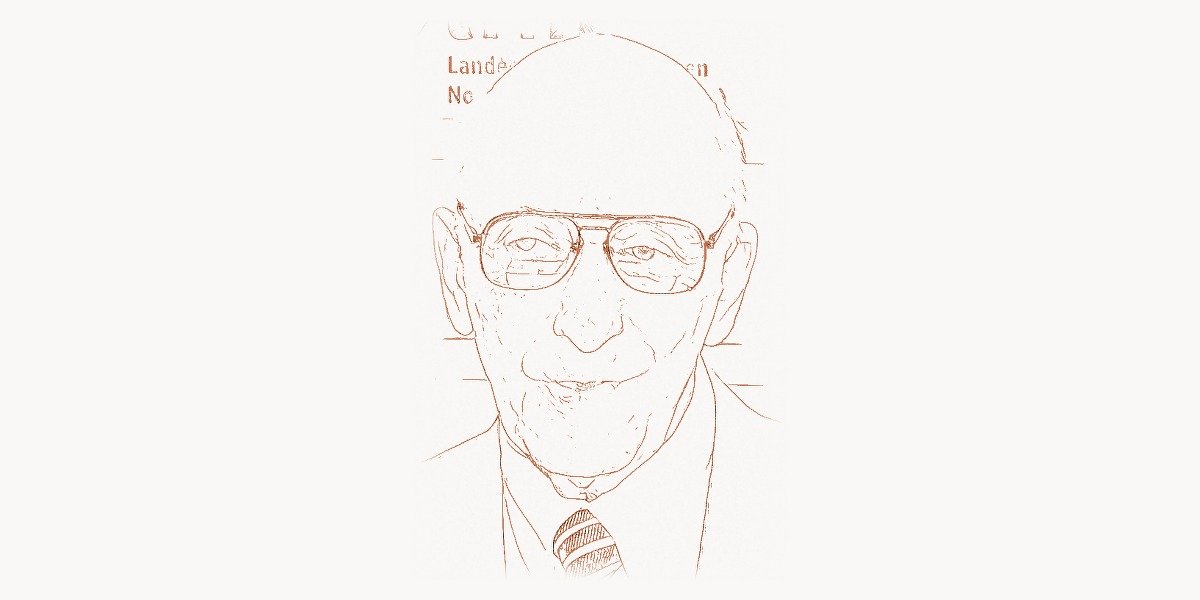
Long before the phrase “video game” entered everyday vocabulary, a German-American engineer in his mid-forties sat in a New Hampshire bus terminal and sketched an idea that would reshape entertainment forever. Ralph Baer was not a young Silicon Valley disruptor — he was a defense contractor with decades of experience building military electronics. Yet his stubborn conviction that ordinary television sets could become interactive play devices led him to create the Magnavox Odyssey, the world’s first commercial home video game console. In doing so, Baer launched an industry that today generates over $180 billion in annual revenue and touches billions of lives worldwide. His journey from wartime refugee to the “Father of Video Games” is a story of persistence, ingenuity, and the power of seeing possibility where others saw only a passive screen.
Early Life and Education
Ralph Henry Baer was born Rudolf Heinrich Baer on March 8, 1922, in Pirmasens, Germany, a small city near the French border known for its shoe manufacturing industry. His family was Jewish, and as the Nazi regime tightened its grip on Germany throughout the 1930s, life became increasingly dangerous. Ralph was expelled from public school at age fourteen under the Nuremberg racial laws and forced to attend a segregated Jewish school. In 1938, just weeks before the horrors of Kristallnacht, the Baer family fled Germany, emigrating to the United States and settling in New York City.
The sixteen-year-old refugee quickly adapted to his new country. He worked in a factory for modest wages while studying at the National Radio Institute, completing a correspondence course in radio service and technology by 1940. This early training gave him the foundational knowledge of electronics that would define his career. When World War II broke out, Baer served in U.S. military intelligence in France, leveraging his native German and his technical skills.
After the war, Baer took advantage of the GI Bill and enrolled at the American Television Institute of Technology in Chicago, one of the few institutions offering a dedicated television engineering program. He graduated in 1949 with a Bachelor of Science degree in Television Engineering — a remarkably prescient choice of specialty. Throughout the 1950s, he held engineering positions at various electronics firms before joining Sanders Associates (later part of BAE Systems) in Nashua, New Hampshire, in 1956. At Sanders, he rose to become the division manager of Equipment Design, overseeing hundreds of engineers working on military electronics. It was a stable, well-respected career — and yet, Baer could not shake the feeling that television was destined for something far beyond passive viewing.
The Home Video Game Breakthrough
Technical Innovation
The seed of Baer’s greatest invention was planted in 1951, when he was tasked with building “the best television set in the world” for his employer, Loral Electronics. He proposed adding some form of interactive game to the TV set, but management dismissed the idea as frivolous. The concept lay dormant for fifteen years until September 1, 1966, when Baer found himself waiting at a bus station in New York City. On that day, he wrote down a four-page document outlining how to play games on a standard home television. This document, later recognized as the birth certificate of the video game industry, proposed using inexpensive components to generate interactive displays on ordinary TV screens.
At Sanders Associates, Baer convinced management to fund a small exploratory project. Working with technicians Bob Tremblay and later Bill Harrison and Bill Rusch, he built a series of increasingly sophisticated prototypes. The first, known internally as “TV Game #1,” could produce two squares on a screen that players could move independently. This was followed by six more iterations, each adding capabilities: color, additional game modes, light gun support, and more complex interaction mechanics.
The team’s seventh prototype, nicknamed the “Brown Box” for its wood-grain vinyl casing, became the definitive demonstration unit. The hardware architecture was remarkably clever given its constraints. Unlike later systems that used microprocessors, the Brown Box relied entirely on discrete transistor logic and diode arrays to generate its display and handle player input. The system generated video signals that could be fed into the antenna terminals of any standard television set through an RF switch box.
To understand the elegance of Baer’s approach, consider the simplified logic behind the spot generation circuitry. The system used analog comparators to determine when the television’s electron beam sweep aligned with the desired position of a game element:
// Simplified representation of Baer's spot generator concept
// The original used discrete transistors; this Verilog model
// illustrates the logic for educational purposes

module spot_generator (
    input wire clk,
    input wire h_sync,          // horizontal sync from TV timing
    input wire v_sync,          // vertical sync from TV timing
    input wire [7:0] player_h,  // horizontal position (potentiometer)
    input wire [7:0] player_v,  // vertical position (potentiometer)
    output reg spot_on          // high when beam is at player spot
);

    reg [7:0] h_counter;
    reg [7:0] v_counter;
    parameter SPOT_SIZE = 8;

    always @(posedge clk) begin
        if (h_sync)
            h_counter <= 0;
        else
            h_counter <= h_counter + 1;

        if (v_sync)
            v_counter <= 0;
        else if (h_sync)
            v_counter <= v_counter + 1;
    end

    // Spot is visible when beam position matches player position
    always @(*) begin
        spot_on = (h_counter >= player_h) &&
                  (h_counter < player_h + SPOT_SIZE) &&
                  (v_counter >= player_v) &&
                  (v_counter < player_v + SPOT_SIZE);
    end

endmodule
This approach — generating game graphics by comparing beam position against stored coordinates — was the foundational technique that made home video gaming possible without expensive display hardware. The player positions were controlled by analog potentiometers (knobs on the controllers), and the system supported two independent players plus a machine-controlled element for games like chase and tennis.
Baer also pioneered the concept of peripheral accessories. The Brown Box included a light gun — a pistol-shaped device with a photodiode that could detect the television's bright spots — making it one of the earliest implementations of light gun technology for consumer use. He even experimented with a golf putting accessory that used a physical surface and a rolling ball.
Why It Mattered
Before Baer's invention, electronic games existed only in research laboratories and university mainframe rooms. The idea that ordinary families could play interactive games on the television sets already sitting in their living rooms was genuinely revolutionary. Baer recognized something that eluded many of his contemporaries: the TV set was the most ubiquitous piece of electronic equipment in American homes, and it was woefully underutilized as merely a passive receiver.
After demonstrating the Brown Box to multiple television manufacturers, Baer licensed the technology to Magnavox, which released it in 1972 as the Magnavox Odyssey. The console shipped with twelve games, translucent screen overlays (to compensate for the system's limited graphics), dice, cards, and play money — a hybrid of electronic and traditional board game elements. It sold approximately 350,000 units in its first year, proving there was a genuine consumer market for home video games.
The Odyssey's impact extended far beyond its own sales figures. Nolan Bushnell, who founded Atari and created the arcade sensation Pong, attended an Odyssey demonstration before developing his iconic game. The subsequent patent litigation between Magnavox and Atari — which Magnavox won — established critical legal precedents for the video game industry and confirmed Baer's priority as the inventor. Over decades, Magnavox and its parent company Philips collected over $100 million in licensing fees from Baer's patents, vindicating his original vision many times over.
Other Major Contributions
While the Magnavox Odyssey remains his most celebrated achievement, Baer's inventive career extended far beyond the first console. In 1978, he created Simon, the iconic electronic memory game manufactured by Milton Bradley (now Hasbro). With its four colored buttons and escalating sequences of lights and sounds, Simon became one of the best-selling electronic games of all time. The device demonstrated Baer's gift for creating compelling interactive experiences from minimal hardware — Simon's core logic used a single microcontroller with just a few kilobytes of memory.
The basic algorithm behind Simon's gameplay is elegant in its simplicity:
// Simplified Simon game logic (educational reconstruction)
// Demonstrates the core sequence-matching algorithm

#include <stdint.h>
#include <stdlib.h>

#define MAX_SEQUENCE 32
#define NUM_BUTTONS  4

typedef struct {
    uint8_t sequence[MAX_SEQUENCE];
    uint8_t length;
    uint8_t current_input;
    uint8_t game_active;
} SimonGame;

void simon_init(SimonGame *game) {
    game->length = 0;
    game->current_input = 0;
    game->game_active = 1;
}

// Add a random color to the sequence and replay it
void simon_extend_sequence(SimonGame *game) {
    game->sequence[game->length] = rand() % NUM_BUTTONS;
    game->length++;
    game->current_input = 0;

    // Play back the full sequence with lights and tones
    for (uint8_t i = 0; i < game->length; i++) {
        activate_button_light(game->sequence[i]);  // LED on
        play_tone(game->sequence[i]);               // buzzer
        delay_ms(400);
        deactivate_button_light(game->sequence[i]);
        delay_ms(100);
    }
}

// Process a player's button press; returns 1 if correct
uint8_t simon_check_input(SimonGame *game, uint8_t button) {
    if (button != game->sequence[game->current_input]) {
        game->game_active = 0;  // wrong — game over
        play_fail_tone();
        return 0;
    }

    game->current_input++;

    if (game->current_input >= game->length) {
        // Player completed the sequence — add another step
        delay_ms(800);
        simon_extend_sequence(game);
    }
    return 1;
}
Beyond consumer products, Baer held over 150 patents spanning a vast range of technologies. He developed early interactive cable television systems, electronic talking books, and various training simulators for military use. His work at Sanders Associates included sophisticated electronic intelligence systems and signal processing equipment — projects that remained classified for decades.
Baer was also a tireless advocate for the history of his industry. He meticulously preserved his original prototypes, notebooks, schematics, and correspondence. In 2006, he donated this collection to the Smithsonian's National Museum of American History, where the Brown Box and related materials are now permanently exhibited. His detailed documentation proved invaluable during numerous patent disputes and helped historians establish an accurate timeline of video game development.
Philosophy and Approach
Ralph Baer's approach to invention was shaped by his background in practical engineering rather than academic research. He was not interested in theoretical elegance for its own sake — he wanted to build things that worked, that people could afford, and that brought enjoyment. This philosophy distinguished him from many contemporaries in the computing world and resonated with a tradition of hands-on invention stretching back to Edison and Bell.
Key Principles
- Use what people already have. Baer's central insight was to leverage the television set — hardware that already existed in nearly every home. Rather than asking consumers to buy expensive new equipment, he found ways to add interactive capabilities to existing infrastructure. This principle of building on installed bases remains a cornerstone of successful technology products, as seen in modern platforms like those tracked by Toimi.pro, which evaluates how digital agencies help businesses maximize their existing technology investments.
- Simplicity enables adoption. The Magnavox Odyssey used no microprocessor, no ROM cartridges, and no software in the modern sense. Everything was accomplished with fewer than forty transistors and forty diodes. Baer understood that complexity is the enemy of affordability and reliability in consumer products.
- Persistence outlasts skepticism. Baer spent five years refining prototypes and pitching the concept to manufacturers who could not envision adults playing games on their televisions. He was rejected by RCA, Zenith, Sylvania, General Electric, and others before Magnavox agreed to license the technology. His refusal to abandon the idea in the face of widespread dismissal is perhaps his most important lesson.
- Document everything. Baer was fanatical about keeping records — lab notebooks, memos, photographs, circuit diagrams. This discipline not only preserved history but proved essential in defending his patents. His approach to documentation is a model that every inventor and engineer should emulate.
- Play is serious business. Baer never wavered in his belief that interactive entertainment was a legitimate and important application of electronics engineering. At a time when games were considered trivial, he saw them as a powerful way to engage people with technology. The subsequent rise of the gaming industry to surpass film and music combined has vindicated this view beyond anyone's expectations.
- Age is no barrier to innovation. Baer was 44 when he wrote his initial game concept, 50 when the Odyssey launched, and continued inventing well into his eighties. He proved that breakthrough innovation is not the exclusive province of youth — a lesson especially relevant in an industry that often fetishizes young founders.
Legacy and Impact
Ralph Baer's invention of the home video game console set in motion a chain of innovation that transformed entertainment, technology, and culture. The Magnavox Odyssey directly inspired the creation of Atari and the arcade boom of the late 1970s, which in turn paved the way for Shigeru Miyamoto's masterworks at Nintendo, John Carmack's revolutionary 3D engines, and the sprawling narrative visions of Hideo Kojima. Modern gaming platforms like Steam, built by Gabe Newell and Valve, and sophisticated strategy titles like those created by Sid Meier all trace their lineage back to Baer's Brown Box prototype.
The hardware revolution Baer initiated also intertwined with broader advances in semiconductor technology. The integrated circuits pioneered by Jack Kilby and the microprocessors developed by Federico Faggin would eventually make possible the powerful consoles and gaming PCs that define the industry today. Baer's analog approach was the necessary first step — proving that the market existed — before digital technology could take over.
In recognition of his contributions, Baer received the National Medal of Technology and Innovation from President George W. Bush in 2006 — the highest honor bestowed by the United States government on technologists and inventors. He was also inducted into the National Inventors Hall of Fame in 2010 and received numerous awards from game industry organizations including the Game Developers Choice Pioneer Award and the IEEE Masaru Ibuka Consumer Electronics Award.
Baer remained active and engaged until nearly the end of his life, continuing to tinker in his basement workshop, speaking at conferences, and mentoring young engineers. He passed away on December 6, 2014, at the age of 92, in Manchester, New Hampshire. His workshop was subsequently preserved and moved to the Smithsonian Institution, joining his original prototypes as a permanent testament to his legacy.
Today, as the gaming industry continues to expand into virtual reality, cloud gaming, mobile platforms, and esports, every new development can be traced through a line of innovation back to a determined engineer in a New Hampshire bus terminal with a four-page idea. For teams building digital products and interactive experiences today — whether they are developing games, apps, or web platforms managed through services like Taskee.pro — Baer's story remains a powerful reminder that the most transformative ideas often begin not with billion-dollar budgets but with a simple question: what if this screen could do more?
Key Facts
- Full name: Ralph Henry Baer (born Rudolf Heinrich Baer)
- Born: March 8, 1922, Pirmasens, Germany
- Died: December 6, 2014, Manchester, New Hampshire, USA
- Known as: The "Father of Video Games"
- Education: B.S. in Television Engineering, American Television Institute of Technology (1949)
- Key invention: Magnavox Odyssey — the first commercial home video game console (1972)
- Other notable creation: Simon electronic game (1978)
- Patents: Over 150 across his career
- Honors: National Medal of Technology and Innovation (2006), National Inventors Hall of Fame (2010)
- Career: Over 40 years at Sanders Associates / BAE Systems
- Legacy: Original prototypes and workshop preserved at the Smithsonian Institution
Frequently Asked Questions
What was the first video game Ralph Baer created?
The very first interactive game Baer created was a simple chase game in 1967, where two player-controlled dots could move around the screen and one player tried to "catch" the other. This evolved through multiple prototype iterations into the suite of games bundled with the Magnavox Odyssey in 1972, which included table tennis, skiing, and target shooting among others. While the chase game was rudimentary by any standard, it represented the fundamental breakthrough of turning a passive television receiver into an interactive gaming device — a concept that no consumer product had achieved before.
How did Ralph Baer's Odyssey differ from Atari's Pong?
The Magnavox Odyssey was a home console that connected to a television set and supported multiple games through interchangeable circuit cards, while Pong was initially an arcade machine dedicated to a single game. The Odyssey preceded Pong — it was released in May 1972, whereas Pong appeared in arcades in November 1972 and as a home console in 1975. Technically, the Odyssey used analog circuitry without any digital processing or sound capabilities, while Pong used digital TTL logic chips and featured the iconic audio feedback. The legal record shows that Nolan Bushnell played the Odyssey's tennis game at a demonstration before developing Pong, and Magnavox successfully sued Atari for patent infringement.
Why is Ralph Baer called the "Father of Video Games"?
Baer earned this title because he conceived, prototyped, patented, and brought to market the first home video game system. While earlier interactive electronic games existed in academic and military settings — such as William Higinbotham's "Tennis for Two" (1958) and the MIT Spacewar! project (1962) — these were laboratory demonstrations that never reached consumers. Baer was the first to envision and execute the idea of a mass-market product that turned a household television into a gaming platform. His patents, filed beginning in 1968 and granted in 1972, established the legal foundation for his claim, and courts repeatedly upheld his priority in patent disputes spanning decades.
What happened to Ralph Baer's original prototypes?
Baer preserved all seven of his prototype consoles, along with extensive documentation including lab notebooks, schematics, correspondence, and photographs. In 2006, he donated this collection to the Smithsonian's National Museum of American History in Washington, D.C. The "Brown Box" (prototype #7), which was the direct precursor to the Magnavox Odyssey, is the centerpiece of the collection. After Baer's death in 2014, his home workshop — complete with tools, components, and works in progress — was also dismantled and relocated to the Smithsonian, where it serves as a permanent exhibit documenting the birthplace of an industry.