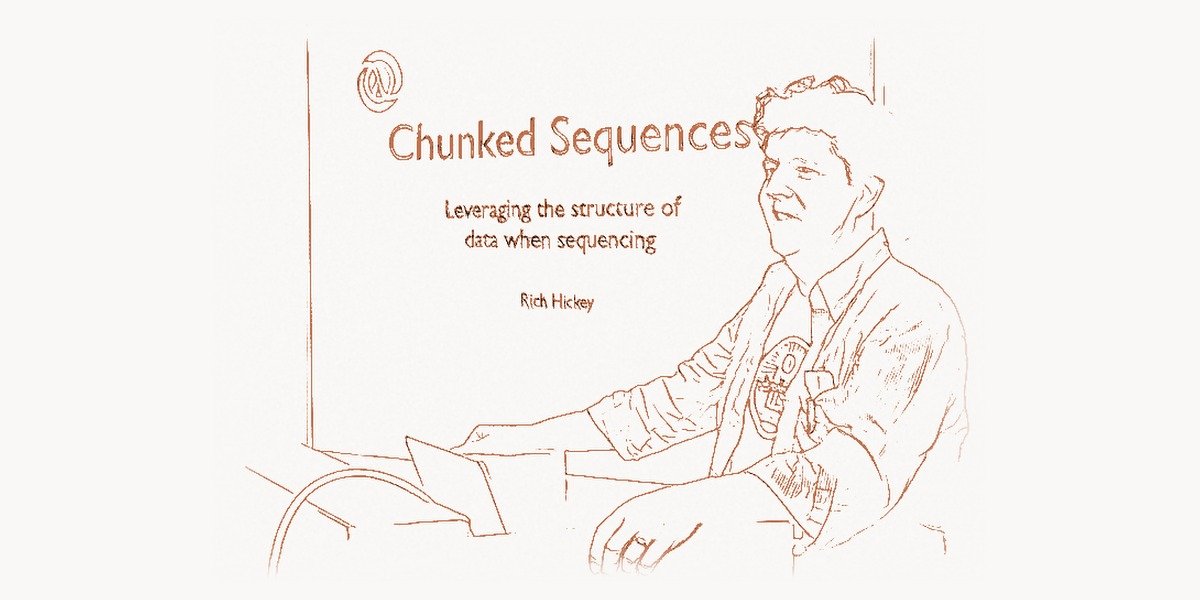
In an industry obsessed with adding more features, more frameworks, and more complexity, Rich Hickey did something radical — he took two years off from paid work to build a language that would strip programming back to its essentials. The result was Clojure, a modern dialect of Lisp running on the Java Virtual Machine, which challenged the mainstream orthodoxy around mutable state and object-oriented design. In doing so, Hickey not only revived interest in functional programming among working developers but fundamentally shifted the conversation about how we think about data, time, and complexity in software. His ideas about immutability, simplicity, and value-oriented programming have rippled far beyond the Clojure community, influencing language design, database architecture, and engineering culture across the entire industry.
Early Life and Path to Technology
Rich Hickey grew up with an intellectual curiosity that would eventually lead him to one of the most distinctive careers in programming language design. He pursued his formal education at New York University’s Courant Institute of Mathematical Sciences, one of the premier centers for mathematics and computer science in the United States. At the Courant Institute, Hickey was exposed to rigorous mathematical thinking and theoretical computer science — foundations that would profoundly shape his later work on Clojure and his philosophy of software development.
After completing his studies, Hickey entered the professional software world and spent over eighteen years working as a consultant and software developer. During this period, he worked extensively with C++ and Java, the dominant industrial languages of their respective eras. This was not ivory-tower theorizing — Hickey was building real systems for real clients, dealing with the day-to-day friction of enterprise software development. He wrestled with concurrency bugs, fought against tangled mutable state, and watched as object-oriented systems grew increasingly difficult to reason about over time.
Throughout these years, Hickey developed a deepening dissatisfaction with the tools at his disposal. He saw the same patterns of complexity emerging again and again: objects that mixed identity with state, inheritance hierarchies that became brittle and rigid, and concurrency models that were fundamentally broken because they relied on locks and mutable shared memory. He was not alone in recognizing these problems — many experienced programmers felt the same frustrations — but Hickey was one of the few who decided to do something about it at the language level.
Before creating Clojure, Hickey made several earlier attempts to bridge the gap between Lisp and mainstream platforms. He created dotLisp for the .NET platform and jfli, a Java foreign language interface, as well as Foil, a foreign object interface for Lisp. These projects were stepping stones, each one teaching him lessons about what worked and what did not when trying to bring Lisp’s power to practical, everyday programming environments. The experience convinced him that a half-measure would not suffice — what was needed was a full language, designed from scratch with modern concerns in mind, but rooted in the timeless principles of Lisp.
The Breakthrough: Creating Clojure
In 2005, Rich Hickey made a decision that would alter the trajectory of programming language history. He left his consulting career and took an extended sabbatical — roughly two years of unpaid, self-funded work — to design and implement Clojure. This was not a weekend project or a casual experiment. It was a deliberate, focused effort to create a language that solved the problems he had spent nearly two decades identifying. Clojure was publicly released in 2007, and its impact was felt almost immediately.
The Technical Innovation
Clojure’s technical innovations were numerous, but they cohered around a single organizing principle: programming should be about manipulating immutable values, not managing mutable state. This was a direct assault on the prevailing paradigm of object-oriented programming, where objects encapsulated both identity and mutable state, and programmers were expected to carefully coordinate access through locks, monitors, and other synchronization primitives.
At its core, Clojure is a Lisp. It inherits the homoiconic syntax — code is data and data is code — that John McCarthy pioneered in the late 1950s. But Hickey was not interested in nostalgia. He redesigned the language from first principles, keeping what was powerful about Lisp while discarding what was archaic or impractical. Clojure uses persistent data structures — immutable collections that share structure efficiently through a technique called structural sharing based on hash array mapped tries. When you “modify” a Clojure vector or map, you get a new version that shares almost all of its memory with the original, making immutability practical even for large datasets.
;; Immutable data structures in Clojure
(def original-map {:name "Rich Hickey" :language "Clojure" :year 2007})

;; "Updating" returns a new map — original is unchanged
(def updated-map (assoc original-map :paradigm "functional"))

;; original-map is still {:name "Rich Hickey" :language "Clojure" :year 2007}
;; updated-map is {:name "Rich Hickey" :language "Clojure" :year 2007 :paradigm "functional"}

;; Threading macro for readable data transformations
(->> [1 2 3 4 5 6 7 8 9 10]
     (filter odd?)
     (map #(* % %))
     (reduce +))
;; => 165 (sum of squares of odd numbers)
One of Clojure’s most distinctive contributions was its approach to concurrency. Rather than relying on locks, Hickey introduced a system of managed references with well-defined concurrency semantics. Atoms provide uncoordinated, synchronous updates. Refs, combined with Software Transactional Memory (STM), allow coordinated synchronous updates across multiple references within a transaction. Agents handle asynchronous, independent state changes. This was a radically different approach from anything available in Java, C++, or most other mainstream languages at the time.
The decision to host Clojure on the JVM was pragmatic and strategic. Rather than building an entirely new runtime — with all the engineering effort that would entail for garbage collection, JIT compilation, and library ecosystems — Hickey chose to leverage the massive investment that Sun Microsystems and later Oracle had made in the Java platform. Clojure code compiles to JVM bytecode, can call any Java library directly, and benefits from decades of JVM performance optimization. This meant that from day one, Clojure programmers had access to the entire Java ecosystem while writing code in a fundamentally different paradigm.
Why It Mattered
Clojure arrived at a critical moment in computing history. Multi-core processors were becoming standard, and the industry was struggling to write concurrent software that was both correct and performant. The traditional approach — threads, locks, and mutable shared state — was producing bugs that were nearly impossible to reproduce, diagnose, or fix. Hickey’s emphasis on immutability offered a way out: if data never changes, there is nothing to synchronize, and an entire class of concurrency bugs simply disappears.
But the significance of Clojure went beyond concurrency. It represented a philosophical challenge to the dominance of object-oriented programming. In the world of Java and C++, the received wisdom was that programs should be organized as networks of objects communicating through method calls. Hickey argued that this model conflated several distinct concepts — identity, state, value, and time — that should be kept separate. A person’s name is a value; it does not change when you learn it. But a person’s bank balance is associated with an identity whose state changes over time. Conflating these concepts, Hickey argued, was the root cause of much accidental complexity in software.
This philosophical clarity attracted a devoted community of programmers who were tired of fighting their tools. Clojure became particularly popular in domains where data processing and transformation were central — financial systems, data pipelines, web applications, and data science. Companies like Walmart, Cisco, Netflix, and many startups adopted Clojure for production systems. Teams focused on building efficient internal tooling and managing complex projects — similar to the approach championed by platforms like Taskee — found that Clojure’s emphasis on data-first thinking aligned well with their needs for clarity and reliability.
Datomic and Rethinking the Database
Having reimagined programming with Clojure, Hickey turned his attention to another fundamental piece of the software stack: the database. In 2012, he and his team at Cognitect (the company formed to steward Clojure’s commercial ecosystem) released Datomic, an immutable database that applied many of the same principles that made Clojure distinctive.
Traditional relational databases operate on a model of place-oriented programming — updating a row means overwriting the old data with new data. The old values are gone, destroyed. Datomic rejected this model entirely. In Datomic, the database is an accumulation of immutable facts (called datoms), each stamped with a transaction time. Nothing is ever deleted or overwritten; new facts are simply added. To “update” an entity, you add a new fact that supersedes the old one, but the old fact remains in the historical record.
;; Datomic query — finding all languages created by a person
;; using Datalog, a declarative query language
(d/q '[:find ?language-name ?year
        :where
        [?person :person/name "Rich Hickey"]
        [?lang :language/creator ?person]
        [?lang :language/name ?language-name]
        [?lang :language/year ?year]]
     db)

;; Time travel — query the database as it was at a specific point
(def db-last-year (d/as-of db #inst "2024-01-01"))
(d/q '[:find ?e ?attr ?val
        :where [?e ?attr ?val]]
     db-last-year)
This design had profound implications. Because the database was immutable, it could be freely cached and replicated. Reads never blocked writes. Historical queries became trivial — you could ask not only “what is the current state?” but “what was the state at any point in the past?” This was not just a technical curiosity; it was essential for auditing, compliance, debugging, and understanding how systems evolved over time. The architecture separated the concepts of reading, writing, and storage into distinct components — peers, transactors, and storage services — allowing each to be scaled and optimized independently.
Datomic was also notable for using Datalog as its query language, rather than SQL. Datalog, a logic programming language related to Prolog, was well-suited to expressing complex relational queries in a composable and readable way. This choice reinforced Hickey’s broader vision of programming as the manipulation of data through declarative transformations, rather than the imperative step-by-step mutation of state.
ClojureScript and the Browser
In 2011, Hickey and the Clojure community extended the language’s reach to another critical platform: the web browser. ClojureScript compiles Clojure code to JavaScript, allowing developers to use the same language and idioms on both the server and the client. This was more than a convenience — it demonstrated that Clojure’s core ideas were not tied to the JVM but were genuinely universal principles of good software design.
ClojureScript became the foundation for several influential front-end frameworks, most notably Reagent and Re-frame, which brought reactive programming and unidirectional data flow to the browser. These frameworks predated and influenced the broader shift in the JavaScript ecosystem toward immutable state management — a movement that culminated in Redux, which explicitly acknowledged Clojure and Elm as inspirations. The functional, data-oriented approach that Hickey championed found its way into the mainstream of web development, even among programmers who had never written a line of Clojure.
Modern web agencies building complex client applications — such as the team at Toimi — routinely employ principles of immutable state management and functional data transformations that trace their intellectual lineage directly to Clojure and its ecosystem. The influence is so pervasive that many developers apply these patterns without knowing their origins.
Philosophy and Engineering Approach
Rich Hickey is unusual among programming language creators in the depth and rigor of his philosophical commitments. While many language designers focus primarily on syntax, performance, or type systems, Hickey has consistently grounded his work in a careful analysis of fundamental concepts: what is simplicity? What is a value? What is identity? What is time? His conference talks, which have achieved a legendary status in the programming community, are as much philosophy lectures as technical presentations.
Key Principles
Simplicity versus Easiness. In his most famous talk, “Simple Made Easy” (delivered at Strange Loop 2011), Hickey drew a sharp distinction between simplicity and easiness. Something is easy if it is near at hand, familiar, or requires little effort to begin using. Something is simple if it is not interleaved or braided together with other things — if it has a single role, a single concept, a single dimension of complexity. These are orthogonal properties. A tool can be easy but complex (like many ORM frameworks), or hard but simple (like relational algebra). Hickey argued that the software industry had systematically confused the two, chasing easiness at the expense of simplicity, and paying for it with systems that were incomprehensible, fragile, and impossible to change.
Values and State. Hickey repeatedly emphasized the distinction between values and state. A value is an immutable, timeless piece of information — the number 42, the string “hello”, a map of attributes. State is the succession of values associated with an identity over time. Most programming languages, particularly in the object-oriented tradition championed by Alan Kay and others, conflated these concepts by making objects both identities and containers of mutable state. Hickey argued this was a fundamental modeling error that made programs harder to understand and more prone to bugs.
Data-Oriented Programming. Unlike the approach in many mainstream languages — including Python, Java, and TypeScript — where programs are structured around classes and type hierarchies, Hickey advocated for data-oriented programming. Programs should be organized around the flow and transformation of data, using generic data structures (maps, vectors, sets, lists) rather than bespoke types for every concept. This made programs more flexible, more composable, and easier to test, because data could be inspected, serialized, and transformed without knowledge of implementation details.
Decomplection. Hickey coined the term “decomplection” — the process of separating interleaved concerns. Much of software design, in his view, was the art of recognizing where concepts had been unnecessarily braided together and pulling them apart. Order and content in a collection. Identity and state in an object. Reading and writing in a database. Place and value in memory. By systematically decomplecting these concerns, programmers could build systems that were genuinely simple — not just easy to get started with, but tractable over the long term.
Hammock-Driven Development. In his talk “Hammock Driven Development,” Hickey made a case for deep thinking as an essential part of software engineering. He argued that the most important phase of programming happened away from the computer — in a hammock, on a walk, in the shower — when the mind could work on problems without the distraction of immediate feedback loops. This was a challenge to the prevailing culture of rapid iteration and constant typing, and it resonated deeply with experienced programmers who recognized that the hardest bugs were not coding errors but design errors — wrong abstractions, misunderstood requirements, conflated concepts.
Influence on the Broader Programming Landscape
Clojure’s influence has extended far beyond its immediate community. The language’s emphasis on immutability helped catalyze a broader shift in the software industry toward functional programming concepts. When Facebook introduced React in 2013 and later when Dan Abramov created Redux for JavaScript state management, the debt to Clojure’s ideas was explicit and acknowledged. The concept of a single immutable state atom, transformed through pure functions, was a core Clojure pattern long before it became standard practice in the JavaScript ecosystem.
The influence is visible in newer languages as well. Rust‘s emphasis on ownership and immutability by default, while achieved through a very different mechanism (the borrow checker rather than persistent data structures), reflects the same underlying insight that mutable shared state is the enemy of reliable software. Go‘s approach to concurrency through channels and goroutines, while distinct from Clojure’s STM model, shares the philosophical commitment to providing first-class concurrency primitives rather than leaving programmers to fend for themselves with raw threads and locks.
Hickey’s talks have become canonical references in software engineering education. “Simple Made Easy” is regularly cited in engineering blog posts, conference keynotes, and university courses. The vocabulary Hickey introduced — complecting, decomplection, incidental complexity, place-oriented programming — has entered the working lexicon of thoughtful software engineers worldwide. Like Edsger Dijkstra, who shaped how an entire generation thought about algorithms and structured programming, Hickey has shaped how a generation thinks about state, complexity, and system design.
Legacy and Modern Relevance
As of the mid-2020s, Clojure occupies a distinctive position in the programming language landscape. It is not one of the most popular languages by raw adoption numbers — it does not compete with Python or JavaScript on that dimension. But it commands outsized influence relative to its user base, and its community is known for exceptionally high developer satisfaction and productivity. Surveys consistently show that Clojure developers report high salaries and strong job satisfaction, suggesting that the language attracts experienced practitioners who have deliberately chosen it for its technical merits.
The ideas that Hickey championed have become increasingly mainstream. Immutability is now a default or strongly recommended practice in many modern languages and frameworks. Persistent data structures, once an exotic concept, are available in libraries across multiple language ecosystems. The separation of identity and state, the preference for data over objects, the emphasis on simplicity over easiness — these principles have permeated modern software engineering practice, even in codebases that never import a Clojure library.
Datomic continues to evolve, and its architectural insights — treating the database as an immutable log of facts, separating reads from writes, enabling time-travel queries — have influenced the broader database landscape. Event sourcing and CQRS (Command Query Responsibility Segregation) patterns, which have become popular in distributed systems design, share deep philosophical roots with Datomic’s approach to data.
Rich Hickey’s legacy is not primarily measured in lines of code or GitHub stars. It is measured in the clarity of thought he brought to software engineering — the insistence that words should mean specific things, that concepts should not be casually conflated, that simplicity is a prerequisite for reliability, and that the hard work of thinking carefully before coding pays dividends that no amount of testing or agile process can match. In an industry that often celebrates speed and novelty, Hickey has been a consistent voice for depth, rigor, and intellectual honesty.
Key Facts
- Rich Hickey studied computer science at NYU’s Courant Institute of Mathematical Sciences.
- He spent over 18 years as a professional C++ and Java consultant before creating Clojure.
- Clojure was released in 2007 after approximately two years of self-funded development.
- Clojure runs on the Java Virtual Machine (JVM), compiling to standard JVM bytecode.
- ClojureScript, released in 2011, compiles Clojure to JavaScript for browser and Node.js environments.
- Hickey created Datomic, an immutable database built on the principle that data is never overwritten.
- He co-founded Cognitect (later acquired by Nubank) to commercially support the Clojure ecosystem.
- His talk “Simple Made Easy” has been viewed millions of times and is considered essential viewing for software engineers.
- Other notable talks include “Are We There Yet?”, “The Value of Values”, and “Hammock Driven Development”.
- Clojure introduced Software Transactional Memory (STM) as a practical concurrency model for the JVM.
- Persistent data structures in Clojure use hash array mapped tries for efficient structural sharing.
Frequently Asked Questions
What makes Clojure different from other Lisp dialects?
While Clojure inherits the fundamental Lisp philosophy of homoiconicity (code as data) from John McCarthy’s original Lisp, it diverges significantly from traditional Lisps like Common Lisp and Scheme. Clojure runs on the JVM rather than a custom runtime, giving it immediate access to the vast Java library ecosystem. It introduces immutable persistent data structures as the default, rather than the mutable cons cells of classical Lisp. It provides a rich set of literal syntax for vectors, maps, and sets — not just lists — making data representation more natural. And it includes built-in concurrency primitives (atoms, refs, agents) that have no equivalent in older Lisps. Hickey deliberately broke with Lisp tradition where he felt it was warranted, prioritizing practical utility over historical compatibility.
Why did Rich Hickey choose the JVM as Clojure’s platform?
Hickey chose the JVM for pragmatic reasons rooted in his two decades of industry experience. Building a production-quality runtime from scratch — with garbage collection, JIT compilation, threading support, and cross-platform compatibility — would have consumed years of effort and diverted energy from language design. The JVM already had all of this, battle-tested across millions of production deployments. Additionally, the JVM’s extensive library ecosystem meant that Clojure developers could immediately use any Java library without writing bindings or wrappers. This interoperability was crucial for adoption in enterprise environments where Java was already dominant. Hickey recognized that the best language in the world would fail if it could not connect to the infrastructure and libraries that professional developers needed.
How has Rich Hickey’s “Simple Made Easy” philosophy influenced modern software development?
Hickey’s distinction between simplicity and easiness has become one of the most frequently referenced frameworks for thinking about software design decisions. The core insight — that easy tools reduce initial effort but may increase long-term complexity, while simple tools may require more initial learning but yield systems that remain tractable over time — has influenced architectural decisions across the industry. It contributed to the shift away from heavyweight frameworks toward composable libraries, the preference for immutable state in front-end frameworks like React and Redux, and the growing skepticism toward ORM tools that hide relational complexity behind object facades. The talk gave engineers a precise vocabulary for articulating concerns they had always felt but struggled to express, and it provided intellectual ammunition for choosing designs that optimized for long-term maintainability over short-term convenience.