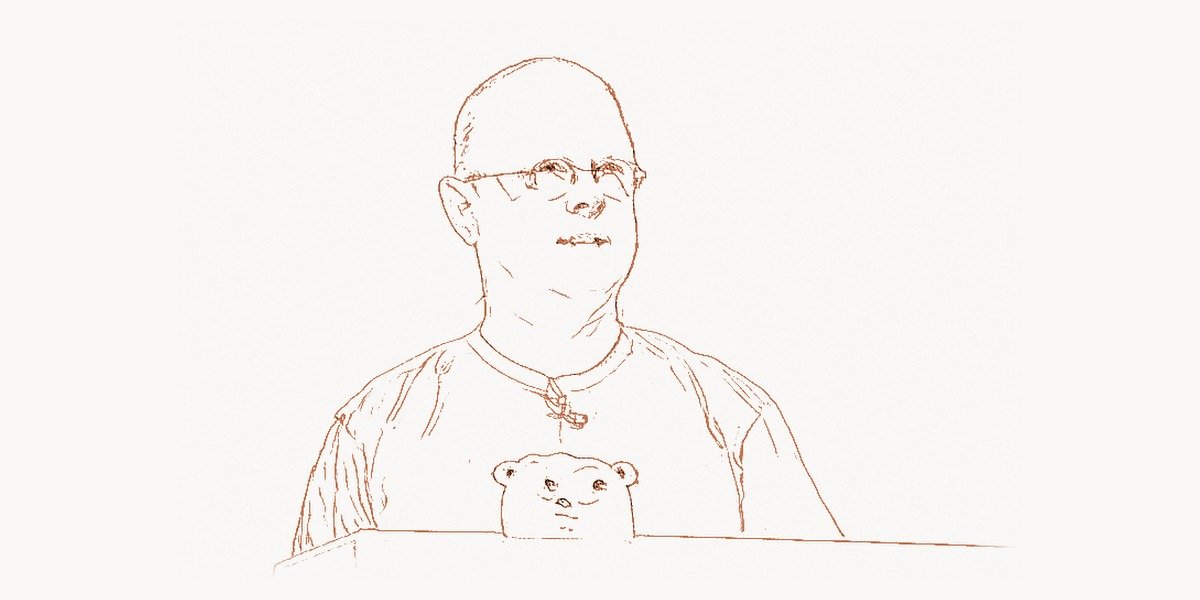
On September 21, 2007, Rob Pike sent an email to Robert Griesemer and Ken Thompson with the subject line “a]language.” Attached was a rough sketch of ideas for a new programming language — one that would be fast to compile, efficient to execute, and pleasant to write in. The three men, all working at Google, were frustrated by the same problem: building large-scale distributed systems in C++ took forever, not because the programs were slow but because the compilation was slow, the dependency management was broken, and the language’s complexity had grown unwieldy. That email became Go (also known as Golang), which Google publicly announced on November 10, 2009. By 2026, Go has become the dominant language for cloud infrastructure — powering Docker, Kubernetes, Terraform, Prometheus, and much of the tooling that runs the modern internet. But Go was only one chapter in a career that spans five decades of systems research. Pike co-created UTF-8, the universal text encoding that handles 98.2% of all web pages. He built the Plan 9 and Inferno operating systems at Bell Labs. He co-invented the Limbo programming language. And alongside Ken Thompson, he helped define what it means to build simple, composable software systems.
Early Life and Path to Technology
Robert C. Pike was born on February 2, 1956, in Canada and grew up in Toronto, Ontario. He attended the University of Toronto, where he studied physics and earned his Bachelor of Science. He then crossed the border to pursue graduate work at the California Institute of Technology (Caltech), where he completed a Master of Science in electrical engineering in 1982.
Pike’s career at Bell Labs began in 1980, where he joined the Computing Science Research Center — the same department where Ken Thompson and Dennis Ritchie had built Unix and C. Pike quickly became a central figure in the systems research group. His early work at Bell Labs included developing the Blit terminal — one of the first bitmap graphics terminals for Unix — and creating the sam and acme text editors, which introduced innovative approaches to text editing with mouse-driven interfaces and structural regular expressions. He co-authored the influential book The Unix Programming Environment (1984) with Brian Kernighan and later The Practice of Programming (1999), also with Kernighan — both became required reading in computer science programs worldwide.
The Breakthrough: UTF-8 and the Go Programming Language
The Technical Innovation: UTF-8
In September 1992, Pike and Thompson faced a concrete problem while working on the Plan 9 operating system at Bell Labs. The computing world needed a way to represent text from every human writing system in a single encoding that was also backward-compatible with ASCII — the 7-bit character encoding that American software had relied on since the 1960s. The Unicode Consortium had defined a universal character set, but the proposed encoding (UCS-2, later UTF-16) used two bytes per character and was incompatible with existing Unix software that assumed null-terminated, ASCII-compatible strings.
Over dinner at a New Jersey diner on September 2, 1992, Pike and Thompson designed UTF-8 on a placemat. The encoding was elegant in its simplicity: ASCII characters (0-127) were represented as single bytes, identical to their ASCII encoding. Characters from other scripts used multi-byte sequences of 2 to 4 bytes, with a clever bit pattern that made the encoding self-synchronizing — you could find the start of any character without scanning from the beginning of a string. Pike implemented the encoding in Plan 9 that same evening, and Thompson updated the compiler the next morning.
UTF-8 became the standard encoding of the internet. By 2008, it surpassed ASCII as the most common encoding on the web. By 2026, 98.2% of all web pages use UTF-8. Every modern operating system, programming language, and database supports it. The reason is precisely the property Pike and Thompson designed in: perfect backward compatibility with ASCII, which meant that existing software could handle UTF-8 strings without modification, while new software could use the full range of Unicode characters. This is why you can read Chinese, Arabic, Hindi, and emoji on any web page — because two Bell Labs researchers solved the encoding problem on a placemat over dinner in 1992.
The Technical Innovation: Go
Fifteen years after UTF-8, Pike found himself at Google, watching a C++ build that would take 45 minutes to compile. He and his colleagues Robert Griesemer and Ken Thompson (who had also joined Google) decided this was unacceptable. Google’s infrastructure ran on millions of lines of C++, Java, and Python, and each language had significant drawbacks for the kind of large-scale distributed systems Google built. C++ was fast but complex and slow to compile. Java was safe but verbose and carried the overhead of the JVM. Python was productive but too slow for systems work.
Go was designed to combine the strengths of all three while avoiding their weaknesses. Its compilation speed came from a clean dependency model — each source file explicitly declares its imports, and the compiler processes them in a single pass. A Go project with millions of lines of code compiles in seconds, not minutes. Its execution speed came from compiling to native machine code, not bytecode. Its productivity came from a small, simple language specification (the Go spec is about 50 pages, compared to C++’s 1,500+) with built-in concurrency primitives.
The concurrency model was Go’s most distinctive feature. Pike drew on Tony Hoare’s Communicating Sequential Processes (CSP) theory, which he and Thompson had already implemented in the Limbo language on Plan 9’s successor, Inferno. In Go, goroutines — lightweight threads managed by the Go runtime — can be launched with the simple go keyword. Goroutines communicate through channels, typed conduits that pass data safely between concurrent processes:
package main

import (
    "fmt"
    "time"
)

func fetchURL(url string, ch chan<- string) {
    // Simulate an HTTP request
    time.Sleep(100 * time.Millisecond)
    ch <- fmt.Sprintf("Fetched: %s", url)
}

func main() {
    urls := []string{
        "https://api.example.com/users",
        "https://api.example.com/orders",
        "https://api.example.com/products",
    }

    ch := make(chan string)

    for _, url := range urls {
        go fetchURL(url, ch) // Launch concurrent goroutines
    }

    for range urls {
        fmt.Println(<-ch) // Receive results as they complete
    }
}
This model made concurrent programming accessible to ordinary developers, not just concurrency experts. A goroutine costs roughly 2KB of stack space (compared to 1MB+ for an OS thread), so a single Go program can easily manage hundreds of thousands of concurrent operations — exactly what cloud services need to handle thousands of simultaneous client connections.
Go also included opinionated tooling from the start. gofmt automatically formatted all Go code to a single standard style, eliminating formatting debates forever. go test provided a built-in testing framework. go build produced a single static binary with no external dependencies — you could copy it to any Linux machine and run it, with no runtime installation required. This deployment simplicity made Go a natural fit for Docker containers and microservices.
Why It Mattered
Go arrived at the exact moment when the software industry was shifting from monolithic applications to distributed microservices running in containers on cloud infrastructure. Docker (released 2013) was written in Go. Kubernetes (released 2014) was written in Go. Terraform, Prometheus, etcd, CockroachDB, Consul, Vault, Hugo, and dozens of other foundational cloud tools were written in Go. The language’s fast compilation, simple deployment (single binary), built-in concurrency, and straightforward syntax made it the default choice for infrastructure software.
At Google itself, Go replaced significant amounts of C++ and Python in production systems. The dl.google.com download server was one of the first production Go services, replacing a C++ implementation. Today, Go powers critical parts of Google’s infrastructure, and thousands of companies use Go for their backend services. The web framework ecosystem around Go includes Gin, Echo, and Fiber, which offer high-performance HTTP routing with minimal overhead.
Go’s Impact on Cloud-Native Development
Go’s influence on cloud-native computing deserves special attention because the language did not merely participate in the containerization revolution — it enabled it. Docker, released by Solomon Hykes at dotCloud in March 2013, was written in Go because the language’s static compilation produced a single binary with no dependencies, its goroutines handled the concurrent container management operations efficiently, and its fast compilation speed made the rapid iteration cycle that Docker’s development required feasible. When Docker popularized Linux containers, it proved that Go was the right tool for systems software that needed to be both reliable and easy to deploy.
Kubernetes, released by Google as open source in June 2014 and developed largely by Joe Beda, Brendan Burns, and Craig McLuckie, was also written in Go. Kubernetes’ architecture — a control plane that manages desired state through declarative configuration, with controllers running reconciliation loops — was a natural fit for Go’s concurrent programming model. Each controller ran as a goroutine, watching for changes and reconciling actual state with desired state. The client-go library became the standard way to interact with Kubernetes clusters programmatically, and the operator pattern — custom controllers that manage application-specific resources — spawned an entire ecosystem of Go-based infrastructure automation.
HashiCorp built their entire product suite in Go: Terraform (infrastructure as code), Vault (secrets management), Consul (service mesh), Nomad (orchestration), and Packer (image building). These tools, collectively used by hundreds of thousands of organizations, demonstrated that Go’s combination of performance, simplicity, and cross-platform compilation made it ideal for DevOps and infrastructure tooling. The Go ecosystem also includes Prometheus (monitoring), Grafana Loki (log aggregation), etcd (distributed key-value store), CockroachDB (distributed SQL), and Traefik (reverse proxy) — forming a nearly complete infrastructure stack written in a single language.
Beyond Go: Other Contributions
Pike’s contributions to computing extend far beyond Go and UTF-8. At Bell Labs, he was a principal designer of the Plan 9 operating system (1992) — a research OS that reimagined Unix’s “everything is a file” philosophy by making every resource (including the network, display, and processes on remote machines) accessible through the file system. Plan 9 introduced concepts like per-process namespaces and the 9P protocol that influenced later systems, including Linux’s /proc filesystem.
He and Thompson also designed the Inferno operating system and the Limbo programming language, which ran on a virtual machine called Dis. Limbo’s channel-based concurrency model was a direct precursor to Go’s goroutines and channels. His text editors — sam and acme — introduced ideas about structural manipulation of text that influenced later editors and development environments.
Pike is also an accomplished competitive archer — he represented Canada at the 1980 Olympics that were boycotted, and won a silver medal in team archery at the 1988 World Indoor Archery Championships. He holds multiple national archery titles, a reminder that excellence in one domain often correlates with disciplined practice in others.
Philosophy and Engineering Approach
Key Principles
Pike’s engineering philosophy can be summarized in one word: simplicity. He has argued consistently throughout his career that complexity is the enemy of reliability and that the best systems are those simple enough to be understood completely by a single person. This belief permeates Go’s design — the language deliberately omits features that other languages consider essential: generics were only added in Go 1.18 (2022) after a decade of careful deliberation, there is no inheritance, no exceptions (Go uses explicit error returns), no macros, and no operator overloading.
“Simplicity is complicated,” Pike said in a 2015 talk. He meant that achieving simplicity requires hard decisions about what to leave out. Go is frequently criticized for being too simple — for requiring repetitive error handling boilerplate, for lacking expressiveness compared to Rust or TypeScript. But Pike and the Go team view this as a feature, not a bug. In a language used by thousands of engineers at Google, readability and uniformity matter more than cleverness. Code is read far more often than it is written, and Go optimizes for the reader.
Pike also emphasizes composition over inheritance — a principle rooted in Unix’s pipe-based design philosophy, where small programs are combined to solve larger problems. Go’s interface system embodies this: rather than declaring that a type implements an interface, a type satisfies an interface simply by having the right methods. This allows types to satisfy interfaces they were never designed for, enabling the kind of compositional flexibility that Thompson and Ritchie built into Unix through pipes and filters.
Legacy and Modern Relevance
In 2026, Go and UTF-8 together touch virtually every internet user on the planet. UTF-8 encodes the text of 98.2% of web pages. Go powers the container orchestration systems (Kubernetes), the infrastructure-as-code tools (Terraform), the monitoring stacks (Prometheus, Grafana’s backend), and countless microservices that make up modern cloud infrastructure. When you deploy a container, it is almost certainly orchestrated by software written in Go, serving content encoded in UTF-8.
Go’s influence on server-side development has been substantial. Its proof that a garbage-collected language could deliver performance close to C for networked services challenged the assumption that systems software required manual memory management. Go 1.22 (2024) continued to improve the language with enhanced routing patterns in the standard library’s HTTP package, range-over-function iterators, and continued garbage collector improvements that keep pause times under 1 millisecond.
Rob Pike retired from Google in 2020 after over a decade of work on Go. He had already been stepping back from active Go development, consistent with his belief that good systems should outlive their creators. The Go team at Google, along with the open-source community, continues to evolve the language — adding generics, improving tooling, and expanding the standard library — without Pike’s daily involvement. It is a measure of his design success that Go thrives without him, carrying forward the principles of simplicity, composability, and practical engineering that Pike spent fifty years refining at Bell Labs and beyond.
Key Facts
- Born: February 2, 1956, Canada
- Known for: Co-creating Go, co-inventing UTF-8, Plan 9 and Inferno operating systems
- Key projects: Go (2007–present), UTF-8 (1992), Plan 9, Inferno, Limbo, sam and acme editors
- Awards: None of the typical computing awards (ACM, IEEE) — Pike’s recognition comes through adoption: UTF-8 on 98%+ of web pages, Go in virtually all cloud infrastructure
- Notable books: The Unix Programming Environment (1984), The Practice of Programming (1999), both co-authored with Brian Kernighan
Frequently Asked Questions
Who is Rob Pike?
Rob Pike is a Canadian computer scientist and software engineer who spent decades at Bell Labs and Google. He co-created the Go programming language with Ken Thompson and Robert Griesemer, co-invented the UTF-8 text encoding with Ken Thompson, and was a principal designer of the Plan 9 and Inferno operating systems. He is also co-author of two influential programming books with Brian Kernighan.
What did Rob Pike create?
Pike’s two most widely-used creations are UTF-8 (the text encoding used by 98%+ of all web pages, co-invented with Ken Thompson in 1992) and the Go programming language (co-created with Thompson and Griesemer, announced in 2009). He also designed the Plan 9 operating system, the Inferno OS and its Limbo language, the sam and acme text editors, and the Blit graphics terminal.
Why is Rob Pike important?
Pike’s work underpins two fundamental aspects of modern computing: how we represent text and how we build cloud infrastructure. UTF-8 solved the problem of representing every human writing system in a single, ASCII-compatible encoding, making the multilingual internet possible. Go solved the problem of building reliable, high-performance distributed systems that are easy to deploy and maintain. Together, these contributions affect virtually every person who uses the internet today.