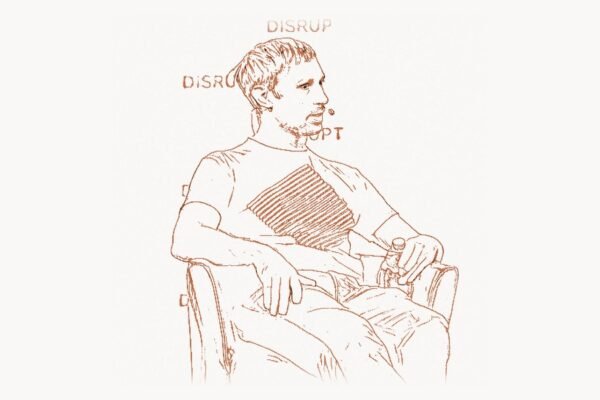
In the early 1970s, a young mathematician at Cornell University looked at a fundamental problem in computer science — how to efficiently explore every corner of a graph — and produced an algorithm so elegant that it would reshape the entire field of graph theory. That mathematician was Robert Endre Tarjan, and his depth-first search framework became the skeleton key for unlocking dozens of problems that had resisted efficient solutions for decades. From finding strongly connected components to analyzing network reliability, Tarjan turned the abstract beauty of graph theory into concrete, blazingly fast algorithms that underpin everything from compilers to social network analysis.
Today, if you have ever run a garbage collector, queried a database optimizer, or used a version control system that detects dependency cycles, you have benefited from Tarjan’s work. His contributions earned him the 1986 Turing Award — shared with John Hopcroft — and cemented his place among the most influential computer scientists of the twentieth century. This article traces the intellectual journey of a thinker who proved, again and again, that the right data structure can transform an intractable problem into a trivial one.
Early Life and Academic Formation
Robert Endre Tarjan was born on April 30, 1948, in Pomona, California. His fascination with mathematics appeared early: by high school he was devouring advanced texts on logic and combinatorics. He earned his bachelor’s degree in mathematics from the California Institute of Technology in 1969, then moved to Stanford University for graduate work under the supervision of Robert Floyd and Donald Knuth — two giants whose influence on algorithms and analysis of programs was already immense.
At Stanford, Tarjan absorbed Knuth’s rigorous approach to algorithm analysis and Floyd’s pioneering work on graph algorithms. His 1972 doctoral dissertation, An Efficient Planarity Testing Algorithm, demonstrated what would become a career-long theme: taking a well-known problem, stripping it down to its combinatorial essence, and producing a solution whose efficiency bordered on the theoretically optimal. The planarity testing algorithm ran in linear time — a result that startled the community and announced the arrival of a formidable new mind.
Depth-First Search: The Universal Solvent
Before Tarjan’s work, depth-first search (DFS) was understood as a useful traversal technique, but its full power as an algorithmic framework had not been systematically exploited. In a landmark 1972 paper, Tarjan showed that DFS could be used to solve a remarkable range of graph problems in linear time, including finding biconnected components, bridges, and articulation points.
The key insight was classifying edges during the DFS traversal into tree edges, back edges, forward edges, and cross edges. This classification turned a simple walk through a graph into a powerful analytical tool. Edsger Dijkstra had earlier pioneered structured approaches to graph exploration, but Tarjan’s systematic framework elevated DFS from a technique to a methodology — one that computer science students still learn as a foundational skill today.
Tarjan’s Strongly Connected Components Algorithm
Perhaps the most celebrated application of Tarjan’s DFS framework is his algorithm for finding strongly connected components (SCCs) in a directed graph. A strongly connected component is a maximal set of vertices such that every vertex is reachable from every other vertex in the set. Identifying SCCs is essential in compilers (for optimizing recursive function calls), in model checking (for verifying system properties), and in web analysis (for understanding the link structure of the internet).
Tarjan’s SCC algorithm works by maintaining a stack of vertices and computing two key values for each vertex during the DFS: a discovery index (the order in which the vertex is first visited) and a low-link value (the smallest discovery index reachable from the subtree rooted at that vertex). When a vertex’s low-link value equals its own discovery index, it is the root of a strongly connected component, and all vertices on the stack above it belong to that component.
def tarjan_scc(graph):
    index_counter = [0]
    stack = []
    low = {}
    disc = {}
    on_stack = {}
    result = []

    def strongconnect(v):
        disc[v] = index_counter[0]
        low[v] = index_counter[0]
        index_counter[0] += 1
        stack.append(v)
        on_stack[v] = True

        for w in graph.get(v, []):
            if w not in disc:
                strongconnect(w)
                low[v] = min(low[v], low[w])
            elif on_stack.get(w, False):
                low[v] = min(low[v], disc[w])

        # If v is a root node, pop the SCC
        if low[v] == disc[v]:
            component = []
            while True:
                w = stack.pop()
                on_stack[w] = False
                component.append(w)
                if w == v:
                    break
            result.append(component)

    for v in graph:
        if v not in disc:
            strongconnect(v)

    return result

# Example usage
graph = {
    0: [1],
    1: [2],
    2: [0, 3],
    3: [4],
    4: [5],
    5: [3]
}
sccs = tarjan_scc(graph)
# Output: [[5, 4, 3], [2, 1, 0]]
The algorithm runs in O(V + E) time — linear in the size of The Graph — which is asymptotically optimal since you must examine every vertex and edge at least once. This result was a tour de force: it showed that a problem with deep structural implications could be solved with the same efficiency as simply reading the input. The algorithm remains one of the most taught and most implemented in all of computer science, featured in every serious algorithms textbook from Cormen, Leiserson, Rivest, and Stein (CLRS) to Sedgewick’s Algorithms.
Union-Find: The Disjoint Set Forest
While graph traversal was a core theme, Tarjan also revolutionized the world of data structures. His analysis of the union-find (disjoint set) data structure — developed in collaboration with John Hopcroft — is a masterclass in amortized complexity analysis.
The union-find structure maintains a collection of disjoint sets and supports two operations: find (determine which set a given element belongs to) and union (merge two sets). These operations appear in Kruskal’s minimum spanning tree algorithm, in network connectivity problems, and in image processing for labeling connected regions.
Tarjan proved that with two optimizations — union by rank and path compression — a sequence of m operations on n elements takes O(m · α(n)) time, where α is the inverse Ackermann function. This function grows so slowly that for all practical input sizes (even those exceeding the number of atoms in the observable universe), α(n) ≤ 4. In effect, each operation takes nearly constant amortized time. Tarjan further proved that this bound is tight — no comparison-based union-find structure can do better.
class UnionFind:
    def __init__(self, n):
        self.parent = list(range(n))
        self.rank = [0] * n

    def find(self, x):
        # Path compression: make every node
        # on the path point directly to the root
        if self.parent[x] != x:
            self.parent[x] = self.find(self.parent[x])
        return self.parent[x]

    def union(self, x, y):
        rx, ry = self.find(x), self.find(y)
        if rx == ry:
            return False

        # Union by rank: attach the shorter
        # tree under the root of the taller tree
        if self.rank[rx] < self.rank[ry]:
            rx, ry = ry, rx
        self.parent[ry] = rx
        if self.rank[rx] == self.rank[ry]:
            self.rank[rx] += 1
        return True

# Example: Kruskal's MST uses union-find
# to efficiently detect cycles
uf = UnionFind(6)
edges = [(1, 0, 1), (2, 0, 2), (3, 1, 2),
         (4, 2, 3), (5, 3, 4), (6, 4, 5)]
mst = []
for weight, u, v in sorted(edges):
    if uf.find(u) != uf.find(v):
        uf.union(u, v)
        mst.append((u, v, weight))
# mst contains the minimum spanning tree edges
The inverse Ackermann analysis was itself a landmark in the theory of computation. It showed that amortized analysis could reveal truths about data structure performance that worst-case analysis would miss, and it introduced techniques that became standard tools in the algorithmist's repertoire.
Splay Trees: Self-Adjusting Optimality
In 1985, Tarjan and Daniel Sleator introduced splay trees — a type of self-adjusting binary search tree that reorganizes itself with every access through a process called splaying. Unlike AVL trees or red-black trees, splay trees require no balance information stored at each node. Instead, accessed nodes are moved to the root via a sequence of rotations (zig, zig-zig, and zig-zag steps), which has the side effect of roughly halving the depth of every node on the access path.
The beauty of splay trees lies in their amortized performance guarantee: any sequence of m operations on a tree with n nodes takes O(m log n) amortized time. But splay trees go further — they satisfy the so-called dynamic optimality conjecture in a weaker form. If certain elements are accessed more frequently, splay trees automatically reorganize to place those elements closer to the root, achieving performance that adapts to the access pattern. This property makes splay trees competitive with any static binary search tree for any access sequence — a property known as static optimality.
Splay trees found practical applications in caching systems, memory allocators, and network routers. Their simplicity (no extra balance fields, no complex rebalancing rules) made them attractive for systems where code simplicity and cache-friendliness matter. The dynamic optimality conjecture — whether splay trees are as fast as any binary search tree algorithm on every access sequence — remains one of the great open problems in theoretical computer science.
The Turing Award and Collaboration with Hopcroft
In 1986, Tarjan and John Hopcroft were jointly awarded the A.M. Turing Award for their fundamental contributions to the design and analysis of algorithms and data structures. The award citation recognized their work on planarity testing, graph algorithms, and the theory of data structures — a body of work that had transformed computer science from a discipline that designed algorithms by intuition into one that could rigorously prove their efficiency.
Their collaboration produced several landmark papers, including efficient algorithms for graph isomorphism of planar graphs and the theoretical foundations of the union-find structure. The Hopcroft-Tarjan partnership exemplified how the combination of mathematical rigor and algorithmic creativity could produce results far beyond what either discipline could achieve alone. In the lineage of Turing Award recipients, Tarjan stands alongside Alan Turing himself and other foundational figures like John McCarthy and John Backus — scientists who defined what it means to compute efficiently.
Fibonacci Heaps and Priority Queues
Tarjan's collaboration with Michael Fredman yielded another landmark data structure: the Fibonacci heap (1987). Fibonacci heaps support decrease-key operations in O(1) amortized time and extract-min in O(log n) amortized time. This was a critical improvement because Dijkstra's shortest path algorithm and Prim's minimum spanning tree algorithm both rely heavily on decrease-key operations.
With Fibonacci heaps, Dijkstra's algorithm achieves O(V log V + E) time — a significant improvement over the O((V + E) log V) bound with binary heaps when the graph is dense. While Fibonacci heaps are notoriously difficult to implement efficiently in practice due to their high constant factors and poor cache behavior, they remain the theoretically optimal choice for these problems and have inspired a long line of research into practical priority queue designs.
Link-Cut Trees and Dynamic Connectivity
Another major contribution came with Sleator and Tarjan's link-cut trees (1983), a data structure for maintaining a forest of rooted trees under link and cut operations. Link-cut trees support each operation in O(log n) amortized time and can answer path queries (such as finding the minimum weight edge on a path between two nodes) with the same efficiency.
Link-cut trees solved the dynamic tree problem — maintaining a forest that changes over time while answering structural queries — and found applications in network flow algorithms, dynamic connectivity, and the analysis of competitive online algorithms. The data structure builds on the splay tree mechanism, using splay trees to represent preferred paths in the forest, which demonstrates how Tarjan's ideas formed an interconnected web of concepts rather than isolated results.
Influence on Modern Computing
Tarjan's algorithms and data structures permeate modern software systems in ways both visible and invisible. His SCC algorithm is used in compiler optimization passes, package dependency resolution, and deadlock detection in concurrent systems.
The union-find structure appears in image segmentation algorithms, in Kruskal's algorithm implementations inside network routing protocols, and in the equivalence-class computations performed by type inference engines in functional programming languages. Splay trees and their descendants are used in memory allocators, in the Linux kernel's virtual memory management, and in text editors that need to efficiently manage large sequences of characters.
In the world of professional web development and software engineering, understanding graph algorithms is essential for building scalable systems.
The Pedagogy of Algorithms
Beyond his research contributions, Tarjan has profoundly shaped how algorithms are taught. His textbook Data Structures and Network Algorithms (1983) is a model of clarity and rigor, presenting complex data structures through a lens of amortized analysis that makes their behavior intuitive. Generations of students have learned to think about algorithms through the frameworks Tarjan established — the interplay between worst-case and amortized bounds, the power of potential functions, and the importance of choosing the right data structure for the problem at hand.
This pedagogical influence connects Tarjan to a long tradition of computer scientists who shaped the field through both research and teaching, much as Niklaus Wirth taught a generation to think about programming through the design of Pascal, and Brian Kernighan made the C language accessible through his legendary writing.
Career at Bell Labs, Princeton, and Beyond
Tarjan's career took him through several of the most important institutions in computer science. After faculty positions at Cornell and UC Berkeley, he joined Bell Laboratories in 1980, where he worked alongside a concentration of talent that included many of the architects of Unix and the C language. At Bell Labs, the culture of combining theoretical depth with practical systems work suited Tarjan perfectly.
In 1985, he joined Princeton University, where he continued to produce fundamental results while mentoring a new generation of researchers. Many of his students and collaborators went on to become leading figures in theoretical computer science. He also held positions at Hewlett-Packard's research labs and has served as a chief scientist at several technology companies, bridging the gap between theoretical insights and industrial application.
Throughout his career, Tarjan has received virtually every major honor in computer science and mathematics: the Turing Award (1986), the Nevanlinna Prize (1983), membership in the National Academy of Sciences, the National Academy of Engineering, and the American Academy of Arts and Sciences. These honors reflect a body of work that is remarkable not just for its depth but for its breadth — spanning graph algorithms, data structures, computational geometry, and complexity theory.
Legacy and Continuing Impact
Robert Tarjan's legacy extends far beyond any single algorithm or data structure. He demonstrated that theoretical computer science could produce results of immediate practical value — that the quest for asymptotically optimal algorithms was not an academic exercise but a pathway to better software. His work on amortized analysis created a new way of thinking about efficiency that has become a standard tool in the field.
The problems Tarjan worked on remain central to computer science. Dynamic graph algorithms, cache-oblivious data structures, and the dynamic optimality conjecture for splay trees continue to attract top researchers. Every new result in these areas builds on foundations that Tarjan laid, and the elegance of his original solutions continues to set the standard for what great algorithm design looks like.
In an era where software systems must process graphs with billions of vertices — social networks, web link graphs, biological networks, knowledge graphs — the efficiency guarantees that Tarjan proved are more relevant than ever. His algorithms do not merely run fast; they run as fast as theoretically possible, which means they scale gracefully to the enormous datasets that define modern computing.
From his earliest work on depth-first search to his recent contributions to concurrent data structures, Robert Tarjan has consistently shown that deep mathematical insight, combined with a passion for elegant design, can produce algorithms and data structures that stand the test of time. He is, in the truest sense, a pioneer — one whose maps we still follow every time we traverse a graph, merge two sets, or splay a tree.
Frequently Asked Questions
What is Tarjan's algorithm used for?
Tarjan's most famous algorithm finds strongly connected components (SCCs) in a directed graph in linear time, O(V + E). It is used in compiler optimization (detecting recursive call cycles), package managers (resolving circular dependencies), model checking (verifying finite-state systems), web crawling (analyzing link structure), and social network analysis (finding tightly connected communities). The algorithm uses depth-first search with a stack and two per-vertex values (discovery index and low-link) to identify SCCs in a single pass through the graph.
Why did Robert Tarjan win the Turing Award?
Robert Tarjan shared the 1986 A.M. Turing Award with John Hopcroft for their fundamental contributions to the design and analysis of algorithms and data structures. Their joint and individual work — including linear-time planarity testing, the union-find analysis with inverse Ackermann bounds, efficient graph algorithms via depth-first search, and the invention of splay trees and Fibonacci heaps — transformed computer science into a discipline where algorithm efficiency could be rigorously proved and practically achieved.
What are splay trees and why are they important?
Splay trees are self-adjusting binary search trees invented by Daniel Sleator and Robert Tarjan in 1985. After every access (search, insert, or delete), the accessed node is moved to the root through a series of rotations called splaying. Splay trees achieve O(log n) amortized time per operation without storing any balance information, and they automatically adapt to access patterns — frequently accessed elements migrate closer to the root. They are used in caching systems, memory allocators, and network routers. The open question of whether splay trees are dynamically optimal remains one of the great unsolved problems in theoretical computer science.
How does the union-find data structure work?
The union-find (disjoint set) data structure maintains a collection of non-overlapping sets and supports two operations: find (determine which set contains a given element) and union (merge two sets into one). With Tarjan's two key optimizations — union by rank (always attach the shorter tree under the taller one) and path compression (make every node on a find path point directly to the root) — a sequence of m operations on n elements runs in O(m · α(n)) time, where α is the inverse Ackermann function. Since α(n) ≤ 4 for all practical input sizes, this is effectively constant time per operation.
How does Tarjan's work relate to modern software development?
Tarjan's contributions are embedded in the infrastructure of modern software. Compilers use his SCC algorithm for optimization passes and dead code elimination. Database query optimizers rely on graph algorithms he pioneered. Build systems and package managers use topological sorting and cycle detection algorithms derived from his DFS framework. Network routers use priority queues descended from his Fibonacci heaps. Even garbage collectors in managed languages use graph traversal techniques that trace directly back to Tarjan's foundational work on depth-first search. Any developer working with graphs, trees, or set operations is building on algorithms Tarjan invented or fundamentally improved.