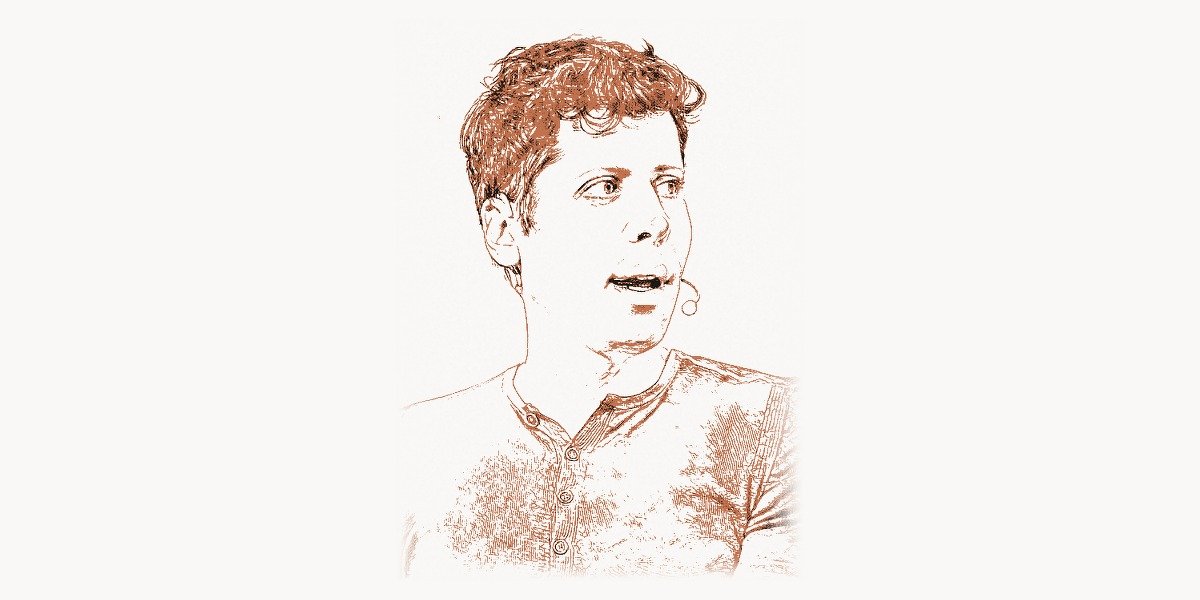
On November 30, 2022, OpenAI quietly released a chatbot called ChatGPT as a “low-key research preview.” Nobody expected what happened next. One million users signed up in five days. By January 2023, it had 100 million monthly active users — the fastest-growing consumer application in history, surpassing TikTok’s nine-month record. Within a year, every major tech company had restructured its product roadmap around AI. Google declared a “code red.” Microsoft invested $10 billion. The person at the center of this transformation was Sam Altman, a 37-year-old CEO who had spent eight years betting that artificial general intelligence was not a distant dream but an engineering problem with a near-term solution.
Early Life and Path to Technology
Samuel Harris Altman was born on April 22, 1985, in Chicago, Illinois, and grew up in St. Louis, Missouri. He received his first computer — a Macintosh — at age eight, and later said it changed his understanding of what was possible. He attended John Burroughs School, a private preparatory school in St. Louis, before enrolling at Stanford University in 2003 to study computer science.
Altman dropped out of Stanford after two years to co-found Loopt, a location-based social networking app. This was 2005 — three years before the iPhone App Store launched. Loopt was early to mobile location sharing but never gained mass traction. The company was acquired by Green Dot Corporation in 2012 for $43.4 million, a modest exit by Silicon Valley standards. But Loopt earned Altman something more valuable than a big payout: it got him into Y Combinator’s Summer 2005 batch, the second class ever. Y Combinator’s founder, Paul Graham, took notice of Altman’s intensity and strategic thinking.
In February 2014, at age 28, Altman was appointed president of Y Combinator, succeeding Paul Graham. At YC, he oversaw investments in more than 2,000 startups, including companies that would become household names: Airbnb, Stripe, Instacart, DoorDash, Coinbase, and Reddit. He expanded YC’s scope with the YC Growth Fund and YC Research, a nonprofit arm that funded basic research. His tenure at YC gave him a network that spanned virtually every sector of Silicon Valley — a network he would later leverage to fund and staff OpenAI.
The Breakthrough: OpenAI and GPT
The Technical Innovation
In December 2015, Altman co-founded OpenAI alongside Elon Musk, Peter Thiel, Reid Hoffman, Jessica Livingston, and others. The organization launched as a nonprofit research lab with $1 billion in pledged funding and a stated mission: ensure that artificial general intelligence (AGI) benefits all of humanity. At the time, most AI researchers considered AGI a distant goal — decades away at minimum. Many dismissed OpenAI’s mission as naive or premature.
The technical strategy that defined OpenAI’s success was the “scaling hypothesis” — the idea that making neural networks bigger and training them on more data would produce emergent capabilities that smaller models could not achieve. This was controversial within the AI research community. Many researchers believed that architectural innovations or symbolic reasoning approaches were more important than raw scale.
OpenAI’s Generative Pre-trained Transformer (GPT) series tested this hypothesis systematically:
- GPT-1 (June 2018): 117 million parameters. Demonstrated that pre-training a transformer on a large text corpus and then fine-tuning it on specific tasks outperformed training task-specific models from scratch. The paper established the paradigm of “pre-train, then fine-tune”
- GPT-2 (February 2019): 1.5 billion parameters — 10x larger than GPT-1. Could generate coherent multi-paragraph text, answer questions, and perform basic translation without any task-specific training. OpenAI initially withheld the full model, citing concerns about misuse in generating disinformation. This “staged release” strategy generated both praise (for safety consciousness) and criticism (for seeming like marketing)
- GPT-3 (June 2020): 175 billion parameters. A qualitative leap. GPT-3 could write essays, generate working code, compose poetry, and hold extended conversations. It demonstrated “few-shot learning” — performing new tasks from just a few examples in the prompt, without any fine-tuning. OpenAI released API access, and thousands of startups built products on GPT-3
- GPT-4 (March 2023): Rumored to have over 1 trillion parameters (OpenAI did not disclose the exact figure). Multimodal — accepting both text and image inputs. Scored in the 90th percentile on the bar exam, the 99th percentile on the Biology Olympiad, and could solve complex reasoning problems. The gap between GPT-3 and GPT-4 silenced many skeptics of the scaling hypothesis
The key innovation behind ChatGPT specifically was RLHF — Reinforcement Learning from Human Feedback. GPT-3 was powerful but difficult to use effectively; it required careful prompt engineering to produce useful outputs. OpenAI trained InstructGPT (the model underlying ChatGPT) by having human raters rank model outputs and using those rankings to fine-tune the model’s behavior. The result was a model that followed instructions, admitted uncertainty, and refused harmful requests — making it accessible to non-technical users for the first time.
# How LLMs work: simplified transformer attention mechanism
# This is the core idea behind GPT — predicting the next token
# by attending to all previous tokens in the sequence

import numpy as np

def scaled_dot_product_attention(Q, K, V):
    """
    Q (Query), K (Key), V (Value) are matrices derived from input embeddings.
    Each token generates a query ("what am I looking for?"),
    a key ("what do I contain?"), and a value ("what do I output?").
    """
    d_k = K.shape[-1]  # dimension of keys

    # Step 1: Compute attention scores
    # How much should each token "attend to" every other token?
    scores = np.matmul(Q, K.T) / np.sqrt(d_k)

    # Step 2: Convert scores to probabilities via softmax
    attention_weights = softmax(scores, axis=-1)

    # Step 3: Weighted sum of values
    # Each token's output is a blend of all tokens' values,
    # weighted by how relevant they are
    output = np.matmul(attention_weights, V)

    return output, attention_weights

# GPT stacks ~96 of these attention layers (in GPT-3)
# with ~175 billion learned parameters that encode patterns
# from training on hundreds of billions of words
Why It Mattered
ChatGPT’s impact was not primarily technical — GPT-4 was a more significant model. ChatGPT mattered because it was the first AI product that ordinary people could use. Previous AI advances (AlphaGo, GPT-3, DALL-E) were impressive demonstrations but required technical knowledge or API access. ChatGPT was a web page with a text box. Anyone could type a question and get a coherent, useful answer. This accessibility transformed AI from a research topic into a consumer technology overnight.
The economic impact was immediate. Microsoft integrated GPT-4 into Bing, Office 365 (as Copilot), and GitHub (as GitHub Copilot). Google rushed to release Bard (later Gemini). Anthropic, founded by former OpenAI researchers, released Claude. Meta released LLaMA as open source. By the end of 2023, virtually every major software company had an AI strategy, and “AI” appeared in the earnings calls of companies from agriculture to healthcare.
Beyond GPT: Altman’s Broader Vision
Altman’s ambitions extend well beyond ChatGPT. He has described his long-term goal as developing artificial general intelligence — AI systems that match or exceed human cognitive abilities across all domains. He has framed this as the most important technological development in human history and has argued that getting it right could solve problems from climate change to disease.
His actions reflect this ambition at an unusual scale. In early 2024, reports emerged that Altman was seeking up to $7 trillion in investment to build a global network of semiconductor fabrication plants — a project that would dwarf any private enterprise in history. While the specific figure was disputed, the direction was clear: Altman believes AI progress requires computing infrastructure at a scale that does not yet exist.
He also co-founded Worldcoin (now World) in 2019, a project that uses a custom iris-scanning device (the “Orb”) to verify unique human identities, with the goal of distributing a universal basic income via cryptocurrency. The project has been controversial — privacy advocates have raised concerns about biometric data collection, and several countries have banned or restricted the Orb. But it reflects Altman’s thinking about the economic disruption AI will cause and the need for new income distribution models.
The November 2023 Crisis
On Friday, November 17, 2023, OpenAI’s board of directors fired Sam Altman as CEO. The four-sentence press release stated that Altman “was not consistently candid in his communications with the board.” No further explanation was provided.
What followed was one of the most extraordinary episodes in Silicon Valley history. Within hours, OpenAI president Greg Brockman resigned in protest. Microsoft CEO Satya Nadella publicly offered Altman and his team positions at Microsoft. Over the weekend, 738 of OpenAI’s approximately 770 employees signed a letter threatening to resign and follow Altman to Microsoft unless the board reversed its decision and resigned. The letter was remarkable — it meant that nearly the entire company was loyal to its fired CEO rather than to its governing board.
By November 22, five days after his firing, Altman was reinstated as CEO. The original board was dissolved and replaced with a new board that included Bret Taylor (former Salesforce co-CEO) and Larry Summers (former US Treasury Secretary). The incident exposed the fundamental tension in OpenAI’s structure: a nonprofit board overseeing a company valued at tens of billions of dollars, with the board’s mission (safe AGI development) potentially conflicting with the commercial pressures of rapid deployment and investor returns.
Impact on Software Development
For web developers, the AI revolution Altman accelerated has already reshaped daily work. GitHub Copilot, powered by OpenAI’s Codex model (a GPT variant fine-tuned on code), was the first widely adopted AI coding assistant. It launched as a technical preview in June 2021 and reached 1.3 million paid subscribers by 2024.
The productivity impact is measurable. GitHub’s own research found that developers using Copilot completed tasks 55% faster than those without it. A 2023 study at Google found that AI-assisted code accounted for more than 25% of new code at the company. These tools are not replacing developers — they are changing what developers spend their time on, shifting effort from writing boilerplate to reviewing, architecting, and testing.
// Modern AI-assisted development workflow example:
// Developer writes a descriptive function signature and comment,
// AI generates the implementation

/**
 * Debounce a function call — delays execution until after
 * the specified wait time has elapsed since the last invocation.
 * Returns a cancel-able debounced function.
 *
 * @param {Function} fn - Function to debounce
 * @param {number} delay - Delay in milliseconds
 * @returns {{ call: Function, cancel: Function }}
 */
function createDebouncedFunction(fn, delay) {
  let timeoutId = null;

  function call(...args) {
    if (timeoutId !== null) {
      clearTimeout(timeoutId);
    }
    timeoutId = setTimeout(() => {
      fn.apply(this, args);
      timeoutId = null;
    }, delay);
  }

  function cancel() {
    if (timeoutId !== null) {
      clearTimeout(timeoutId);
      timeoutId = null;
    }
  }

  return { call, cancel };
}

// The developer's role shifts: describe intent clearly,
// review generated code for correctness and edge cases,
// focus on architecture and system design
AI tools now assist across the entire development lifecycle: code generation, code review, debugging, test writing, documentation, database query generation, and even infrastructure configuration. Tools like Cursor, Cody, and Claude Code integrate AI directly into the development environment, making AI assistance a continuous presence rather than a separate step.
Philosophy and Engineering Approach
Key Principles
Altman’s approach combines several distinct threads. He is a scale maximalist — he believes that the path to AGI runs through building ever-larger models with ever-more compute. This contrasts with researchers who emphasize architectural innovation, data quality, or hybrid approaches. His willingness to raise and deploy capital at unprecedented scale reflects this conviction.
He practices aggressive deployment. OpenAI released ChatGPT to the public before many AI safety researchers thought it was ready. Altman has argued that public deployment generates real-world feedback that lab testing cannot replicate, and that iterative deployment is safer than building in secret. Critics counter that deploying powerful AI systems to hundreds of millions of users creates risks that are difficult to reverse.
He holds a techno-optimist worldview about AI’s potential to solve major problems — energy production, healthcare, education, scientific discovery — while acknowledging the risks of displacement and misuse. His public statements consistently frame AGI as the greatest opportunity in human history, though he has also called it potentially the most dangerous technology ever created.
Controversy and Criticism
Altman and OpenAI face sustained criticism from multiple directions:
- Mission drift: OpenAI began as a nonprofit with a mission to ensure AGI benefits humanity. It restructured into a “capped-profit” company in 2019, then announced plans to transition further toward a fully for-profit structure. Critics argue this represents a fundamental betrayal of the original mission. Elon Musk, a co-founder, has sued OpenAI over this transition
- Safety vs. speed: Several prominent AI safety researchers have left OpenAI, including co-founder Ilya Sutskever and safety lead Jan Leike, citing concerns that safety work was not prioritized relative to product development. The Superalignment team, tasked with ensuring advanced AI remains safe, was effectively disbanded in 2024
- Copyright and training data: The New York Times, multiple book authors, and other content creators have sued OpenAI, alleging that GPT models were trained on copyrighted material without permission or compensation. These lawsuits could reshape the legal framework around AI training data
- Job displacement: AI’s potential to automate knowledge work — writing, coding, translation, data analysis, customer support — raises concerns about economic disruption affecting tens of millions of workers
- Power concentration: A small number of companies (OpenAI, Google, Anthropic, Meta) control the most powerful AI models. Researchers and policymakers worry about the consequences of this concentration
- Governance: The November 2023 board crisis demonstrated that OpenAI’s governance structure was inadequate. The board meant to ensure safety could not even fire the CEO without nearly destroying the company
Legacy and Modern Relevance
Whatever one thinks of Altman personally, his impact on the technology industry is difficult to overstate. He identified the potential of large language models earlier than most, raised the capital needed to build them, and deployed them to a mass audience at the right moment. ChatGPT did not just create a new product category — it restructured the priorities of every major technology company on Earth.
For developers specifically, the tools that emerged from OpenAI’s work have become part of the standard development workflow. Version control, automated testing, CI/CD pipelines — and now AI code assistants. The question is no longer whether developers will use AI tools, but how effectively they integrate them into their practice.
The deeper question Altman has raised — whether AI will reach and exceed human-level intelligence, and what happens to society if it does — remains open. He has been more willing than most tech leaders to discuss both the promise and the risk. Whether OpenAI’s approach to building AGI is correct, whether it is safe enough, and whether a for-profit company is the right structure for a technology this consequential are questions that will define the next decade of technology development.
As of early 2025, OpenAI is valued at over $150 billion. It has launched GPT-4o (an optimized multimodal model), the o1 series (focused on chain-of-thought reasoning), Sora (a video generation model), and continues to push toward what Altman describes as AGI. The Python-powered AI ecosystem grows daily, with frameworks like LangChain, LlamaIndex, and AI-integrated frontend tools creating new categories of software that did not exist two years ago.
Key Facts
- Born: April 22, 1985, Chicago, Illinois
- Education: Stanford University (dropped out after 2 years)
- Known for: CEO of OpenAI, former president of Y Combinator
- Key projects: Loopt (2005), Y Combinator president (2014–2019), OpenAI co-founder (2015), ChatGPT launch (2022), Worldcoin/World (2019)
- ChatGPT growth: 1 million users in 5 days, 100 million in 2 months
- OpenAI valuation: Over $150 billion (2025)
- Y Combinator portfolio: Oversaw 2,000+ startup investments including Airbnb, Stripe, DoorDash
- Notable event: Fired and reinstated as OpenAI CEO in November 2023
- GPT series: GPT-1 (2018) to GPT-4o (2024), scaling from 117M to estimated 1T+ parameters
Frequently Asked Questions
Who is Sam Altman?
Sam Altman is the CEO of OpenAI, the artificial intelligence company behind ChatGPT and the GPT series of large language models. Before OpenAI, he was president of Y Combinator, Silicon Valley’s most prominent startup accelerator. He co-founded OpenAI in 2015 and has led the company through its transformation from a nonprofit research lab to one of the most valuable technology companies in the world.
What did Sam Altman create?
Altman co-founded OpenAI and directed its strategy toward building increasingly powerful language models (GPT-1 through GPT-4). Under his leadership, OpenAI released ChatGPT, the fastest-growing consumer application in history. He also co-founded Loopt (a mobile social network) and Worldcoin (a biometric identity and cryptocurrency project). As president of Y Combinator, he oversaw investments in thousands of startups.
Why is Sam Altman important to computer science?
Altman made the strategic bet that scaling up transformer-based language models would produce increasingly capable AI systems — and that bet proved correct. The GPT series demonstrated emergent capabilities at scale that reshaped the field. ChatGPT made advanced AI accessible to hundreds of millions of non-technical users, accelerating AI adoption across every industry. The tools OpenAI built, particularly for code generation, have changed how software is developed.
What is Sam Altman doing today?
As of 2025, Altman leads OpenAI as it continues developing more capable AI models, including the o1 reasoning series and Sora video generation. He is pursuing massive infrastructure investments to support AI computation at scale. OpenAI is also navigating its transition from a capped-profit to a potentially fully for-profit structure, ongoing copyright lawsuits, and increasing regulatory scrutiny from governments worldwide.