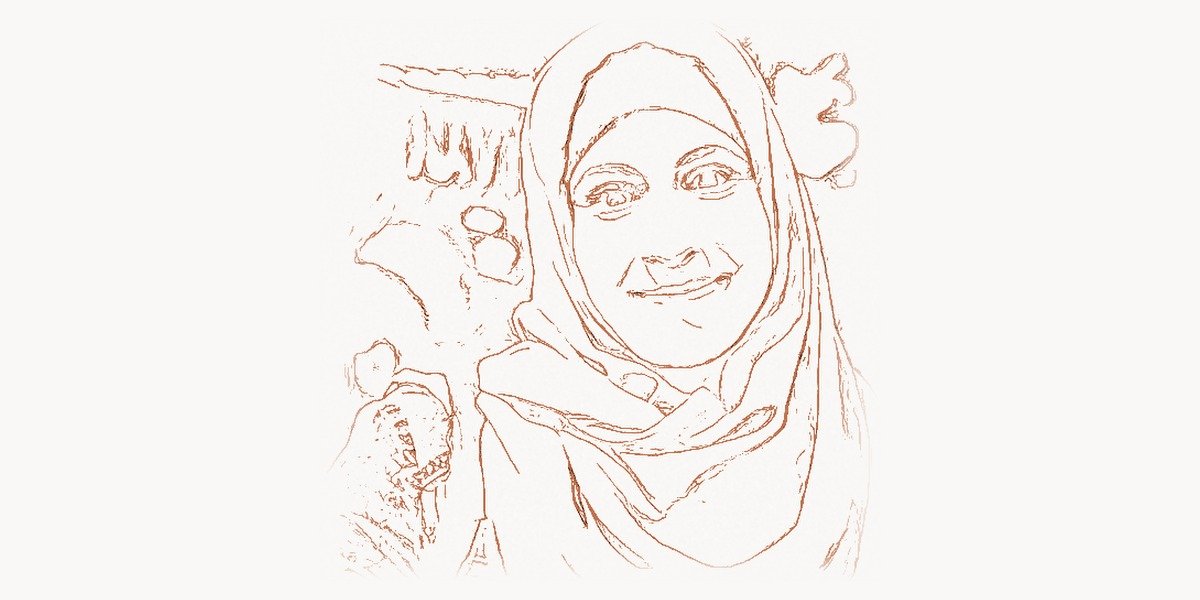
When the web standards community needed someone to make SVG accessible, interactive, and truly practical for modern web development, it was Sara Soueidan who stepped forward. A Lebanese-Canadian front-end developer, author, and accessibility specialist, Soueidan transformed SVG from an obscure XML-based image format into a foundational pillar of responsive, accessible web design. Her deep technical writing, conference talks, and relentless advocacy for inclusive design have shaped how an entire generation of developers thinks about building for the web. In a field where flashy JavaScript frameworks often steal the spotlight, Soueidan proved that mastering the platform itself — HTML, CSS, SVG, and ARIA — is the most powerful skill a front-end developer can possess.
Early Life and Education
Sara Soueidan grew up in Lebanon, a country with a thriving intellectual culture but limited exposure to the global tech industry during her formative years. She studied computer and communications engineering at the Lebanese University, where she developed a strong foundation in both the theoretical and practical aspects of computing. While many of her peers gravitated toward back-end systems or hardware engineering, Soueidan found herself drawn to the visual, interactive side of computing — the web browser as a canvas for creative expression and human interaction.
Her early exposure to web technologies came through self-directed learning, reading specifications, experimenting with CSS and HTML, and contributing to online communities. Unlike many developers who entered front-end work through design or JavaScript frameworks, Soueidan approached the discipline from an engineering perspective. She wanted to understand not just how things looked, but how they worked at the deepest level — parsing specifications, understanding rendering pipelines, and building mental models of browser behavior. This engineering mindset would become her defining characteristic and set the stage for her later contributions to SVG and accessibility.
During her university years, Soueidan began writing about her discoveries on her personal blog, breaking down complex web specifications into clear, practical tutorials. Her writing quickly gained attention for its unusual combination of technical depth and pedagogical clarity. She was not simply explaining how to use CSS properties or SVG attributes — she was teaching developers how to think about the web platform as a coherent, interconnected system.
Career and SVG Accessibility Mastery
Technical Innovation
Sara Soueidan’s most significant technical contribution is her work on making Scalable Vector Graphics truly accessible and practical for production web development. Before her advocacy and documentation efforts, SVG was widely misunderstood. Many developers treated it as a replacement for icon fonts or a tool for simple illustrations, unaware of its deep integration with the DOM, CSS, and ARIA accessibility APIs.
Soueidan systematically explored every corner of the SVG specification and documented how it interacted with assistive technologies. She investigated how screen readers interpreted SVG elements, how the <title> and <desc> elements mapped to accessible names and descriptions, and how different embedding techniques — <img>, <object>, <iframe>, inline SVG — affected accessibility semantics. Her research revealed significant inconsistencies across browsers and screen readers, and she provided practical workarounds that developers could implement immediately.
One of her key insights was that SVG accessibility required a fundamentally different mental model than HTML accessibility. While HTML elements carry implicit semantics — a <button> is inherently a button, a <nav> is a navigation region — SVG elements are semantically neutral by default. A <circle> or <path> carries no meaning to an assistive technology unless the developer explicitly provides it through ARIA attributes or SVG’s own accessibility features.
Here is an example of how Soueidan taught developers to make interactive SVG elements accessible:
<svg role="img" aria-labelledby="chart-title chart-desc"
     xmlns="http://www.w3.org/2000/svg" viewBox="0 0 400 300">
  <title id="chart-title">Monthly Revenue Growth</title>
  <desc id="chart-desc">
    Bar chart showing revenue increase from $50K in January
    to $120K in June, with consistent month-over-month growth.
  </desc>
  <!-- Visual bars with accessible group labels -->
  <g role="list" aria-label="Revenue by month">
    <g role="listitem">
      <rect x="20" y="200" width="40" height="100"
            aria-label="January: $50,000" tabindex="0" />
    </g>
    <g role="listitem">
      <rect x="80" y="160" width="40" height="140"
            aria-label="February: $65,000" tabindex="0" />
    </g>
  </g>
</svg>
This pattern — combining SVG’s native accessibility elements with ARIA roles and properties — became a standard approach recommended by accessibility consultants worldwide. Soueidan did not merely document what was possible; she tested across dozens of browser and screen reader combinations to determine what actually worked.
Why It Mattered
Before Soueidan’s work, SVG accessibility was a neglected corner of web development. Icon systems, data visualizations, interactive infographics, and UI components built with SVG were frequently invisible to screen readers or, worse, exposed confusing or misleading information to assistive technology users. As the web moved increasingly toward visual, icon-driven interfaces, this gap in accessibility knowledge became a serious barrier to digital inclusion.
Soueidan’s research and advocacy addressed this at a critical moment. The responsive web design movement, championed by Evan You and others building component-based interfaces, was driving rapid adoption of SVG for resolution-independent graphics. Without clear accessibility guidance, millions of SVG elements would have been deployed across the web with no semantic meaning — a vast expansion of the accessibility gap.
Her impact extended beyond SVG. By thoroughly documenting how assistive technologies interpret web content, Soueidan illuminated broader principles of accessible front-end architecture. She demonstrated that accessibility is not a separate concern layered on top of visual design, but a fundamental dimension of web engineering — as essential as performance, responsiveness, or cross-browser compatibility. This philosophy echoed the values championed by Linus Torvalds in open source: the importance of getting the fundamentals right rather than chasing superficial features.
Other Major Contributions
While SVG accessibility remains her signature work, Sara Soueidan’s contributions to web development span a much broader range of topics. She authored a comprehensive reference on CSS and SVG for O’Reilly Media, providing one of the first deep treatments of how CSS styling and animation applied to SVG content. The book became an essential resource for developers working with vector graphics on the web.
Soueidan’s CSS expertise is equally remarkable. She has written extensively about CSS layout systems, custom properties, the cascade, specificity, and modern techniques for building resilient, maintainable stylesheets. Her approach to CSS mirrors the engineering rigor she brings to SVG — not just showing how properties work in isolation, but explaining how they interact within the complex system of cascade, inheritance, and the box model.
Her focus on practical CSS techniques complemented the work of developers like Misko Hevery, whose frameworks relied on CSS for component styling. Soueidan consistently argued that understanding CSS at a deep level was essential even when using CSS-in-JS solutions or utility-first frameworks, because the underlying cascade and layout algorithms remained the same.
She also became one of the most sought-after speakers at international web conferences, delivering talks at events such as SmashingConf, CSSConf, An Event Apart, and Fronteers. Her presentations were notable for their meticulous preparation, live demos that worked reliably, and a teaching style that made complex specifications feel approachable. Conference organizers frequently cited her as one of the most consistently excellent speakers in the web development community.
Here is an example of a CSS technique Soueidan promoted for creating accessible, visually hidden content — a critical pattern for inclusive design:
/* Visually hidden but accessible to screen readers */
.sr-only {
  position: absolute;
  width: 1px;
  height: 1px;
  padding: 0;
  margin: -1px;
  overflow: hidden;
  clip: rect(0, 0, 0, 0);
  white-space: nowrap;
  border: 0;
}

/* Allow element to become visible on focus for keyboard users */
.sr-only.focusable:active,
.sr-only.focusable:focus {
  position: static;
  width: auto;
  height: auto;
  margin: 0;
  overflow: visible;
  clip: auto;
  white-space: normal;
}
This pattern, which she refined and popularized through her writing and conference talks, became a standard inclusion in CSS resets and component libraries worldwide. The .sr-only class appears in Bootstrap, Tailwind CSS, and countless custom design systems — a testament to how deeply Soueidan’s practical recommendations penetrated the ecosystem.
In 2020, Soueidan shifted her professional focus to become a full-time accessibility consultant, working with companies and organizations to audit and improve the accessibility of their web products. This transition represented a natural evolution of her career — from documenting accessibility best practices to directly implementing them in production environments. Her consultancy work allowed her to encounter real-world accessibility challenges at scale and feed those insights back into her educational content.
She also developed and delivered comprehensive accessibility training courses, building a structured curriculum that covered WCAG guidelines, ARIA patterns, accessible form design, keyboard navigation, and testing methodologies. These courses filled a critical gap in professional development for front-end developers, who historically received little to no formal training in accessibility. Through platforms like Taskee, developers inspired by Soueidan’s approach can organize their own accessibility learning journey with structured project-based tasks.
Philosophy and Approach
Sara Soueidan’s philosophy of web development is built on a set of principles that have remained remarkably consistent throughout her career. Unlike many prominent developers who shift paradigms with each new framework cycle, Soueidan has anchored her work in the enduring fundamentals of the web platform itself.
Key Principles
- Specification-first thinking. Soueidan consistently emphasizes reading and understanding official specifications rather than relying on blog posts or Stack Overflow answers. She argues that specifications reveal not just what is possible, but why features were designed a certain way — knowledge that enables developers to make better architectural decisions. This mirrors the approach of pioneers like Rob Pike, who built Go’s design philosophy on deep understanding of language semantics.
- Progressive enhancement as a core strategy. Rather than building for the latest browsers and polyfilling backward, Soueidan advocates starting with a solid HTML foundation and layering CSS and JavaScript on top. This ensures that content remains accessible and functional across the widest range of devices and assistive technologies.
- Accessibility is not an add-on. Central to Soueidan’s philosophy is the conviction that accessibility must be integrated from the beginning of the design and development process, not bolted on as an afterthought. She argues that retrofitting accessibility is more expensive, less effective, and produces inferior results compared to building it in from the start.
- Deep knowledge over shallow breadth. In an industry that often rewards developers for knowing many tools superficially, Soueidan champions the value of deep expertise. She has frequently argued that truly understanding HTML, CSS, SVG, and ARIA is more valuable than surface-level familiarity with dozens of frameworks — a perspective that echoes the Unix philosophy embraced by Fabrice Bellard, who mastered systems at the lowest levels.
- Teaching as a form of engineering. Soueidan views her educational work not as separate from her technical practice, but as an integral part of it. Writing clear explanations of complex topics forces deeper understanding, surfaces gaps in knowledge, and creates artifacts that benefit the entire community. This pedagogical commitment parallels the legacy of Leslie Lamport, whose LaTeX and theoretical writings educated generations of computer scientists.
- Empathy-driven development. Every design decision, every ARIA attribute, every alternative text string should be informed by genuine understanding of how people with different abilities interact with the web. Soueidan frequently reminds developers that the users of assistive technologies are not edge cases — they are people with the same needs, goals, and frustrations as any other user.
Her approach has earned comparisons to other methodical thinkers in the field. Like Richard Hipp, who built SQLite on principles of simplicity and correctness, Soueidan builds her recommendations on thorough testing and careful reasoning rather than trends or assumptions.
Legacy and Impact
Sara Soueidan’s influence on web development is both broad and deep. Her SVG and accessibility work has been cited in browser bug reports, W3C specification discussions, and accessibility guidelines published by major technology companies. When browser vendors fix SVG accessibility issues, they often reference the cross-browser testing matrices that Soueidan published, which documented the exact behavior of each screen reader and browser combination.
Her educational impact is equally significant. Thousands of front-end developers credit Soueidan’s articles and talks as their entry point into understanding SVG and accessibility. Her work has been referenced in university curricula, bootcamp materials, and corporate training programs worldwide. The clarity of her writing has set a standard for technical communication in the web development community.
Soueidan has received numerous industry recognitions. She has been named among the most influential people in web development by publications such as net magazine and was awarded an O’Reilly Web Platform Award for her outstanding contributions to the open web. These accolades reflect the community’s recognition that her work has materially improved the quality and inclusivity of the web.
The broader significance of Soueidan’s career lies in her demonstration that front-end development is genuine engineering — requiring deep technical knowledge, systematic testing, and rigorous problem-solving. In a field where front-end work is sometimes dismissed as merely visual or superficial, Soueidan has shown that building accessible, performant, standards-compliant interfaces is among the most intellectually demanding work in software development. For teams looking to build accessible products systematically, project management platforms like Toimi can help coordinate accessibility audits and remediation sprints across development teams.
Her transition to full-time accessibility consulting signals an important trend in the industry: the growing recognition that accessibility expertise is a specialized, high-value discipline that deserves dedicated professional attention. As digital accessibility regulations expand worldwide — including the European Accessibility Act and updates to Section 508 in the United States — Soueidan’s pioneering work in making accessibility practical and approachable for everyday developers becomes more relevant than ever.
Key Facts
- Full name: Sara Soueidan
- Nationality: Lebanese-Canadian
- Education: Computer and Communications Engineering, Lebanese University
- Known for: SVG accessibility research, CSS expertise, inclusive design advocacy
- Book: Author of a comprehensive reference on SVG and CSS for O’Reilly Media
- Award: O’Reilly Web Platform Award recipient
- Recognized by: net magazine as one of the most influential people in web development
- Career transition: From front-end developer and speaker to full-time accessibility consultant
- Conference circuit: SmashingConf, CSSConf, An Event Apart, Fronteers, and many others
- Key expertise areas: SVG, CSS, ARIA, WCAG, assistive technology testing
FAQ
What is Sara Soueidan best known for in web development?
Sara Soueidan is best known for her pioneering work on SVG accessibility and her deep technical writing about CSS, SVG, and inclusive web design. She systematically documented how SVG interacts with assistive technologies and provided practical patterns for making vector graphics accessible to screen reader users. Her research revealed critical browser inconsistencies and established best practices that are now standard across the industry. She is also recognized as one of the most effective technical educators in the front-end community, with articles and conference talks that have shaped how developers understand the web platform.
How did Sara Soueidan change the way developers use SVG?
Before Soueidan’s work, SVG was primarily treated as a static image format or a replacement for icon fonts. Soueidan demonstrated that SVG, when used properly, could be a fully accessible, interactive, and styleable component of the web platform. She documented the accessibility implications of different SVG embedding methods, explained how to use ARIA attributes with SVG elements, and provided tested code patterns for common use cases such as icon systems, data visualizations, and interactive graphics. Her work shifted the industry’s understanding of SVG from a visual convenience to a first-class web technology with meaningful semantic capabilities.
Why is accessibility important in front-end development?
Accessibility ensures that web applications and content are usable by everyone, including people with visual, auditory, motor, and cognitive disabilities. Approximately 15 percent of the global population lives with some form of disability, and many more experience temporary or situational impairments. Accessible web design is not only an ethical imperative but increasingly a legal requirement under regulations such as the European Accessibility Act and the Americans with Disabilities Act. Soueidan has consistently argued that accessibility improves the experience for all users — better semantic HTML benefits search engines, keyboard navigation helps power users, and clear visual hierarchy aids comprehension for everyone.
What can developers learn from Sara Soueidan’s approach to web standards?
Soueidan’s approach emphasizes reading official specifications, testing across real browser and assistive technology combinations, and building on progressive enhancement rather than framework-specific patterns. Developers can learn that investing time in understanding the platform’s fundamentals — HTML semantics, CSS cascade behavior, SVG structure, and ARIA semantics — provides returns that outlast any single framework or tool. Her career demonstrates that deep specialization in core web technologies is both professionally rewarding and deeply impactful for the broader community.