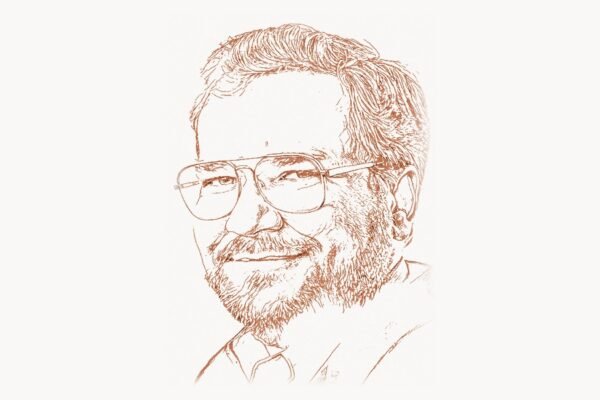
In 1976, a tall, quiet engineer from Chippewa Falls, Wisconsin, unveiled a machine that looked like nothing the computing world had ever seen. It was shaped like a cylinder, upholstered in padded seats around its base (which concealed the cooling system), and wrapped in transparent panels that revealed columns of densely packed circuit boards. It was called the Cray-1, and it could perform 160 million floating-point operations per second — making it the fastest computer on Earth by a wide margin. The machine was beautiful, outrageously expensive ($8.8 million in 1976 dollars), and immediately became the instrument of choice for weapons design, weather forecasting, and computational fluid dynamics. The man who designed it, Seymour Cray, had been building the world’s fastest computers for nearly two decades by that point. He would continue doing so for two more, until his death in a car accident in 1996 at the age of 71. In the history of computing, there are theorists who laid foundations — John von Neumann, Alan Turing — and there are engineers who built empires. Seymour Cray was something rarer: a solitary designer who pushed the physical limits of what a computer could do, generation after generation, for four decades. He is, by universal consensus, the father of supercomputing.
Early Life and Education
Seymour Roger Cray was born on September 28, 1925, in Chippewa Falls, a small city in western Wisconsin. His father was a civil engineer, and the young Cray showed an early fascination with electronics and electrical engineering. By the time he was ten, he had built a functioning automatic telegraph machine in his basement using Erector Set parts and surplus electrical components. His high school yearbook reportedly predicted he would become a scientist, and the prediction proved accurate in ways no one could have imagined.
After graduating from high school in 1943, Cray served in the U.S. Army during World War II as a radio operator and electrician, stationed in Europe and later in the Pacific theater. He worked with radio communications and cryptographic equipment — an experience that gave him hands-on exposure to the most advanced electronic systems of the era. After the war, Cray took advantage of the GI Bill to attend the University of Minnesota, where he earned a Bachelor of Science in electrical engineering in 1950 and a Master of Science in applied mathematics in 1951. This dual training — deep expertise in both hardware and mathematics — would define his career. Most computer designers specialized in one or the other. Cray mastered both, and it was this combination that allowed him to design machines that were not just fast but architecturally innovative.
In 1951, Cray joined Engineering Research Associates (ERA) in Saint Paul, Minnesota, a company founded by former Navy cryptanalysts to build computers for the intelligence community. ERA was one of the earliest commercial computer companies in the United States, and it placed Cray at the frontier of digital computing. When ERA was acquired by Remington Rand (later Sperry Rand) in 1952, Cray found himself working alongside some of the best engineers in the nascent computer industry. But corporate bureaucracy frustrated him. He wanted to design computers, not attend meetings. This tension between Cray’s need for focused, uninterrupted design work and the demands of corporate life would recur throughout his career — and would ultimately lead him to found his own company.
The Supercomputing Breakthrough
Technical Innovation
Cray’s breakthrough was not a single invention but a sustained methodology: he designed entire computer systems from the ground up, optimizing every component — logic circuits, memory systems, interconnects, cooling, packaging — as parts of a unified whole. Where other designers accepted off-the-shelf components and worked within their limitations, Cray treated the entire machine as a design problem and solved it holistically.
His first major success came at Control Data Corporation (CDC), which he co-founded with William Norris in 1957 after leaving Sperry Rand. At CDC, Cray designed the CDC 1604 (1960), one of the first fully transistorized computers, and then the CDC 6600 (1964), which is generally considered the first successful supercomputer. The CDC 6600 was three times faster than the next fastest machine (the IBM 7030 Stretch) and introduced several architectural innovations that remain relevant today.
The CDC 6600 used a technique Cray called “peripheral processors” — ten simple, independent processors that handled input/output operations, freeing the central processor to focus entirely on computation. This was an early form of what we now call offloading or heterogeneous computing. The central processor itself used a functional-unit architecture with multiple independent execution units (for addition, multiplication, division, etc.) that could operate in parallel. This instruction-level parallelism was decades ahead of mainstream processor design.
But it was the Cray-1 (1976), designed after Cray left CDC to found Cray Research in 1972, that cemented his legend. The Cray-1 introduced vector processing as the dominant paradigm for high-performance computing. Instead of processing one data element at a time (scalar processing), the Cray-1 operated on entire arrays of data simultaneously using vector registers and pipelined functional units. A single vector instruction could initiate an operation on 64 elements, with results streaming out one per clock cycle after the pipeline was filled.
C     VECTOR ADDITION ON THE CRAY-1
C     This loop processes 64 elements per vector instruction.
C     The Cray-1 hardware detects the pattern and pipelines
C     the operations automatically — no special syntax needed.
C
C     On a scalar machine, this takes N clock cycles.
C     On the Cray-1, after pipeline fill, it takes ~N/64 cycles.
C
      PROGRAM VECTOR_ADD
      PARAMETER (N = 4096)
      REAL A(N), B(N), C(N)

C     Initialize arrays
      DO 10 I = 1, N
         A(I) = REAL(I) * 1.5
         B(I) = REAL(I) * 2.3
   10 CONTINUE

C     Vector addition — the Cray-1 vectorizes this loop
C     automatically, loading 64 elements into vector registers
C     and processing them in a single pipeline pass
      DO 20 I = 1, N
         C(I) = A(I) + B(I)
   20 CONTINUE

C     Dot product — also vectorized, using chained
C     vector multiply and vector add functional units
      SUM = 0.0
      DO 30 I = 1, N
         SUM = SUM + A(I) * B(I)
   30 CONTINUE

      WRITE(*,*) 'Sum = ', SUM
      STOP
      END
The Cray-1’s architecture also introduced register chaining, which allowed the output of one vector operation to feed directly into the input of the next without waiting for the first to complete entirely. This technique, analogous to pipelining at the instruction level, could multiply effective throughput several times over. The machine’s 80 MHz clock rate (fast for 1976) was achieved through extremely short wire lengths — Cray famously bent the machine into a C-shape (later a full cylinder) specifically to minimize the distance signals had to travel between components.
Why It Mattered
Before the Cray-1, supercomputing was a niche pursuit. After it, supercomputing became an essential tool of science, engineering, and national security. The Cray-1 and its successors were used by national laboratories to simulate nuclear weapons tests (replacing physical testing after the Comprehensive Nuclear-Test-Ban Treaty), by the National Weather Service to run numerical weather prediction models, by aerospace companies to simulate airflow over aircraft designs, and by oil companies to process seismic data for petroleum exploration.
The vector processing paradigm Cray pioneered eventually migrated into mainstream computing. Modern GPUs — the engines driving deep learning and AI — are essentially massively parallel vector processors. When an NVIDIA GPU trains a neural network by performing matrix multiplications on thousands of data elements simultaneously, it is executing a direct descendant of the architectural concepts Seymour Cray introduced in the 1970s. The connection between Cray’s vector machines and modern GPU computing is not metaphorical; it is architectural.
Other Major Contributions
Cray’s career was a sequence of machines, each faster than the last, each pushing a different boundary of what was physically possible.
CDC 6600 (1964) — The first supercomputer. Its 10 peripheral processors and scoreboard-based instruction scheduling anticipated modern out-of-order execution by three decades. IBM’s Thomas Watson Jr. reportedly wrote an internal memo asking how it was possible that a small company in Minnesota, led by a team of 34 engineers, had outperformed IBM’s vast resources. The answer was Seymour Cray.
CDC 7600 (1969) — Five times faster than the 6600. It introduced pipelined functional units and a more sophisticated memory hierarchy. The 7600 was the fastest computer in the world from 1969 to 1975 and was used extensively for nuclear weapons simulation at Los Alamos and Lawrence Livermore National Laboratories.
Cray-1 (1976) — The machine that defined supercomputing. 160 MFLOPS, vector registers, register chaining, the iconic cylindrical design. Over 80 units were sold, an extraordinary number for a machine of its price and specialization.
Cray X-MP (1982) — The first successful multi-processor vector supercomputer, designed primarily by Steve Chen under Cray’s architectural guidance. It combined two Cray-1-class processors with shared memory, achieving up to 800 MFLOPS. The X-MP demonstrated that multiprocessing and vector processing could be combined effectively — a principle that underpins all modern high-performance computing.
Cray-2 (1985) — Cray’s most radical design. It packed four processors into a remarkably compact enclosure and was, for a time, the fastest computer in the world at 1.9 GFLOPS. The Cray-2’s most famous innovation was its cooling system: the entire machine was immersed in Fluorinert, an inert fluorocarbon liquid made by 3M, which circulated through the densely packed circuit boards to carry away heat. This liquid immersion cooling approach, considered exotic in 1985, has come full circle — modern data centers are increasingly adopting liquid immersion cooling for high-density GPU clusters.
Cray-3 (1993) — Cray’s attempt to build a supercomputer using gallium arsenide (GaAs) semiconductors instead of silicon. GaAs transistors switch faster than silicon, but the manufacturing technology was immature. The Cray-3 was technically brilliant but commercially unsuccessful — only one unit was delivered. It represented a bet on materials science that was ahead of its time.
Throughout these designs, Cray pioneered cooling innovations that were essential to achieving the performance he demanded. Dense packaging reduced signal propagation delays but generated enormous heat. Cray’s solutions — from the Freon-based refrigeration of the Cray-1 to the liquid immersion of the Cray-2 — were as innovative as his circuit designs. He understood, earlier than most, that thermal management was not a secondary concern but a primary constraint on computer performance. This insight is more relevant today than ever, as modern chip designers struggle with power density and heat dissipation in processors built on nanometer-scale processes, following trends predicted by Gordon Moore’s famous law.
Philosophy and Approach
Key Principles
Seymour Cray’s engineering philosophy was distinctive, consistent, and profoundly influential. Several principles defined his approach.
Radical simplicity. Cray favored simple, clean designs over complex ones. He believed that complexity was the enemy of speed and reliability. The CDC 6600’s instruction set was deliberately minimalist — it had only 64 opcodes. Cray argued that a simple design, executed at extreme speed, would outperform a complex design that tried to do too many things at once. This principle echoes through modern processor design, from the RISC revolution of the 1980s to the streamlined architectures of modern GPUs.
Solitary focus. Cray insisted on working in small teams, often in isolation. When he was designing the CDC 6600, he asked CDC to let him set up a separate laboratory in his hometown of Chippewa Falls, far from the corporate offices in Minneapolis. He repeated this pattern at Cray Research, designing the Cray-1 and Cray-2 in Chippewa Falls while the company’s business operations were headquartered in Minneapolis. He believed that a small group of brilliant engineers, shielded from corporate politics and bureaucracy, could outperform much larger teams. The CDC 6600 was designed by 34 people. The Cray-1 was largely the work of Cray himself with a small support team.
Physical intuition. Unlike many computer architects who worked primarily at the logical level, Cray thought in terms of physics — signal propagation time, heat dissipation, electromagnetic interference, wire length. He designed his machines from the physical layout up, not from the logical architecture down. The Cray-1’s cylindrical shape was not aesthetic whimsy; it was an engineering solution to minimize the longest wire path in the machine, reducing signal propagation delay and enabling a faster clock speed.
/*
 * Illustration: Why wire length matters in supercomputer design.
 *
 * Seymour Cray's key insight: the speed of light (and the speed
 * of electrical signals in copper, ~2/3 c) is a hard physical
 * limit. If your wires are too long, no amount of clever logic
 * design can make the machine faster.
 *
 * At 80 MHz (Cray-1 clock), one clock cycle = 12.5 nanoseconds.
 * Signal speed in copper ~ 0.2 m/ns (20 cm per nanosecond).
 * Maximum round-trip wire length per cycle ~ 2.5 meters.
 *
 * Cray bent the machine into a cylinder to keep the longest
 * wire path under ~1.2 meters — well within the budget.
 */

#include <stdio.h>

#define SPEED_OF_LIGHT   299792458.0  /* meters per second */
#define COPPER_FRACTION   0.667       /* signal speed in copper vs c */
#define CRAY1_CLOCK_HZ   80000000.0  /* 80 MHz */

int main(void) {
    double signal_speed = SPEED_OF_LIGHT * COPPER_FRACTION;
    double cycle_time   = 1.0 / CRAY1_CLOCK_HZ;
    double max_distance = signal_speed * cycle_time;

    printf("Cray-1 Design Constraintsn");
    printf("=========================n");
    printf("Clock frequency : %.0f MHzn", CRAY1_CLOCK_HZ / 1e6);
    printf("Cycle time      : %.1f nsn", cycle_time * 1e9);
    printf("Signal speed    : %.2f m/nsn", signal_speed / 1e9);
    printf("Max wire (1-way): %.2f metersn", max_distance);
    printf("Max round-trip  : %.2f metersn", max_distance / 2.0);
    printf("nCray's cylindrical design kept all paths < 1.2 mn");

    return 0;
}
Generational leaps. Cray was not interested in incremental improvement. Each new machine was designed to be a significant multiple faster than its predecessor, often through fundamental architectural changes rather than simple clock speed increases. The CDC 7600 was five times faster than the 6600 through pipelining. The Cray-1 achieved another leap through vector processing. The Cray-2 pushed density and cooling to new extremes. This commitment to generational leaps, rather than evolutionary refinement, is what made Cray’s career so remarkable.
Skepticism of trends. Cray was famously skeptical of the massively parallel processing (MPP) movement of the late 1980s, which proposed building supercomputers from thousands of commodity processors. He believed that a small number of very fast processors, designed from scratch, would outperform a large number of slow processors struggling to coordinate. History has been mixed on this point — modern supercomputers use massive parallelism, but each node contains processors far more powerful than the commodity chips of the 1980s, and the coordination problem Cray identified remains a central challenge. His concern about the overhead of parallelism anticipated the difficulties that continue to plague distributed computing, from data centers running API architectures to clusters training large language models.
Legacy and Impact
Seymour Cray died on October 5, 1996, from injuries sustained in a car accident near Colorado Springs two weeks earlier. He was 71 years old and still actively designing computers — at the time of his death, he was working on the Cray-4 at his latest company, SRC Computers.
His legacy in computing is monumental. Cray Research, the company he founded in 1972, dominated the supercomputer market for two decades and became synonymous with high-performance computing. The name “Cray” became a generic term for supercomputer in the same way that “Xerox” became a verb for photocopying. When a scientist said “we need to run this on the Cray,” they meant “we need the fastest computer available.” Cray Inc. (the successor company) continues to build some of the world’s most powerful supercomputers to this day.
The architectural concepts Cray pioneered — vector processing, register chaining, pipelined functional units, liquid cooling, dense three-dimensional packaging — have all become standard techniques in modern computing. Modern GPUs, which dominate AI training and scientific computing, are architecturally closer to Cray’s vector machines than to conventional scalar processors. When NVIDIA’s A100 GPU performs a matrix multiplication by loading data into registers and streaming it through pipelined arithmetic units, the architectural lineage traces directly back to the Cray-1.
Cray’s influence extends beyond specific technical innovations to the culture of computer engineering. He demonstrated that a small team of focused, brilliant engineers could consistently outperform much larger organizations — a lesson that resonates in today’s startup culture. He showed that aesthetics and engineering were not in conflict; the Cray-1 was both the fastest computer in the world and one of the most beautiful machines ever built, a fact that Jack Kilby, who revolutionized hardware through the integrated circuit, would surely have appreciated. He proved that understanding physics, not just logic, was essential to building fast computers — a principle that becomes more important with every new generation of semiconductor technology.
Perhaps most importantly, Cray established the idea that there should be machines at the absolute frontier of computational performance, purpose-built for the hardest problems in science and engineering. Before Cray, “computer” meant a general-purpose business machine. After Cray, there was a distinct category of machine — the supercomputer — dedicated to pushing the boundaries of what could be computed. Today’s exascale supercomputers, like Frontier at Oak Ridge National Laboratory (which achieved 1.1 exaFLOPS in 2022 — nearly seven billion times faster than the Cray-1), are the direct descendants of the machines Seymour Cray built in Chippewa Falls. The LINPACK benchmark that Jack Dongarra created to measure supercomputer performance was itself born from the need to compare machines like Cray’s. Every weather forecast you check, every crash simulation that makes your car safer, every drug molecule modeled computationally — all of these trace a direct line back to the work of one quiet engineer in a small Wisconsin town who decided to build the fastest computers in the world, and then did so, again and again, for forty years.
Key Facts
- Born: September 28, 1925, Chippewa Falls, Wisconsin, USA
- Died: October 5, 1996, Colorado Springs, Colorado, USA
- Known for: Founding supercomputing as a discipline, designing the CDC 6600, Cray-1, Cray-2, and Cray-3; pioneering vector processing, liquid immersion cooling, and high-density circuit packaging
- Key machines: CDC 1604 (1960), CDC 6600 (1964), CDC 7600 (1969), Cray-1 (1976), Cray X-MP (1982), Cray-2 (1985), Cray-3 (1993)
- Companies founded: Co-founder of Control Data Corporation (1957), founder of Cray Research (1972), founder of Cray Computer Corporation (1989), founder of SRC Computers (1996)
- Awards: IEEE Computer Society Harry H. Goode Memorial Award (1972), ACM Seymour Cray Computer Engineering Award (named in his honor, 1997), IEEE Computer Pioneer Award
- Education: B.S. Electrical Engineering, University of Minnesota (1950); M.S. Applied Mathematics, University of Minnesota (1951)
Frequently Asked Questions
Who was Seymour Cray and why is he called the father of supercomputing?
Seymour Cray (1925-1996) was an American electrical engineer and computer architect who designed a series of machines that were, at the time of their introduction, the fastest computers in the world. He is called the father of supercomputing because he essentially created the category: before Cray, there were fast computers and slow computers, but there was no distinct class of machine purpose-built for extreme computational performance. Starting with the CDC 6600 in 1964 and continuing through the Cray-1, Cray-2, and beyond, he established both the technology and the market for supercomputers. His architectural innovations — vector processing, register chaining, pipelined functional units — defined how high-performance computers were built for decades.
What made the Cray-1 so revolutionary?
The Cray-1 (1976) was revolutionary for several reasons. It introduced vector processing as the primary computing paradigm for high-performance machines, using vector registers that could hold 64 elements and pipelined functional units that could produce one result per clock cycle. It used register chaining to overlap multiple vector operations. Its iconic cylindrical design was an engineering solution to minimize wire lengths and signal propagation delays, enabling an 80 MHz clock speed. It was immensely faster than any competing machine — its 160 MFLOPS peak performance was roughly ten times faster than the IBM 370/195. And it proved that there was a viable commercial market for dedicated supercomputers, with over 80 units sold at approximately $8.8 million each.
How did Seymour Cray’s work influence modern computing?
Cray’s influence on modern computing is pervasive. Vector processing, which he pioneered, is the architectural basis of modern GPUs — the processors that power AI training, scientific simulation, and computer graphics. His liquid immersion cooling technique (Cray-2, 1985) is being adopted by modern data centers for high-density computing. His emphasis on minimizing wire lengths and signal propagation delays anticipated the interconnect challenges that dominate modern chip design. The software engineering practices developed for programming Cray machines — vectorization, loop optimization, memory access pattern tuning — remain essential techniques for writing high-performance code today. And his demonstration that small, focused teams could build the world’s best computers continues to inspire engineering organizations.
What is vector processing and why was it important?
Vector processing is a computing technique in which a single instruction operates on an entire array (vector) of data elements simultaneously, rather than processing them one at a time. Seymour Cray popularized this approach with the Cray-1, which had vector registers holding 64 elements and pipelined arithmetic units that could produce one result per clock cycle after an initial startup delay. Vector processing was important because it dramatically increased throughput for scientific and engineering workloads that involved repetitive operations on large datasets — weather simulation, fluid dynamics, structural analysis, nuclear physics. The concept directly influenced the design of modern GPUs, SIMD (Single Instruction, Multiple Data) extensions in CPUs like Intel’s AVX, and the parallel processing frameworks used in machine learning. When a modern GPU trains a neural network by performing the same operation on millions of data points, it is executing the vision Seymour Cray realized in hardware fifty years ago.