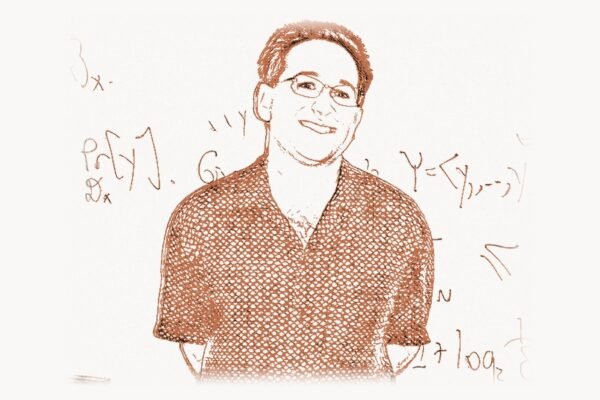
In a world where every online transaction, every digital signature, and every encrypted message depends on mathematical guarantees of security, few researchers have shaped the theoretical landscape as profoundly as Silvio Micali. Born in Palermo, Sicily, Micali went from studying mathematics in Rome to co-inventing zero-knowledge proofs at MIT — a cryptographic concept so powerful that it lets one party prove knowledge of a secret without revealing any information about it whatsoever. His work with Ron Rivest and Shafi Goldwasser earned him the 2012 Turing Award, often called the Nobel Prize of computing. But Micali never stopped there: decades after reshaping theoretical cryptography, he entered the blockchain arena with Algorand, applying his academic rigor to the problem of building a truly decentralized, scalable, and secure digital economy.
Early Life and Education
Silvio Micali was born in 1954 in Palermo, the capital of Sicily. Growing up in southern Italy in the postwar period, he was drawn to the clarity and precision of mathematics from an early age. He completed his undergraduate studies at the Sapienza University of Rome, earning his Laurea in Mathematics in 1978. It was during this time that he became fascinated with the intersection of mathematics and computation — a field that was rapidly evolving in European and American universities alike.
Seeking deeper engagement with theoretical computer science, Micali crossed the Atlantic to pursue his PhD at the University of California, Berkeley. There, he studied under the guidance of Manuel Blum, one of the founding figures of computational complexity theory and himself a Turing Award laureate. Blum’s lab at Berkeley was a hotbed of cryptographic innovation. It was in this environment that Micali first met Shafi Goldwasser, a fellow doctoral student who would become his most important collaborator. Together under Blum’s mentorship, they began exploring questions that would redefine what it meant to prove something computationally — without revealing how you proved it.
Micali completed his PhD in 1983, and his dissertation work on probabilistic encryption — co-developed with Goldwasser — immediately signaled that a new kind of cryptographic thinking had arrived. That same year, he joined the faculty at MIT, where he would remain for the next four decades and beyond, building one of the most influential research programs in the history of computer science.
Career and Technical Contributions
Micali’s career at MIT spans an extraordinary range of contributions to theoretical computer science, cryptography, and mechanism design. From probabilistic encryption to verifiable random functions, his work has repeatedly introduced concepts that seemed paradoxical at first and then became indispensable. His intellectual output is characterized by mathematical elegance and a drive to solve problems others had not yet formulated clearly.
Technical Innovation: Zero-Knowledge Proofs
The most celebrated contribution of Micali’s career is the co-invention of zero-knowledge proofs, introduced in a 1985 paper with Shafi Goldwasser and Charles Rackoff. The concept is deceptively simple in statement yet revolutionary in implication: a zero-knowledge proof is an interactive protocol in which a prover can convince a verifier that a statement is true without conveying any information beyond the validity of the statement itself.
Consider the classic analogy. Suppose you know the secret combination to a lock inside a cave with two paths that loop around to the same exit. You can prove to an observer that you know the combination by consistently emerging from whichever path they request — without ever revealing the combination itself. Micali, Goldwasser, and Rackoff formalized this intuition into rigorous mathematical definitions of completeness, soundness, and zero-knowledge, creating a framework that would underpin decades of cryptographic protocol design.
Their original paper, “The Knowledge Complexity of Interactive Proof Systems,” introduced the class IP (Interactive Proofs) and demonstrated that zero-knowledge proofs exist for all of NP — a result later strengthened by Oded Goldreich, Micali, and Avi Wigderson. This means that for any problem where a solution can be efficiently verified, there exists a protocol to prove possession of that solution without leaking any information about it.
The conceptual skeleton of a zero-knowledge proof protocol can be illustrated with pseudocode. Here is a simplified interactive ZKP for graph isomorphism:
import random

def zero_knowledge_proof_graph_isomorphism(G1, G2, isomorphism_map, rounds=40):
    """
    Prover demonstrates knowledge of isomorphism between G1 and G2
    without revealing the actual mapping.

    G1, G2: adjacency matrices of isomorphic graphs
    isomorphism_map: the secret permutation mapping G1 -> G2
    rounds: number of interactive rounds (security parameter)
    """
    for round_num in range(rounds):
        # PROVER: Create a random permutation of G1
        random_perm = generate_random_permutation(len(G1))
        H = apply_permutation(G1, random_perm)

        # PROVER -> VERIFIER: Send the permuted graph H
        send_to_verifier(H)

        # VERIFIER: Choose a random challenge bit
        challenge = random.choice([1, 2])

        # PROVER: Respond based on the challenge
        if challenge == 1:
            # Reveal permutation from G1 to H
            response = random_perm
        elif challenge == 2:
            # Reveal permutation from G2 to H
            # Compose: G2 -> G1 (inverse of isomorphism) -> H
            inverse_iso = invert_permutation(isomorphism_map)
            response = compose_permutations(random_perm, inverse_iso)

        # VERIFIER: Check the response
        if not verify_permutation(
            G1 if challenge == 1 else G2, H, response
        ):
            return "REJECT"  # Prover failed

    return "ACCEPT"  # Convinced after all rounds
This protocol achieves zero-knowledge because in each round, the verifier sees only a random permutation of the original graph. No individual round — and no combination of rounds — reveals the secret isomorphism mapping. Yet a dishonest prover who does not know the isomorphism can only succeed with probability 2-40 after 40 rounds, making the protocol both sound and complete.
Why It Mattered
Zero-knowledge proofs transformed cryptography from a discipline primarily concerned with hiding data to one capable of nuanced reasoning about knowledge itself. Before Micali and Goldwasser’s work, the dominant paradigm treated encryption as a black box: data goes in, ciphertext comes out. Their framework introduced a spectrum of knowledge complexity — how much a verifier learns beyond the single bit of information that the statement is true.
The practical implications have been staggering. Zero-knowledge proofs are foundational to modern authentication protocols, digital signatures, secure multiparty computation, and — most visibly in recent years — blockchain privacy systems. Technologies like zk-SNARKs and zk-STARKs, used in platforms such as Zcash and Ethereum Layer 2 rollups, are direct descendants of the theoretical framework Micali helped create. The work of Vitalik Buterin on Ethereum’s scalability roadmap relies heavily on zero-knowledge rollup technology rooted in these foundational ideas.
As Whitfield Diffie and Martin Hellman gave the world public-key cryptography, Micali and Goldwasser gave it a way to reason about what knowledge a cryptographic protocol actually reveals. This was a philosophical shift as much as a technical one — and its reverberations are still expanding.
Other Notable Contributions
While zero-knowledge proofs remain his most famous achievement, Micali’s research portfolio extends far beyond a single breakthrough.
Probabilistic Encryption (1984). Together with Goldwasser, Micali introduced the notion of semantic security — the idea that an encryption scheme should reveal nothing about the plaintext beyond its length. Their Goldwasser-Micali cryptosystem was the first provably secure public-key encryption scheme under standard computational assumptions, setting the standard for all future encryption research.
Pseudorandom Functions (1986). With Goldreich and Goldwasser, Micali showed how to construct functions that are computationally indistinguishable from truly random functions. Pseudorandom functions became a workhorse primitive in cryptographic protocol design, used in everything from key derivation to message authentication codes. This work helped bridge the gap between theoretical randomness and practical cryptographic security — a challenge that researchers like Daniel J. Bernstein would later tackle from different angles.
Verifiable Random Functions (1999). Micali, along with Michael Rabin and Salil Vadhan, introduced Verifiable Random Functions (VRFs), which produce outputs that are provably pseudorandom and can be verified by any party holding the corresponding public key. VRFs became essential building blocks in blockchain consensus protocols, including Micali’s own Algorand.
Algorand (2017). Perhaps the most ambitious application of Micali’s theoretical work, Algorand is a blockchain platform designed from first principles to solve the “blockchain trilemma” — the supposed impossibility of simultaneously achieving decentralization, security, and scalability. Micali’s Pure Proof-of-Stake consensus mechanism uses cryptographic sortition (built on VRFs) to randomly and secretly select block proposers and committee members, enabling near-instant finality without the energy waste of proof-of-work systems. Unlike the early designs explored by Satoshi Nakamoto for Bitcoin, Algorand was designed from the start with formal security proofs and rigorous game-theoretic analysis.
Algorand’s consensus can be configured with specific network parameters. Here is an example of a node configuration that illustrates some of the protocol’s key tunable properties:
{
  "Version": 28,
  "GossipFanout": 4,
  "NetAddress": "",
  "DNSBootstrapID": ".algorand.network",
  "EnableProfiler": false,
  "IncomingConnectionsLimit": 800,
  "AccountsRebuildSynchronousMode": 1,
  "AgreementIncomingBundlesQueueLength": 15,
  "AgreementIncomingProposalsQueueLength": 25,
  "CatchupBlockDownloadRetryAttempts": 1000,
  "DeadlockDetection": 0,
  "MaxCatchpointDownloadDuration": 7200000000000,
  "TransactionPoolSize": 75000,
  "BaseLoggerDebugLevel": 4,
  "CadaverSizeTarget": 0,
  "EnableAgreementReporting": false,
  "EnableAgreementTimeMetrics": false,
  "EnableAssembleStats": false,
  "EnableProcessBlockStats": false,
  "SuggestedFeeBlockHistory": 3,
  "EnableTxnEvalTracer": false
}
This configuration reflects Algorand’s design philosophy: high throughput through carefully tuned gossip protocols, large transaction pools for handling peak loads, and built-in telemetry hooks for monitoring network health — all without requiring mining hardware or energy-intensive computation.
Mechanism Design. Micali also contributed to algorithmic game theory and mechanism design, collaborating with researchers to create protocols where rational participants are incentivized to behave honestly. This work directly informed the economic design of Algorand’s staking and reward mechanisms — an area where tools for project management and team coordination play an increasingly important role in organizing decentralized development efforts.
Philosophy and Key Principles
Micali’s approach to research is guided by several distinctive principles that have remained consistent throughout his career.
Rigor before implementation. Unlike many contemporaries who rush to build systems and patch vulnerabilities later, Micali insists on formal proofs of security before any code is written. His famous stance is that a cryptographic protocol without a proof is merely a conjecture — one bad assumption away from catastrophic failure. This philosophy stands in contrast to the “move fast and break things” ethos of Silicon Valley, and it has been vindicated repeatedly as supposedly secure systems have fallen to attacks that formal analysis would have predicted.
Simplicity as a design goal. Micali has consistently argued that the best cryptographic constructions are the simplest ones that achieve their goals. Algorand’s consensus mechanism is elegant precisely because it reduces the complex problem of distributed agreement to a series of simple, independently verifiable cryptographic operations. This mirrors the design philosophy articulated by Edsger Dijkstra decades earlier: that elegance in computing is not a luxury but a prerequisite for reliability.
Democratization of trust. A recurring theme in Micali’s work is the elimination of centralized trust. Zero-knowledge proofs remove the need to trust a prover with your data. Probabilistic encryption removes the need to trust that ciphertext does not leak information. And Algorand removes the need to trust a small set of miners or validators with the integrity of a global financial ledger. Micali envisions a world where mathematical proof replaces institutional trust — a vision shared by cryptographers from Adi Shamir to the anonymous creator of Bitcoin.
Interdisciplinary thinking. Micali draws freely from mathematics, economics, and philosophy. His work on mechanism design brings game theory into protocol design, while his approach to blockchain governance incorporates insights from political science and social choice theory. He has argued that the next generation of decentralized systems will require not just better algorithms, but better models of human behavior — a perspective increasingly relevant as digital agencies and technology consultancies help organizations navigate the complexities of decentralized infrastructure adoption.
Legacy and Impact
Silvio Micali’s contributions have shaped essentially every major area of modern cryptography and have spilled over into distributed systems, blockchain technology, and economic mechanism design.
The 2012 Turing Award, shared with Shafi Goldwasser, recognized their transformative work on probabilistic encryption and zero-knowledge proofs. The ACM citation noted that their contributions established the mathematical foundations on which modern cryptography rests. But the award only captured a fraction of their total impact. Micali’s h-index exceeds 80, and his papers have been cited tens of thousands of times across computer science, mathematics, and economics.
His academic lineage is equally impressive. As a professor at MIT’s Computer Science and Artificial Intelligence Laboratory (CSAIL), Micali has mentored generations of researchers who have gone on to shape cryptography, blockchain technology, and theoretical computer science. His teaching has influenced how MIT structures its entire approach to cryptographic education.
Algorand, meanwhile, has grown into a significant blockchain ecosystem with a market capitalization that has fluctuated in the billions of dollars. The platform processes thousands of transactions per second with near-instant finality and negligible energy consumption — a stark contrast to the proof-of-work systems that dominated the first decade of blockchain technology. Algorand has been adopted by governments (the Marshall Islands explored it for a national digital currency), financial institutions, and decentralized application developers worldwide.
Perhaps most importantly, Micali’s work on zero-knowledge proofs has experienced a dramatic renaissance in the 2020s. As privacy concerns have intensified and blockchain scalability has become a critical bottleneck, technologies built on ZKP foundations — zk-SNARKs, zk-STARKs, zk-rollups — have moved from theoretical curiosities to production infrastructure handling billions of dollars in transactions. Every time a privacy-preserving proof is verified on a blockchain, every time a user authenticates without revealing their password, every time a protocol demonstrates compliance without exposing underlying data, it traces back to the framework Micali, Goldwasser, and Rackoff formalized in 1985.
Micali’s trajectory from a mathematics student in Palermo to one of the most decorated computer scientists alive illustrates a broader truth about foundational research: the most impactful innovations often begin as abstract theoretical insights that take decades to find their full application. In Micali’s case, the applications are still multiplying.
Key Facts
| Detail | Information |
|---|---|
| Full Name | Silvio Micali |
| Born | 1954, Palermo, Sicily, Italy |
| Education | Laurea in Mathematics, Sapienza University of Rome (1978); PhD Computer Science, UC Berkeley (1983) |
| PhD Advisor | Manuel Blum |
| Institutional Affiliation | MIT, Computer Science and Artificial Intelligence Laboratory (CSAIL) |
| Major Awards | Turing Award (2012), Gödel Prize (1993), RSA Award for Excellence in Mathematics (2004) |
| Key Contributions | Zero-knowledge proofs, probabilistic encryption, pseudorandom functions, verifiable random functions, Algorand blockchain |
| Key Collaborator | Shafi Goldwasser |
| Notable Publication | “The Knowledge Complexity of Interactive Proof Systems” (1985) |
| Founded | Algorand (2017) |
Frequently Asked Questions
What are zero-knowledge proofs and why did Micali receive the Turing Award for them?
Zero-knowledge proofs are cryptographic protocols that allow one party (the prover) to convince another party (the verifier) that a statement is true without revealing any information beyond the truth of the statement. Silvio Micali, along with Shafi Goldwasser and Charles Rackoff, formalized this concept in 1985, creating precise mathematical definitions of what it means for a proof to convey “zero knowledge.” The 2012 Turing Award recognized Micali and Goldwasser for this work and for their earlier invention of probabilistic encryption, both of which laid the mathematical foundations for modern cryptography. Today, zero-knowledge proofs power privacy-preserving blockchain systems, authentication protocols, and secure computation frameworks used by millions of people worldwide.
How does Algorand differ from Bitcoin and other blockchain platforms?
Algorand uses a Pure Proof-of-Stake consensus mechanism designed by Micali, which fundamentally differs from Bitcoin’s Proof-of-Work. Instead of requiring miners to solve energy-intensive puzzles, Algorand uses cryptographic sortition — based on Verifiable Random Functions — to secretly and randomly select block proposers and validation committees. This means any token holder can participate in consensus without specialized hardware. The result is a network that achieves transaction finality in under four seconds, processes thousands of transactions per second, and consumes negligible energy compared to proof-of-work chains. Micali designed the protocol with formal security proofs, ensuring that the system remains secure as long as more than two-thirds of the stake is held by honest participants.
What is probabilistic encryption and why was it groundbreaking?
Before Micali and Goldwasser’s 1984 paper, encryption schemes were evaluated informally — a cipher was considered “good” if no one had found a way to break it yet. Micali and Goldwasser introduced the concept of semantic security, which rigorously defines that an encryption scheme is secure if an adversary learns nothing about the plaintext from the ciphertext beyond what can be inferred from the plaintext’s length alone. Their Goldwasser-Micali cryptosystem was the first to achieve this property with a formal mathematical proof, transforming cryptography from an engineering art into a rigorous mathematical science. This paradigm shift influenced every subsequent encryption scheme and established the standard by which all modern cryptographic security is measured.
How has Micali’s theoretical work influenced modern blockchain and Web3 technology?
Micali’s theoretical contributions form the backbone of several key technologies in the blockchain and Web3 ecosystem. His zero-knowledge proofs directly inspired zk-SNARKs (used in Zcash for private transactions), zk-STARKs (used in StarkNet for scalable computation), and zk-rollups (used on Ethereum for Layer 2 scaling). His Verifiable Random Functions are used in multiple blockchain consensus protocols beyond Algorand, including Chainlink’s VRF oracle service. And his work on mechanism design has influenced how decentralized protocols structure their economic incentives to ensure honest participation. In essence, much of the mathematical infrastructure that makes decentralized, trustless systems possible traces directly or indirectly to research Micali conducted or inspired over four decades at MIT.