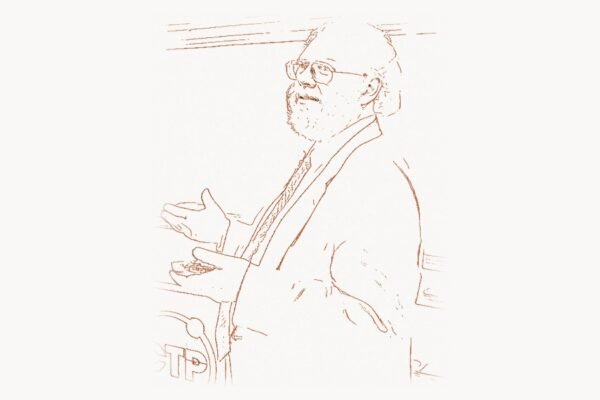
Imagine a world where self-interested individuals — each pursuing their own goals — somehow produce outcomes that benefit everyone. This tension between individual rationality and collective welfare sits at the heart of game theory, and no one has done more to quantify it in the age of algorithms than Tim Roughgarden. A Stanford professor turned Columbia faculty member, Roughgarden has spent over two decades building the mathematical foundations that explain why selfish routing on the internet doesn’t cause total gridlock, how to design auctions that maximize social welfare, and what happens when economic incentives collide with computational constraints. His work on the price of anarchy, optimal mechanism design, and blockchain protocols has reshaped how computer scientists, economists, and engineers think about systems populated by strategic agents.
Early Life and Academic Formation
Tim Roughgarden was born in 1975 and grew up in an academic household — his father, Jonathan Roughgarden, was a well-known theoretical ecologist at Stanford. This early exposure to rigorous scientific thinking shaped Tim’s intellectual trajectory. He pursued his undergraduate degree at Stanford University, graduating with a degree in mathematical sciences. The combination of pure mathematics and applied problem-solving would become the defining characteristic of his career.
For his doctoral work, Roughgarden moved to Cornell University, where he studied under Éva Tardos, one of the foremost experts in combinatorial optimization and algorithmic game theory. It was at Cornell that Roughgarden began his groundbreaking work on selfish routing — the study of how self-interested agents navigate networks. His 2002 PhD dissertation, which formalized and bounded the price of anarchy in network routing games, immediately established him as a leading figure in the emerging field of algorithmic game theory. This work built on the legacy of pioneers like John von Neumann, whose foundational game theory work with Oskar Morgenstern had launched the entire discipline decades earlier.
The Price of Anarchy: Quantifying Selfishness
Roughgarden’s most celebrated contribution is his analysis of the price of anarchy — a concept that measures how much worse a system performs when its participants act selfishly compared to when a central authority coordinates everyone optimally. The term was coined by Elias Koutsoupias and Christos Papadimitriou in 1999, but Roughgarden transformed it from an abstract idea into a precise, applicable tool. His work with Christos Papadimitriou on Braess’s paradox and selfish routing demonstrated that in many real-world networks, the efficiency loss from selfish behavior is surprisingly bounded.
Consider the classic scenario: drivers on a road network each choose the fastest route for themselves. Intuitively, you might expect this selfish behavior to cause massive congestion. Roughgarden proved that for networks with linear latency functions, the worst-case ratio between selfish routing and optimal routing is exactly 4/3. In other words, selfishness costs at most 33% more than perfect coordination — a remarkably tight bound.
The following pseudocode illustrates a simplified computation of the price of anarchy for a two-path network, the kind of model Roughgarden analyzed in his foundational proofs:
def compute_price_of_anarchy(network, total_flow):
    """
    Compute Price of Anarchy for a parallel-link network.
    Each edge e has a latency function l_e(x) = a_e * x + b_e.

    PoA = Total_Cost(Nash_Equilibrium) / Total_Cost(Social_Optimum)
    """
    # Step 1: Find Nash Equilibrium (Wardrop equilibrium)
    # At equilibrium, all used paths have equal latency
    nash_flow = find_wardrop_equilibrium(network, total_flow)

    # Calculate total latency at Nash equilibrium
    nash_cost = 0
    for edge in network.edges:
        flow_e = nash_flow[edge]
        latency_e = edge.a * flow_e + edge.b
        nash_cost += flow_e * latency_e  # cost = flow * latency

    # Step 2: Find Social Optimum
    # Minimize total cost: sum of f_e * l_e(f_e) over all edges
    # Uses marginal cost: d/df[f * l(f)] = l(f) + f * l'(f)
    optimal_flow = minimize_total_cost(network, total_flow)

    optimal_cost = 0
    for edge in network.edges:
        flow_e = optimal_flow[edge]
        latency_e = edge.a * flow_e + edge.b
        optimal_cost += flow_e * latency_e

    # Step 3: Compute the Price of Anarchy
    price_of_anarchy = nash_cost / optimal_cost

    # Roughgarden's Theorem: For linear latencies, PoA <= 4/3
    assert price_of_anarchy <= 4/3 + epsilon

    return price_of_anarchy

# Example: Braess's Paradox network
# Two paths from S to T, with latency functions:
# Path 1: l(x) = x      (congestion-dependent)
# Path 2: l(x) = 1      (constant, like a highway)
# Adding a shortcut can INCREASE total latency
network = create_braess_network()
poa = compute_price_of_anarchy(network, total_flow=1.0)
print(f"Price of Anarchy: {poa:.4f}")  # ≤ 1.3333
This result has profound implications beyond computer science. Transportation engineers, network designers, and internet architects all rely on Roughgarden's bounds to understand the cost of decentralization. His analysis showed that the protocols underlying the internet — where each packet independently seeks the best route — don't degrade as badly as one might fear. This understanding connects deeply to the work of Leonard Kleinrock, whose packet-switching theory provided the foundational architecture that Roughgarden's game-theoretic models analyze.
Mechanism Design and Auction Theory
If the price of anarchy asks "how bad can selfish behavior get?", mechanism design asks the inverse question: "how can we design rules so that selfish behavior produces good outcomes?" Roughgarden has made substantial contributions to computational mechanism design, particularly in the design of auctions and incentive-compatible systems.
His work on simple versus optimal auctions demonstrated a surprising result: in many settings, a simple posted-price mechanism achieves a constant fraction of the revenue of the theoretically optimal (but hopelessly complex) auction. This bridged the gap between the elegant theory of Nobel laureate William Vickrey's second-price auctions and the practical constraints that real-world systems face.
Roughgarden's analysis of the Vickrey-Clarke-Groves (VCG) mechanism — the gold standard of truthful auctions — revealed both its power and its limitations. He showed that while VCG mechanisms guarantee truthfulness (bidders maximize their utility by bidding honestly), they can be computationally intractable or susceptible to collusion in certain combinatorial settings. This led him to explore alternative mechanisms that trade a small amount of optimality for dramatic gains in simplicity and robustness.
The following implementation demonstrates a second-price (Vickrey) auction alongside a mechanism design concept that Roughgarden extensively analyzed — the relationship between truthfulness, computational efficiency, and revenue maximization:
class VickreyAuction:
    """
    Second-price sealed-bid auction (Vickrey auction).
    Truthful: dominant strategy is to bid your true value.
    Roughgarden analyzed when simple mechanisms like this
    approximate optimal (revenue-maximizing) mechanisms.
    """

    def __init__(self, reserve_price=0):
        self.reserve_price = reserve_price  # Myerson's optimal reserve

    def run_auction(self, bids):
        """
        bids: dict of {bidder_id: bid_value}
        Returns (winner, payment) or (None, 0) if no valid bid.

        Key insight (Roughgarden): Setting reserve_price =
        median of value distribution achieves ≥ 50% of
        optimal revenue for regular distributions.
        """
        valid_bids = {
            k: v for k, v in bids.items()
            if v >= self.reserve_price
        }

        if not valid_bids:
            return None, 0

        # Sort bidders by bid value (descending)
        sorted_bidders = sorted(
            valid_bids.items(),
            key=lambda x: x[1],
            reverse=True
        )

        winner = sorted_bidders[0][0]

        # Payment = max(second-highest bid, reserve price)
        # This is the VCG payment: externality imposed on others
        if len(sorted_bidders) > 1:
            payment = max(sorted_bidders[1][1], self.reserve_price)
        else:
            payment = self.reserve_price

        return winner, payment

    def verify_truthfulness(self, true_values, num_trials=10000):
        """
        Empirically verify that truthful bidding is dominant.
        For each bidder: compare utility from truthful bid vs.
        random deviations. Truthful should always win.
        """
        truthful_wins = 0
        for _ in range(num_trials):
            # Truthful outcome
            winner_t, pay_t = self.run_auction(true_values)

            # Pick a random bidder to deviate
            deviator = random.choice(list(true_values.keys()))
            deviated = true_values.copy()
            deviated[deviator] = random.uniform(0, 2 * true_values[deviator])

            winner_d, pay_d = self.run_auction(deviated)

            # Calculate utility for the deviator
            utility_truthful = (
                true_values[deviator] - pay_t
                if winner_t == deviator else 0
            )
            utility_deviated = (
                true_values[deviator] - pay_d
                if winner_d == deviator else 0
            )

            if utility_truthful >= utility_deviated:
                truthful_wins += 1

        return truthful_wins / num_trials  # Should be ~1.0

# Example: Ad auction (inspired by Google/Bing search ad systems)
auction = VickreyAuction(reserve_price=0.50)
bids = {"advertiser_A": 3.20, "advertiser_B": 2.75, "advertiser_C": 1.80}
winner, price = auction.run_auction(bids)
print(f"Winner: {winner}, Pays: ${price:.2f}")
# Output: Winner: advertiser_A, Pays: $2.75
This work has direct applications in the advertising auctions that power companies like Google and Meta. The design of systems where billions of dollars change hands through automated auctions draws directly from the principles Roughgarden formalized. Organizations building project management tools and enterprise software face similar mechanism design challenges when implementing resource allocation systems, bidding processes, and priority queues where multiple stakeholders compete for limited resources.
Algorithmic Game Theory as a Discipline
Beyond individual results, Roughgarden is arguably the person most responsible for establishing algorithmic game theory as a coherent academic discipline. His 2007 textbook Algorithmic Game Theory (co-edited with Noam Nisan, Éva Tardos, and Vijay Vazirani) became the definitive reference for the field, used in graduate programs worldwide. His later textbook Twenty Lectures on Algorithmic Game Theory (2016) made the material accessible to a broader audience of computer science students.
Roughgarden's pedagogical contributions extend beyond textbooks. His Stanford courses — particularly CS364A (Algorithmic Game Theory) and CS364B (advanced topics) — are considered among the best graduate-level courses in the field. His lecture notes, freely available online, have trained a generation of researchers. This commitment to open education mirrors the philosophy championed by pioneers like Andrew Ng, who transformed AI education through massive open online courses.
The field that Roughgarden helped build sits at the intersection of several disciplines. It borrows from the computational complexity theory advanced by researchers like Avi Wigderson, applies the optimization techniques refined across decades of algorithm design, and engages with the economic theory that traces back through Nash, Arrow, and von Neumann. What makes algorithmic game theory distinctive is its insistence that computational constraints matter — an auction mechanism that requires solving an NP-hard problem to determine the winner is useless in practice, no matter how elegant its theoretical properties.
Blockchain and Decentralized Mechanism Design
In recent years, Roughgarden has turned his attention to blockchain technology and cryptocurrency protocols, applying his game-theoretic expertise to one of the most consequential mechanism design challenges of the 21st century. His analysis of Ethereum's EIP-1559 fee mechanism — the protocol upgrade that fundamentally changed how transaction fees work on the Ethereum network — is perhaps his most widely known recent contribution.
EIP-1559 replaced Ethereum's first-price auction for transaction fees with a mechanism featuring a dynamically adjusted base fee that is burned (destroyed) and an optional priority fee (tip) paid to miners. Roughgarden provided a rigorous game-theoretic analysis proving that this mechanism is incentive-compatible in a strong sense: users' dominant strategy is to bid their true maximum willingness to pay. This mirrors the truthfulness properties of Vickrey auctions but operates in a decentralized, permissionless environment — a dramatically harder setting.
His work on blockchain mechanism design connects him to a broader community of pioneers who have shaped the cryptocurrency landscape. The challenge of designing incentive-compatible protocols in trustless environments echoes the problems first identified by Satoshi Nakamoto in Bitcoin's proof-of-work mechanism, and later formalized by researchers working on consensus protocols. Roughgarden's contribution was to bring the full power of mechanism design theory to bear on these problems, providing provable guarantees where previously there were only intuitions and empirical observations.
From Stanford to Columbia
After nearly two decades on the Stanford faculty, Roughgarden made the surprising move to Columbia University in 2020, where he joined the Department of Computer Science. The move reflected Columbia's growing strength in theoretical computer science and Roughgarden's desire to build new research programs. At Columbia, he continues to lead research in algorithmic game theory, mechanism design, and the theory of blockchains and decentralized finance.
Roughgarden's research group has produced dozens of influential PhD students and postdoctoral researchers who now hold positions at top universities and research labs worldwide. His mentorship style — rigorous but supportive, with an emphasis on clarity of exposition — has shaped how an entire generation of researchers communicates complex mathematical ideas. Teams working with modern digital strategy and web development agencies often encounter the practical applications of Roughgarden's theories when building auction platforms, recommendation systems, and resource allocation algorithms that must account for strategic user behavior.
Awards and Recognition
Roughgarden's contributions have earned him virtually every major award available to a theoretical computer scientist of his generation. He received the ACM Grace Murray Hopper Award in 2009 for his work on the price of anarchy and algorithmic game theory — an award given to outstanding young computer professionals. He was awarded the Gödel Prize in 2012 for his foundational work on selfish routing, sharing it with Éva Tardos, Christos Papadimitriou, and Elias Koutsoupias.
He is a Fellow of the ACM, a recipient of multiple NSF grants including a CAREER award, and a Guggenheim Fellow. His papers have appeared in the most prestigious venues in both computer science (STOC, FOCS, SODA) and economics (Econometrica, American Economic Review). This dual publication record reflects the genuinely interdisciplinary nature of his work — he is one of the few researchers equally respected in both theoretical computer science and economic theory.
Key Ideas and Lasting Influence
Several of Roughgarden's conceptual contributions deserve special attention for their lasting impact on how we think about computational systems:
The Smoothness Framework
One of Roughgarden's most technically impressive achievements is the smoothness framework — a unified approach to bounding the price of anarchy across different game types and equilibrium concepts. Before this framework, proving price of anarchy bounds required custom arguments for each type of game. Roughgarden showed that a single "smoothness" condition, when satisfied, simultaneously bounds the price of anarchy for Nash equilibria, mixed Nash equilibria, correlated equilibria, and even coarse correlated equilibria. This elegant unification dramatically simplified the field and opened new research directions.
Simple Versus Optimal Mechanisms
Roughgarden's work on the "simplicity gap" in mechanism design asks a fundamental question: how much do we lose by using simple, practical mechanisms instead of theoretically optimal ones? His results show that the answer is often "surprisingly little." A simple posted-price mechanism or a standard auction with a well-chosen reserve price can capture a constant fraction of the optimal revenue. This result has profound practical implications because it tells engineers that they don't need to implement impossibly complex optimal mechanisms — simple designs work well enough.
Beyond Worst-Case Analysis
More recently, Roughgarden has championed the paradigm of beyond worst-case analysis of algorithms. Traditional algorithm analysis focuses on worst-case guarantees, but real-world inputs are rarely worst-case. Roughgarden has developed frameworks for analyzing algorithms under more realistic input models, providing tighter guarantees that better predict actual performance. This program connects deeply to the work of pioneers like Donald Knuth, who established the mathematical foundations of algorithm analysis that Roughgarden's work extends and refines.
Influence on Industry and Technology
While Roughgarden is primarily an academic, his theoretical work has had significant industrial impact. The design of internet routing protocols, online advertising auctions, spectrum auctions, and cryptocurrency fee mechanisms all reflect ideas from algorithmic game theory that Roughgarden helped develop. Google's advertising platform, which generates over $200 billion in annual revenue, runs a variant of the generalized second-price auction — a mechanism whose game-theoretic properties were analyzed using tools from Roughgarden's research program.
His blockchain work has been even more directly applied. The EIP-1559 analysis was commissioned by the Ethereum Foundation and directly influenced the design of one of the largest protocol upgrades in cryptocurrency history. The base fee mechanism he analyzed now processes billions of dollars in transaction value, making his theoretical work some of the most economically consequential in modern computer science.
The field of algorithmic game theory has also influenced how technology companies think about platform design. Social media algorithms, ride-sharing pricing, marketplace mechanisms, and content recommendation systems all involve strategic agents — users, drivers, sellers, creators — whose self-interested behavior must be accounted for. Roughgarden's theoretical tools provide the language and the bounds for reasoning about these systems.
Frequently Asked Questions
What is the price of anarchy and why does it matter?
The price of anarchy is a ratio that measures how much efficiency is lost when participants in a system act selfishly rather than cooperating under central coordination. A price of anarchy of 1 means selfishness causes no harm; higher values indicate greater inefficiency. It matters because most real-world systems — internet routing, traffic networks, markets — lack central control, so understanding how much this costs is essential for engineering robust systems. Roughgarden's key contribution was proving that for many important systems, the price of anarchy is bounded by small constants, meaning decentralized systems work better than worst-case intuitions suggest.
How did Roughgarden's work influence blockchain technology?
Roughgarden provided the first rigorous game-theoretic analysis of Ethereum's EIP-1559 transaction fee mechanism, proving that it incentivizes honest bidding and improves user experience compared to the previous first-price auction system. His analysis helped the Ethereum community gain confidence that the mechanism change would behave as intended. Beyond EIP-1559, his framework for analyzing incentive compatibility in decentralized protocols has become a standard tool for blockchain protocol designers evaluating the security and economic properties of new consensus mechanisms and fee structures.
What is mechanism design and how does it relate to computer science?
Mechanism design is often called "reverse game theory." While game theory predicts outcomes given a set of rules, mechanism design asks: what rules should we create to achieve a desired outcome, given that participants will act strategically? In computer science, this is crucial because many systems involve self-interested agents — search engine advertisers competing for ad slots, internet routers choosing paths, or users selecting cloud computing resources. Roughgarden's work specifically addresses the computational aspect: a mechanism must not only be economically sound but also computationally efficient to implement at scale.
What is the smoothness framework?
The smoothness framework is a general technique Roughgarden developed for proving bounds on the price of anarchy. It works by identifying a single mathematical condition (the smoothness condition) that, when verified for a specific game, automatically implies price of anarchy bounds for many different types of equilibria simultaneously. Before this framework, researchers had to prove separate bounds for each equilibrium concept (pure Nash, mixed Nash, correlated equilibria, etc.). The smoothness framework unified these analyses and made it dramatically easier to establish price of anarchy results for new types of games.
Why did Roughgarden move from Stanford to Columbia?
Roughgarden moved from Stanford to Columbia University in 2020 after nearly 18 years on the Stanford faculty. While the specific reasons are personal and professional, the move reflected Columbia's significant investment in theoretical computer science and data science. At Columbia, Roughgarden continues his research in algorithmic game theory and has expanded his work on blockchain mechanism design and beyond worst-case analysis. The move also gave him the opportunity to build new courses and research programs, continuing his mission of making algorithmic game theory accessible to a broader audience of students and researchers.