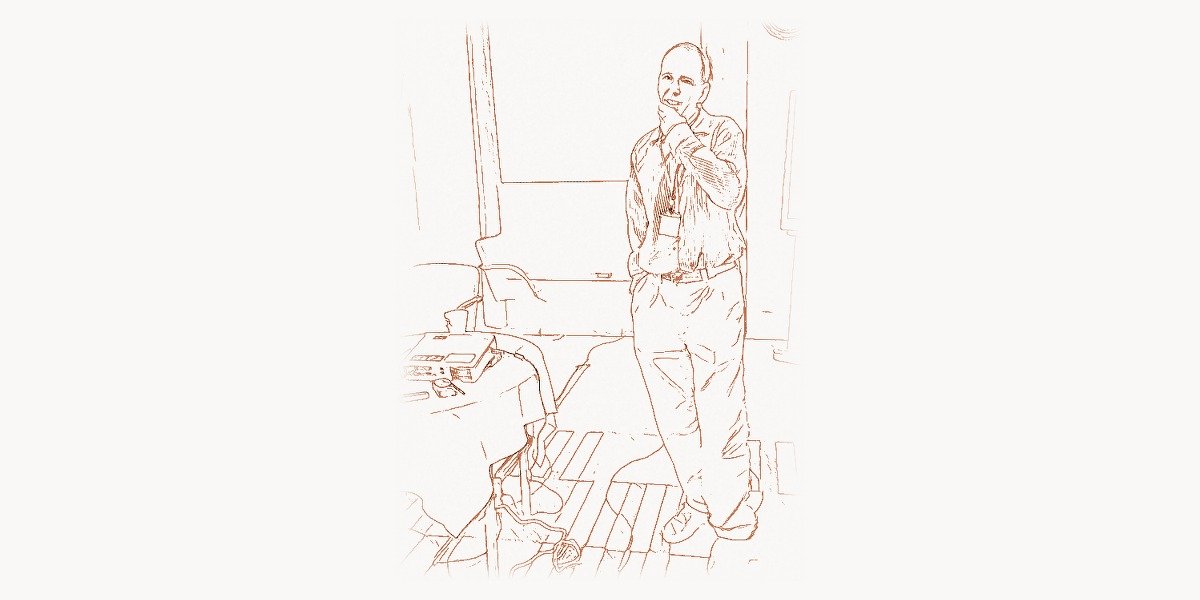
In the early 1980s, when most personal computer owners were still struggling with 64 kilobytes of RAM and single-tasking operating systems, a young American programmer named Walter Bright was building something that no one else in the industry had managed to create: a native-code C++ compiler that ran on a personal computer. His Zortech C++ compiler, released in 1988, was the first C++ compiler to generate native machine code directly on DOS and OS/2 machines, bypassing the slow C-to-assembly translation step that existing tools required. That achievement alone would have earned Bright a footnote in computing history. But it was what came next — a three-decade project to build the programming language that C++ should have been — that defines his lasting contribution to the field. The D programming language, which Bright began designing around 2001 and has self-funded through most of its existence, represents one of the most ambitious and technically sophisticated attempts to fix the deep structural problems in systems programming. D offers what Bjarne Stroustrup’s C++ promised but could never fully deliver: a modern systems language with garbage collection (optional, not mandatory), compile-time function execution, built-in unit testing, and a design philosophy that refuses to sacrifice either programmer productivity or machine performance.
Early Life and Path to Technology
Walter Bright grew up in the United States during the era when personal computing was transitioning from a hobbyist curiosity into a professional tool. Unlike many tech pioneers who came through elite university computer science programs, Bright was largely self-taught in compiler design — a field so specialized that even major universities offered limited coursework in it during the late 1970s and early 1980s. He developed an unusually deep understanding of how programming languages are translated into machine code, an expertise that would define every project he undertook for the next four decades.
His first major achievement was creating the Datalight C compiler in the mid-1980s, a commercial C compiler for DOS that competed against established products from Borland and Microsoft. Writing a production-quality C compiler from scratch, as a largely solo effort, was an extraordinary feat of engineering. Compilers are among the most complex software systems ever built — they must parse an intricate grammar, perform sophisticated optimizations, and generate correct machine code for every edge case in the language specification. That Bright could produce a competitive commercial compiler demonstrated both his technical depth and his ability to execute on large, complex projects independently.
Bright then founded Zortech and set his sights on an even harder problem. C++, which Stroustrup had created at Bell Labs, was rapidly gaining popularity in the late 1980s, but the available compilers were slow and cumbersome. Most worked by translating C++ source code into C first, then compiling the C — a two-step process that produced mediocre code and sluggish build times. Bright’s Zortech C++ compiler eliminated this intermediate step entirely, compiling C++ directly to native machine code on DOS systems. When it shipped in 1988, it was a revelation. Programmers who had been waiting ten minutes or more for a compile-link cycle could now build their C++ programs in a fraction of the time. The compiler was later acquired by Symantec and became the Symantec C++ compiler, but the core technology was Bright’s creation. He lived and worked in the Seattle area, close to the heart of the American software industry, and continued to push the boundaries of what a single engineer could accomplish in compiler technology.
The Breakthrough: Creating the D Programming Language
The Technical Innovation
By the late 1990s, Bright had spent nearly two decades deep inside the C and C++ compilation pipeline — fixing bugs, implementing optimizations, and watching programmers struggle with language features that were fundamentally hostile to productivity and correctness. C++ had grown into an enormously powerful but also enormously complex language, burdened by decades of backward compatibility with C, a preprocessing system that invited subtle bugs, a header file inclusion model that crippled build times, and a template metaprogramming system that was accidentally Turing-complete but nearly impossible to debug. Bright believed that the right approach was not to patch C++ incrementally but to start fresh — keeping the features that worked while discarding the historical baggage that could not be fixed.
Around 2001, he began designing D. The name was a deliberate nod to the lineage: if Dennis Ritchie’s C begat C++, then the next step in that evolutionary line should be D. But where C++ had prioritized backward compatibility with C above almost everything else, D prioritized getting the design right. Bright was willing to break compatibility with C and C++ in order to fix problems that could not be solved otherwise.
D’s most distinctive technical feature is compile-time function execution (CTFE). In most languages, the compiler only evaluates constant expressions at compile time — simple arithmetic like 3 + 4. D allows the compiler to execute arbitrary functions at compile time, as long as those functions do not perform I/O or other side effects that only make sense at runtime. This means that complex computations — parsing a regular expression, building a lookup table, computing a hash function — can be performed during compilation, with the results embedded directly into the compiled binary. The runtime program pays zero cost for these computations because they have already been completed before the program even starts.
// Compile-time function execution in D
// This function computes a lookup table at compile time
int[] computeSieveOfEratosthenes(int limit)() {
    bool[] isComposite = new bool[limit];
    int[] primes;
    for (int i = 2; i < limit; ++i) {
        if (!isComposite[i]) {
            primes ~= i;
            for (int j = i * i; j < limit; j += i)
                isComposite[j] = true;
        }
    }
    return primes;
}

// The sieve is computed entirely at compile time
// The resulting array is embedded in the binary
static immutable primes = computeSieveOfEratosthenes!1000();

void main() {
    import std.stdio;
    // No runtime cost — primes are already computed
    writeln("Number of primes below 1000: ", primes.length);
    writeln("First 10 primes: ", primes[0..10]);
}
This CTFE capability is far more powerful than the constexpr feature that C++ later adopted (starting with C++11 and expanded in subsequent standards). In D, any function that meets the purity requirements can be evaluated at compile time — the programmer does not need to write separate compile-time and runtime versions of the same logic. This eliminates an entire category of code duplication and template metaprogramming tricks that make C++ codebases notoriously difficult to maintain.
D also introduced string mixins — the ability to generate code from strings at compile time. Combined with CTFE, this allows programmers to write domain-specific languages, parser generators, and code generators that execute during compilation and produce optimized machine code. This is metaprogramming done right: instead of C++’s accidental Turing completeness through template specialization (which produces incomprehensible error messages and glacial compile times), D provides an explicit, readable mechanism for compile-time code generation.
Other features that distinguished D from both C++ and the managed languages of the early 2000s included built-in array slices (safe, bounds-checked views into arrays without copying), built-in associative arrays (hash maps as a language primitive rather than a library type), built-in unit testing (any function can have a unittest block that runs automatically during test builds), contract programming (preconditions, postconditions, and invariants as language features), and a module system that replaced C’s fragile #include mechanism with proper separate compilation. D also provided optional garbage collection — the language included a garbage collector by default for convenience, but programmers working on performance-critical systems code could disable it entirely and manage memory manually, using the same malloc/free patterns familiar from C.
Why It Mattered
D mattered because it demonstrated — years before Rust, Go, or Zig entered the conversation — that a systems programming language did not have to inherit C’s mistakes. Bright proved that you could build a language with C-level performance, C++ interoperability, and radically better ergonomics, all without the backing of a major corporation or research institution. D was a proof of concept that influenced the entire next generation of systems languages, even if those languages ultimately attracted larger communities.
The compile-time function execution model that Bright pioneered in D directly influenced the design of similar features in Zig (which credits D’s CTFE as an inspiration) and Rust (whose const fn feature serves a similar purpose). D’s built-in unit testing predated the test-driven development movement’s push for first-class testing support in languages. Its approach to optional garbage collection — providing a GC for convenience while allowing manual memory management for performance — anticipated the debate that would dominate systems language design for the next two decades.
D also mattered because it came from an individual, not an institution. Where C++ was backed by AT&T Bell Labs, Python by a growing open-source community, Java by Sun Microsystems, and later Go by Google, D was largely the product of one person’s vision and self-funding. Bright maintained the reference compiler (DMD), wrote extensive documentation, and engaged with the community — all while earning a living through other means. This independence gave D a design coherence that committee-designed languages often lack, but it also meant that D could never match the marketing budgets and corporate evangelism that competitors enjoyed.
D’s Ecosystem and Compiler Infrastructure
D’s compiler ecosystem reflects the language’s pragmatic philosophy. The reference compiler, DMD (Digital Mars D), is Bright’s own creation — fast to compile, easy to install, and designed for rapid iteration during development. For production deployments where maximum runtime performance is required, LDC (the LLVM-based D compiler) leverages the same LLVM optimization infrastructure that powers Clang, Swift, and Rust, producing highly optimized machine code that competes with C and C++ output. A third compiler, GDC, integrates D into the GCC toolchain, giving D access to GCC’s vast platform support. Having three production-quality compilers — each built on a different backend — gives D developers flexibility that few languages can match.
The DUB package manager serves as D’s build system and dependency manager, hosting thousands of packages in its registry. D’s standard library, Phobos, provides comprehensive functionality covering ranges (D’s answer to iterators), algorithms, file I/O, networking, concurrency, and string processing. The language also maintains a C and C++ interop layer that allows D code to call C functions directly (with no overhead) and link against C++ code with mangled name support — critical for a language that positions itself as a C++ replacement in existing codebases.
D’s range-based design deserves special attention. Where C++ uses iterator pairs (begin/end) and Rust uses its Iterator trait, D uses ranges — a concept that unifies lazy evaluation, composition, and algorithm design into a single abstraction. Ranges allow programmers to chain operations like filtering, mapping, and reducing without creating intermediate arrays, producing code that is both readable and efficient:
import std.algorithm, std.range, std.stdio;

void main() {
    // Lazy, composable range pipeline
    auto result = iota(1, 100)          // numbers 1 to 99
        .filter!(n => n % 3 == 0)       // divisible by 3
        .map!(n => n * n)               // square each
        .take(5)                         // first 5 results
        .array;                          // materialize

    writeln(result);  // [9, 36, 81, 144, 225]

    // Built-in unit test block
    // Runs automatically when compiled with -unittest flag
}

unittest {
    assert([1, 2, 3].map!(x => x * 2).array == [2, 4, 6]);
    assert(10.iota.sum == 45);
}
This range-based approach was ahead of its time. C++20’s Ranges library, which arrived nearly two decades after D introduced the concept, bears a striking resemblance to D’s design — an acknowledgment, however indirect, that Bright and the D community had found the right abstraction for sequence processing in a systems language.
Industry Adoption and Real-World Use
Despite lacking the corporate sponsorship that propelled languages like Go and Rust, D has found its way into notable production environments. eBay used D to build a large-scale machine learning and data processing pipeline, citing D’s combination of high performance and developer productivity as the deciding factors. Netflix employed D for internal tooling and data processing tasks where Python was too slow but C++ was too cumbersome for rapid development. Facebook (now Meta) included D-generated code in portions of their Folly C++ library’s infrastructure. Mercedes-Benz has used D for internal software development, leveraging the language’s systems programming capabilities alongside its high-level features.
These adoptions demonstrate that D is production-ready and competitive with mainstream languages in demanding environments. The pattern is consistent: organizations that adopt D typically do so because they need performance close to C++ but cannot accept C++’s development velocity and maintenance burden. D occupies a practical middle ground — faster to write than C++, faster to execute than Go or Java, and more mature than newer systems languages. For teams working on complex software projects that demand both performance and maintainability, D represents a compelling alternative to the more well-known options.
Philosophy and Engineering Approach
Key Principles
Walter Bright’s design philosophy for D is rooted in decades of practical compiler engineering rather than academic language theory. He approaches language design as an optimization problem: what set of features maximizes programmer productivity per unit of effort while minimizing the opportunity for bugs? This pragmatic orientation is visible in every major design decision.
Bright believes that a language should not force programmers to repeat themselves. D’s CTFE, string mixins, and template system all serve the DRY (Don’t Repeat Yourself) principle at a fundamental level — if a computation can be performed at compile time, the programmer should be able to express it once and have the compiler do the work. This contrasts with C++, where programmers often maintain parallel compile-time (template) and runtime versions of the same logic, and with languages like those inspired by Dijkstra’s more theoretically pure approaches that prioritize formal correctness over practical convenience.
He also believes that defaults matter enormously. D defaults to garbage collection (because most code benefits from it), bounds-checked arrays (because buffer overflows are a leading source of security vulnerabilities), and immutable strings (because mutating strings creates subtle bugs). But every default can be overridden when the programmer has a good reason — D never forces a one-size-fits-all model. The language trusts the programmer’s judgment while making the safe choice easy and the unsafe choice explicit.
Bright’s approach to backward compatibility is deliberately different from C++’s. Where Stroustrup maintained strict backward compatibility with C (inheriting all of C’s problems in the process), Bright was willing to break with C’s conventions when doing so produced a better language. D does not have a preprocessor. It does not have header files. It does not support implicit integer conversions that lose data. These breaks with tradition made D cleaner and safer, even though they meant that C code could not be compiled as D without modification.
Perhaps most distinctively, Bright has pursued his vision through personal funding and individual effort rather than seeking corporate or institutional backing. This independence has allowed D to be designed according to consistent technical principles rather than being pulled in different directions by competing corporate interests — a fate that has befallen committee-designed standards more than once. For modern web development teams evaluating systems languages, D’s coherent design philosophy represents a refreshing alternative to the compromises inherent in languages shaped by institutional politics.
Beyond D: Walter Bright’s Broader Contributions
While D is Bright’s most significant ongoing project, his contributions to compiler technology extend beyond any single language. The techniques he developed for the Zortech and Symantec C++ compilers — particularly in the areas of code optimization and fast compilation — influenced an entire generation of compiler engineers. His work demonstrated that a single talented engineer could produce a commercial-quality compiler that competed with products from companies with hundreds of developers, challenging the assumption that compiler development required institutional resources.
Bright has also been an active voice in the programming language community, writing extensively about compiler design, optimization techniques, and language design principles. His articles and conference presentations have educated thousands of developers about the inner workings of the tools they use every day. He has been particularly vocal about the importance of fast compilation — arguing that slow build times are not just an inconvenience but a fundamental drag on software quality, because programmers who must wait minutes for feedback write fewer tests and iterate less frequently.
His influence on the broader systems programming landscape is visible in the features of newer languages. Zig’s comptime (compile-time execution) feature is a direct descendant of D’s CTFE. Rust’s const functions serve a similar purpose. Even C++ has gradually adopted features — constexpr, modules, ranges — that D demonstrated years or decades earlier. Bright may not have built the most popular systems language, but he has built one of the most technically influential.
Legacy and Modern Relevance
By 2026, the systems programming landscape has become more competitive than ever. Rust has captured the memory safety conversation. Go dominates cloud infrastructure. Zig is emerging as a minimalist alternative to C. Yet D continues to evolve and find new users, because it occupies a design space that no other language precisely replicates. D is the systems language for programmers who want C++ power without C++ complexity — who need garbage collection sometimes but not always, who want compile-time metaprogramming that is readable rather than arcane, and who value a language designed by someone who has spent forty years understanding exactly what compilers can and cannot do efficiently.
Walter Bright’s story is also a testament to what individual determination can accomplish in a field increasingly dominated by corporate-backed languages. He did not have Google’s resources (Go), Mozilla’s sponsorship (Rust), or Apple’s ecosystem (Swift). He had a deep understanding of compiler technology, a clear vision of what a better systems language should look like, and the willingness to spend decades building it. D may never become the most popular systems language, but its technical innovations — compile-time function execution, ranges, string mixins, optional garbage collection — have seeded ideas across the entire language design landscape. In the genealogy of systems programming, the line runs from C to C++ to D, and from D to the generation of languages that followed. Walter Bright built a link in that chain that the field could not have produced without him.
Key Facts
- Nationality: American
- Known for: Creating the D programming language, building the first native C++ compiler for PCs (Zortech C++)
- Key projects: D programming language (2001–present), Zortech/Symantec C++ compiler, Datalight C compiler, DMD reference compiler
- D compilers: DMD (reference, Digital Mars), LDC (LLVM-based), GDC (GCC-based)
- Notable D users: eBay, Netflix, Facebook/Meta (Folly library), Mercedes-Benz
- Location: Seattle area, United States
Frequently Asked Questions
Who is Walter Bright?
Walter Bright is an American software engineer and compiler developer who created the D programming language and the Zortech C++ compiler — the first native-code C++ compiler for personal computers. He has spent over four decades working on compiler technology and programming language design, largely self-funding the development of D as an independent project outside of any major corporation or research institution.
What is the D programming language?
D is a systems programming language that Walter Bright began designing around 2001 as an attempt to build what C++ should have been — a modern language for systems-level work that fixes C++’s historical mistakes while retaining its power. D features compile-time function execution (CTFE), optional garbage collection, built-in unit testing, string mixins for compile-time code generation, ranges for composable sequence processing, and direct interoperability with C and C++ code. It is compiled by three major compilers: DMD (the reference compiler), LDC (LLVM-based), and GDC (GCC-based).
Why is Walter Bright important?
Bright demonstrated that a single determined engineer could create both a commercial-quality C++ compiler and an entirely new systems programming language that pioneered features — compile-time function execution, built-in testing, ranges, optional garbage collection — which were later adopted by mainstream languages including C++, Rust, and Zig. His work on D proved that the problems in C++ were solvable and provided a concrete blueprint for how to build a better systems language, influencing the entire generation of languages that followed.
How does D compare to Rust and C++?
D occupies a middle ground between C++ and Rust. Like C++, D provides direct hardware access, manual memory management options, and C interoperability. Like Rust, D offers modern safety features including bounds-checked arrays and an optional garbage collector. D’s unique strengths are its compile-time function execution (more powerful than C++’s constexpr or Rust’s const fn), its readable metaprogramming through string mixins, and its range-based standard library. D prioritizes programmer productivity alongside performance, while Rust prioritizes memory safety guarantees, and C++ prioritizes backward compatibility.